
TuRist
Your pseudonym, TuRist, reflects your deep connection to travel. How have your journeys shaped your artistic vision and the emotional language of your work?
I would not say that travel has strongly influenced my style or artistic language in the way it did, for example, with Gauguin. Rather, travel generates impressions, inspires new themes, and awakens thoughts and emotions. Immersing yourself directly in another culture and economy is much more immersive than seeing something on television or online. For instance, after visiting camel races in Qatar, I wanted to create a work about the migration policies of the Persian Gulf countries, to discuss their advantages and disadvantages. And after attending the completely dull and toothless Venice Biennale, I created a work with monkeys about cowardice in contemporary art.
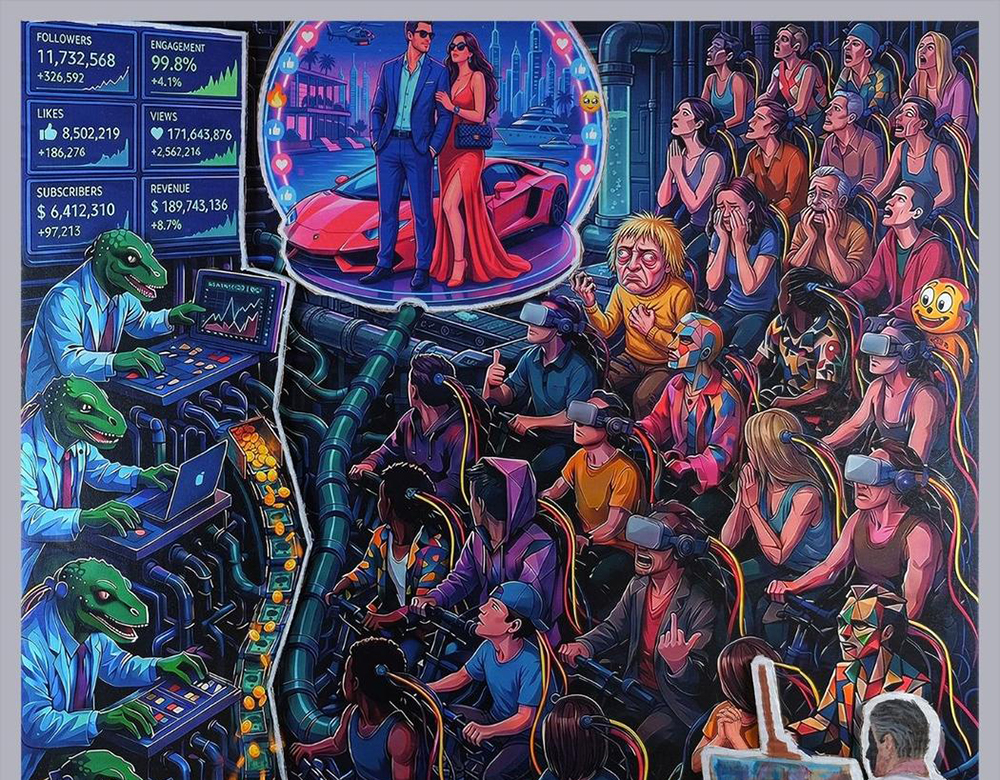
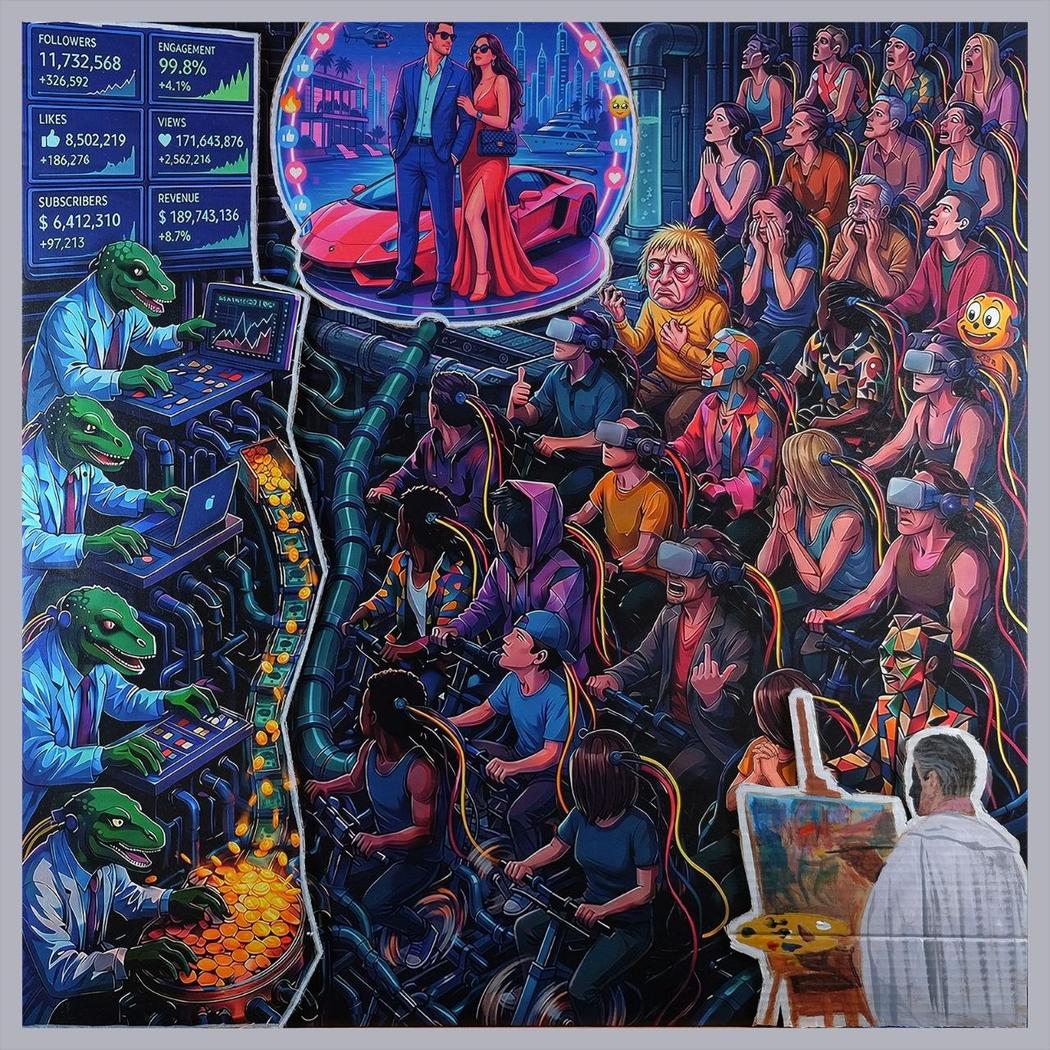 TuRist | Envy | 2026
In your creative process, how do personal emotions and lived experiences transform into visual images?
Images appear in my mind, and the stronger the emotion, the more obsessive the image becomes. In general, my first works emerged as a form of art therapy. I had an almost irresistible desire to share an emotion or a conclusion, and then I realized that I could “pour it out onto the canvas.”
You are not classically trained as an artist. Do you feel that this gives you more freedom in your work?
No, rather the opposite. I feel a lack of education and technique, a lack of systematic knowledge. I try to fill these gaps quickly: I run around museums and exhibitions all over the world like crazy, hire the best and most intelligent guides, communicate a lot with other artists and art historians, and learn from all of them as I go.
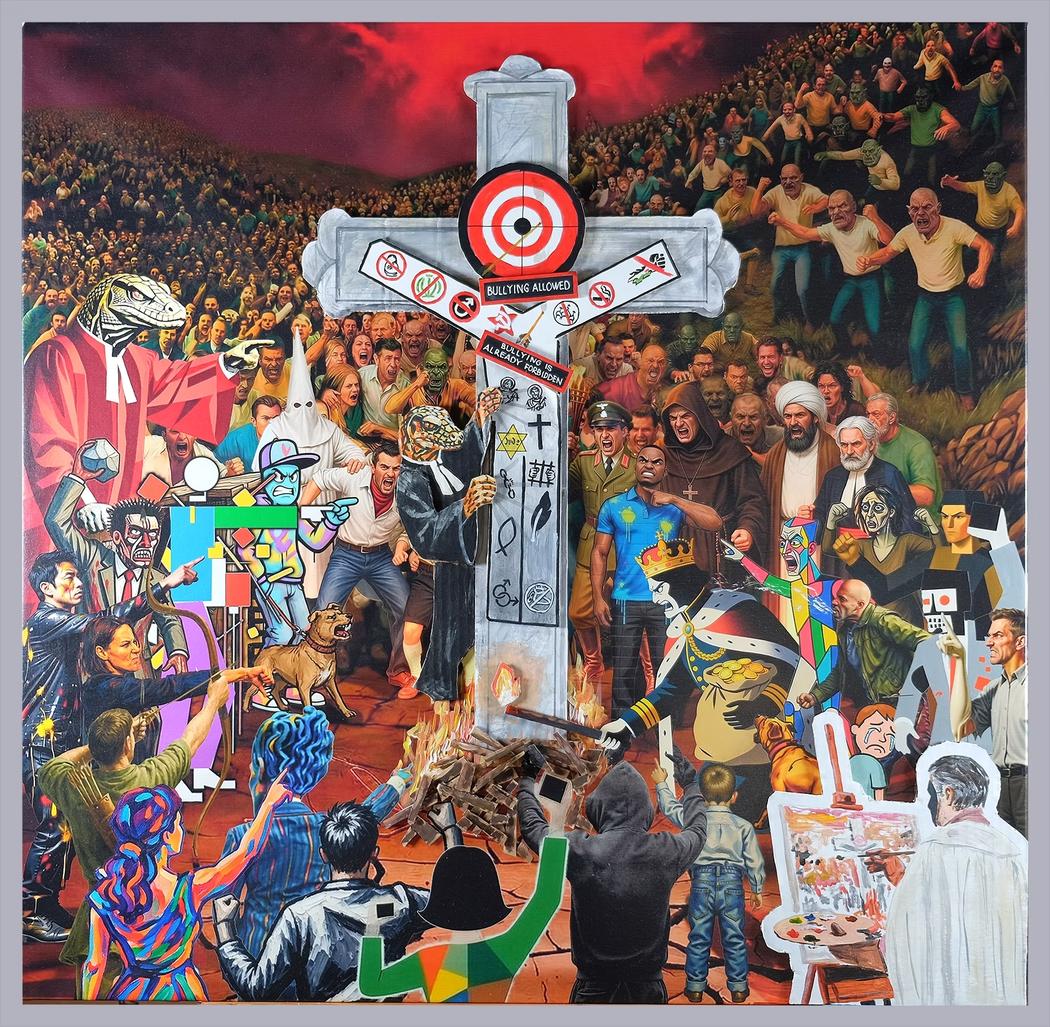 TuRist | Hate | 2026
Your practice brings together Russian avant-garde poster traditions, naive art, and AI-generated imagery. What attracts you to these very different visual languages?
As a social thinker, I look for the most effective ways to visualize my ideas. The choice of the avant-garde poster is obvious in this sense. The naivety of the style, especially at the beginning, often came from my inability to draw well. And neural networks have helped greatly to accelerate and expand the production process. There will be other styles as well — I am still searching.
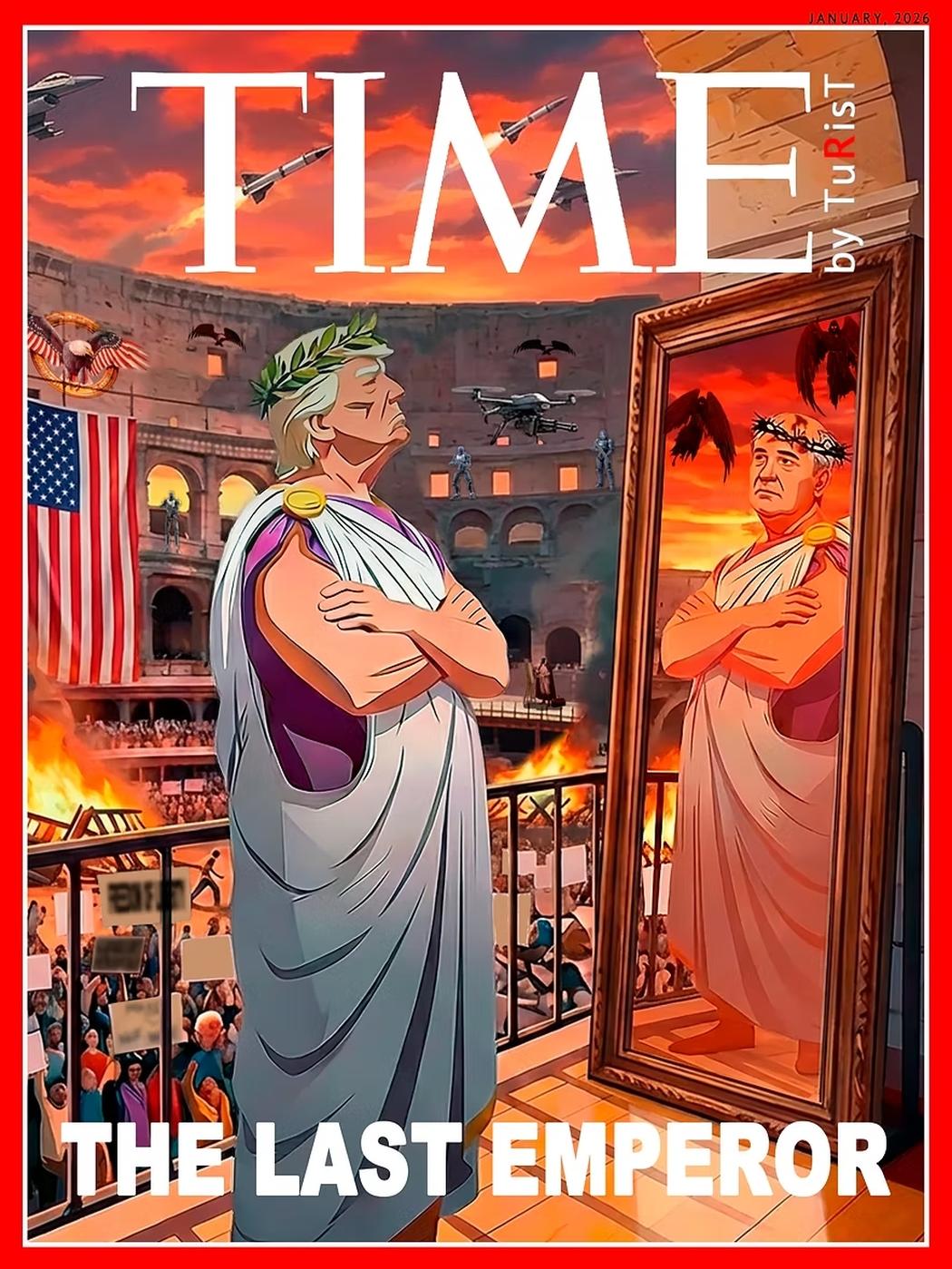
The themes of technological transformation, artificial intelligence, and the digital future appear frequently in your work. Do you see technology as a threat, a tool, or both?
As I just mentioned, from a technical point of view, neural networks, Photoshop, and other technologies have proved very useful for us as artists, and we use them with pleasure. But when speaking about humanity as a whole, the question becomes much more complex. Technologies that improve our lives and make our work easier should not lead to the degradation of human beings themselves.
For example, by removing heavy physical labor and the need for daily survival through machines, we have ended up with weaker, more delicate, and more fragile men — and now we are surprised that they cannot, and do not want to, defend their homeland as they once did. By spreading calculators everywhere, we have forgotten how to do mental arithmetic. By dictating voice messages, we have begun to forget how to write.
I strongly believe in Engels’s idea that labor transformed the ape into man. Now, in the age of AI, we must make a serious effort not to turn back into apes. To do this, we must constantly improve ourselves and develop talents and skills that are inaccessible to machines.
Your statement speaks about an age of profound global transformation. What role do you believe art can play during moments of crisis and uncertainty?
Art should play a very important role. Visualization sometimes reaches the mind and heart better than words. Art should also comfort, motivate, mobilize, or, on the contrary, help people relax. In the age of modernism, art was at the forefront of change — hence the word “avant-garde.” Today, because of censorship, tolerance, and fear of cancellation, we are trailing behind society. This is exactly what I am trying to fight against: to write about what matters most — the survival of human beings in the age of AI, the crisis of democracy, the degradation of public finances and the devaluation of savings, migration, and the loss of identity.
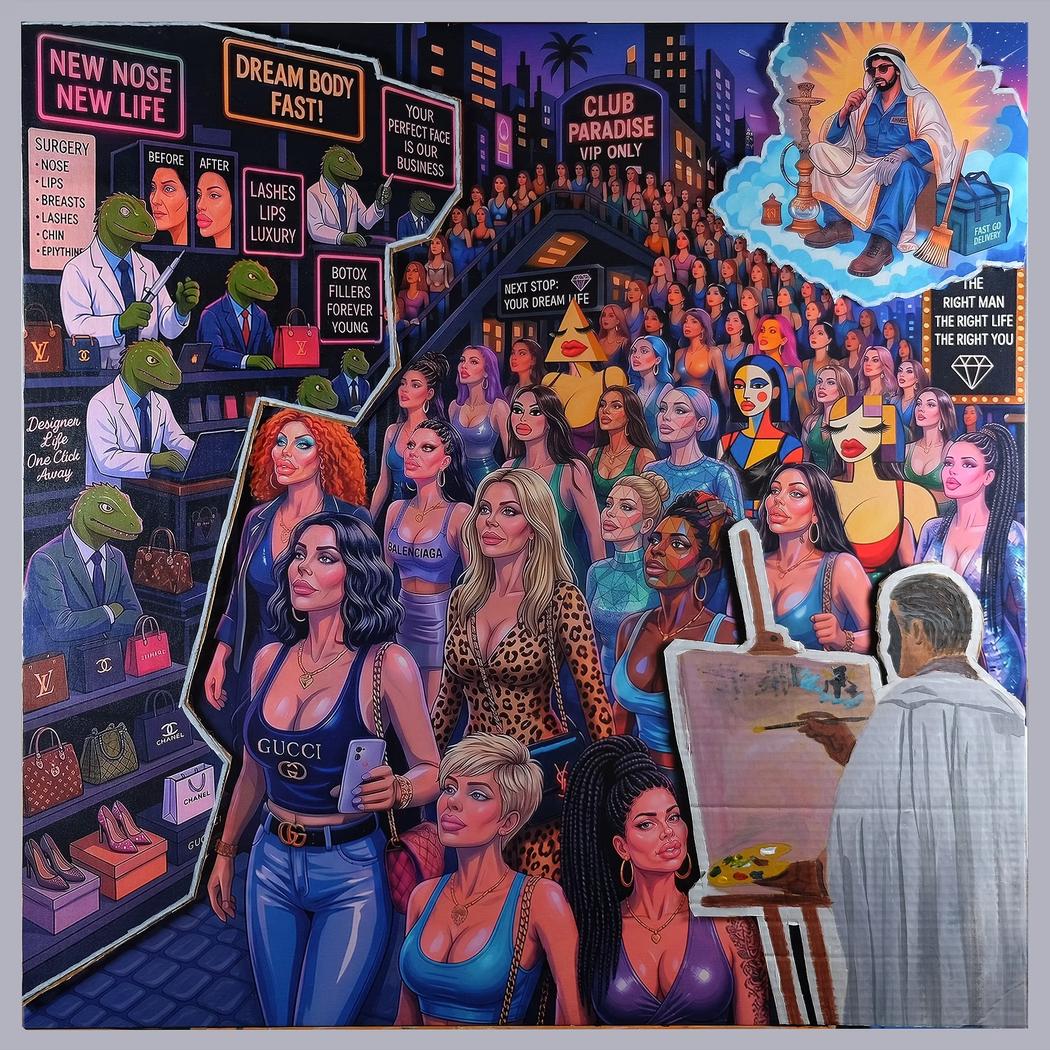 TuRist | Hope | 2026
When viewers encounter your work, what kind of response do you hope to awaken in them — reflection, discomfort, recognition, hope, or something else?
First of all, I want to make the viewer pay attention to a problem, think about it, start arguing, discuss it with others or within themselves. At first, the viewer needs to be drawn in — for example, through provocation, strong emotion, or mystery. But afterward, it is essential to arrive at a discussion of an important topic.
Many people say that my art is dark, depressive, and frightening. But I do not see it that way. I frighten people a little and create a sense of unease so that viewers can better understand the depth of the problem and become motivated to solve it positively. For example: “your savings will soon disappear, so you should buy gold,” or “they are turning you into idiots by forcing you to watch short reels, so read long books and learn to understand why you are being overloaded in exactly this way.”
Ultimately, my task is to make my own modest contribution to preventing us from turning into a herd of apes.