
Liza Gruzdeva
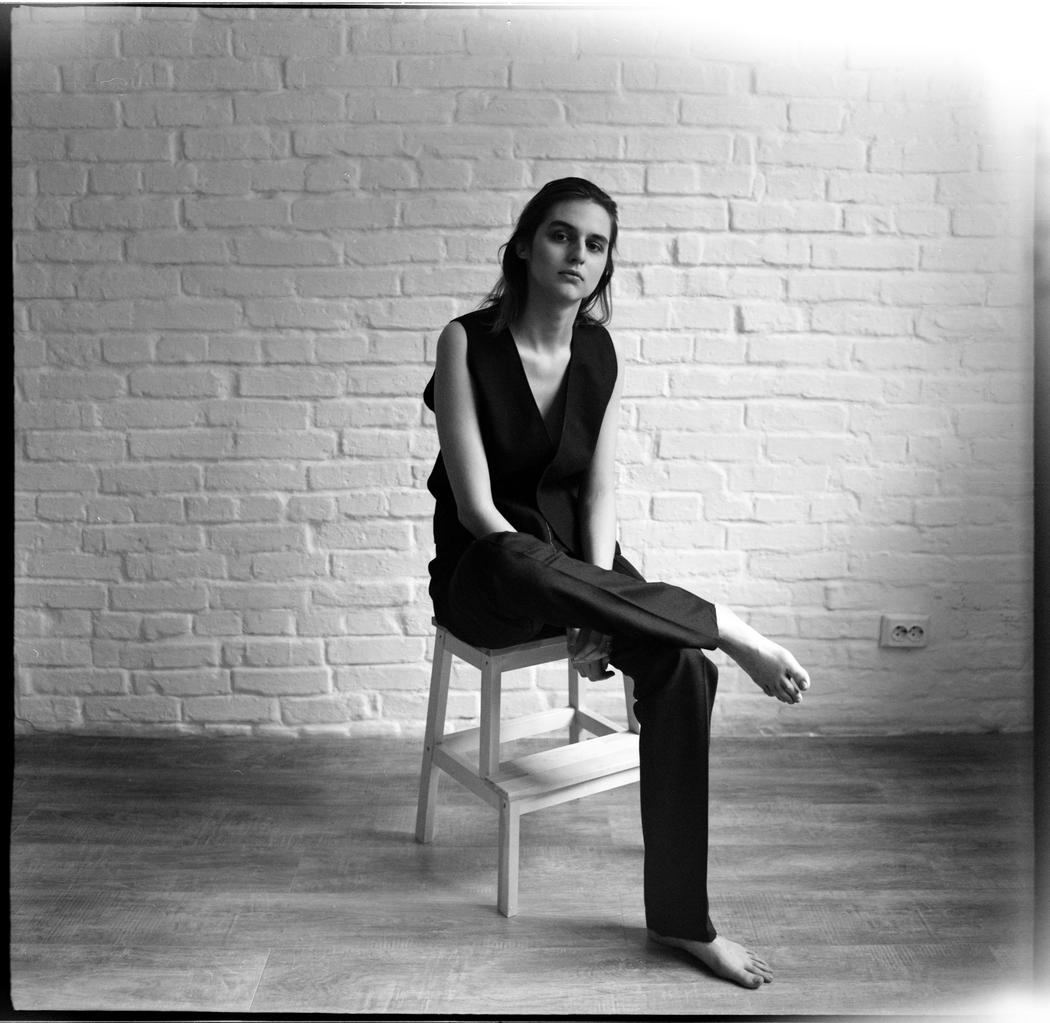
You mention that architecture taught you to understand space in order to later distort it. What does “distorted space” mean to you as an artistic method?
I am developing my own universe, in which the distortion of space is one of the main artistic methods. Through it, I can convey an inner state, an emotion, or the idea of the multidimensional nature of existence — things that, in my view, cannot be fully expressed through a realistic image that appears “correct” to the eye.
In my practice, spatial distortion can be seen in the flexibility of lines, in the intersection of several planes, and in the combination of different scales within a single painting. You also will not find a conventional horizon. All images seem to float in the air, even when there is a hint of a floor.
Each painting has its own meaning. But in general, everything takes place beyond visible space.
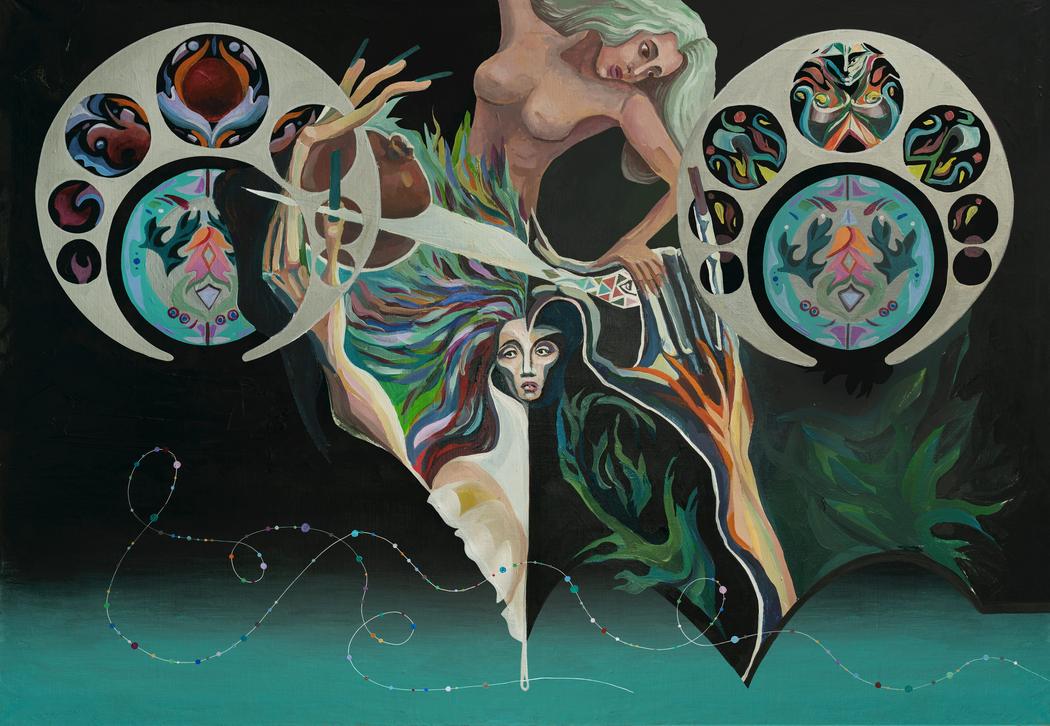 Liza Gruzdeva | Сhoice
Your works often seem to exist between dream, myth, and inner psychological landscape. How would you describe the world that appears in your paintings?
My universe is built around the idea of a shared reality — a space where only we and our experience exist.
My paintings are thematic rooms within this universe. Each one reveals a separate fragment of its “lore,” yet together they form a single network. Through these rooms, the viewer can enter the infinitely white space of reality — the pure, primordial fabric of being.
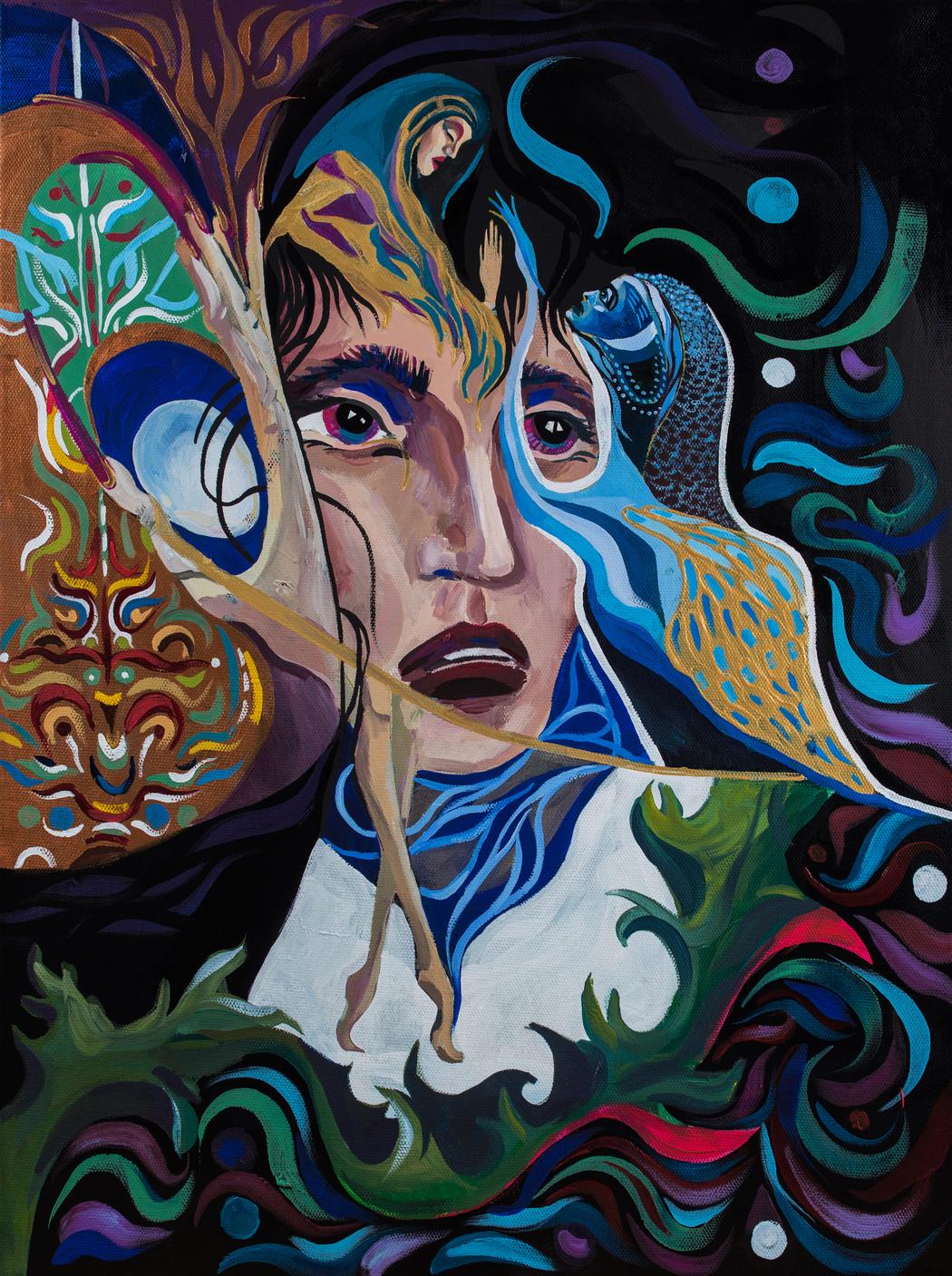 Liza Gruzdeva | Prayer
In your paintings, figures, animals, masks, ornaments, and architectural fragments seem to merge into one symbolic environment. How do these images appear – intuitively, through sketches, or through a carefully planned composition?
I suppose I should thank my surprisingly active subconscious. Everything I have seen, read, and felt throughout my life is processed and stored. Later, when my personal experience makes me reflect on a certain process or concept, my subconscious almost instantly presents me with a completed work. At first it is not entirely clear, but as the process unfolds, everything becomes more defined.
You describe your first important painting, “The Lady in an Apron as Part of the Whole”, as a turning point. What did you discover in that work that continues to define your artistic language today?
“Lady in an Apron as Part of a Whole” was my first independent, non-academic work. In it, I allowed myself for the first time to paint the way I see and feel.
This work marked the debut of the principles that would become the foundation of my artistic language: the infinity and multilayered nature of space, the absence of horizon and gravity, and hidden images that reveal themselves over time. Key symbols also emerged here: the egg as a person’s picture of the world, the hand as possession or responsibility, and the “cabbage” as a ribbon of life energy.
The work laid the foundation for my artistic language and became the starting point for my subsequent explorations.
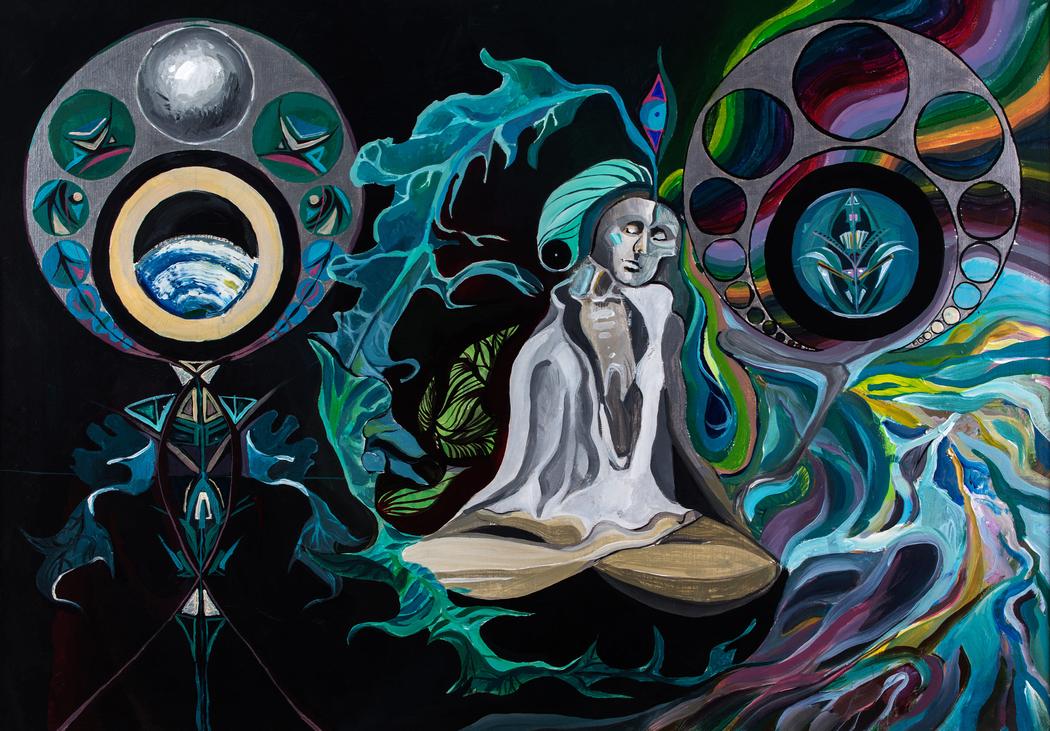 Liza Gruzdeva | Meditation Period
Your artistic language, as you say, does not change but becomes deeper. What themes or questions have become more important to you over time?
A sense of constant immersion is generally characteristic of my creative journey. It is reflected in the re-reading of paintings I have already created: meanings seem to catch up with me and gradually reveal themselves. This is also true of the way I choose new themes.
As I grow older, I gain new experiences. For example, five years ago I became a mother. Now I find myself reflecting on the miracle of a new human being coming into the world. Memories from distant childhood are also being revealed and analyzed. At the moment, this material serves to expand my universe.
I am searching for the connection between the divine miracle and our perception — both then, far back in childhood, and now, when we have become adults.
In May of this year, I created the painting Someone Who Cannot Be Seen, but Can Be Felt, which is precisely about this. It has two interpretations. The first is our experience in the mother’s womb: we cannot see or even imagine our mother, but we can feel her care and tenderness. The second interpretation is that the painting is about a person who has already been born, who feels God but likewise cannot imagine Him.
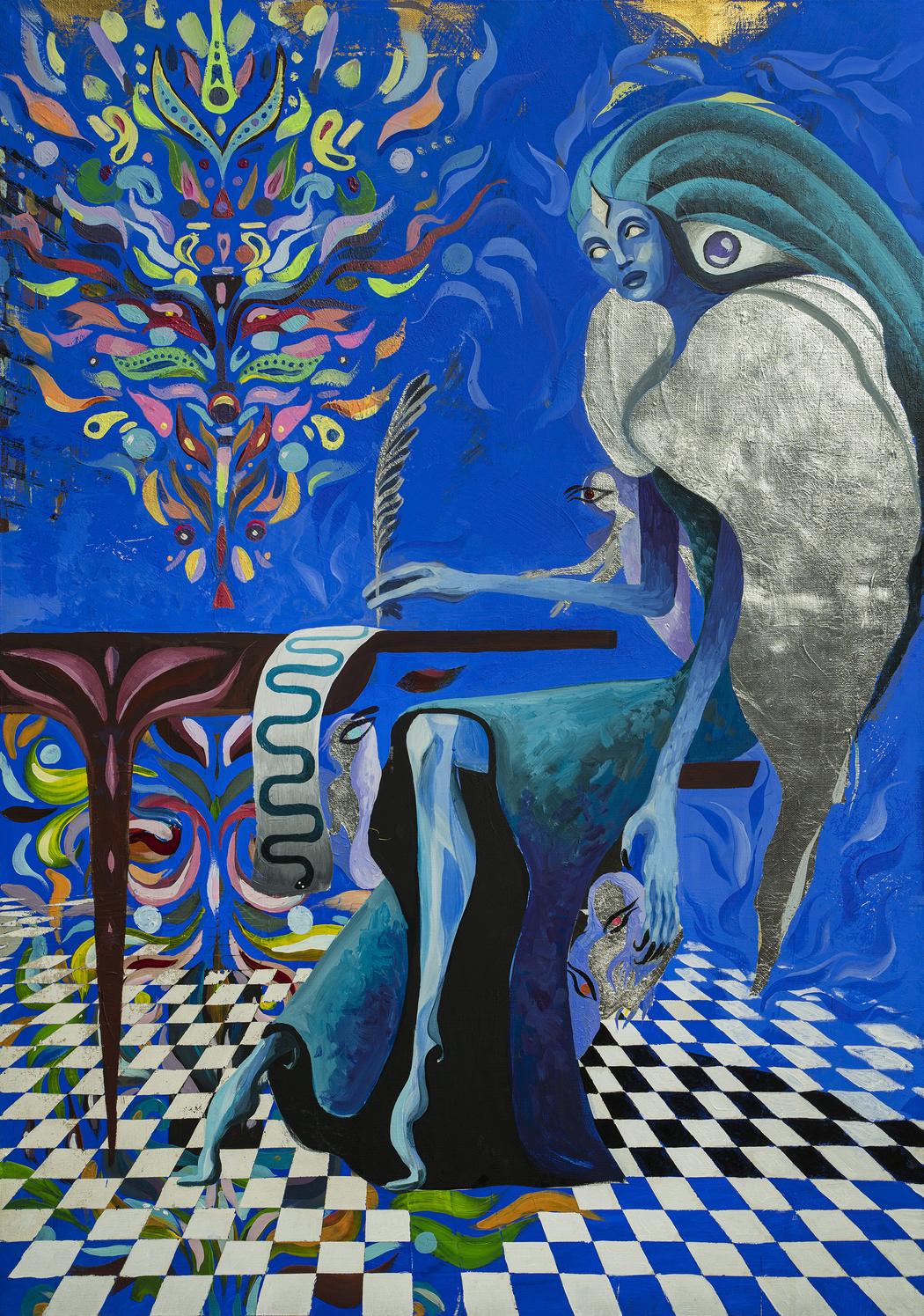 Liza Gruzdeva | Library
The checkerboard floor, mirrored elements, and surreal perspectives in your works create a sense of transition or instability. Are you interested in the idea of crossing between different realities?
Yes, this is literally the foundation of my artistic perception. I am not afraid of instability or transitions into the unknown — on the contrary, I always feel joy when I experience something like this.
It comes to me in different ways: through dreams, conversations with loved ones, meditation, good films, philosophical texts, or even story-driven video games. For me, all of these are not merely impressions, but separate realities that enrich my library of the unconscious and gradually shape my worldview.
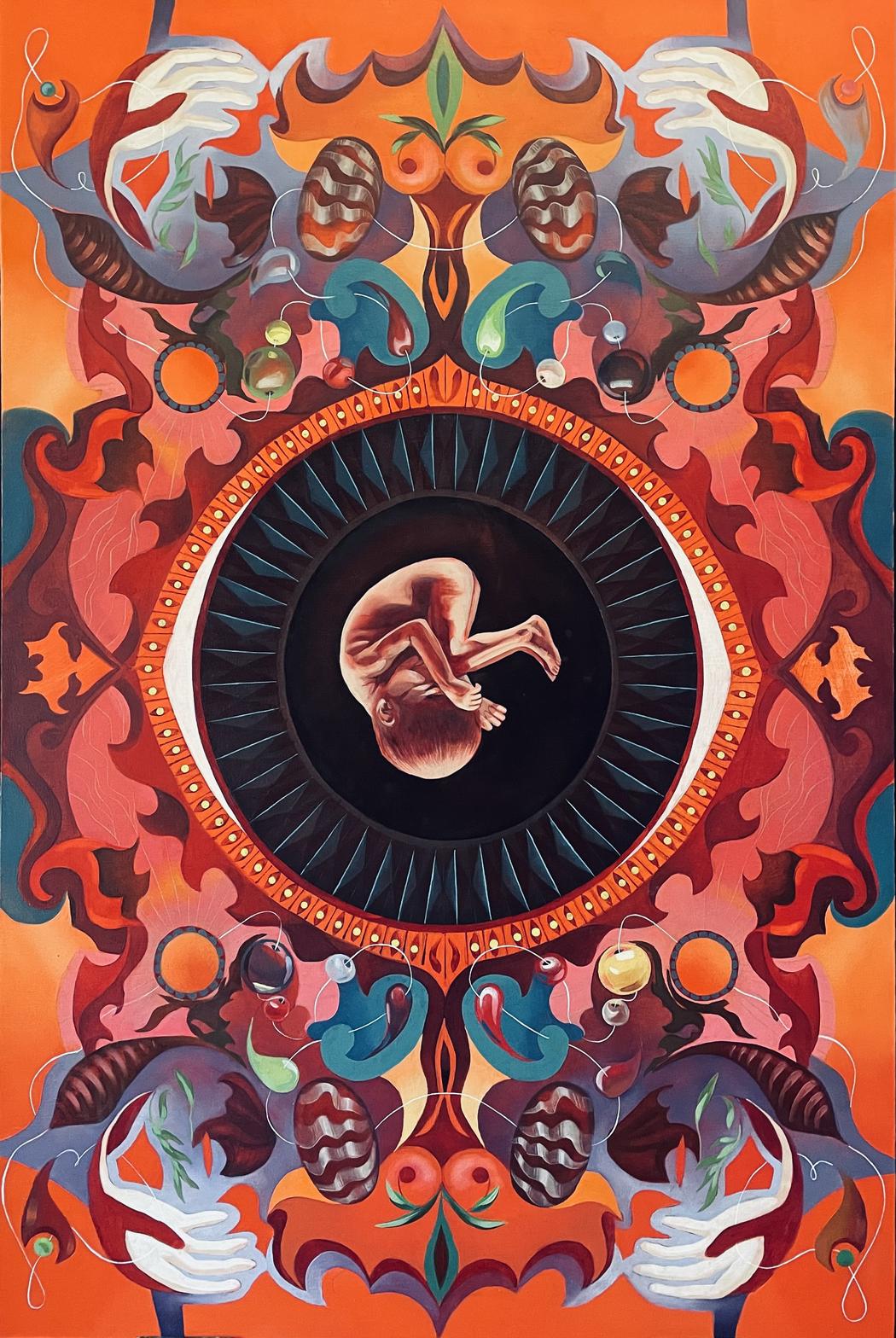 Liza Gruzdeva | Who Can’T Be Seen, But You Can Feel
You write about the desire “to see the authentic behind the visible”. What do you hope the viewer will discover when looking beyond the surface of your paintings?
I truly hope that the viewer will find themselves there — in an endlessly white space where there is only the viewer and their own experience. Ideally, they will discover not only their personal experience, but also the collective unconscious. This is what I strive for as well — a sense of unity, rightness, and authenticity.
Leave a Reply
You must be logged in to post a comment.