
Lola Fischer
Your works balance abstraction with recognizable human forms. How do you decide how much of the figure to reveal and how much to leave undefined?
It depends on how much I want to leave unsaid in the artwork and how much mystery I want to reveal to the observer. To be honest, I love playing the game of hiding and revealing. I like to use the language of artistic ambiguity. I get really excited when people discover new meanings in my artworks over time. Sometimes, those discoveries surprise me too, which is absolutely astonishing. I care about the many different levels of interpretation. I experiment with form, simplifying it to create abstraction, twisting perspective planes and blending lines and colour spots to achieve this effect. Similarly, I experiment with titles for the same reason: to create different meanings through wordplay. It’s such an exciting game to play!
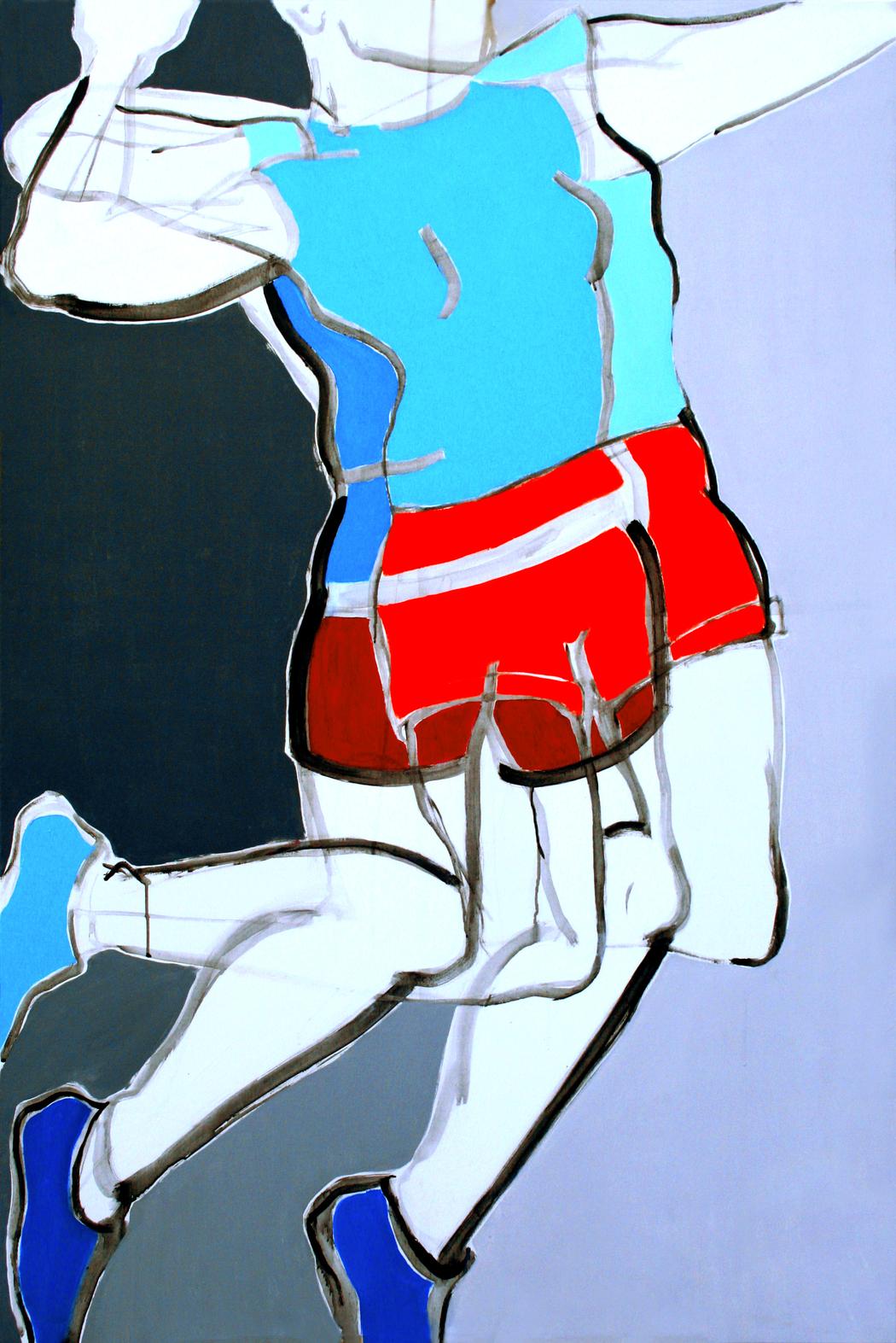 Lola Fischer | Fitness Witness | 2014
Bright colour and expressive line play a central role in your paintings. What emotional or psychological effect are you hoping these visual elements create?
I use expressive, organic lines and intense colours to evoke emotion. This conveys sensuality, intensity and passion. This also helps me create dynamic compositions and a sense of motion, bringing an effect of change and transformation. The reason behind this is my personal perspective on the world and how I feel. This may not be universal, but I share it with others through art. It is my way of inviting others into my intimate world of imagination and emotions, and it is my own personal language. It is also the result of my experience working in two art disciplines: painting and graphic art.
Many of your compositions seem to capture movement and transformation. What interests you most about depicting the human body in motion?
Well, ballet and modern dance have inspired me my whole life, ever since I was a child. I have been taking ballet classes since the age of three. When I was a bit older, I used to dance in the bushes in the countryside while my parents listened to music by Chopin or Vivaldi. It must have looked hilarious to the neighbours, but I found it really satisfying. As a teenager, I performed in an amazing street theatre, which also used the body as the main tool for expression. So, for me as an artist, it was only natural to use movement to depict human struggles and transformation. At the same time, I have always been hugely influenced by art concentrating on the human body, such as the sculptures of Alina Szapocznikow and Magdalena Abakanowicz. As an art student, I was intrigued by the fact that the models who came to the nude drawing classes all had stories written over their bodies in the form of scars and other marks. I realised that human body carries powerful personal stories. This is why I focus on body expression in my art.
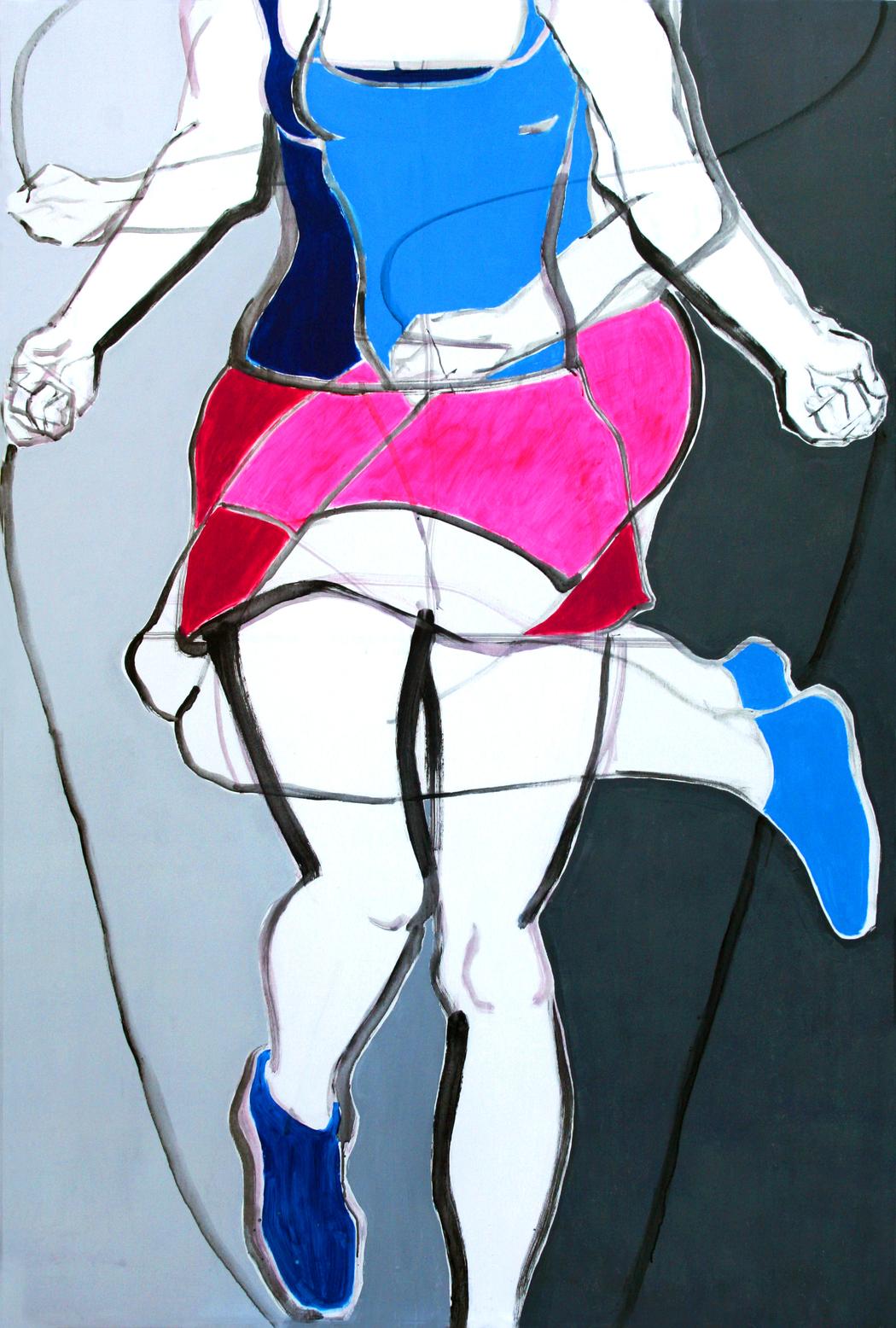 Lola Fischer | Fitness Witness | 2014
Your artworks often simplify the figure into fluid contours and dynamic shapes. Do you see this process as a way of exploring identity beyond physical appearance?
Yes, I use material structure as a basis for more abstract reflections. When it comes to humans, it could be identity or consciousness; when it comes to nature or the universe, it could be ideas or concepts. I notice patterns that we can recognise in the material world, and these patterns build bigger compositions. This is why I have always been fascinated by the Fibonacci spirals, fractals, the golden ratio and numbers. It is also why I believe that everything can be as simple as an abstraction.
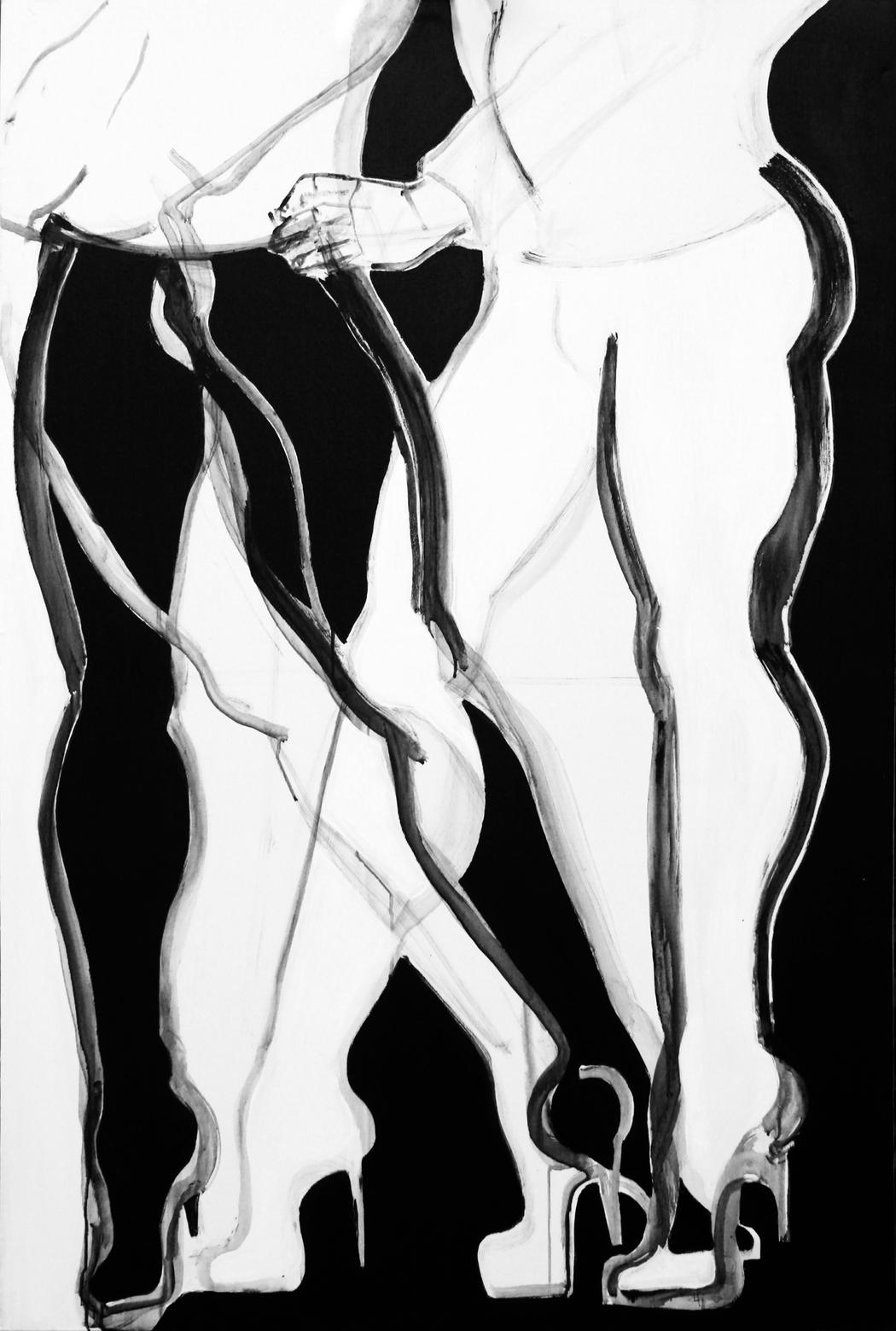 Lola Fischer | Fashion Able | 2014
Fashion, posture, and gesture appear subtly in several of your paintings. How important is contemporary culture and everyday observation in your artistic practice?
I observe pop culture, and I find some aspects of it inspirational. I was born in communist Poland in the 1980s. The Polish streets were dark and dreary, but I was a child of Polish bohemia as my parents are artists. That world was full of expression and was also quite eccentric. At that time in Poland, there were only a few fashion designers who worked for state-owned fashion houses. This is why my father decided to start his career as an independent fashion designer, which lasted for around ten years. It was crazy because, as a child, I could spend time backstage at fashion shows. I also loved watching fashion shows on TV with my dad. It was a great experience and I still find it inspiring today. Another influence on my art is queer culture, which is bold, colourful and provocative. My fascination with this began in childhood when I used to watch drag artists impersonating women on Italian television channel RAI UNO. In recent years, I have painted under the influence of the Ukrainian band Kazaky, whose members dance in high heels. It was a fantastic show, and I wanted to explore that theme in my work.
Having exhibited internationally for many years, how have different cultures and audiences influenced your artistic perspective?
Needless to say, my perspective on art is quite different today. Firstly, I recognise that different cultural environments exhibit different aesthetics and forms of art. This means that the art world is much more diverse than we often realise, and we need to be more open-minded. Another important issue is showing respect for different cultures. As artists, we must recognise that not all art is appropriate in every context. This is why I am not attached to trends, which vary from culture to culture and are temporary. I have also learned that, in our quite unstable, unpredictable and threatening world, artists should come together to promote fundamental values such as human rights, peace and solidarity. This is why I have always participated in exhibitions dedicated to important social and public issues alongside my artist friends from around the world.
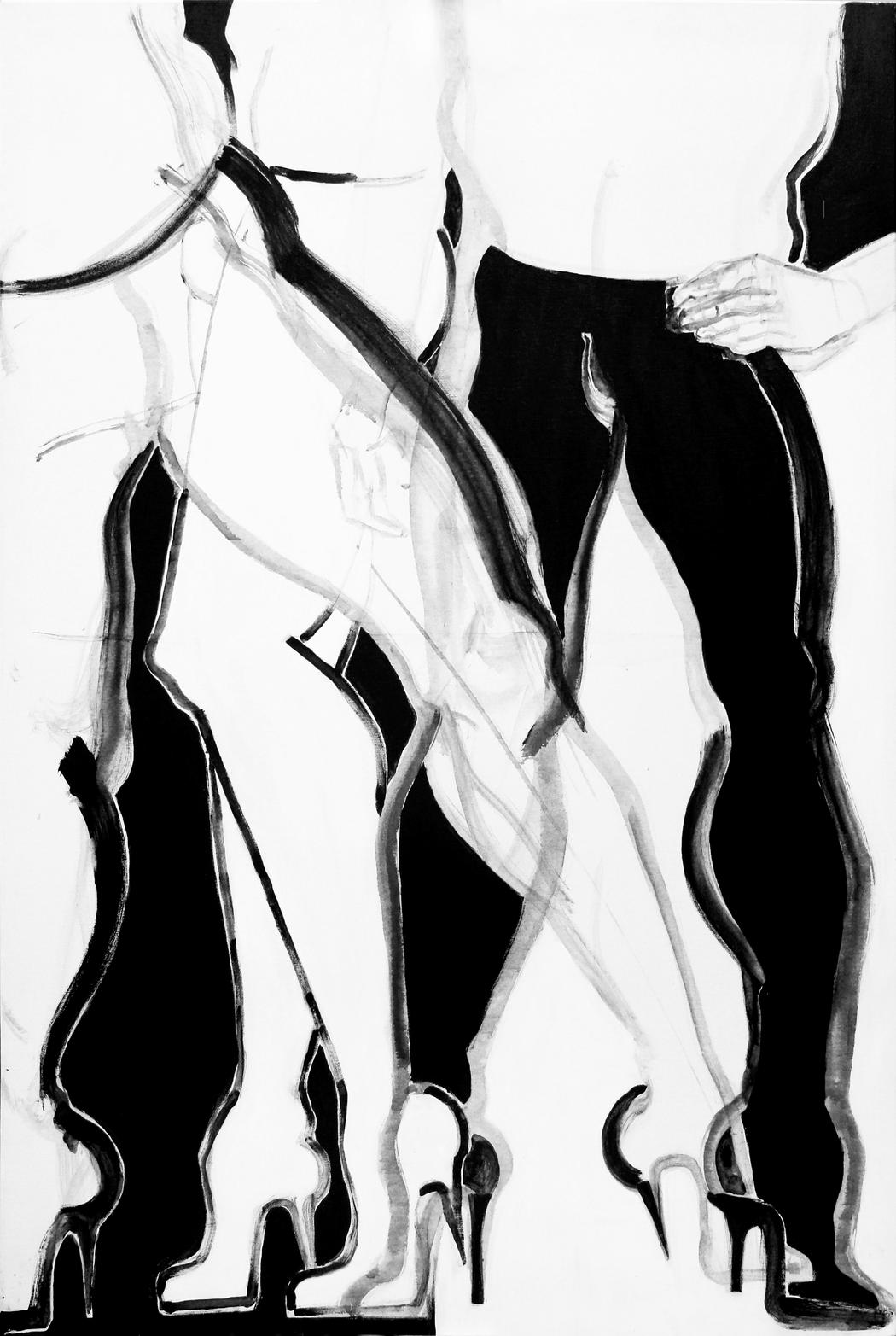 Lola Fischer | Fashion Able | 2014
Looking back at your participation in major international exhibitions such as the Beijing Biennial and the Venice Biennale context exhibition, which experiences have stayed with you the most?
Every exhibition is important to me because it gives me the opportunity to showcase my artwork and share my creations with others. Of course, some exhibitions are more important than others on my CV because of their scale. I had the honour of taking part in the 2008 Beijing Biennale during the Olympics, which saw two major events taking place simultaneously. It was an incredible celebration of art from around the world. Many renowned artists were invited, and the standard of the exhibitions was exceptional. Everything was organised extremely professionally. A couple of years later, I was invited to the famous Personal Structures exhibition, organised in the context of the Venice Biennale, by MEADOWS NGO. It was a real honour to be a part of such a prestigious exhibition. Initiated in 2002 by the artist Rene Rietmeyer, it is an international art project in which many stunning artists, such as Marina Abramovic, Louise Bourgeois, Yoko Ono and Roman Opalka, have taken part over the years. Another exhibition with a long tradition is the Salon des Beaux Arts, organised by the Société Nationale des Beaux Arts in the Carrousel du Louvre in Paris since 1861. It is a dream come true to be part of such significant cultural events.
Leave a Reply
You must be logged in to post a comment.