Liu Xuewen
You began the Looking North at the River project in the autumn of 2021 and have since travelled more than 8,000 kilometres along the rivers of Northeast China. What first drew you to this subject, and how has the project evolved over time?
The first thing I photographed was the Songhua River, which is a river that can be seen every day in front of my home. Based on a simple idea of capturing it, I borrowed Robert Adams and Stephen Shore’s new terrain and landscape shooting methods to start my photography in 2021. The shooting is divided into two parts. One part is from Jiamusi City to Tongjiang City, where the Songhua River flows into the Heilongjiang River at Tongjiang; The other part is filmed from the source of the Songhua River in Tianchi, Changbai Mountain all the way to Harbin, covering a distance of over 1900 kilometers. After the formation of the two-part combination work in 2022, it participated in several exhibitions both domestically and internationally. As I delved deeper into my thoughts and filming, I gradually developed the idea of capturing the entire river basin in Northeast China. It was autumn of 2023, and my wife suddenly fell ill. I accompanied her to the hospital in Dandong for treatment, taking care of her while filming. I started filming from the mouth of the Yalu River in Dandong, along the banks of the Yalu River, all the way to Tianchi in Changbai Mountain. After my wife recovered from her illness and was discharged from the hospital a year later, I started filming the Tumen River again. After the 25th Winter Spring Festival, I started filming the Nenjiang River, Heilongjiang River, and Wusuli River. The filming journey of these rivers will be nearly 6000 kilometers, which will fully capture the rivers in Northeast China. Some places have been filmed more than once, and I started to participate in the filming in the autumn of the 25th year. Photography exhibition. Until now, this project has been under filming. The filming project travels through complex terrain and records the vastly different ecological landscapes on both sides of the boundary river: active trade and frequent border crossings between China and Russia; The border between China and North Korea remains relatively closed due to its special historical background, forming a distinct temporal and spatial contrast.
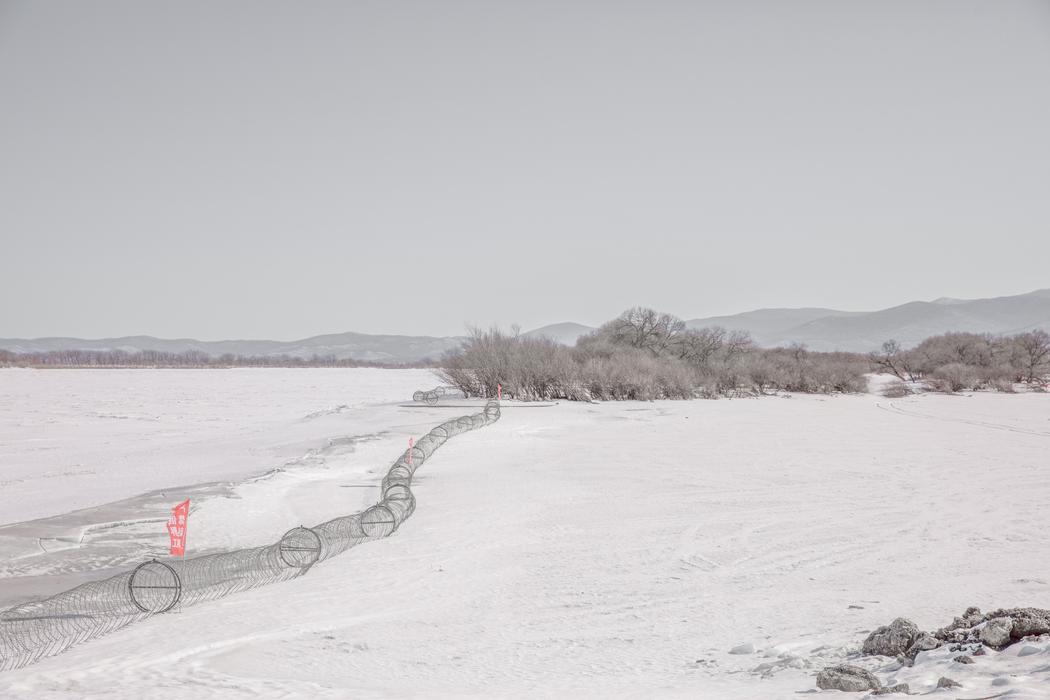 Liu Xuewen | Wusuli River Raohe | 2025
Several of the rivers you photograph form national borders with Russia and North Korea. How does the idea of a border influence the way you observe and photograph these landscapes?
The rivers Heilongjiang and Ussuri in Northeast China border Russia, while the Yalu and Tumen rivers border North Korea. These rivers are also boundary rivers. Among them, Heilongjiang and Ussuri Rivers have a lot of border trade with Russia, while Yalu River and Tumen River have no border trade with North Korea. Photography tracks the changes of rivers and integrates the ecology, geography, and history of the Northeast border into a single visual narrative. The project takes the perspective of “looking north” and uses the boundary river as a dual boundary between geography and culture. The Heilongjiang and Ussuri rivers on the China Russia border are both natural barriers and trade channels. By capturing scenes of border residents trading and cross-border logistics, the “connectivity” of rivers under the background of globalization is demonstrated; The Yalu River and Tumen River on the border between China and North Korea present the metaphor of rivers as “isolation zones” through the juxtaposition of historical and contemporary images. This comparison not only reveals the complexity of geopolitics, but also prompts reflection on the essence of “boundaries” – whether they are obstacles or protections? Is it fragmentation or symbiosis?
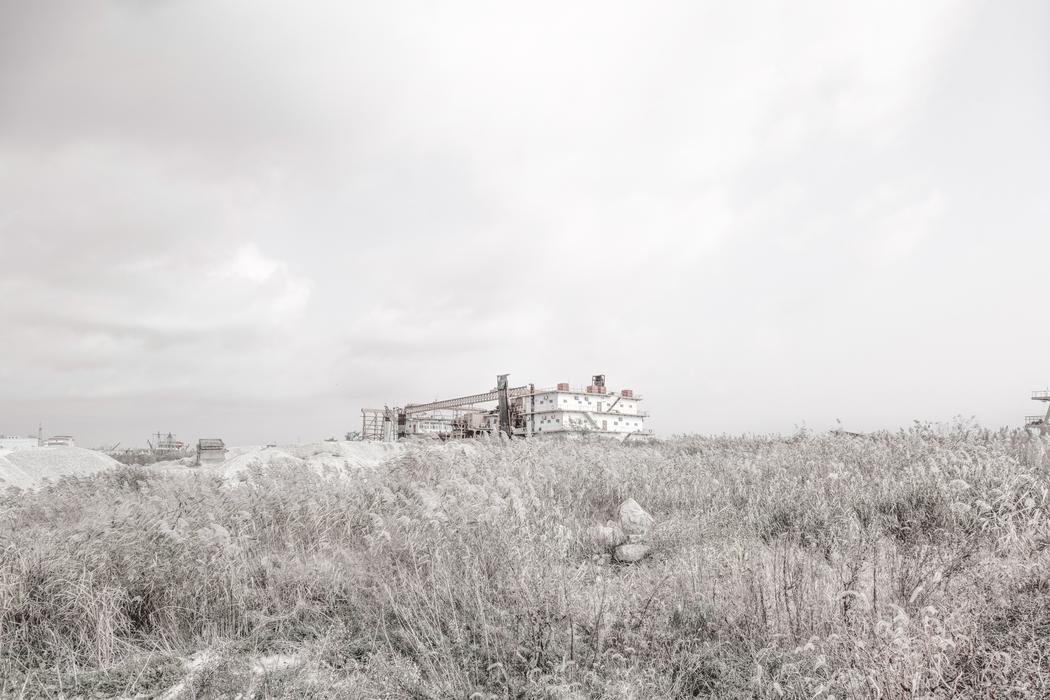 Liu Xuewen | Yalu River Donggang City | 2024
Your photographs are characterised by a restrained, almost monochromatic palette, with snow, mist, pale skies, and muted vegetation often dominating the frame. What led you to develop this visual language?
There are various ways of expressing contemporary photography, some with intense colors, some with subtle colors, some with colorful hues, and some using black and white to explain the world as seen. The colors in the photos I took are quite messy because there are different seasons and time points in the shooting. I think I should use simple color relationships to explain the landscape I see. After trying, I found a happy way to express colors and tones, and further unified them. This makes it easier for people to focus more on the content itself when watching, highlighting the content expressed in the work and weakening the visual differences in color. The boundary between snow and sky is soft, and the shadows of trees slowly blend out in the mist. You can’t distinguish whether the distant mountains are clouds or snow. I don’t want to cut them open with sharp contrast, I just want to use a low saturation tone to keep this “fused together” state – just like the winter in Northeast China is never aggressive, it wraps around you, allowing you to slowly hear your breath in the white mist. I don’t want any unnecessary “performance” in the picture. The faded colors are the only way to prevent the viewer from being pushed away by visual impact. I am willing to slow down and pay attention to a shallow mark on the snow and a thin frost on the branches. These most inconspicuous details hide the most authentic temperature of this land.
Abandoned boats, industrial structures, shipyards, fences, and other traces of human activity repeatedly appear in the series. Do you see these objects as symbols of decline, transformation, survival, or something else?
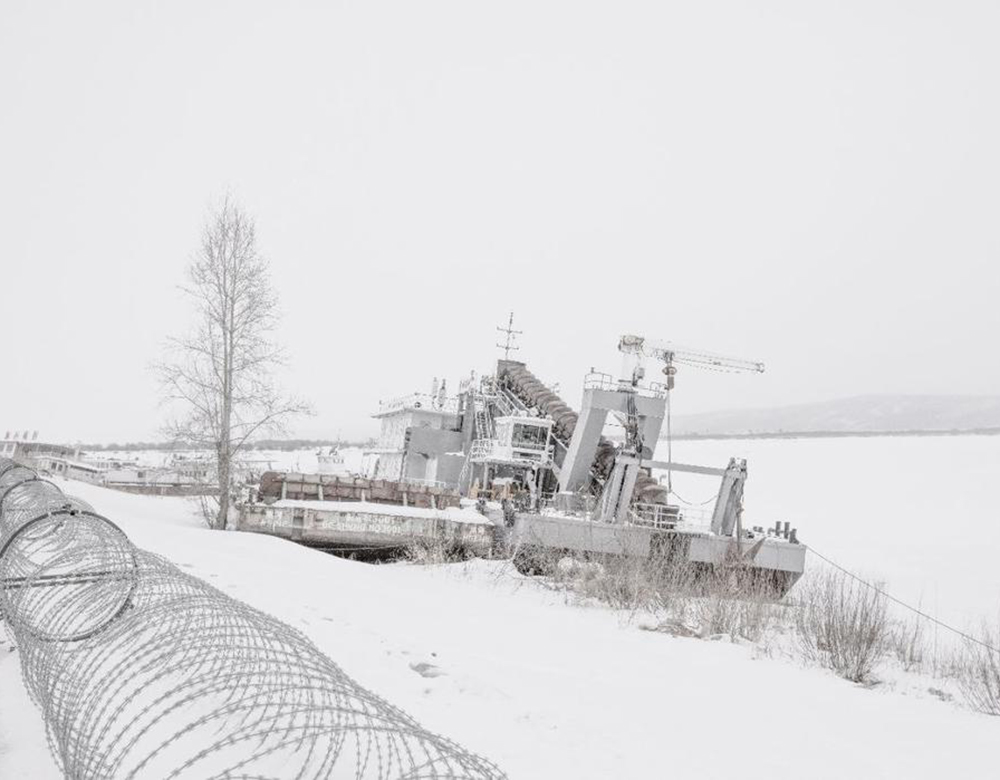
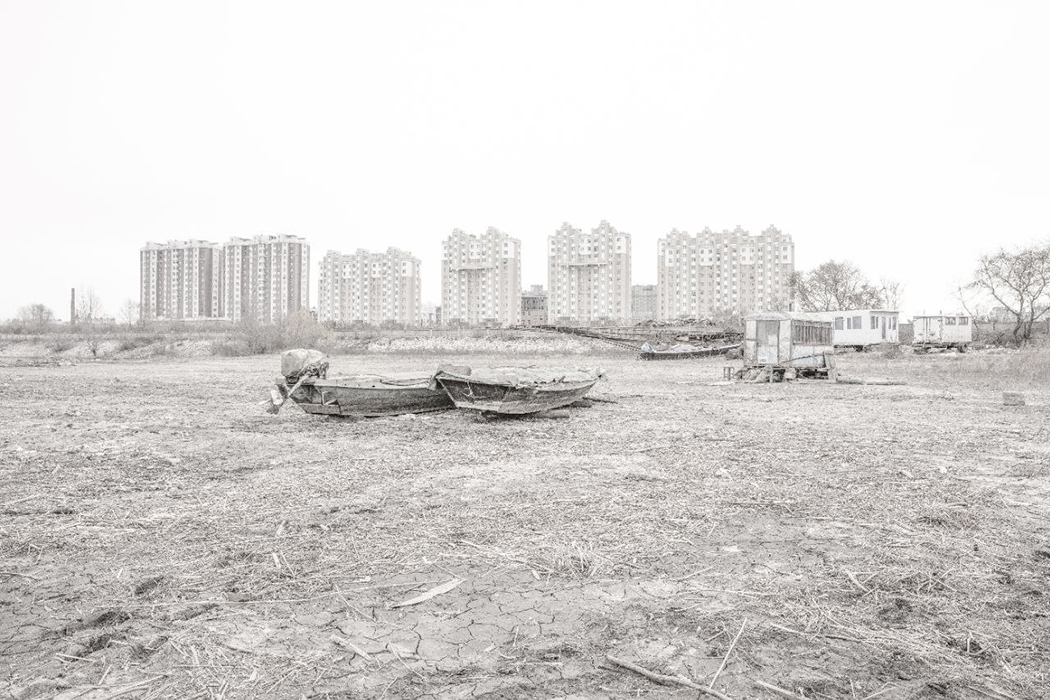
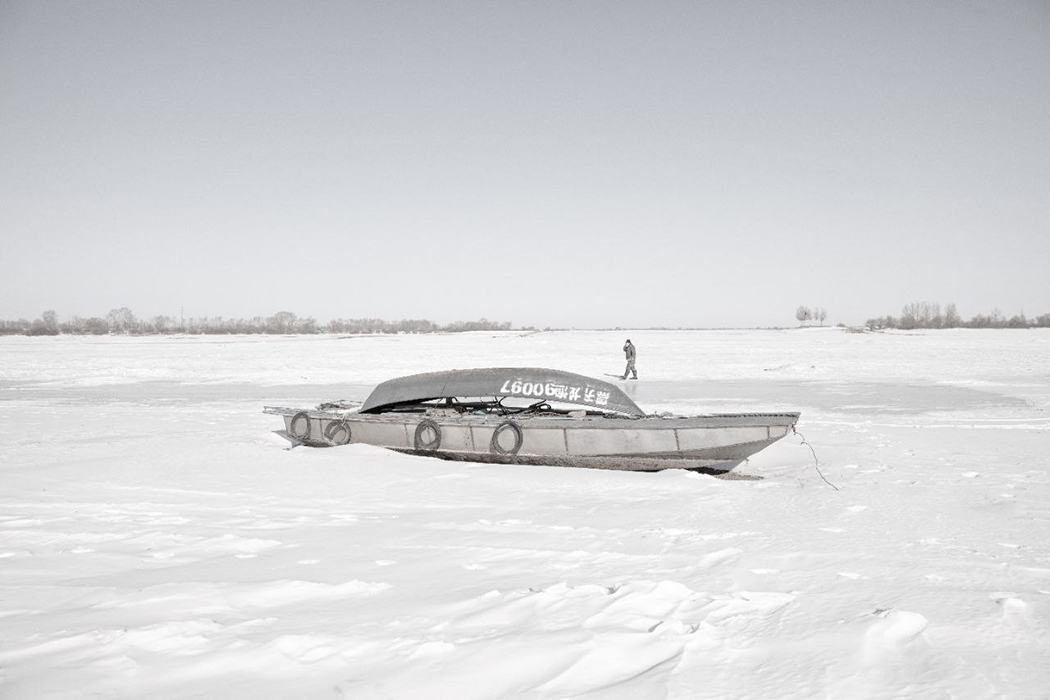
The ships, industrial buildings, shipyards, and fences depicted in the work are mostly during the winter season. The winter river closure in Northeast China starts at the end of November and lasts until the end of April or early May of the following year, making it impossible to conduct boat tourism and fishing on the river surface. The ships are frozen on the ice, and the shipyards stop working at this time. At this time, only some entertainment projects built on the ice are available for local people to play. During this period, it was the time for the children to have winter vacation, and they were very happy and had a great time playing. Looking North at the River “is not only a geographical documentary, but also a contemporary fable about” boundaries “and” connections “. Through the flow of rivers, the project attempts to answer: In today’s world where globalization and nationalism are intertwined, how can humans achieve reconciliation with nature, with others, and with themselves? The answer may be hidden in every wave, every riverbank, and the eyes of every border resident. In the context of globalization and geopolitical conflicts, the Northeast Rivers have become a”liquid mirror” for observing the ecology, economy, and culture of China’s borders. The project attempts to redefine the visual grammar of “borders” through photography as a medium – it is both the geographical endpoint and the historical starting point.
People are either absent from your photographs or appear as very small figures within vast landscapes. What role does the human presence – or absence – play in your work?
The rivers I photograph can feel the presence of people, but in front of nature, people are not the main subject. We know that the sun and moon go through vicissitudes, the stars move, and all things naturally have their own laws of movement. People need to follow these laws and comply with them. In fact, there will be people everywhere, no ship can’t move without people, docks are built by people, buildings are built for people, and even small paths are walked by people. It can be said that people are everywhere, and most of the works have traces of people even though there are no people. The project focuses on the survival status of the two sides of the boundary river with natural rivers as the core, and explores cultural preservation in a closed environment. Through narrative and visual interpretation, explore the symbolic significance of the boundary river as a “liquid boundary” – both a resource channel and a geographical barrier. This micro perspective approach allows the work to transcend geographical records and become a philosophical text about “how people settle down at the boundaries”.
Since beginning the series, have you noticed significant environmental or social changes along the rivers? Have any of these changes altered the direction of the project?
I noticed some issues during the filming process of this project. Cities near rivers have better development, while cities far away from rivers have weaker development. This is true for countries related to rivers in the world geography. Here, I would like to point out that even small towns can develop well by utilizing border ports to develop trade. I deeply confirmed this during the filming process.
At the same time, filming rivers has sparked my thinking. Faced with the political sensitivity and technical challenges of filming boundary rivers, the filming project adopts a “restrained aesthetics” approach: through wide-angle lenses, natural light, environmental types, and other techniques, reducing human intervention, allowing rivers and land to “speak” on their own. The concept of conveying the deep meaning of “coexistence” through silent images attempts to transcend the geographical sense of “looking north” and establish an emotional connection between the audience and the border through visual narrative, redefining the meaning of “border” as a dynamic cultural field.
You are both a freelance photographer and an independent curator. How has your curatorial experience influenced the way you photograph, edit, sequence, and exhibit this body of work?
When it comes to curation, it has had a great impact on me. Curation is the display of works of different categories and forms in the form of themes. Every time I shoot, I need to determine the route, the places I pass through, and the different scenery for planning. The works shot in this project will have several parts, some emphasizing nature, some emphasizing humanities, and some emphasizing industrial landscapes, which will become independent works. I no longer pursue the stunning effect of a single photo, but deliberately reserve enough “narrative gaps” for the entire exhibition, so that the scenery is no longer an isolated background, but a carrier that can support everyone and the story. This requires photographers to have insight and independent thinking ability, which has been very helpful for me in shooting works. For ‘Looking North at the River’, curation has never been a ‘follow-up work’ that begins after taking photos. It started from the first time I surveyed and looked at the river surface – I never took pictures of the river scenery in Northeast China, but the complete story of people living with this river for decades. Curatorial thinking gave me the ability to piece together the scattered fragments along the coast into a world that allows the audience to truly stand by the river.
The Beiwangjiang River project has compiled over 80 photos, with less than 30 selected for the exhibition. The photos compiled by this project have the idea of being edited into a book, and after two years of shooting, the content of the work will be supplemented and improved. At that time, negotiations will be held with the publishing house regarding the publication of the book. In short, curation has taught me to engage in photography creation with a more open-minded attitude.