
Negin Kianpour

Your works merge painting with reflection, turning the mirror into a living surface. How did this idea first come to you, and what does the mirror represent for you personally?
Since childhood, painting has been an inseparable part of who I am — not just a practice, but a reflection of my character. Yet I was always searching for the true meaning of art. Like many artists, I explored different materials and techniques, but traditional forms never gave me that raw feeling of creation.
The idea of painting on mirrors grew stronger when I realised I no longer wanted to present art through conventional methods. Art, for me, has always belonged to the viewer — like a theatre stage that remains incomplete without its audience. But in most traditional settings, the viewer is only invited to look, not to experience or to see themselves within the work.
To me, the mirror is not a silent or passive surface. It is a living, secretkeeping medium that reveals inner emotion. By merging painting with reflection, I dissolve the boundary between the artwork and the audience, creating a shared space where both become part of the same story.
In On the Edge of Hope, fractured faces and red slashes create a sense of tension between destruction and resilience. What emotions or experiences inspired this work?
The idea for On the Edge of Hope emerged from observing the collective emotions of modern society — a society constantly oscillating between fear, anger, exhaustion, and hope. I have always been drawn to how people react emotionally to social pressure and uncertainty. For me, these moments reflect a kind of collective psyche, where the inner and outer worlds of human beings collide.
The fractured faces and red lines in this work represent this tension — cracks between destruction and endurance. None of the faces are whole; each embodies a fragment of contemporary humanity: fear, isolation, resilience, and hope.
Ultimately, this work is not just about suffering, but about the dialogue between individual emotion and shared experience — a reminder that even within silence and fracture, the quiet pulse of hope still persists.
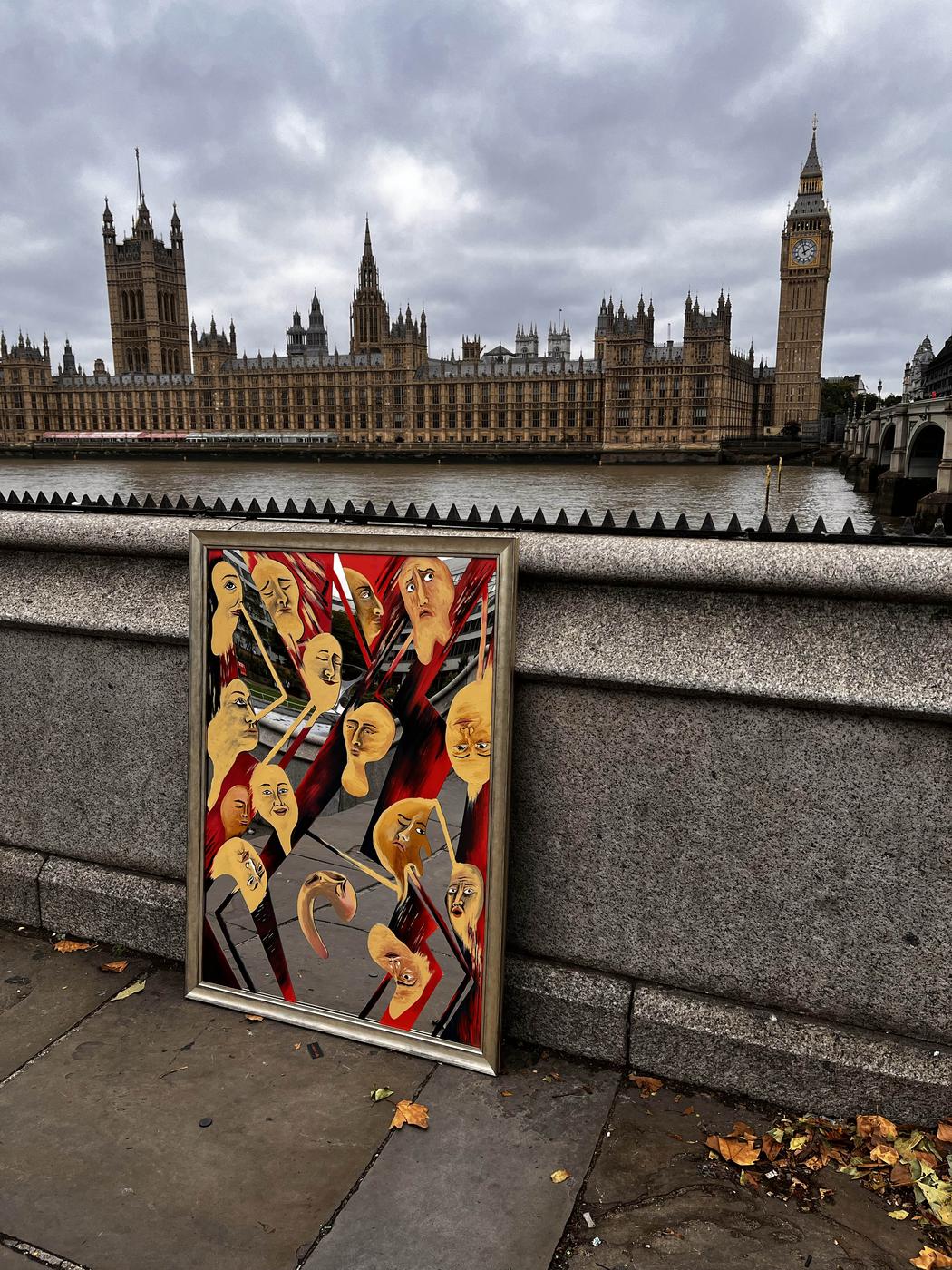 Negin Kianpour | On The Edge Of Hope
Unbroken Reach: The Hands That Remember carries a feeling of longing and human connection. How did you develop the visual language of reaching hands and golden threads?
Unbroken Reach: The Hands That Remember was born from both personal and collective experiences of separation — the distance between people, memories, and the places we once belonged to.
The reaching hands represent bonds that have been torn apart by time yet still long for connection. Their movements through shadow and light express the quiet human effort to rediscover meaning and belonging.
The golden thread that runs between them symbolizes memory and love — an invisible link that continues to bind us together despite distance. To me, this work is about hope within separation, and the belief that perhaps it is in the very act of reaching that we remain alive.
Both works deal with the ideas of memory and touch — but also distance. Do you see them as two sides of the same story?
For me, these two works represent different chapters of a larger story — a story of humanity navigating pressure, distance, and the search for meaning.
In On the Edge of Hope, I explored the collective emotions of a society suspended between fear, anxiety, and resilience.
In contrast, The Hands That Remember begins from a personal feeling of separation that gradually unfolds into a universal search for connection, memory, and wisdom.
Ultimately, They stand as two sides of one journey — one expresses the wound, the other, endurance and quiet hope.
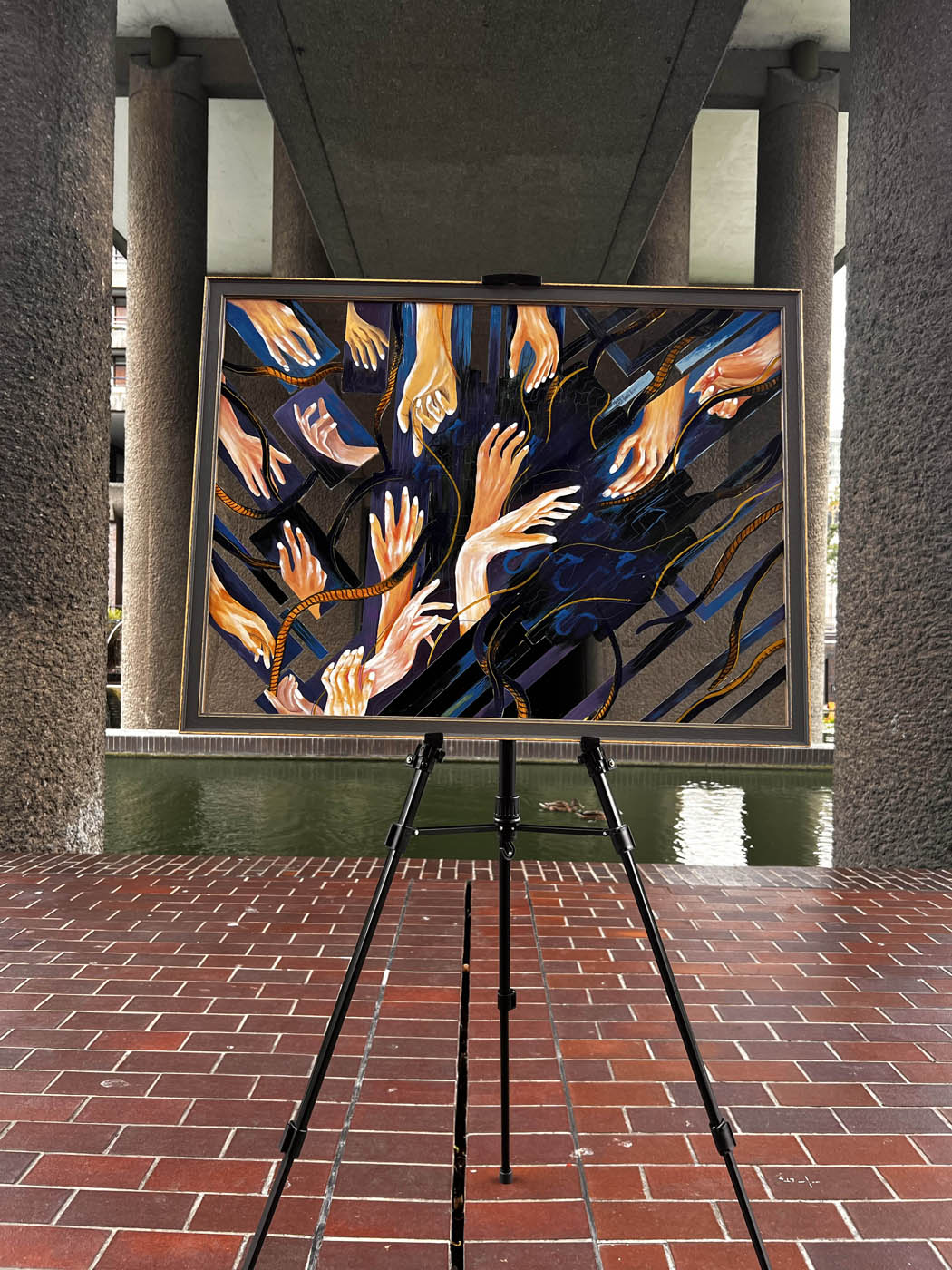 Negin Kianpour | Unbroken Reach
You invite viewers to see themselves within your art — literally and metaphorically. How do you think this active participation changes their relationship with the work?
In my work, the viewer is not a passive observer but becomes part of the piece itself. Unlike traditional art, where the audience stands outside the work, the mirror invites them inside — transforming them from spectators into participants.
When someone sees their own reflection within the artwork, a dual experience emerges: they confront both the emotions of the piece and their own inner world. Each person’s encounter becomes unique — not only visual, but deeply emotional and introspective.
I remember on the day of photography for The Hands That Remember in a public space; people would stop, gaze, and even touch the mirror’s surface. Some seemed lost in thought, others reached out as if to connect. In that moment, I realised the artwork no longer belonged solely to me — it had become a living dialogue between art and humanity, where the boundaries between creator, work, and viewer dissolve.
Your background in architecture is evident in the way you construct space and layers. How does architectural thinking influence your visual compositions?
Before entering the world of architecture, painting was my first language. Even as a child, I had an instinctive sense of space and structure, expressed through colour and line. Architecture later gave me a framework to reshape those same emotions through form, rhythm, and balance. During my Master’s studies in London, this perspective expanded through sociology — I began to understand space not as a physical shell, but as an emotional and social reflection of human life.
In my works, art, architecture, and sociology converge. I construct space like a mental map; the mirror is not just a surface but an environment where the viewer moves, much like a floor plan that becomes meaningful through human presence.
Architectural thinking has made my compositions inherently layered — physically through mirror, paint, and texture, and conceptually through emotion, memory, and reflection. For me, architecture is not merely the creation of space, but the design of lived experience — and painting is the same: an act of constructing emotional space where the viewer can dwell.
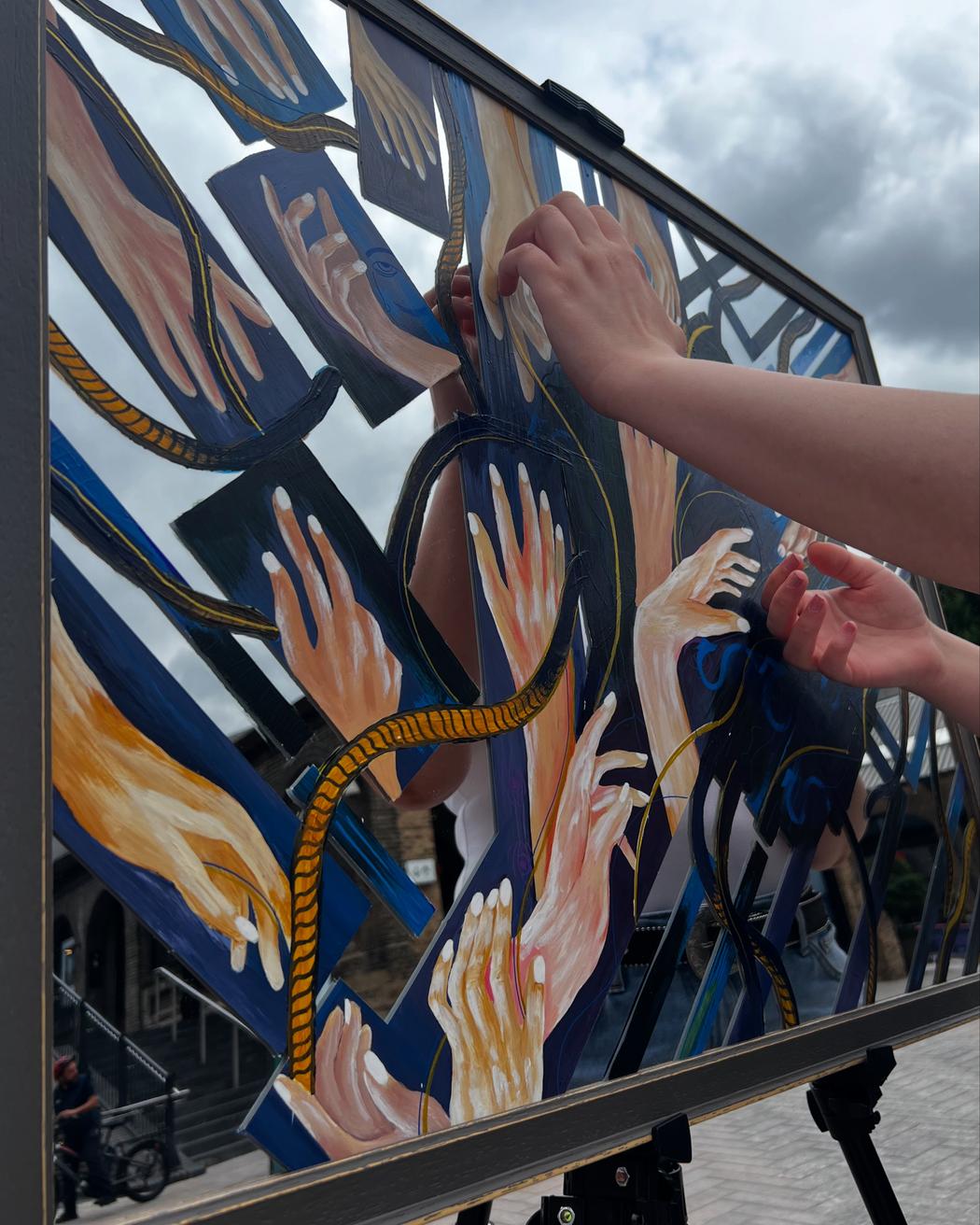 Negin Kianpour | Unbroken Reach
Reflection can be both intimate and uncomfortable. How do audiences usually respond when they suddenly see their own image inside the artwork?
Reflection in my work creates a dual experience — it can be intimate and unsettling at the same time. The moment a viewer sees their own image within the piece, they are confronted with their inner self. It is both beautiful and uneasy, because in that instant, both vulnerability and truth are revealed.
People’s reactions are deeply personal. Some smile softly, some fall silent, others reach out and touch the surface as if to connect. They are searching for something beyond the image — perhaps a forgotten part of themselves.
For me, that encounter between the viewer and their reflection is the peak of the artwork. The mirror is not simply a tool for seeing; it is an instrument of introspection. My aim is for the audience not only to view the work but to experience themselves within it — even if that experience feels quietly uncomfortable.
Leave a Reply
You must be logged in to post a comment.