
Gaëlle Compozia
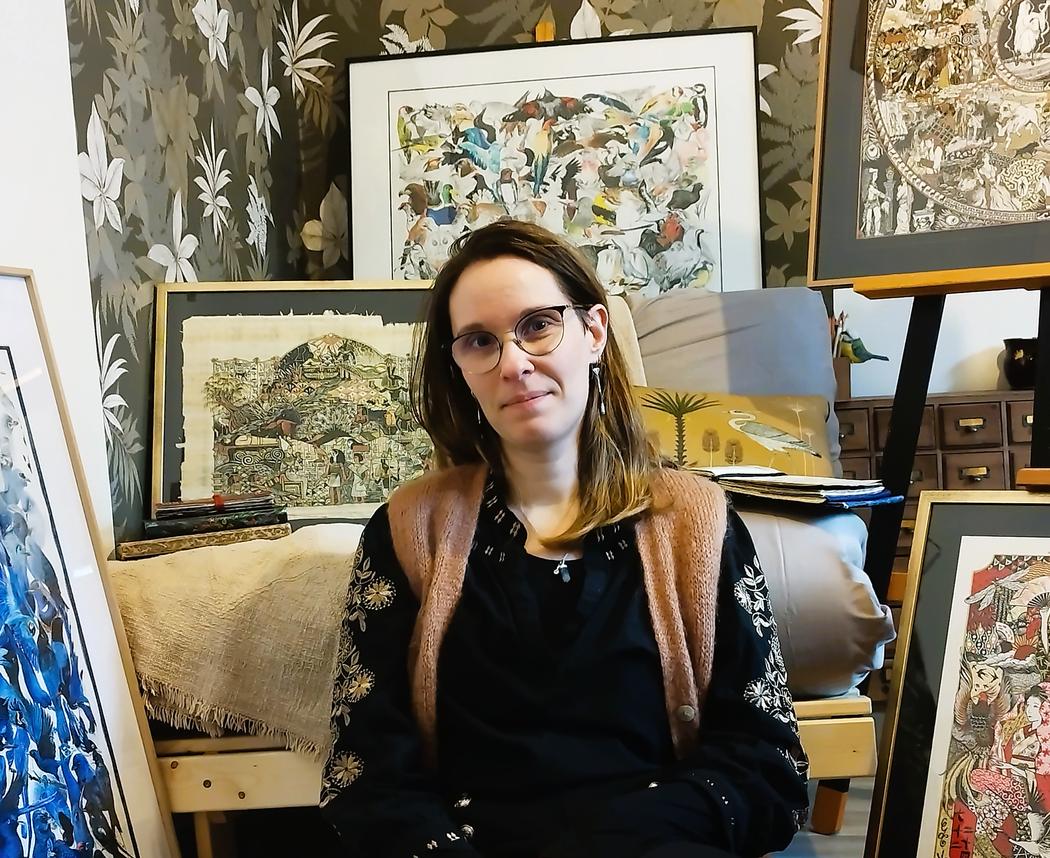
Your works are extremely dense and rich in detail, often described as belonging to a horror vacui aesthetic. What draws you to this visual fullness, and how does it reflect the way you perceive the world?
It’s hard to say. There is still a mystery, even for me. This horror vacui—this fear of the void that I express—is viscerally anchored in me. It is both physical and philosophical. I am looking for harmony, order, and meaning. Filling a whole page, making a dense composition, filling in the gaps, helps me to feel more comfortable with myself—deep inside—and to feel more comfortable with the outside world when I leave my studio. If there are so many details gathered in my artworks, it is because there are so many thoughts and so many emotions running through my mind. Drawing the way I do helps me to channel my mind. It gives me both a sense of control and release.
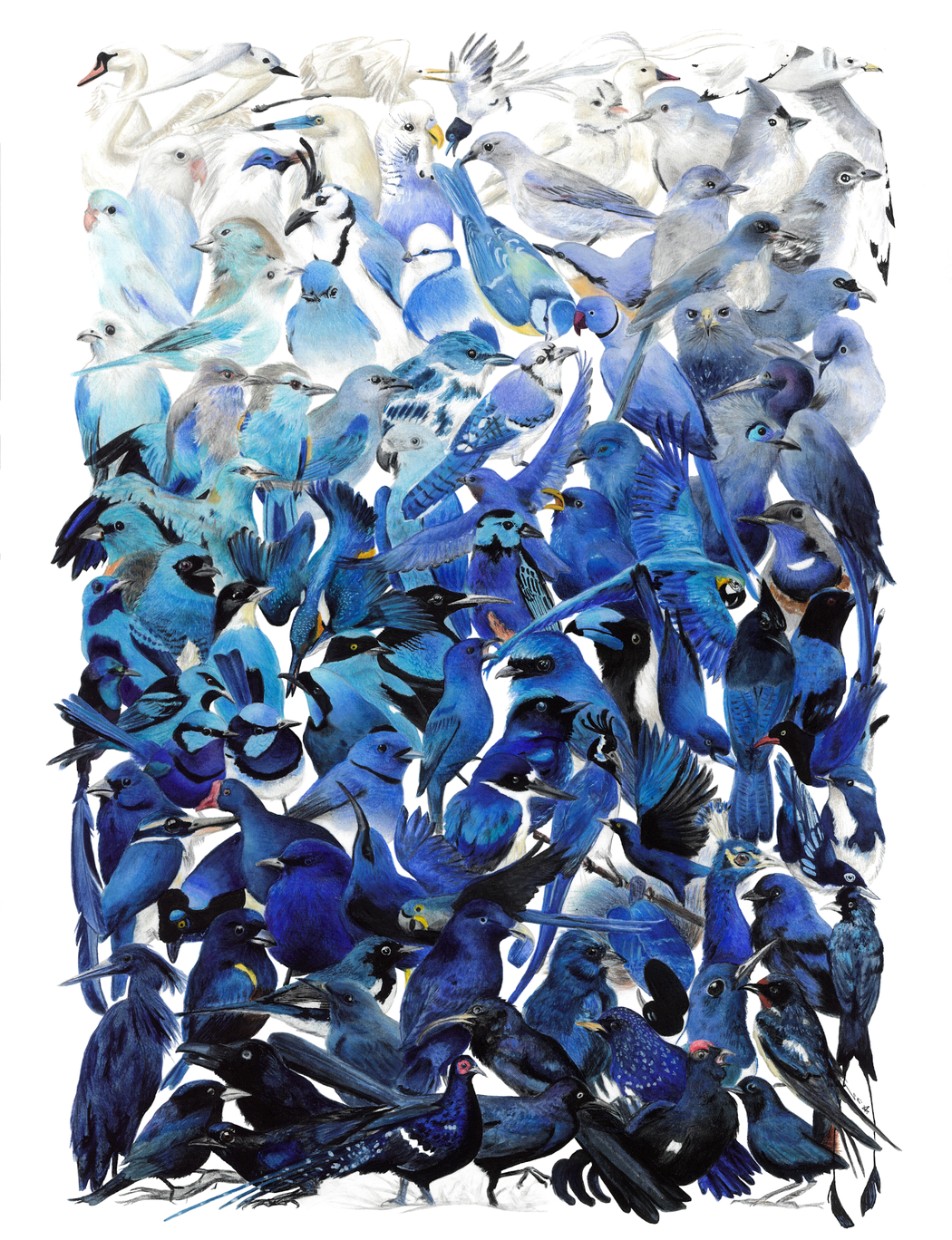 Gaëlle Compozia | Ornithologia Ii, There Is No Softer Color Than… | 2025
You describe your practice as illustration rather than pure fine art, because it is rooted in myths, literature, and stories. What does illustration allow you to express that other artistic categories might not?
Illustration allows me to summarize a subject, to tell a story through only one picture—an overview I could not achieve by other means. There is a connection between my artworks and the texts (or studies) I rely on. And I love that. I seek that: turning words into pictures, a single summarizing image. It’s very satisfying for my brain. I don’t know why, but I need to do it. For now, illustration is the only way I have found to make this possible, to explore and express my sensibility.
As for the choice of medium, I’m not satisfied with painting. I like to draw with Indian ink pens, marker pens, and colored pencils, because I like to draw with hard tools. Brushes and canvas are too soft for me. I like to feel contact and resistance—something my hand holding a pen on a sheet of paper against a table provides. I need a strong support I can lean on. Maybe I should try carving marble someday…
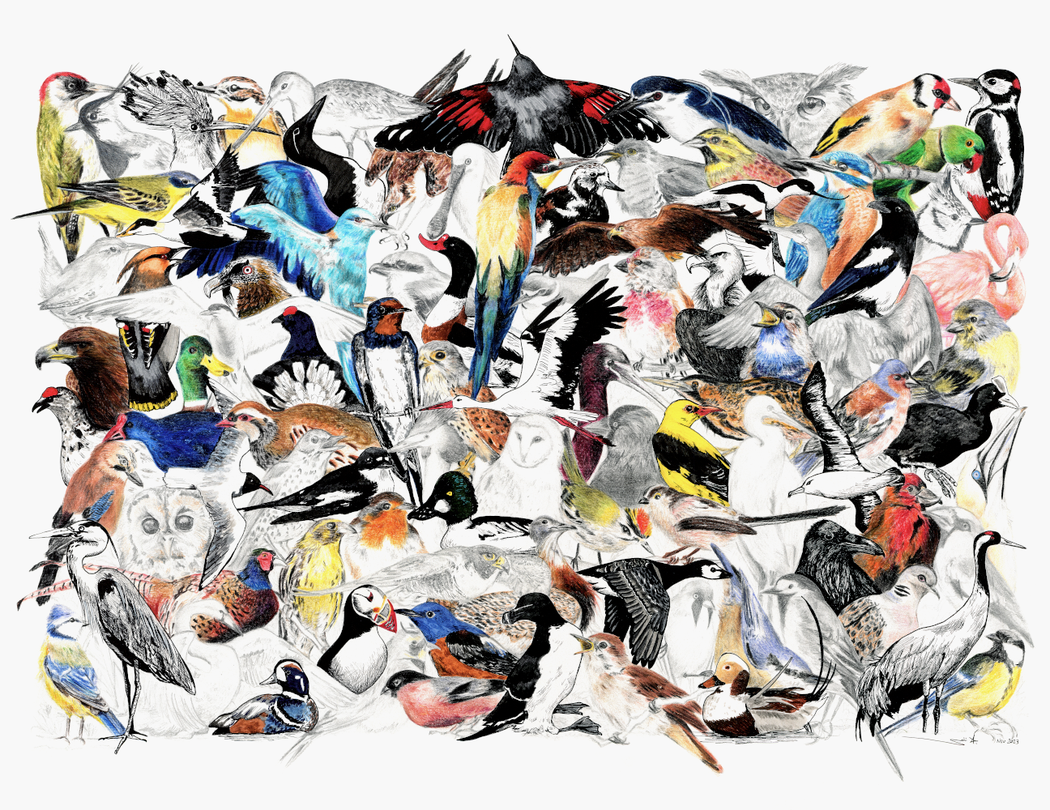 Gaëlle Compozia | Ornithologia I, Behind The Foliage… | 2023
Research and reading play a central role in your creative process, and each artwork is accompanied by a notebook. Could you walk us through how a project evolves from reading and research to the final image?
To describe my creative process and make it understandable, I like to use the metaphor of a puzzle game. I design my artworks as a puzzle whose pieces are put back together. When you start a puzzle, you begin with the frame. In the box, you search for the edge pieces first. Then you select other pieces according to colors and shapes. I do exactly the same with my artworks when I formulate and draw them. Research and reading are the first step: they correspond to sorting the puzzle pieces. Drawing is the next step: it corresponds to putting the pieces back together, filling in the gaps. A puzzle gamer takes a long time sorting the pieces. As an artist, I take a long time researching and reading before drawing. During this process, alongside the illustration, I keep a notebook to write down my ideas, make lists, develop a plan, draw sketches, etc. My notebook is like the puzzle box that contains both the pieces and the model.
When it’s done, as an artist I feel what a puzzle gamer feels: satisfaction, release, accomplishment… and then maybe a kind of depression, because when an illustration or a puzzle is done, you can’t fill in the gaps anymore. You are no longer driven to pursue or achieve something. There is a period of depression before starting a new project.
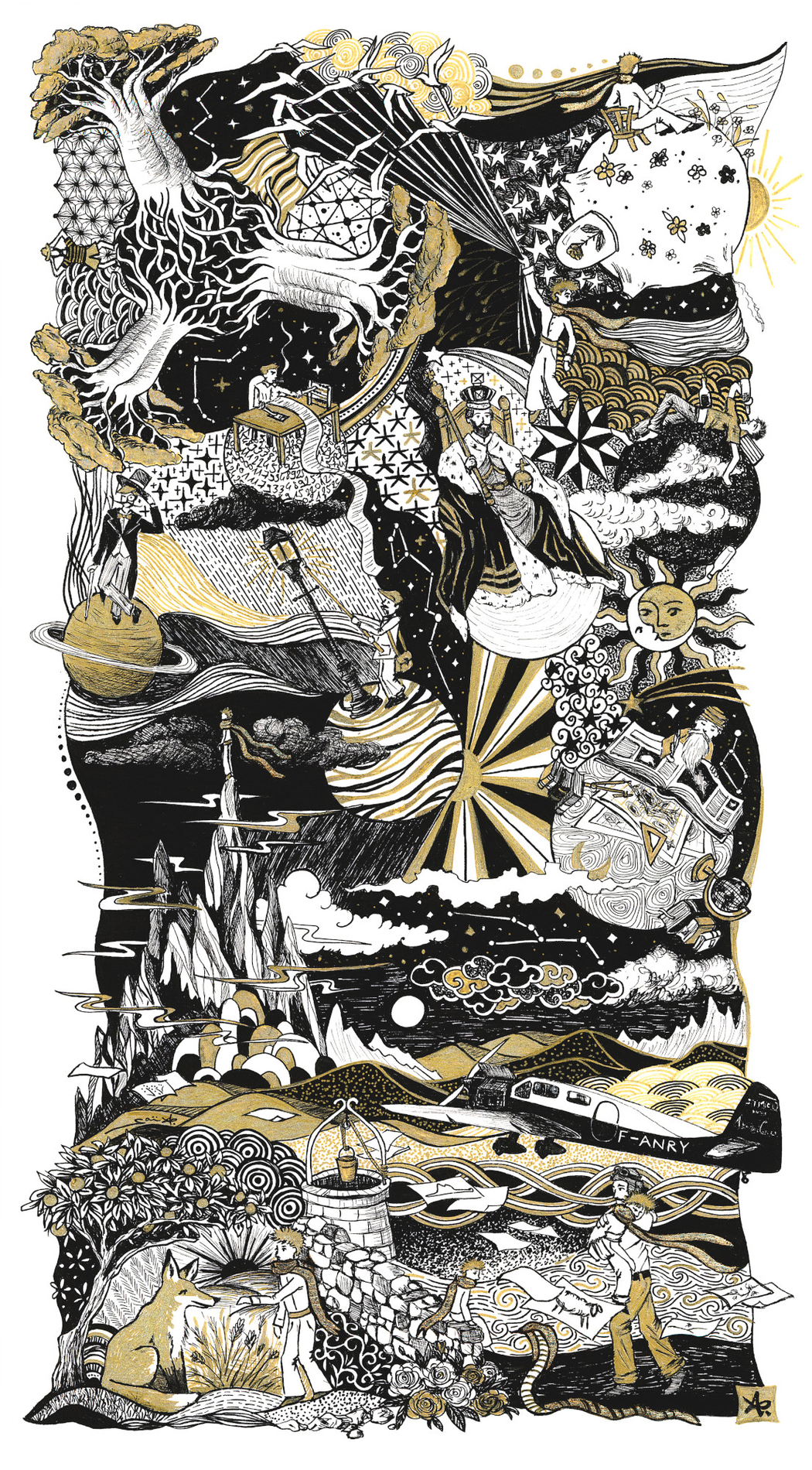 Gaëlle Compozia | One Is Also Alone Among Men, Said The Serpent | 2025
Your compositions often function like visual maps or puzzles, inviting the viewer to explore them slowly. How important is the idea of “reading” an image in your work?
I can use another metaphor to explain my approach: comics. My artworks are like a comic book made of only one panel that summarizes a myth, a novel, or a study. I design them with a specific reading direction: circular, from bottom to top and vice versa. Some of my works are structured with friezes, whose role is to guide the spectator and to guide me during the artistic process. For instance, you can read my illustration of the 12 Labors of Hercules like a clock (the 12 hours of days and nights), following the 12 friezes that outline the 12 labors accomplished. I myself followed this clockwise structure while carrying out the drawing. Reading directions are at the core of my artistic approach. My works are dense and profuse, but very organized. I am driven to set order and achieve an overview.
More recently, your work has turned toward ornithology and the illustration of birds. What sparked this shift, and what do birds symbolize or represent for you within your broader artistic universe?
In the summer of 2022, on a French island, at the beach with my husband, we were watching the sunset. And we were not alone. On the shore, there were grey herons standing and facing the sunset too. I’m sure they were absolutely not fishing. They were not looking down at prey. They were watching the red sun at the horizon, like us. I want to say with us. It was magical—a pure moment of peace and beauty. That’s what birds symbolize for me. When I contemplate them, I feel peaceful. That moment helped me remember that I loved drawing birds as a child. Later, at home, I found old childhood drawings of birds. So I decided to reconnect with this subject and explore it artistically as an adult.
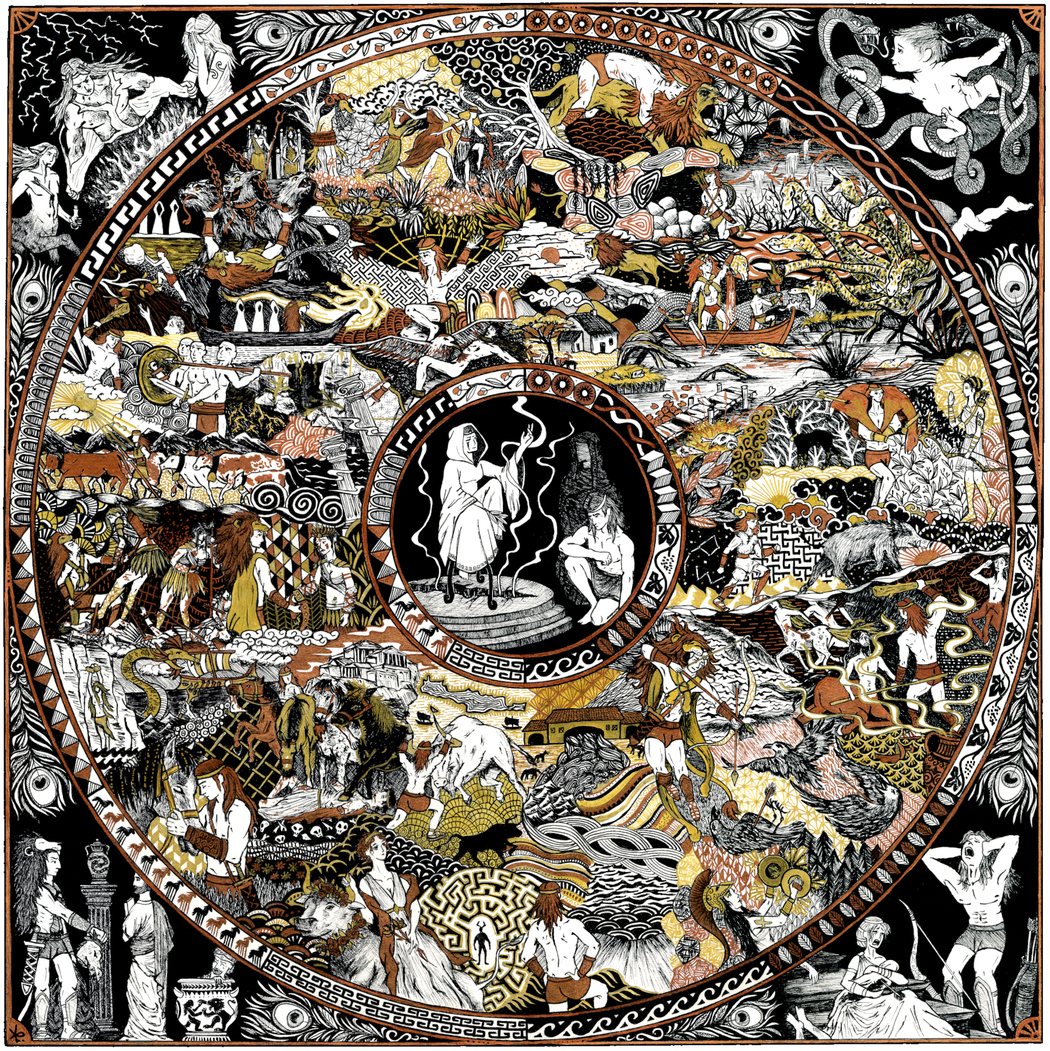 Gaëlle Compozia | In The Name Of Glory | 2023
You balance your artistic practice with a part-time salaried job, which you describe as a way to preserve artistic freedom. How does this balance influence your relationship with time, pressure, and creativity?
I’d lie if I said it’s easy. Keeping a balance between a salaried job and artwork is a daily battle, even if it’s a part-time job. Sometimes I am too tired to draw when I come home from my job as a social worker. Sometimes it steals all my energy. Yet art is my decompression chamber, my safety valve, my refuge from the disruptions of the world. Art is where I feel free. It is where I can set my own rules, my own limits, my own goals, my own pace—not the rules, goals, and pace required by a boss or a customer. It is where I take back control of my life. When I find a privileged moment for art, time and pressure disappear for a while. I feel safe, like in a cocoon. Drawing liberates my overflowing emotions and resets my mind. My part-time job fills my fridge and my bank account, while art fills my heart and my soul. Soon, my heart and soul will also be filled with the love of a child…
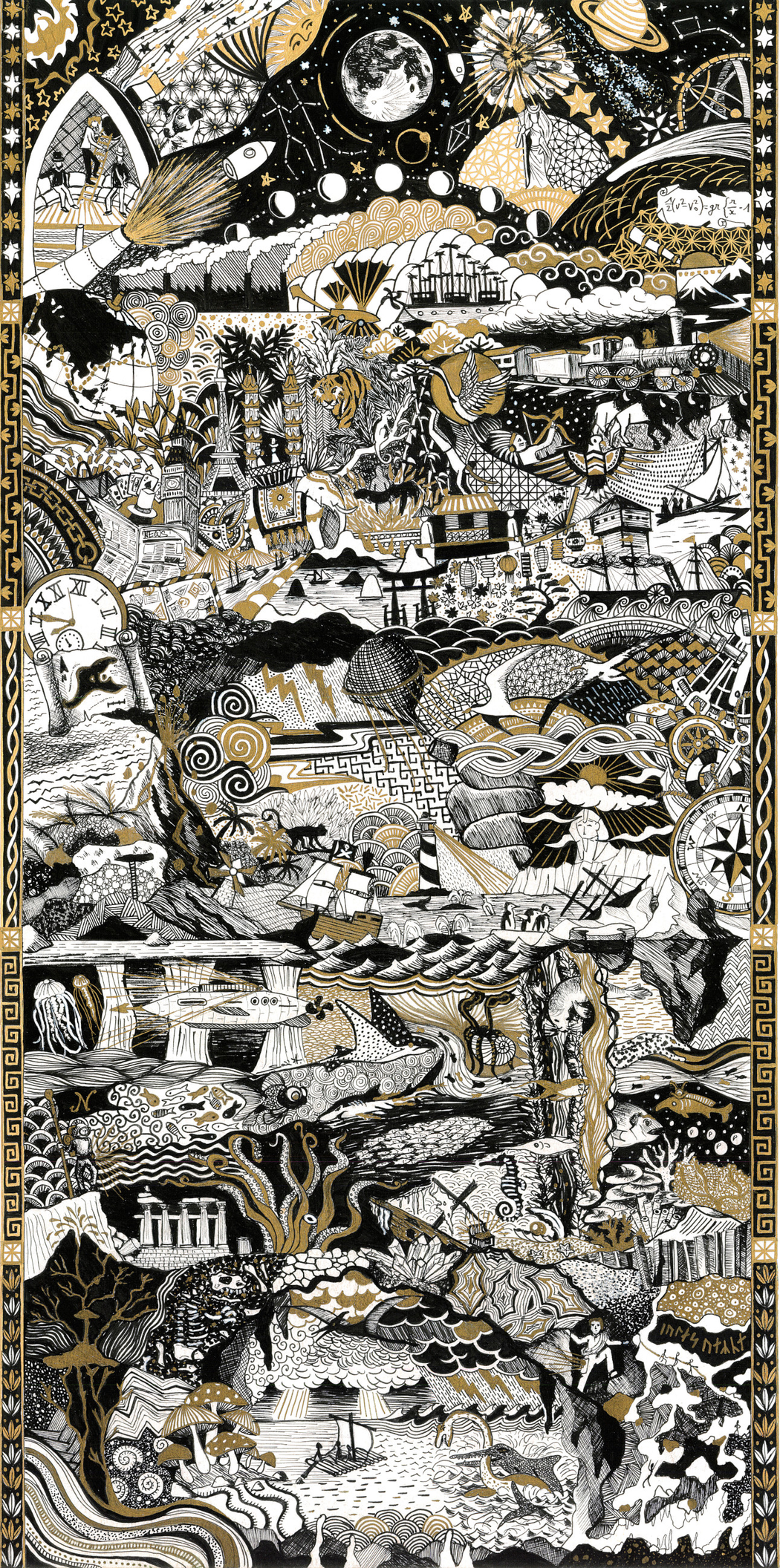 Gaëlle Compozia | To The Very Ends Of The Earth | 2019
As you are entering a new chapter of life by becoming a mother, do you feel this transition is already influencing your artistic vision or inner imagery?
I think so. Before this child I am carrying successfully, I had to endure several miscarriages. These sad events led me into deep reflections on motherhood, femininity, and life and death—reflections that found their way into my artwork. Recently, I made an illustration about Egyptian deities related to motherhood and another one about Osiris, the Egyptian god of death. Behind my blue birds artwork, designed in degraded shades of blue, there is a hidden but strong aspiration for calmness. My illustration of The Little Prince was also influenced by what I was going through. I felt so sad, so lonely. The Little Prince, written by Saint-Exupéry, is a tale about sadness and loneliness, and it resonated deeply within me. This book shook me to my core. That’s why I had to draw The Little Prince—to express and expel my sorrow. Right now, I’m working on a portrait of the Japanese goddess Izanami, and it is no coincidence. I could say a lot about this myth and this new artwork, but it would be too long, so I will simply say that art helps me overcome hard times and rise again after a fall on the road of life.
Leave a Reply
You must be logged in to post a comment.