
Qintong Yu
Qintong Yu: Quiet Growth and the Persistence of the Self
By Tabitha Ysart Green
From 28th September to 2nd October 2026, artist Qintong Yu’s Quiet Growth was presented at Fitzrovia Gallery, London. The exhibition, supported by London Art Collective, is Yu’s first solo exhibition in the UK, and explores personal growth, societal pressure, and internal change.
In the exhibited works Yu explores this theme by visualising slow, often imperceptible internal change, translating it into an external force which disjoints and shatters, as well as making the human body the site of germination. Instead of offering a linear narrative of personal growth, Yu provides a multiperspectival approach on the theme, creating multiple representations through which a broad spectrum of viewers may relate to the core theme of growth. Though there is no set route for viewing the artworks, there is a spectrum of abstraction and thematic development which can be followed.
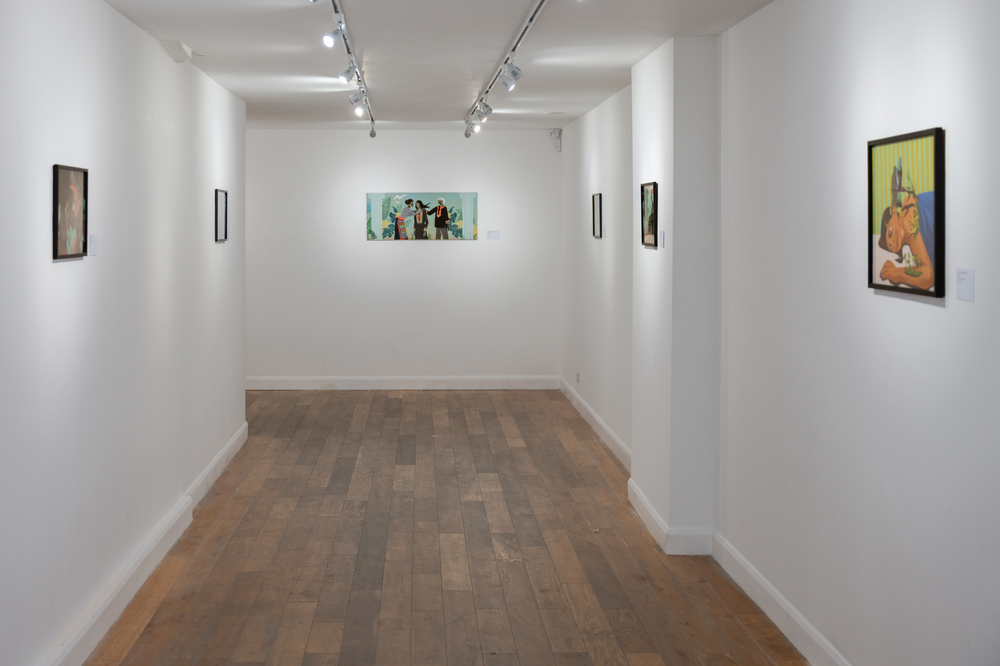
Exhibition view from “Quiet Growth”, Image courtesy of the artist.
A Matriarchal Weave, the least abstracted piece, connects individual experience with female family and cultural heritage by presenting three generations of women within a family, exploring how intergenerational memory becomes part of the self. In Veil of Becoming, Yu simplifies her style to core forms and the interplay of a small colour palette, allowing the bright greens of a mask and muted grays of the self to present the struggle between the external and the internal persona. Through these two works Yu lays the foundation of her study, presenting both the anxieties associated with inherited identity, as well as the mind as a site of personal turmoil. Yu then dips into the world of surrealism in The Silent Germination, which depicts the body as a site where plants and birds emerge as metaphorical forms of growth. Here the exhibition shifts from establishing the conditions of change, to exploring change itself.
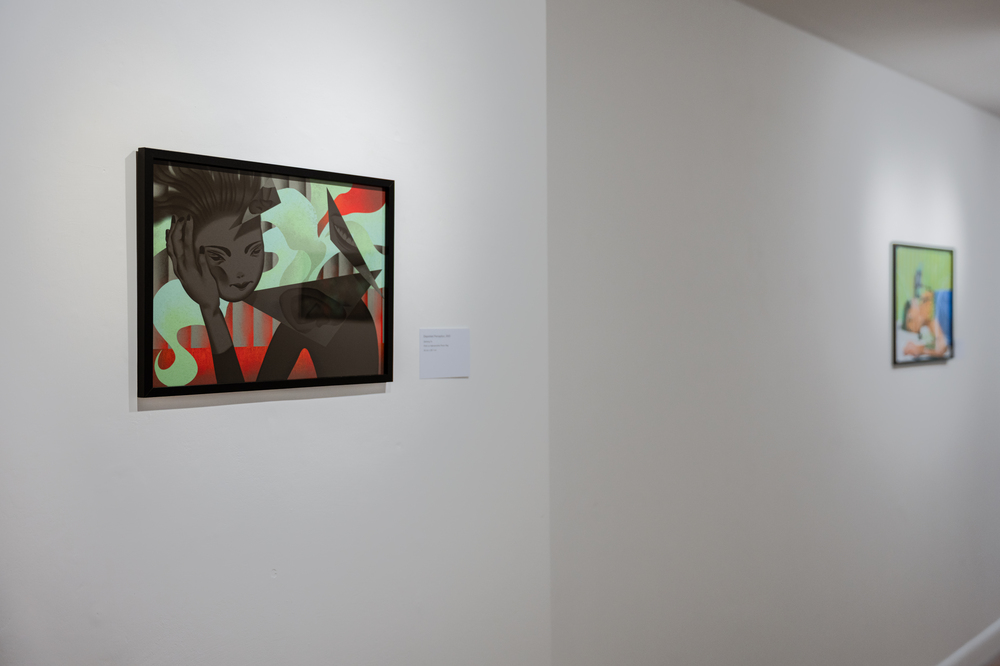
Exhibition view from “Quiet Growth”, Image courtesy of the artist.
The exhibition reaches its visual and thematic climax in a trio of works: Disjointed Perception, Layers of Self, and Splintered Remains. These works appear as a series, sharing visual motifs and a cohesive yet jarring colour palette of greys, teals and reds. Disjointed Perception presents an alternate representation of the themes explored in Veil of Becoming, the dissonance between internal reality and external expectations. Focusing on the senses as a site of tension, Yu explores the splintering effect of attempting to pay attention to both the internal and the external, while continuing to perform. Layers of Self develops this internal dialogue further, presenting the two ‘selves’ as distinct yet interconnected presences. Their interaction suggests an understanding of identity in which concurrent versions of the self coexist instead of resolving into a singular identity. Finally, Splintered Remains presents the most chaotic composition of the trio, layering angular shards over multiple faces and wispy, abstract forms. Through the repeated motif of overlapping, mask-like faces, the work suggests that past identities persist in fragmented and altered forms, maintained as caricatures in the mind, and remaining part of the foundation of our present selves rather than being entirely left behind.
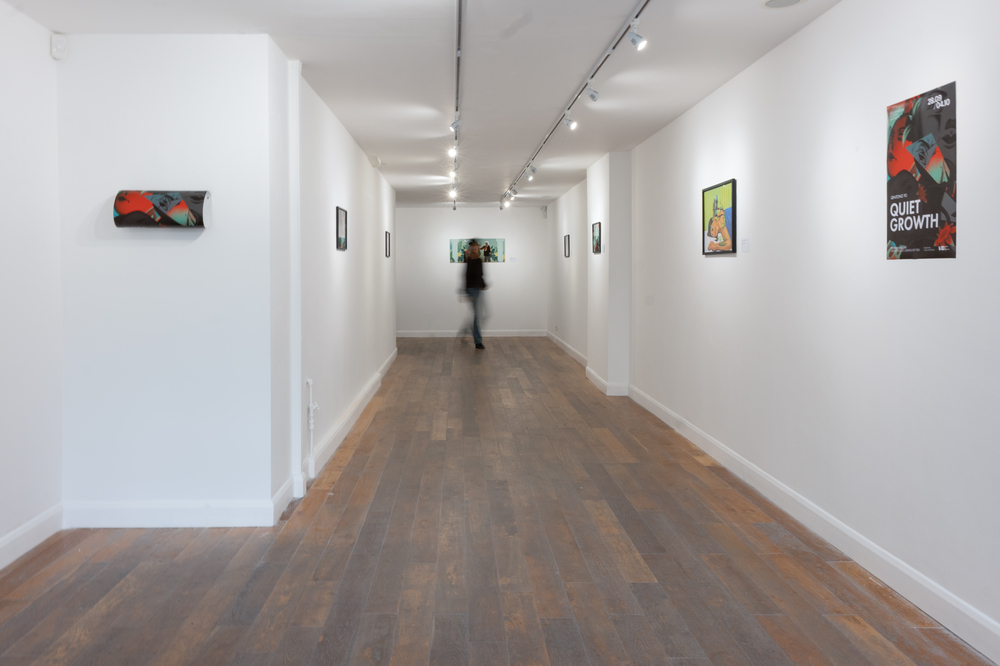
Exhibition view from “Quiet Growth”, Image courtesy of the artist.
Quiet Growth presents a visual exploration of the tensions and personal conflicts inherent in the continual process of personal growth. Through her works, Yu traces the forces that shape and reshape identity, from inherited memory and external expectations to the transformation of the self and the persistence of past identities. The development of subject matter and style suggests a possible route through the exhibition, while the use of abstraction leaves space for individual interpretation and reflection. In doing so, Yu presents growth as a shared human experience and a deeply personal process, one in which change does not necessarily erase the past, but carries it forward into the present.