
Oreofe Oguntola
Your practice spans writing, research, performance, film, visual art and cultural programming. What unites these different forms of expression, and how do you decide which medium best serves a particular idea?
I do not regard my practice as a collection of separate disciplines; I understand it as one intellectual and artistic inquiry expressed through different forms. Writing, research, performance, photography, film, visual art and cultural programming are all extensions of my engagement with memory, identity, spirituality, culture, human existence and the transmission of knowledge. I am particularly interested in what happens when knowledge preserved within a community, family, ritual, oral tradition or cultural practice is translated into a contemporary artistic language. The idea always precedes the medium, and the medium is determined by what the idea requires.
Sometimes an idea demands language because writing allows me to interrogate thought and enter the psychological interior of an audience. At other times, it requires the body because embodiment communicates dimensions of experience that language cannot adequately contain. Photography allows me to preserve a moment and construct visual memory, while film gives me the capacity to develop narrative, movement and atmosphere. Cultural programming allows the work to move beyond the individual artist and become participatory, communal and educational.
My background in English Literature and my experience in research have given me a strong foundation in language, critical inquiry and narrative construction, while my work in festivals and cultural programming has taught me that culture is not an abstract concept confined to museums or academic institutions. It exists in people, ceremonies, clothing, music, food, language, spirituality, communities and collective memory. Across all my disciplines, I am concerned with the movement of knowledge from one generation to another. I therefore do not ask myself whether I am being a writer, filmmaker, performance artist or cultural programmer; I ask what the work needs to become in order to communicate its meaning most powerfully.
You are widely known as the “Cowry God”. How did cowries become central to your artistic identity, and what cultural and personal meanings do they hold for you?
The cowry became central to my practice because I recognised that it was never merely a shell or decorative object. Across African societies, cowries have functioned as currency, ornament, spiritual material, adornment and markers of wealth and exchange. Within Yoruba cultural imagination, they also carry symbolic and spiritual associations that extend far beyond their physical form. I became fascinated by what these small objects had witnessed: transactions, ceremonies, bodies, generations, migrations and changing systems of value. My practice therefore approaches the cowry as both material and archive.
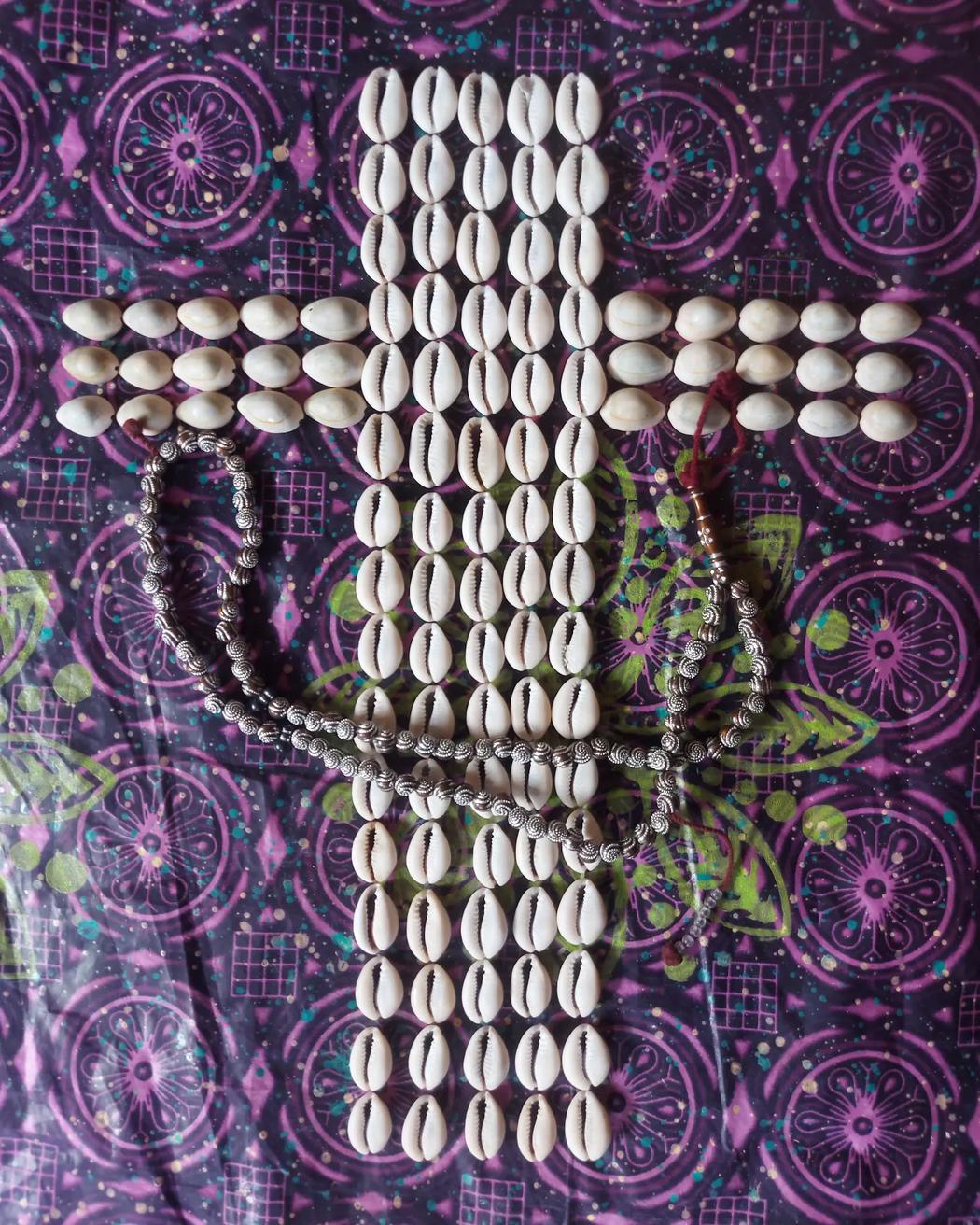
The name “Cowry God” emerged from this sustained engagement. I was not simply decorating objects with cowries; I was reconstructing them, researching their histories and using them to initiate contemporary conversations about identity, spirituality, gender, religion, beauty, power and African history. My work Religious Tolerance, for example, brings together symbols associated with Christianity, Islam and indigenous African spirituality to examine coexistence, faith and religious violence. The work was prompted by the killing of Deborah Samuel in Nigeria 2022, over an accusation of blasphemy. Her death among many others who had died because of religion in my community raised my concern about the extent to which religious difference can be weaponised against human life.
There is also an important personal dimension to my relationship with the cowry. I have always been drawn to materials that people underestimate. A single cowry may appear insignificant, but thousands of them can become architecture, sculpture, costume, image and language. That transformation mirrors my understanding of African cultural heritage: what appears small or ordinary can contain enormous historical and intellectual significance. I therefore use cowries not merely to produce beautiful objects, but to provoke questions about what they remember, who used them, what they represented and what they can mean in the present.
 Oreofe Oguntola | After You Left (Book Cover)
In Arùgbà Olókun, a young girl carries an offering to Olókun and represents purity within Yoruba ritual imagination. What inspired you to revisit this figure through contemporary photography and performance?
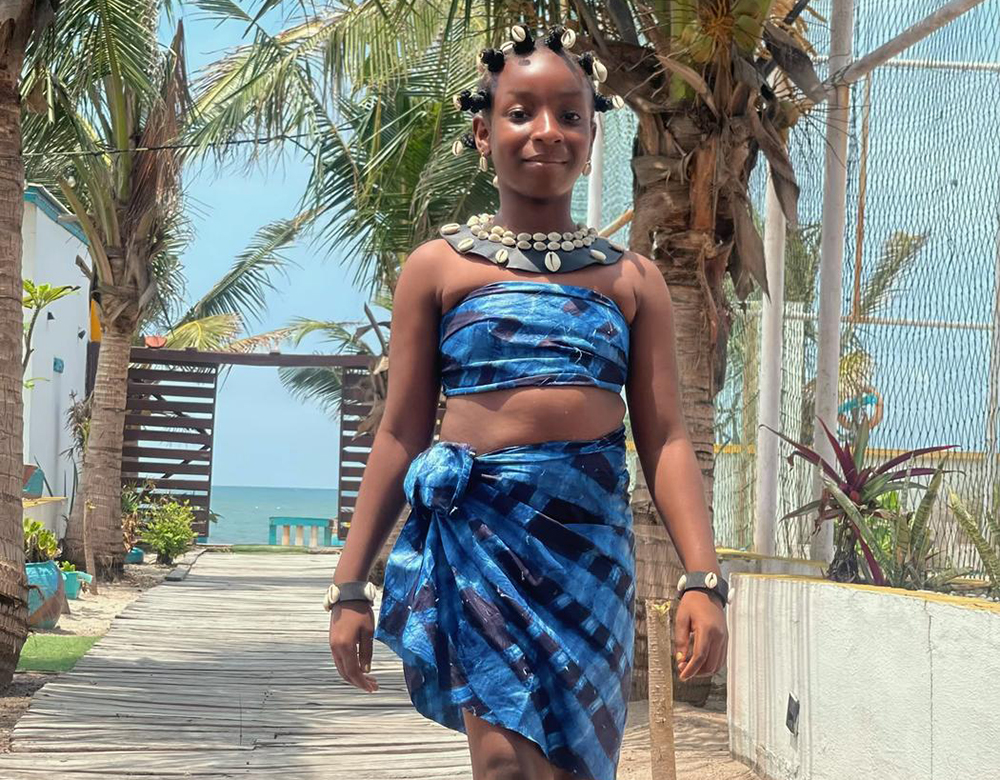
Before anything else, I must introduce the young girl in the image, Michelle Masha, a ten year old Nigerian-based model and one of the young virgin maidens chosen to serve as the Arùgbà of Olókun. The Arùgbà occupies a significant ceremonial position, representing purity, devotion and the ritual presence of Olókun during the festival. My engagement with this figure comes directly from my work as the festival coordinator of the Olokun Festival, where I am deeply involved in the cultural presentation, visual direction and ceremonial processes surrounding the celebration.
Arùgbà Olókun emerged from my desire to translate a living cultural practice into contemporary visual language without stripping it of its meaning. The Arùgbà is not simply a young girl dressed beautifully and carrying an offering; within the ritual imagination, she becomes a symbolic vessel through which ideas of devotion, purity, responsibility and cultural continuity are expressed. I also dress and adorn the Maidens of Olókun, and that aspect of my practice has taught me to understand costume and adornment as forms of cultural language. Every material, colour, arrangement and object placed upon the body contributes to the meaning of the image.
Olókun, associated with the depths of the ocean, wealth and abundance, provides an important conceptual framework for the work, particularly through the symbolism of water as a site of mystery, continuity, transformation and life. The cowries become almost a second skin, extending the body and connecting the individual to a larger cultural vocabulary. The resulting image is therefore not an attempt to reproduce a nostalgic idea of “traditional Africa”; it is a contemporary intervention into a living tradition. The work demonstrates that indigenous knowledge can remain culturally rooted while participating fully in contemporary photography and performance.
How do you approach ideas of purity, femininity and cultural responsibility in Arùgbà Olókun without allowing the subject to become fixed within traditional expectations?
I approach these concepts critically because culture should not become a cage. The idea of a young unmarried woman representing purity can easily be reduced to questions of sexuality, virginity and obedience, but my understanding of purity is considerably broader. It encompasses intention, responsibility, clarity, devotion and the preservation of something considered culturally significant. The Arùgbà is therefore not presented as an object without agency; she occupies a role whose meaning extends beyond the individual.
My understanding of femininity is similarly rooted in agency rather than submission. Yoruba cultural history contains powerful female figures who have served as custodians, priestesses, leaders, healers, artists, mothers and carriers of knowledge. When I work with the female body, I am interested not simply in its aesthetic qualities but in what it remembers, represents and communicates. The body becomes an archive and an instrument through which cultural knowledge can be examined.
My responsibility as an artist is to engage tradition with both reverence and intellectual courage. I preserve what deserves preservation, but I also interrogate inherited meanings where necessary. Preservation without critical engagement can become stagnation, while questioning without cultural understanding can become erasure. My practice operates between those positions, and my stand remains that culture must evolve; there is no beauty in a stagnant tradition, neither is their space for growth and prosperity in a community that doesn’t tap into new things when it should. Through photography, performance, costume, cowry art and Adìrẹ, I place traditional knowledge within contemporary visual language while retaining its cultural integrity.
 Oreofe Oguntola | Osun
You describe Osun as a “living artwork”. What does this term mean within your practice, and how does embodiment transform the work beyond photographic representation?
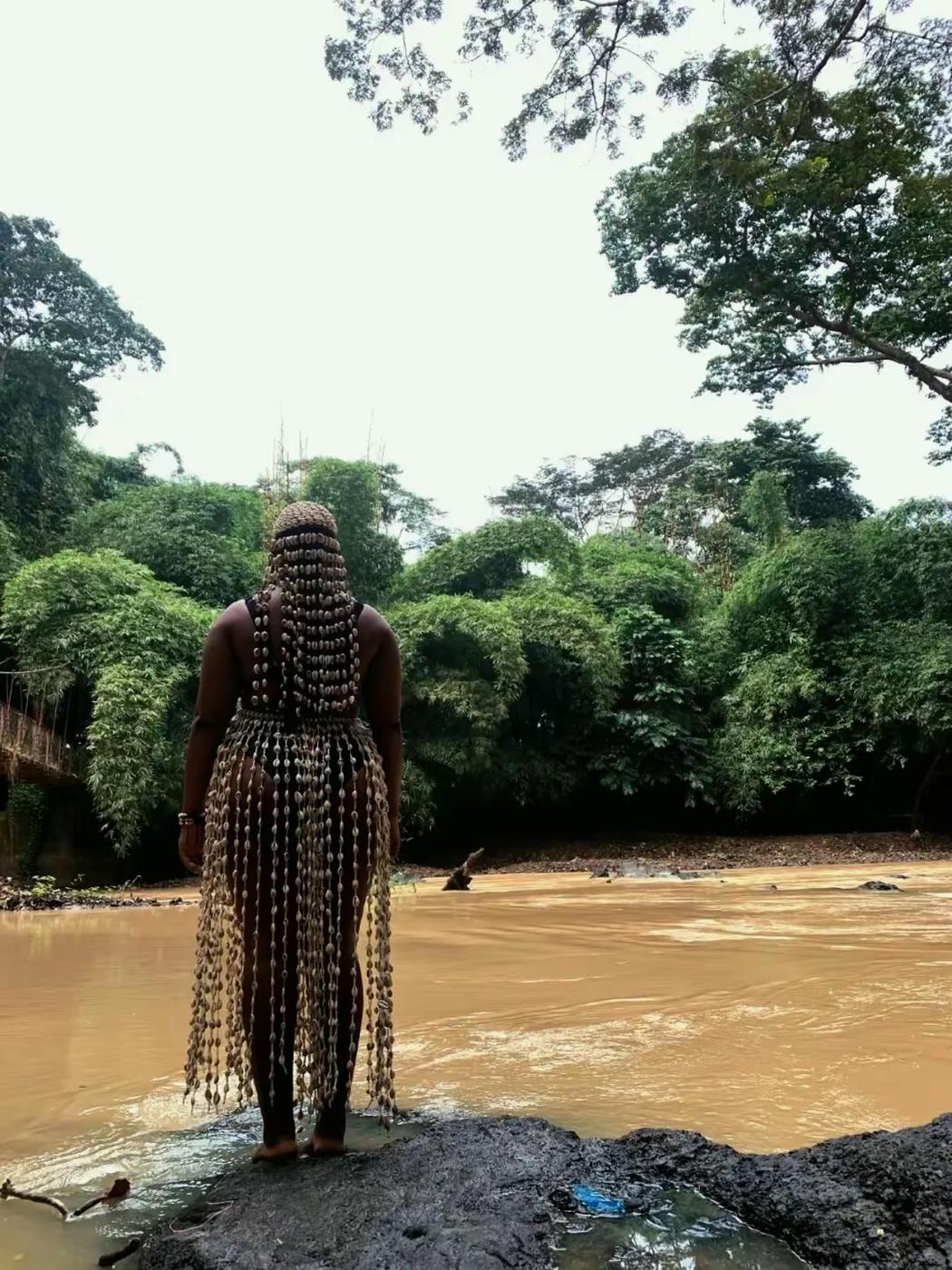
When I describe Osun as a living artwork, I am asserting that the photograph is only one manifestation of the work; the deeper artwork exists through embodiment, movement, environment and performance. Inspired by Osun, the Yoruba Òrìṣà associated with rivers, femininity, fertility, beauty and healing, the work examines the relationship between the human body, divinity, nature and Yoruba spiritual knowledge. I do not claim to literally become the Òrìṣà; rather, I use my body as a site through which ideas associated with Osun can be contemplated and experienced.
Water, trees, cowry costume, gesture and movement are therefore not background elements. They constitute the vocabulary of the work. The body becomes an instrument, the environment becomes a collaborator and the performance becomes an encounter between human presence and natural space. This is what distinguishes embodiment from photographic representation. A photograph preserves one moment, but performance unfolds through time; the performer breathes, moves and responds to the environment, while the audience brings its own interpretation to the encounter.
This understanding also reflects how I approach culture itself. Culture is not an artefact frozen in the past; it survives because people continue to embody, reinterpret and transmit it. Osun consequently positions Yoruba spirituality within contemporary artistic discourse and creates space for conversations about femininity, healing, beauty, nature and humanity’s relationship with the natural world. The photograph records the moment, but the body carries the memory.
Your memoir After You Left explores bereavement, death and compassionate end-oflife care. In what ways do your experiences of grief and memory also enter your visual and performance-based practice?
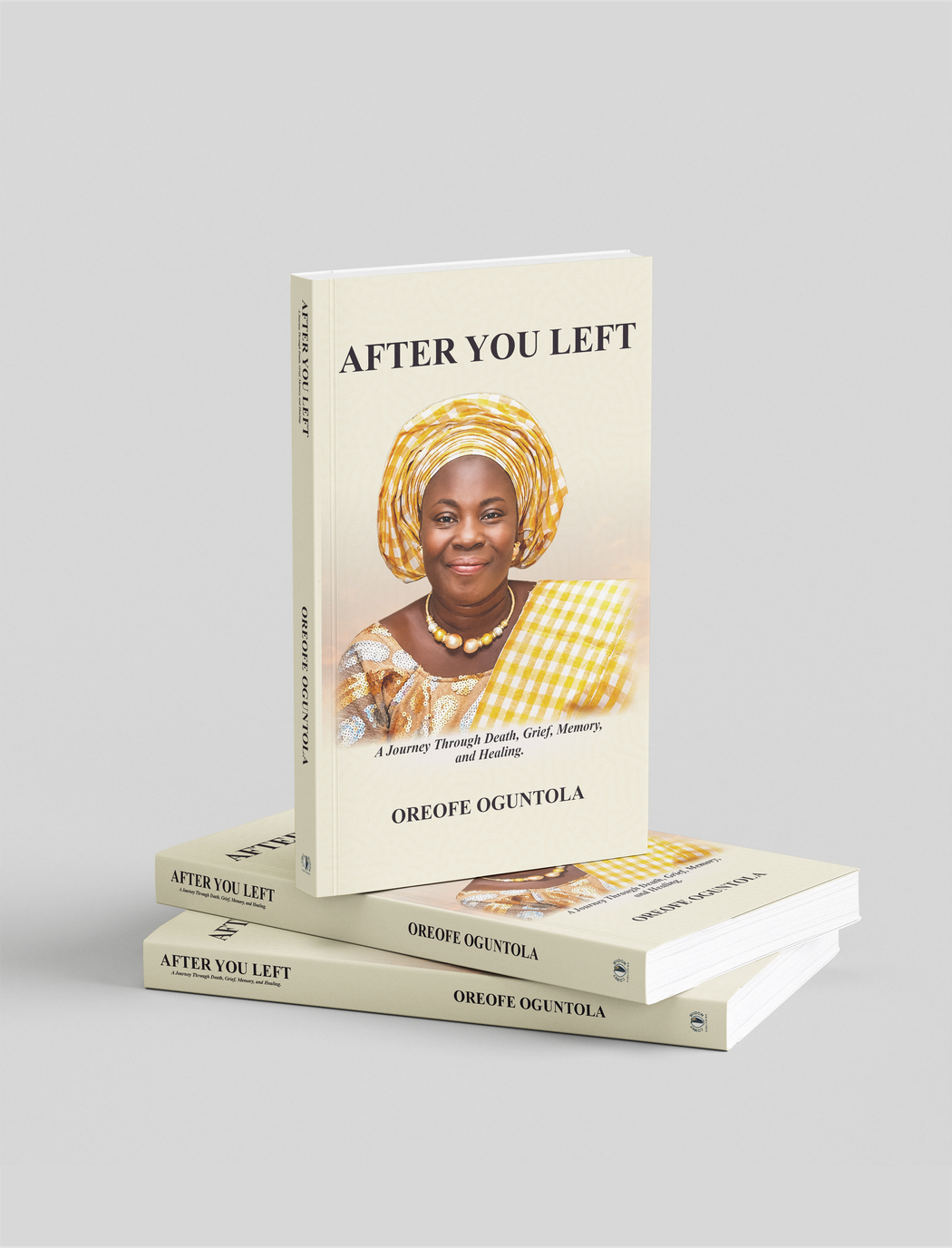
Grief is one of the deepest intellectual and emotional territories from which my practice emerges. Losing both of my parents fundamentally altered my understanding of time, memory, love, the body and human existence. The death of my mother also reopened the experience of losing my father many years earlier, making me confront the peculiar reality of bereavement: you do not simply lose a person; you lose a version of yourself that existed in relation to that person. After You Left emerged from this experience, but it is not simply a memoir about my parents. It examines what happens to the living after death and how people continue carrying relationships with those who are no longer physically present.
The writing led me into extensive engagement with thanatology, bereavement, palliative care, hospice care and the psychological, cultural and spiritual dimensions of dying. My research examines how different societies understand death, mourning, remembrance and continuity, particularly through my own engagement with Nigerian and Yoruba ideas of ancestry and ritual. Research is therefore not separate from my artistic practice; it is one of the principal ways through which I investigate humanity.
These concerns have profoundly shaped my visual and performance work. Grief has taught me that absence can have a physical presence: someone can be absent from a room and still occupy the entire space. I explore that tension through the body, water, objects, photography and performance. Cowries are particularly significant because they can outlive the people who touched, owned or wore them, becoming material witnesses to lives that have disappeared. I also engage directly with grieving communities through grief-focused events and conversations, creating spaces where loss can be acknowledged rather than concealed.
After You Left consequently extends beyond personal testimony into a broader conversation about compassionate end-of-life care and the human experience of loss. I approach death not only as a medical event but as a psychological, cultural and social experience that requires dignity, tenderness and care. The book brings these questions into conversation with literature, psychology, medicine, cultural anthropology and human behaviour, creating a body of work that connects personal memory with wider questions about what survives us, who remembers us and how the living continue after loss.
 Oreofe Oguntola | Religion Tolerance
Through your Cowry Art training programmes, you share indigenous knowledge with schools and communities. What do you hope participants learn beyond the practical craft, and how would you like this educational dimension of your practice to develop?
My Cowry Art training programmes are fundamentally about empowerment. I do not teach people merely how to attach cowries to an object; I teach them how to recognise cultural material as a source of knowledge, creativity and economic value. Through my training initiatives, I have worked with and trained more than 100 participants, particularly young people, introducing them not only to the practical techniques of cowry art but also to the entrepreneurial possibilities within creative practice.
The entrepreneurial component is essential to my teaching. Participants learn how to transform an indigenous material into a viable creative product, develop products, understand value, package their work, present it professionally and recognise the commercial opportunities available within the creative economy. This allows cultural education to become economic empowerment. A participant should leave the training understanding that heritage is not only something to preserve; it can also become a source of livelihood, innovation and enterprise.
I also challenge the false distinction between African culture and contemporary innovation. A cowry can become sculpture, fashion, installation or commercial design; an oral tradition can become film; a festival can become an archive; a ritual costume can become contemporary photography; and an indigenous technique can become an entrepreneurial skill. My educational practice therefore connects cultural history, indigenous creativity, storytelling, contemporary art and enterprise.
The most important outcome is cultural confidence. Participants leave with the understanding that modernity does not require cultural amnesia. They can engage the contemporary world without abandoning where they come from. My work therefore moves beyond preservation towards transmission and empowerment: knowledge moves from one generation to another, while the people receiving that knowledge acquire the confidence and practical skills to create with it, build from it and generate economic value from it.