Emma Oliver
What first drew you to fiber as a sculptural medium, and how did your relationship with the material develop during your studies at Alfred University and Illinois State University?
I was first drawn to fiber as a way to create useful objects for myself and people close to me. Its history is so embedded in craft that it’s hard to get into fiber in any other way. It changed and became an art medium for me at Alfred University when I took a class called How to Be Funny and created a piece representing the sitting president as a clown. The speed in which I can create in the medium has always been an asset and I am able to react faster to what’s in my head than I am in ceramic or other sculptural mediums. At Illinois State, I began to try and push the boundaries of the medium and see how far I could stretch textile and the limitations of my own body. As time went on, I attempted to create larger and larger pieces and pieces where more people were reached by the medium.
Crochet involves building a form through repeated gestures. How does the time spent making a sculpture influence your emotional relationship with it?
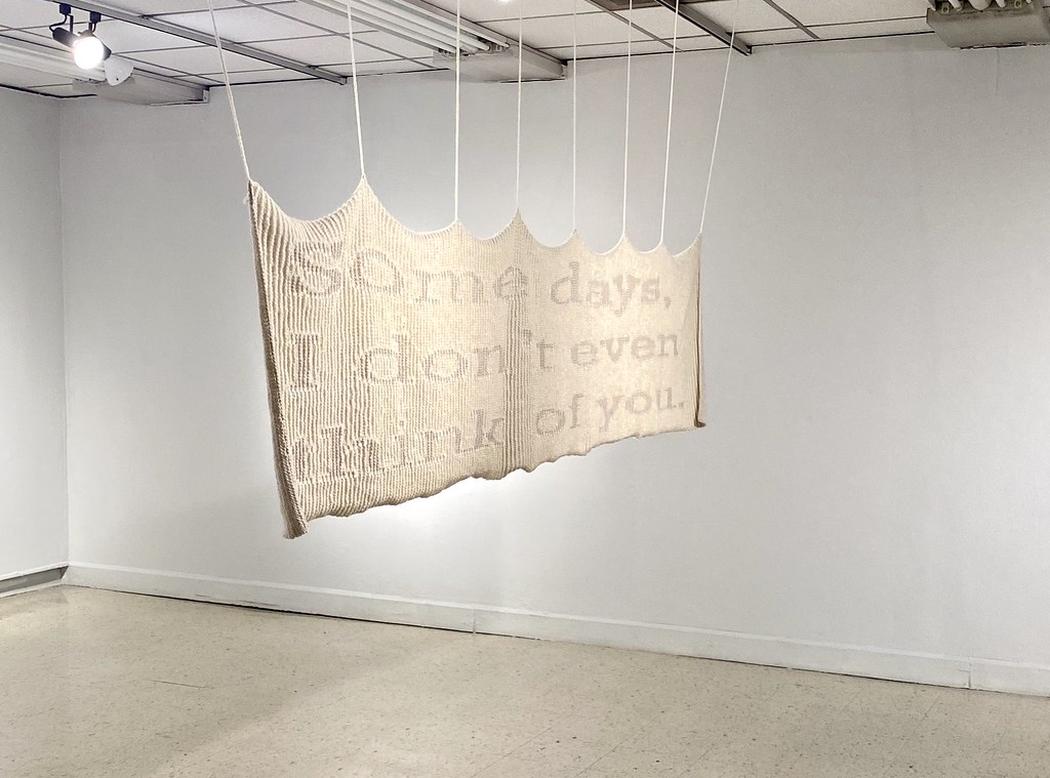
The time I spend making a sculpture is part of the processing of difficult emotions. I, like many artists, make because it’s the way I best express how I’m feeling. I can fully process loss, grief, success, anger, and sadness through the repeated gesture of making a series of stitches. This lets me physically sit in my emotions and makes it apparent that the only way out is through. My emotional relationship with the sculpture changes over time as I work towards the finished result. Originally, my emotions can be as complicated as the work can be in the beginning, but as I get closer to the end it feels like things become clear and uncomplicated.
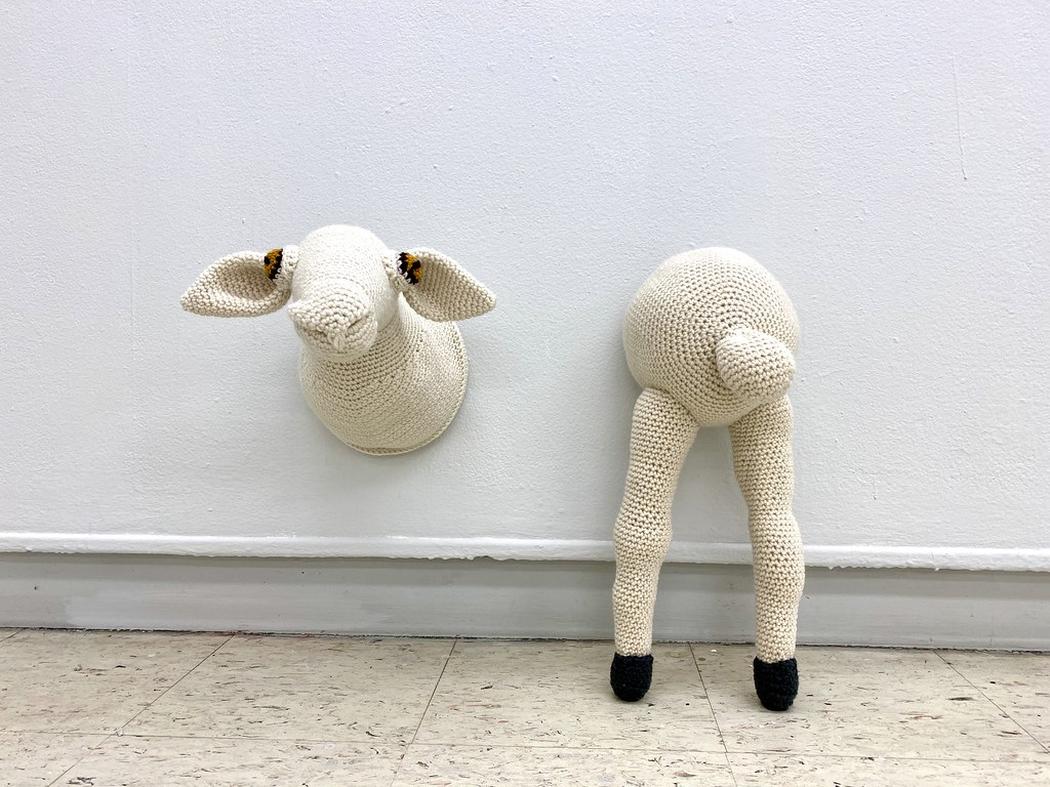
Sheep and rams appear throughout the installation you shared. What drew you to these animals, and what do they allow you to explore about human relationships?
Sheep and rams are frequently herd animals with herd mentality. They flock and stick together as there is protection in numbers. In that work, I was thinking about specific types of sheep (Icelandic sheep) that don’t flock and prefer to be alone or in pairs. I was thinking about how human beings often try to keep groups together that don’t want to be held together any longer, well after the obvious end of a relationship or group relationship. I have definitely been someone who tries to hold onto relationships that no longer exist, and I think it’s an experience that many people have.
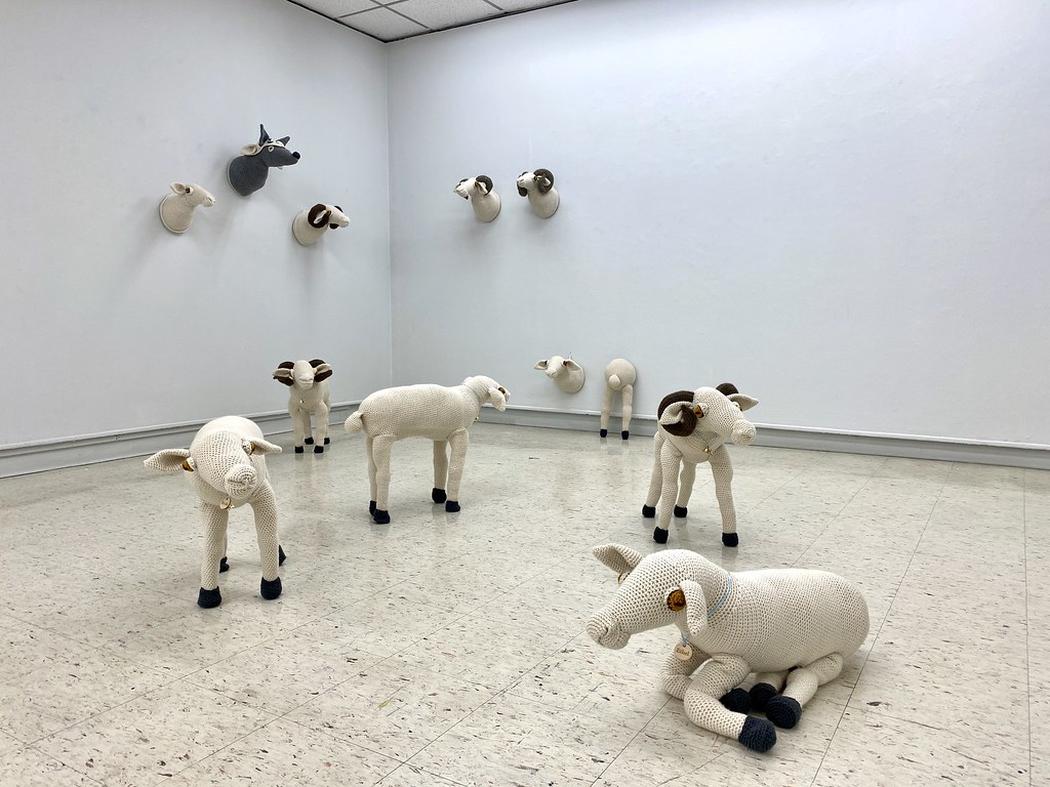
Some of your animal sculptures appear as complete bodies, while others are separated into parts or mounted on the wall like trophies. What interests you about the relationship between wholeness and fragmentation?
The relationship between wholeness and fragmentation is always in my work if you look hard enough. I’m frequently intrigued by the cusp of a beginning or end of an event or relationship, so having a very concrete division or intersection scratches an internal itch for me. It suggests control of a reality that isn’t always possible.
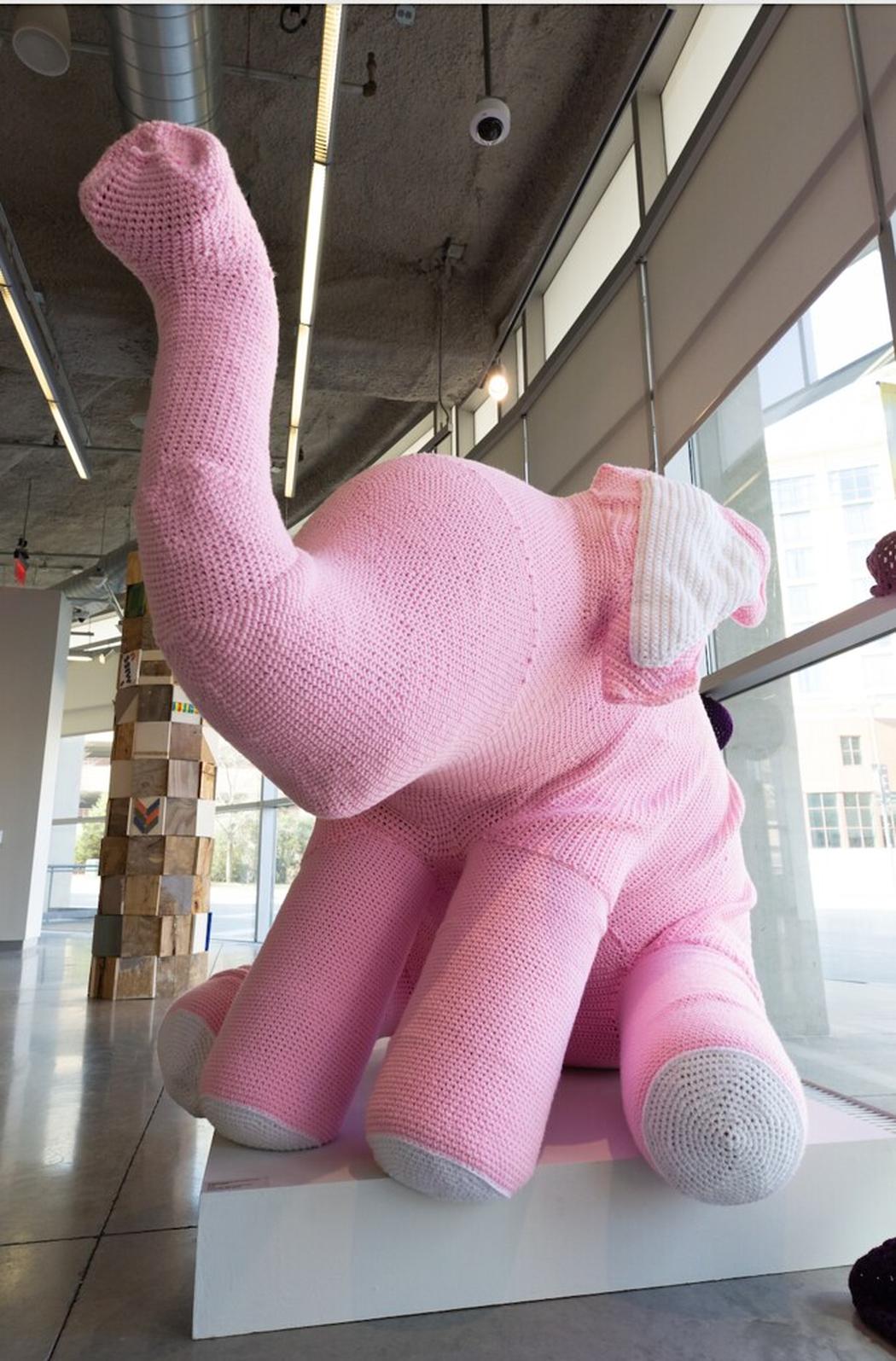
Your large pink elephant combines the familiarity of a soft toy with a striking physical presence. How did you arrive at its scale and color, and what kind of encounter did you want to create for the viewer?
“Pink Elephant” needed to feel both large and small simultaneously. He has to loom over the viewer while still feeling cuddly and accessible. The concept behind that work is that he is the elephant in the room, and a pink elephant (drunken hallucination) all rolled into one. It made me wonder if the anxieties many of us feel become real when we give them space to exist, and without that space would it be easier to quell those feelings?
Could you walk us through the development of one sculpture, particularly a moment when the material led you somewhere you had not originally intended?
I think the sculpture with the most interesting journey is Balloon Sweaters which can be found on my website (www.emmaoliverart.com). Balloon Sweaters are 77 crochet pieces around 77 latex balloons containing the breath of words unspoken. The balloons are protected from popping, which in this metaphor allows the words to remain unmade but does not prevent the balloons from deflating, which of course allows the air to escape. The thinking behind the work is that you can avoid things at the start, but time always runs out and communication must happen. Is it easier to pop the balloon and get it over with? Or would you prefer the elongated process of deflation? At the start of this work, I truly had no idea why I was making this series. It took me 77 balloons to figure it out, which for me as we previously discussed is just sitting and crocheting. It’s interesting how that emotional processing ultimately became directly related to the piece.
Alongside your studio practice, you teach and help students find paid creative work. How do these conversations about building a life as an artist influence your own understanding of artistic success?
I am an Assistant Professor at Montserrat College of Art on the North Shore of Massachusetts as well as the Director of Creative Employment. In my dual role I am frequently met with the Venn Diagram of my own creative practice and the creative and professional practices of students. My roles at Montserrat have broadened my perspective on what success looks like. I think many student experiences in art school give us limited ideas of success and for many it means existing in a little studio, painting the day away, selling work, and somehow affording health care and life expenses. That is just not the reality of the vast majority of creatives and it is a dated view on what being in the creative economy means. I now realize that life is interdisciplinary and realizing that variation in experience can only support your career success later. Putting ourselves into the boxes of our art college major limits us and distracts us from the goal which is usually to make meaningful, purposeful creative work.