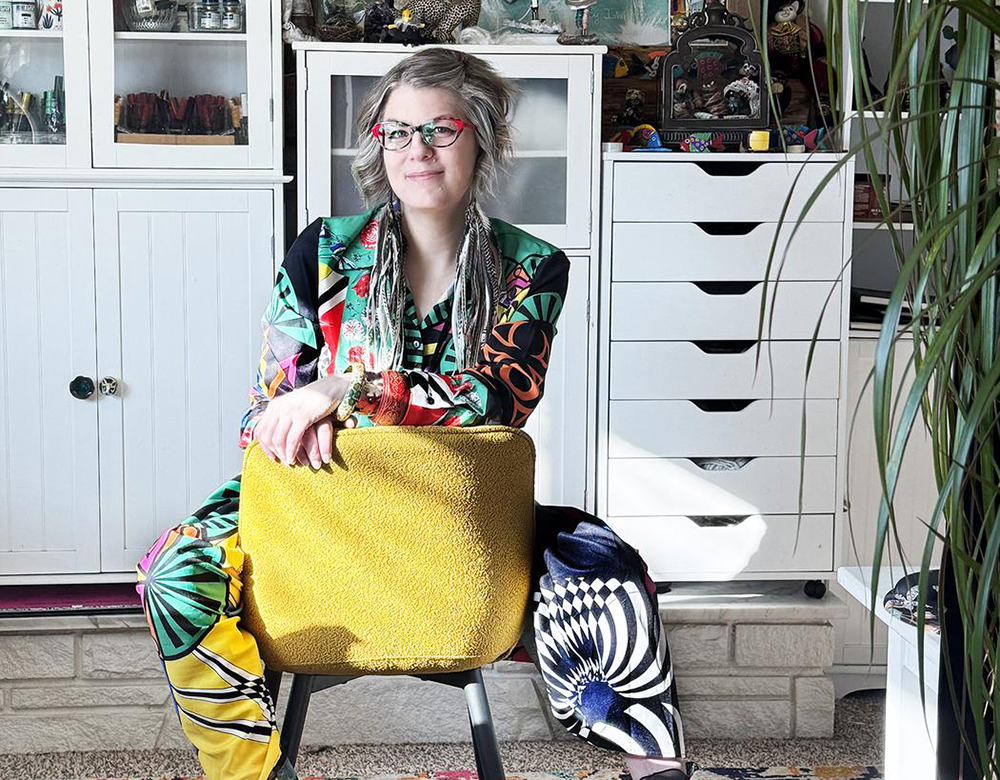
Aunia Kahn
You describe yourself as the originator of “Contemporary Symbolist Folk”. How did this visual language emerge, and which principles distinguish it from traditional folk art or contemporary Symbolism?
Contemporary Symbolist Folk breaks down into three parts, and each one means something specific in how I work. The “contemporary” part is important because it separates what I do from traditional folk art. I’m not working within an inherited cultural practice passed down through community and craft; I’m authoring my own symbols as a working artist today, choosing and layering them myself rather than continuing a tradition someone handed to me. However, I am still pulling from my own culture; it’s just filtered through my own invented symbolism rather than reproduced as it was passed down to me.
And the “symbolist” part is what that visual language is doing underneath the surface. It’s dreamlike and mythic rather than literal; I’m not illustrating a scene. I’m building a world where each element, a bird, a border pattern, a threshold between two worlds, carries its own weight of meaning. Birds represent freedom because I spent so much of my life housebound. Borders and thresholds represent the movement between worlds, safety and exposure, the seen and the hidden. Together, the folk vocabulary and the symbolist meaning let me build images that feel both familiar, like folklore, and deeply personal, like a dream.
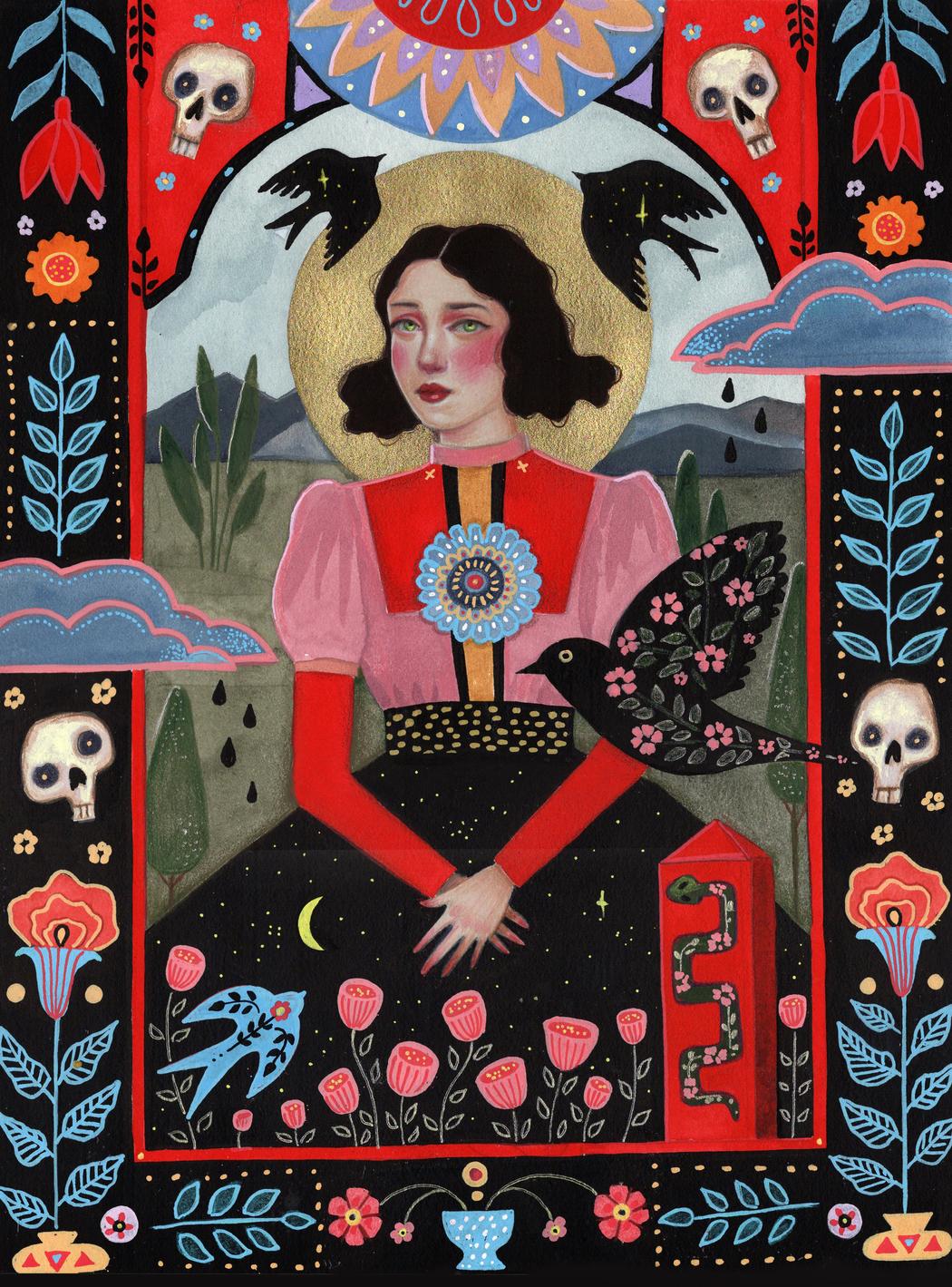 Aunia Kahn | Beloved Ghosts In The Sanctuary Of Memory
Your practice draws upon French Canadian, German, Polish, and Scandinavian folk traditions. How do you bring these different cultural lineages together while maintaining a visual language that remains distinctly your own?
It is bizarre, I never really tried. It was more about me being open to explore my roots for the first time. I avoided even talking about or acknowledging my roots due to a pretty intensely volatile childhood. I tried to remove myself from pretty much anything and everyone so I could heal. But in the years of stability, I realized that your family roots are a part of who you are, like your genetics. There is nothing you can do to change that, but what you can do is own it and then build your own version of what that means. Take the good from it all, even if it is just as small as a little seed, because if you nurture that seed, it will grow, and you will grow. With being able to explore culture and heritage,I just placed everything I loved into my work and hoped for the best. There was no plan, no vision, no end game, just me being a wild alchemist of devotion, throwing in everything I loved without knowing what it would become. I knew I was having fun doing it. Whether it would turn out good, no one knew!
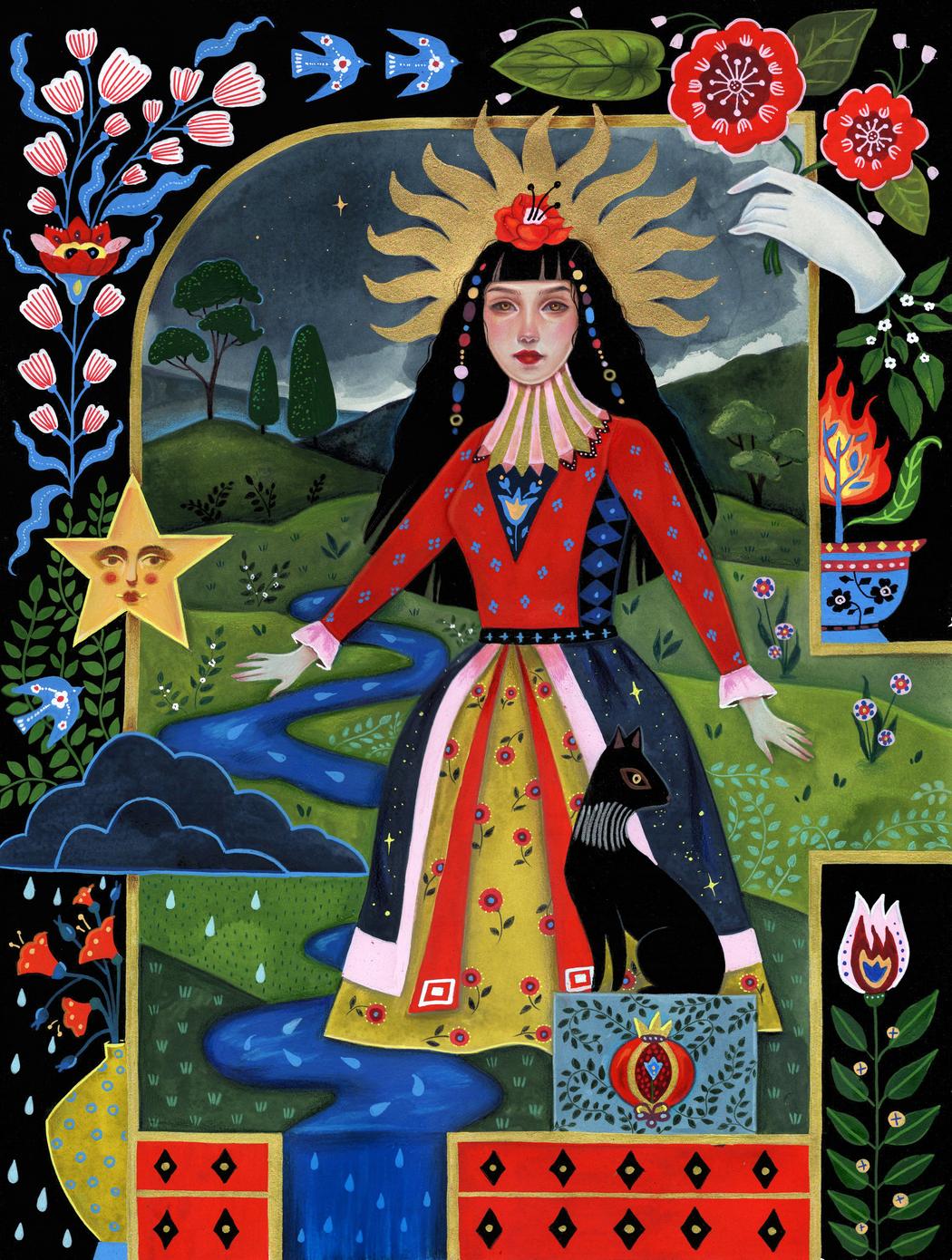 Aunia Kahn | Everything Starved Of Air Came Back Breathing Fire Large
Having lived through years of life-threatening illness, you describe the threshold between life and death as personal terrain. How has this experience changed the way you understand the body, vulnerability, and transformation in your art?
Since I still live with these illnesses, every day is a new experience with the world, my body, art, and vulnerability. I think after 20 years of having no answers, and people telling me I was crazy, that was not helpful. I went as far as signing myself into a psychiatric hospital, willing to accept that everyone around me was right. I was evaluated and told I was stable and solid mentally, but they needed to find out what was wrong with my body. Those years really impacted the way I understood every part of my person, from my practice to how I see the world. I was the only one who believed me, which was understandable after years of doctors saying there was nothing wrong with me.
Once I got a diagnosis and medications only a few short years ago, it brought about a sense of stability, one that can still be very fleeting and unpredictable, like a ticking time bomb. It really changed the way I see each moment. I think those who haven’t had a near-death experience will have a hard time understanding this, and those of us who have, even more than once, will also have a hard time explaining it. There is something almost spiritual, sacred, and pure that comes from knowing you are still alive. It’s a surreal experience.
When I started getting gray hair a few years ago, unlike a woman who might feel uncomfortable about it (and that is her right to feel that way), for me it was “holy moly, I am still here.” I did not think I would make it this long. So each day is a gift, and doing an interview like this, to talk about it, is also a big gift.
The women in your paintings often appear calm and frontal, resembling saints, guardians, or figures from devotional icons. Do you see them as autobiographical presences, universal archetypes, or inhabitants of an evolving personal mythology?
This is a great question. I think I have always seen myself in my work. Never while making it, but after, things come to me and make a lot of sense. It’s very much like a personal narrative, like a visual journal. For example, the women where the heads are separate from their bodies, I really had no idea what they were about when I made them, but once the piece was done and I did a few others, I spent some time with the work and realized it was so symbolic and reflective of my life.
Part of my disease is a connective tissue disorder, and it makes my neck weak because the human head is so heavy (maybe it’s my big brain, just kidding), kind of like Gumby. Laughing about it makes it a bit easier. I have a very hard time keeping it held up without the support of my hand or leaning on something, and have struggled with my head and neck so much that I cut off all my hair with studio scissors just a few months ago, impulsively, because I could not take it anymore. So yes, my work really is autobiographical, in ways that even a year later I still discover, how my life, experience, feelings, relationships, all show up in older pieces.
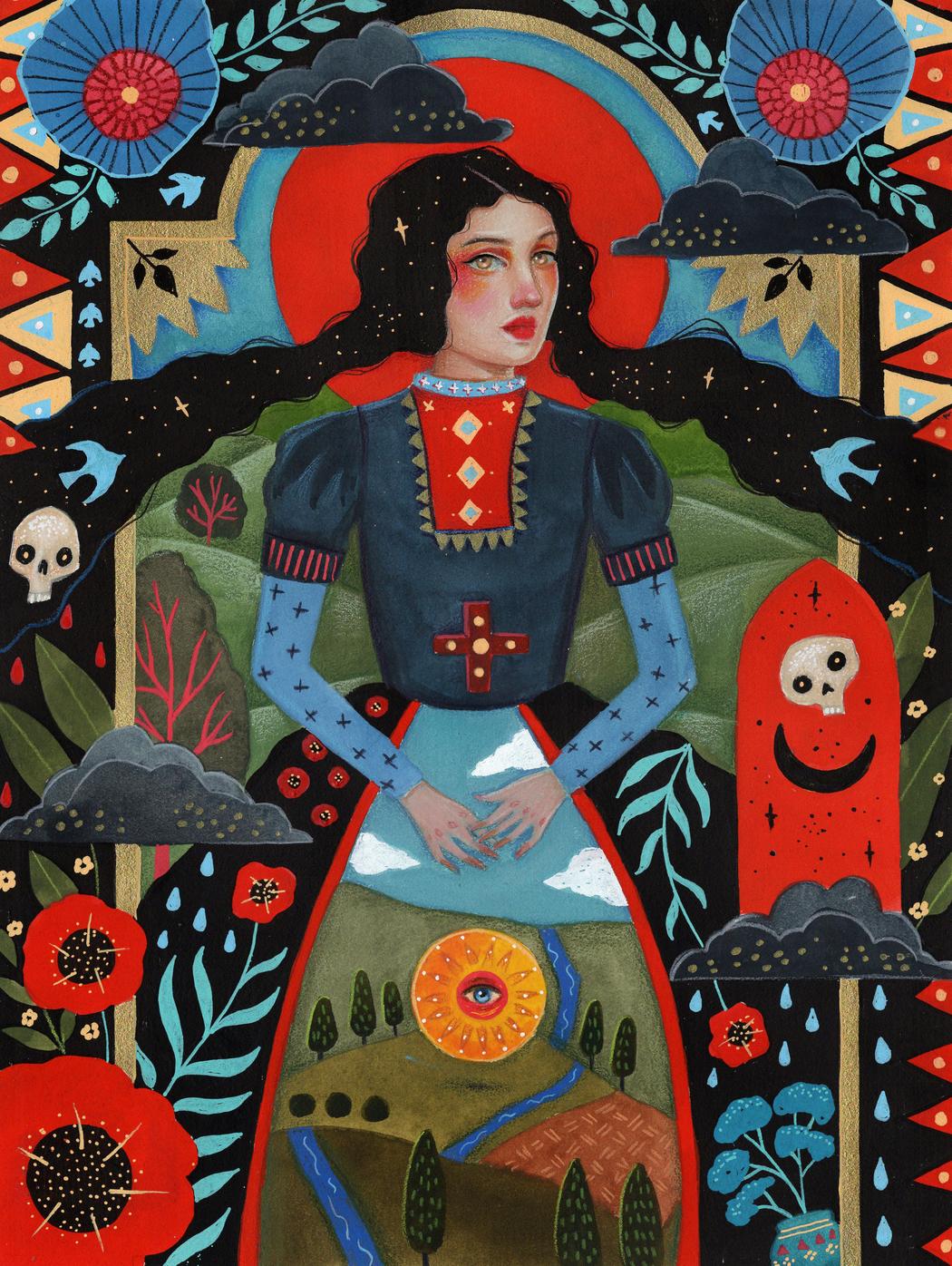 Aunia Kahn | We Holds Every Goodbye In Our Body Like A Landscape
Birds, snakes, cats, swans, flowers, skulls, eyes, and anatomical hearts recur throughout your work. Do these elements have fixed meanings within your symbolic vocabulary, or does their significance change from one painting to another?
More than anything, I do feel that a lot of the symbolism I use often carries the same sentiment. For example, I am obsessed with birds, maybe a little too much. I try to have them in every painting. Being locked in and housebound for so many years, birds are the feeling of freedom for me. I am obsessed with all types of birds, I love animals overall, and for me they represent friendship, a sense of safety, a non-judgmental being. The red thread, or rich red, that I use in my work used to be a color I avoided due to all the medical emergencies and ambulance rise. I avoided red everything. However, becoming stable, it has crept into my work as a life force, the same with hearts. My heart has been a long-time issue for me since I was in my 20s, and I always feared that as well. So bringing the heart into the work, in the color red, metaphorically and obviously with hearts, is a way for me to really face that fear and mortality we all have, and a way to stop running away from the things that scare me.
Your compositions combine highly modeled faces with flatter decorative fields, dense ornamentation, and saturated color. How do you build these visual layers, and how do gouache, acrylic, colored pencil, and dimensional materials contribute differently to the final image?
Most of my work is gouache as the main layer, with the other mediums that come into the stage after that laid down. Then, with any 3D elements, which are often hand-painted collage elements, I add them on at the end. It is fun, almost an Easter egg in the piece, since I don’t typically do but a couple pieces in each work when I choose to do so.
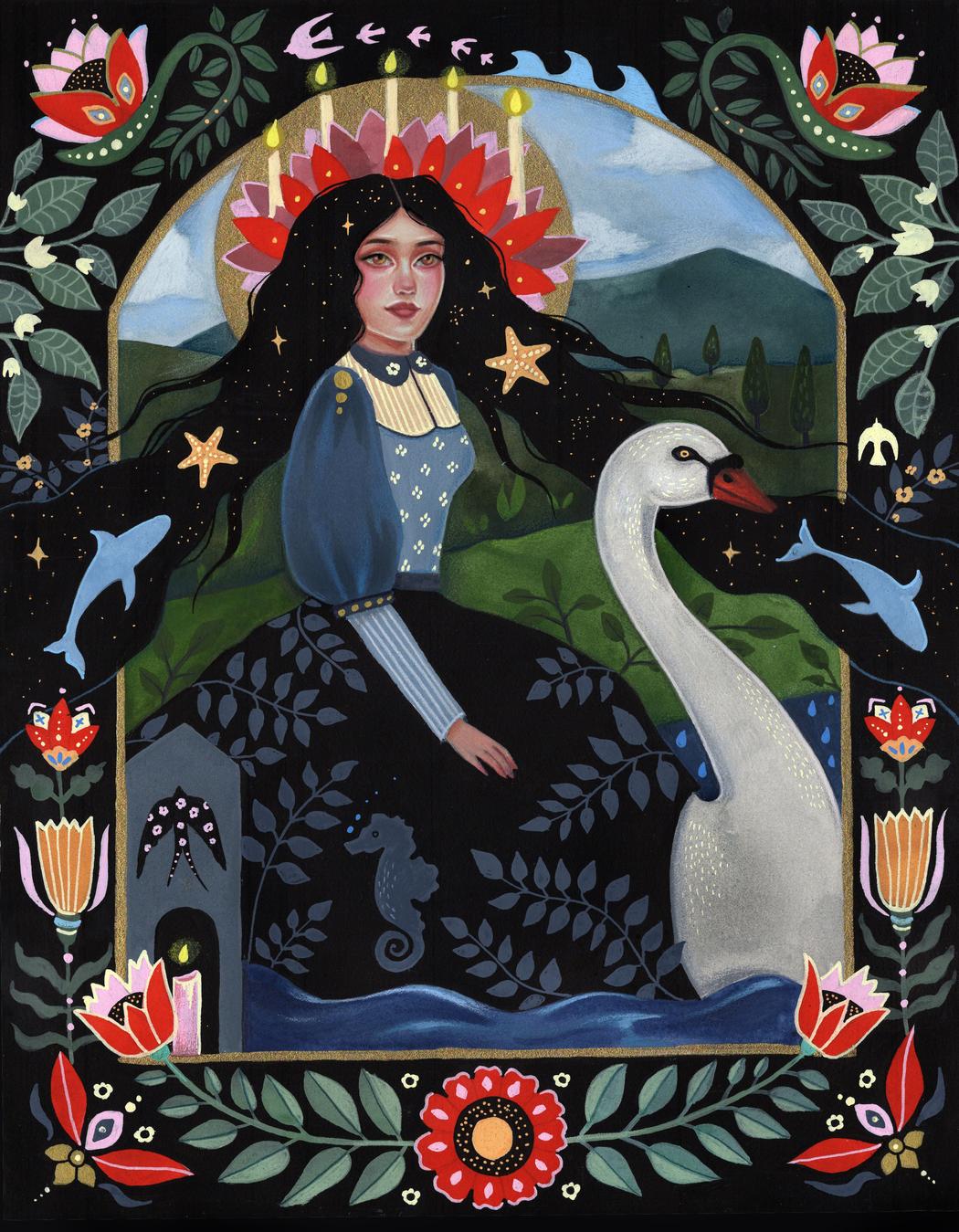 Aunia Kahn | When Understanding Transforms Into Crown
Alongside your studio practice, you work as a curator and create illustrated books and oracle decks. How have these roles influenced the way you construct narratives and symbolic systems within individual paintings?
The first thing I ever bought with my own money was a little clay dog from a craft fair when I was 8 years old. I still own it. That impulse never really left me.
These days it shows up everywhere: our home, the exhibitions I put together, the books I help shape. Guests ask if they can wander through our house like it’s a gallery, because it is! Every object in it is somebody’s history, somebody’s soul, and we built a life around wanting to be near that. Some of that came from genuinely loving art. A lot of it came from spending long stretches confined at home and needing the space around me to feel alive.
With curating art exhibitions, it started because I wanted to build something with real weight behind it. Darkest Dreams, A Lighted Way, which I put on at Fort Gondo in St. Louis back in 2008, brought together artists nationally and locally who were using their work to move through trauma and abuse, not just to express it, but to hand something useful to whoever was standing in front of it. That project is the reason curating became a permanent part of who I am rather than a one-off.
With publishing and book projects, that was also something that started in childhood. In elementary school, they helped us make our own books, and after making two, I was hooked. I started making them on my own at home, and I look at them now and still just love them! So when I realized art and books belonged together, things like art books, oracle decks, and tarot decks, those projects lit me up. With publishing, I get to curate my own personal projects, as well as collaborative ones with other artists, galleries, and curators.
With having my hands in various creative pursuits, it always helps my main work grow. It is so very inspirational.