
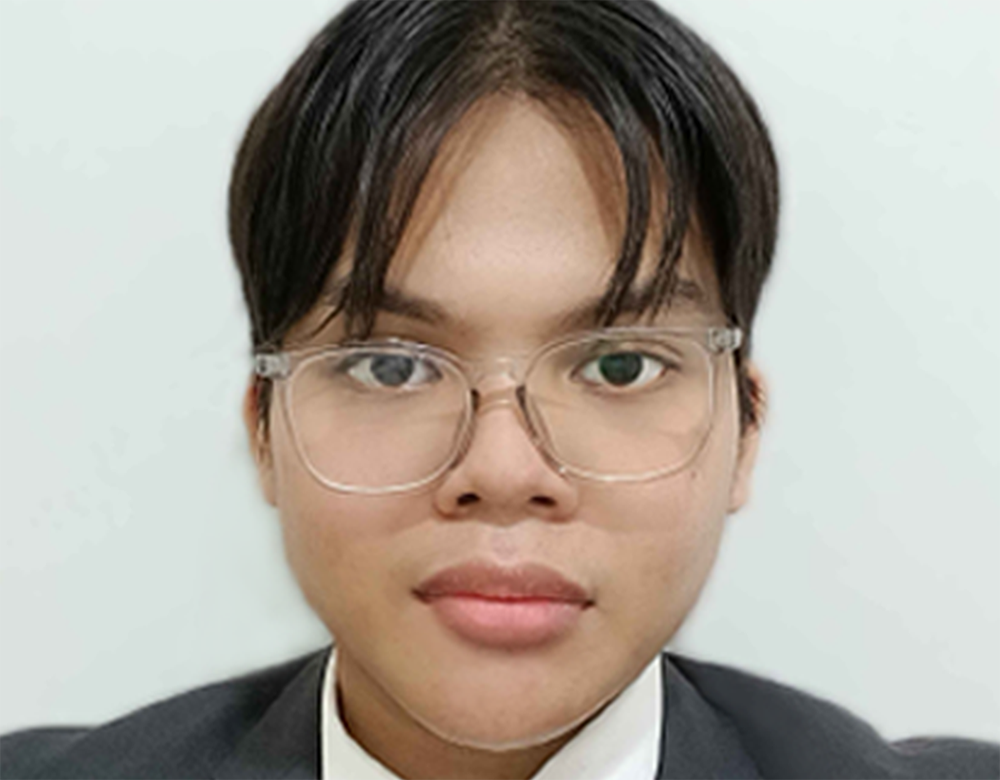
Adam Haris bin Othman
You studied law and began pursuing art seriously only in late 2024. What gave you the confidence to move from a legal career toward a more creative path?
Throughout my college years, I was primarily a digital artist and would normally design presentation slides, posters and the like for group assignments. It was important for me to clearly convey certain information in a way that would get the lecturer’s attention. Even after I graduated, my old college friend who was working at a legal firm had contacted me to design a few slides for a presentation to be shown to shareholders.
As for what gave me that confidence to pursue art in a more serious manner, I was doing my chambering at a legal firm in Kuala Lumpur (one of the big cities in Malaysia) and I could only bear it for about a month due to the hectic nature of the legal field. But every day, I would pass by a number of paintings on my way to my desk. I began to take notice of their composition and the colors and eventually I just went “Yeah, I can do that”. That gave me the confidence I needed to take my art seriously.
Fortunately, my friends gave me some well-needed encouragement. It was difficult at first; trying to get used to the feel of acrylics, having to manage your brushstrokes and the feeling of actually painting on a canvas as compared to a regular tablet, but my friends supported me along the way and even provide me with brushes and paints till this day. Even my college peers were supportive; respecting my decision to pursue art instead of law because they know that law is not for everyone. You can be good at it, but it’s not necessarily something you want to do for what could be the rest of your life.
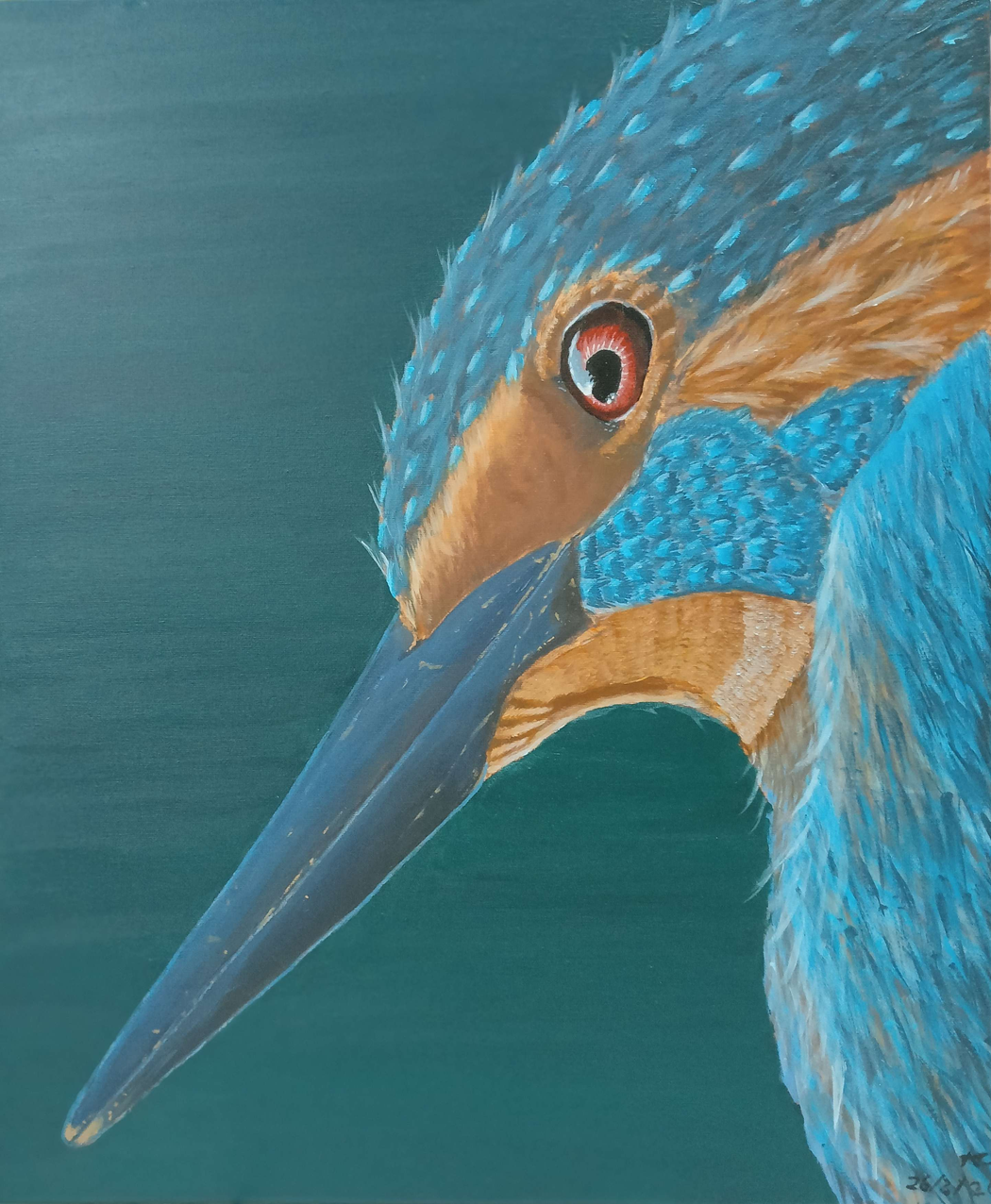 Adam Haris bin Othman | Kingfisher | 2026
As a self-taught artist, how do you approach learning and improving your technique without formal art education?
I did start with digital drawing during my teen years, so I wasn’t completely clueless. I had some level of skill built up mainly in regards to colors, form, and anatomy. But one thing that rarely gets talked about is the transition from digital to traditional and vice versa. I know what I wanted to paint and how I would do it digitally, but having to move your entire arm for certain brushstrokes and color mixing/matching was something very unfamiliar. This led to my first initial painting to be quite terrible. Despite that, my friends urged me on and said that it was quite good for a first attempt. I ended up giving it away to a friend during his birthday which he ended up keeping in his room. It wasn’t until I painted a penguin and a heron where I finally gained my bearings. What I wish to convey is that although your first attempts may be downright disastrous, taking up a new artform is a matter of perseverance; You know what you must do, simply allow your body to catch up with the technical knowledge that you have.
Nowadays, my learning method is primarily from watching full recordings of people painting on Youtube; to learn what colors they use, where they use it, in what brush stroke and with what brush were pivotal for me to become a better artist. It made me understand that we were less painting the exact details and more of the “effect” that these details would give. No sane artist would draw each individual blade of grass; they would use certain brush strokes to give the “effect” of the grass.
It also helps to have a few artist friends to have a back and forth discussion as to what could be improved and what they like about your work. If I am working on an important project, I would always consult my artist friends to see what I can do differently or better. Sometimes it is a matter of subjectivity, but there are a few fundamental areas where all artists can agree on.
Most important of all, give your eyes a break; artists tend to get tunnel vision when they focus on an area for so long that they forget the entire painting as a whole. You can spend the next 2 or 3 hours painting but the subject you painted doesn’t fit the composition you had in mind. So always know when to take a step back and observe the entirety of the painting.
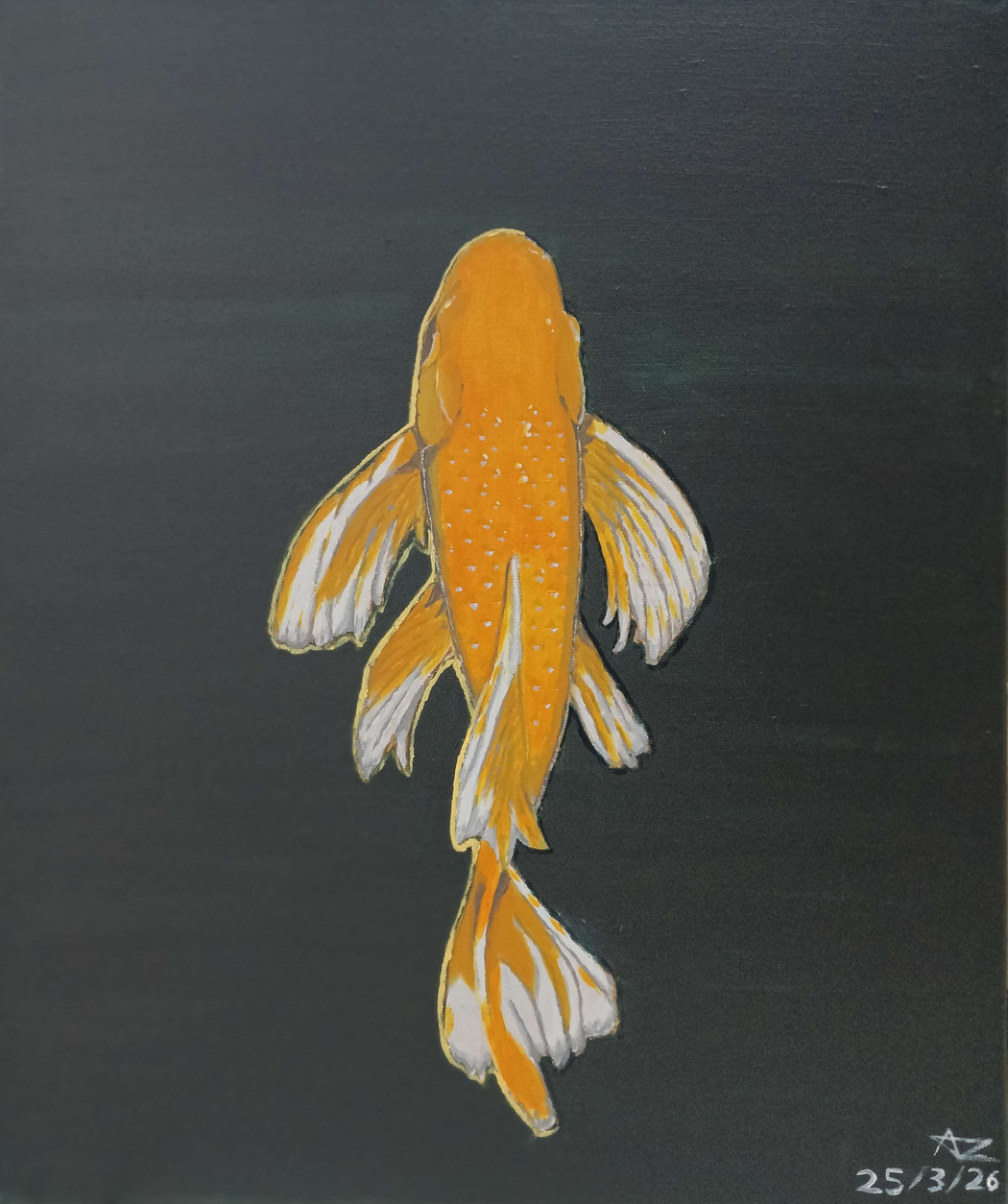 Adam Haris bin Othman | Koi Fish | 2026
Wildlife has become an important subject in your work. What draws you specifically to animals found in Malaysia?
My father used to work as part of an NGO and I was exposed to a lot of conservation efforts from a young age. So when I was looking for inspiration for my next painting, my first instinct was to paint a tiger. Not long after that, I began looking up more and more local wildlife and developed an interest in birds. So now whenever I wish to exhibit a painting, I would end up looking up vibrant birds that are local to Southeast Asia. There’s something that brings me joy whenever I put down layers of fur or feathers one after another. At the same time, a lot of the animals (and birds in particular) are not familiar or even known by the public. If I went up to a random passerby and asked them if they knew what a “Ruby-Cheeked Sunbird” is, they would probably say no. So in a way, I want to showcase that there are these vibrant and beautiful animals simply waiting somewhere in the country; you just need to look hard enough.
How important is your Malaysian background to your artistic identity and to the subjects you choose to paint?
Many of the animals that I choose to paint are closer to Southeast Asian or ASEAN animals rather than uniquely Malaysian animals. For example, I’ve painted a Hornbill before which is synonymous with East Malaysia (Sabah & Sarawak). But they are also found in other Borneo and Southeast Asian countries. I would say that it’s less of my Malaysian background that’s important and more the fact that I am from Southeast Asia, where a large number of the animals are comfortable in any country so long as they have the right habitat. It just so happens that Malaysia shares the same animals as their neighbors.
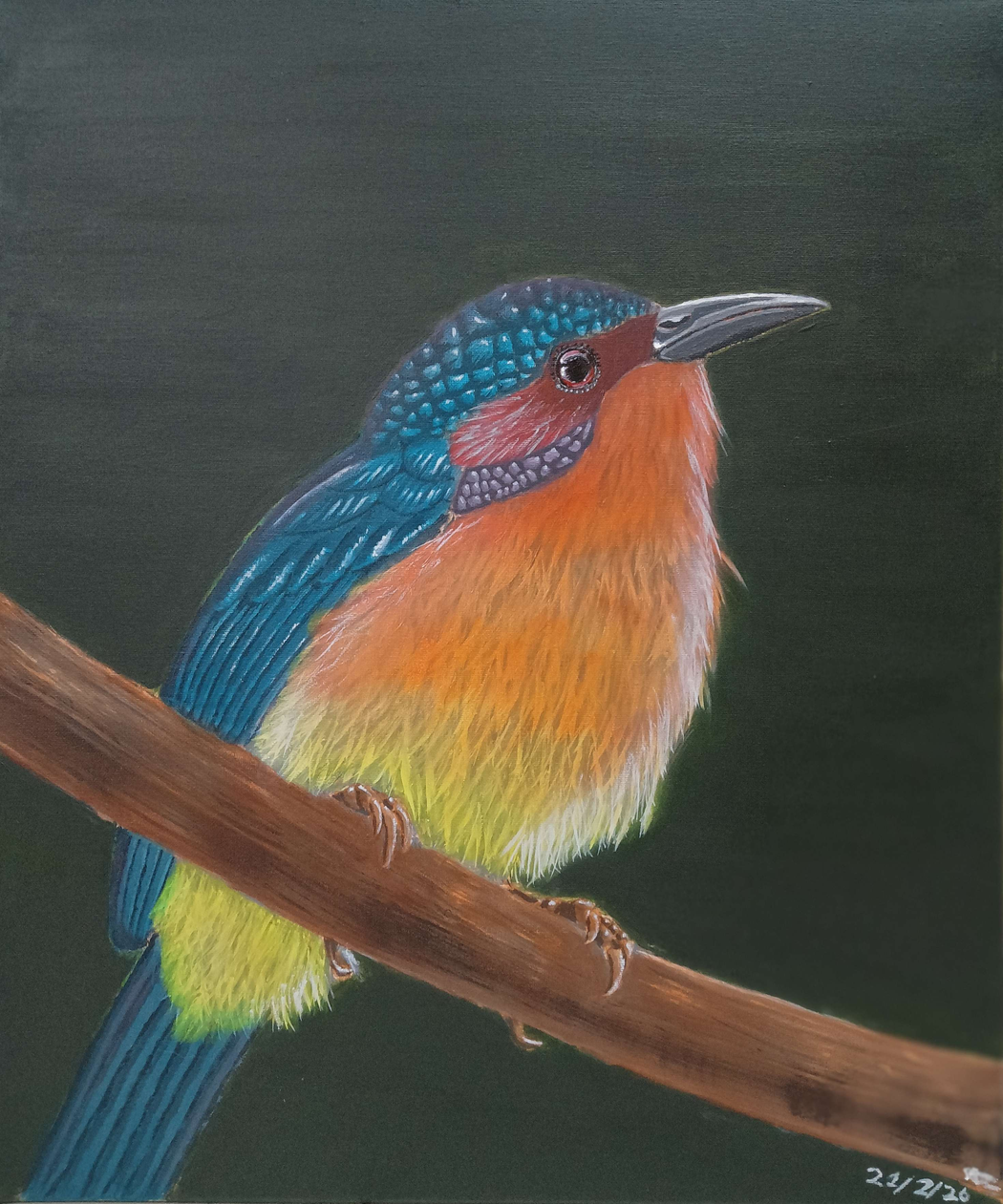 Adam Haris bin Othman | Ruby Cheeked Sunbird | 2026
Your paintings often focus closely on distinctive features of animals, such as the eye, feathers, scales, or patterns. What interests you about working with these details?
I feel that the general public tends to ignore certain details of animals, whether it be due to safety, fear, or a lack of an opportunity to get up close. I wish to convey the beauty that we wouldn’t normally see; the gem-like eye of a tiger, the gradients on a bird’s feathers, and so on. I wanted to draw the viewer’s attention to these specific parts that they either miss or don’t have the opportunity to simply fully soak it in. With these sorts of focal points in mind, it becomes easy to build the painting towards that focal point; everything else can be decent or good, but as long as that focal point is perfect, the entirety of the painting becomes perfect.
Do you see your wildlife paintings primarily as portraits of individual animals, celebrations of Malaysian nature, or as works carrying a wider message about our relationship with the natural world?
In a way, they are an acknowledgement and celebration of Malaysia’s diverse fauna. I wish to spread the word that there are these vibrant animals simply hiding in nature or even in plain sight. There are so many publications and marketing towards our tigers, tapirs and hornbill birds, but it resulted in so many wonderful animals being pushed to the sideline. A good portion of these animals aren’t even exotic, they are simply living and existing out there in their own ecosystem. Yet there aren’t enough people that acknowledge their existence other than “some bird” or “some fish”. So I want my paintings to be a sort of gateway for the public to know that these beautiful animals are out there; you need only give yourself the chance to find them.
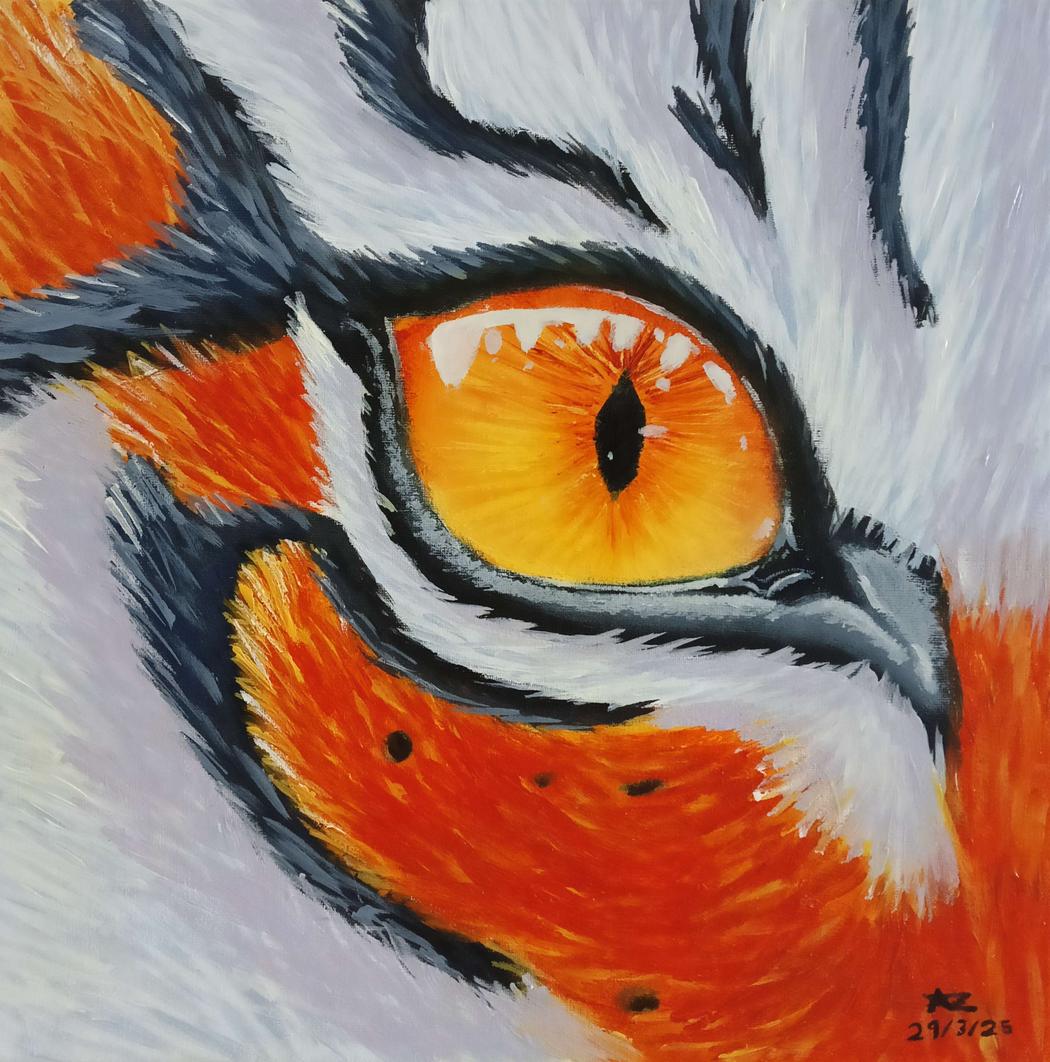 Adam Haris bin Othman | Tiger Eye | 2025
Since you are still relatively early in your artistic career, how has your style or technical approach changed from your first exhibitions in 2025 to the works you are creating now?
I would say my style evolved quite a bit throughout this almost 2 years of painting. Early on, I wanted to emulate the “old masters” style of painting (the ones you’d probably think of hanging at an old Victorian house). But this resulted in me painting with dull colors; there was no vibrancy in them. I got feedback from the exhibitions to focus more on vibrant colors and I began tapping into the sort of colors and artistic mindset you have when doing digital art. Over time, my paintings become more and more saturated and vibrant. My latest painting that I finished had a starry sky with gradients going from green, blue, purple and violet.
My technical approach had quite the interesting turn of events; the two bird paintings were painted in relatively the same timeframe but had different approaches. If you would allow me to be technical, The Ruby Cheeked Sunbird started as a sketch, later painted as an imprimatura (using only brownish/earthy tones), which was then painted over as a griselle (monochrome colors), and lastly glazed over with translucent paint. The end result was safe and effective but I ended up losing some of the brightness that I had from the previous step. On the other hand, The Kingfisher started as a sketch, painted as an imprimatura, and I painted over it as I would normally. It took more time, but the colors were exactly how I wanted it to be with deep cyans and warm browns. I took away from this learning experience understanding that the imprimatura does show up underneath the painting and give it a nice, warm undertone to it. But if i wanted to do griselle and glaze over it, I would have to do extreme contrasts in light and dark values so that the end result doesn’t get dulled out by the glaze.