Amber Ceffalio
You spent more than fifteen years working as an American Sign Language interpreter before focusing more deeply on photography. How has thinking through gesture, expression, and visual communication shaped the way you construct an image?
It’s interesting to trace how ASL, a visual language, shaped my photography. ASL has a grammatical feature called a classifier: a handshape that stands in for an object like a cup, a chair, a person, or an airplane and moves through space to carry the story forward. As my photography has moved toward the abstract, I’ve found myself doing something similar. Objects become representative rather than literal. In my Red Riding Hood image, one of the source photographs is a straightforward shot of my granddaughter and her aunt lying together on a tree branch. I wanted them to become anonymous, to stand in for the many Red Riding Hoods who take refuge in the woods. Their red form is, in a way, a classifier, a shape that carries the story of who they really are.
You describe interpreting as carrying meaning from one form into another without losing its truth. When you work with multiple exposures, how do you decide which elements can be layered together while still preserving the emotional truth of each photograph?
For me, emotional truth is bound up with the feeling I’m trying to evoke and with whoever the photograph is really about. One of my first multiple exposure images layered Lake Michigan and the Ferris wheel at Navy Pier under a peaceful pink sunrise. I wanted the layered elements to carry that same calm, to conjure mornings spent combing for beach glass. Chicago’s shoreline doesn’t have beach glass, so layering an actual photograph of it felt false. But layering paint chips that evoke the color and texture of beach glass supported the feeling honestly, while also giving a nod to the city itself. Look closely and you can still read the paint color names in the image. It’s one of my favorite small secrets.
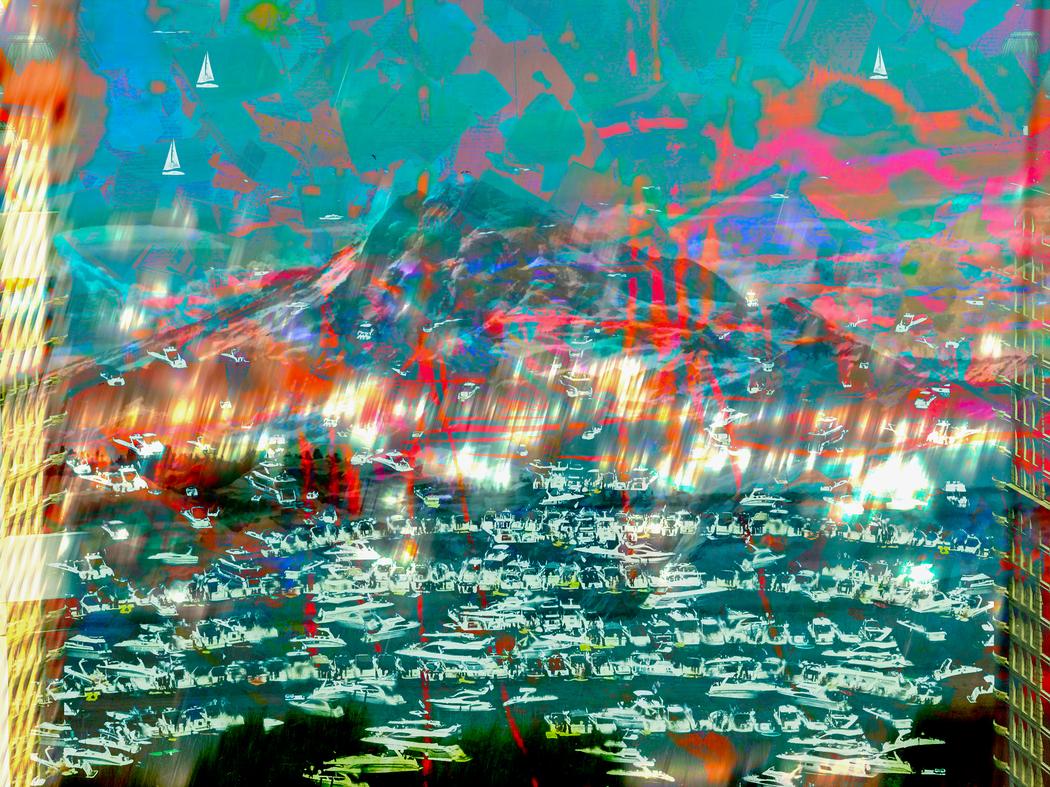 Amber Ceffalio | Mountain Lording Over The Lake
Your images often contain a remarkable density of information, with several places, textures, figures, and moments existing simultaneously. What tells you that an image has reached the right balance between complexity and clarity?
I still struggle with that balance, honestly, and I think about it often. My Art of Composition teacher at Chicago Photo Classes, Jeff Silva, introduced me to dynamic symmetry as a guide for laying out an image. I typically start by placing my subject on a grid, then build outward with supporting elements and detail. He also gave me a phrase that’s stuck with me: a strong image is a puzzle you have to solve. Anyone can take a picture of the Chicago skyline. A photographer creates an image. That distinction is still a work in progress for me, and honestly, some images I’m still puzzling over.
In Mountain Lording Over the Lake, you bring together Alaska and Chicago – two places that represent very different periods of your life. What happens emotionally for you when two geographically distant places are allowed to occupy the same photographic space?
People love to ask me to choose: Alaska or Chicago? Alaska or New York? New York or Chicago? Everyone has an opinion and all opinions are correct. I’m a product of an Alaskan homestead, and I will always consider myself wealthy for having indoor plumbing and electricity. New York taught me the world is both small and so enormous. New York is where I started truly capturing images because everything was delightful and I wanted to pinch myself to be sure it was happening to me! Chicago sits in the balance between those two extremes, and it’s given me room to explore photography in ways neither Alaska nor New York could. This image is my way of saying I value every home I’ve had, and if I could hold them all at once, I would. Maybe it’s time for a mash-up that folds in Brooklyn, as well.
Your Red Riding Hood project reconsiders a familiar fairy tale through ideas of female strength, growth, and independence. What first made you recognize Red Riding Hood as a figure through whom you could explore contemporary experiences of women and girls?
I’m drawn to fairy tales because the protagonist is often female, but even as a child, I felt they never captured the full complexity of girlhood or womanhood. I was taking a Conceptual Portrait class with Erica Ruyle and knew I wanted to build something around fairy tales, but not princesses. Red Riding Hood was the natural answer. As I explored what she meant to me, I realized every Alaskan woman I know is a Red Riding Hood making her own way into the woods, and every New York woman I know is striding into an urban jungle staking her claim. I’m only at the beginning of this project. Over the next few years, I intend to photograph women as the Red Riding Hood they see themselves as. What is their strength? What is yours? We are strong.
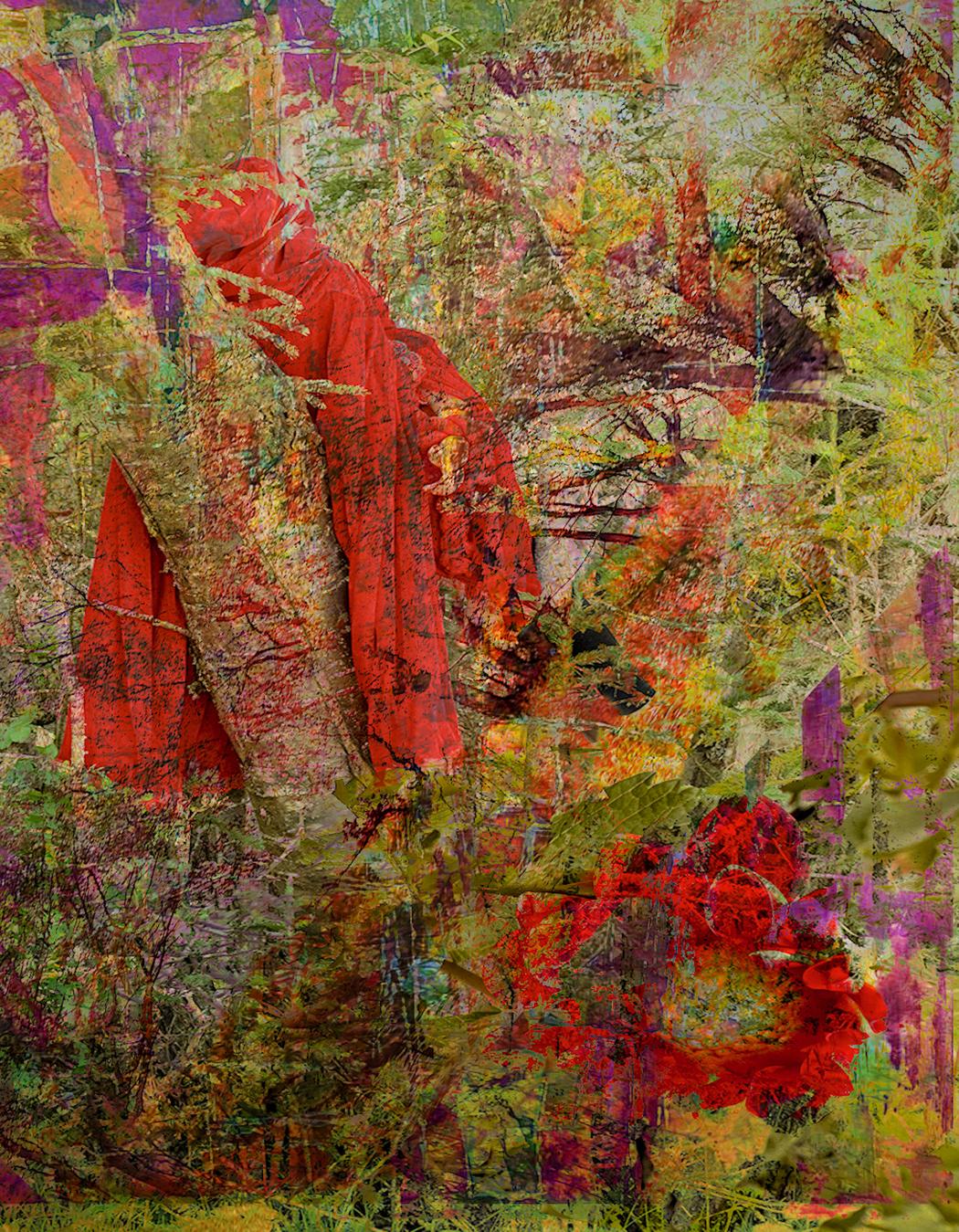 Amber Ceffalio | Red Riding Hood
You grew up surrounded by both monumental Alaskan landscapes and small, fragile details in nature. Do you still consciously move between the “majestic” and the “minuscule” when you photograph or build a multiple-exposure composition?
I have a piece called Joyous Unity. The first thing you see is the nighttime Chicago skyline with cherry blossoms in the foreground, something undeniably majestic. But look more closely and you’ll find children holding hands, dancing through the photograph. People are often taken with the majesty. Don’t overlook the minuscule. That’s where the joy is hiding.
You recently began collaborating with multi-media artist and fellow ASL interpreter Amy Rubinger. What have you discovered through the exchange between photography and collage, and has this collaboration changed the way you think about layering?
I loved working with Amy as a team interpreter. She was supportive and collaborative—the best kind of team interpreter one could have. When I left New York, I bought two of her original pieces to commemorate my time there, and they meant even more because they were made by someone close to me. I never imagined we’d end up collaborating on art. But as my photography shifted from documentary and street work toward the abstract, people who knew us both started noticing the similarities, and pointing them out to us before we’d fully noticed them ourselves. Amy started creating collages inspired by my photographs and incorporating elements of my photographs into her art. Then I tried to create photographs based on some of her work. Red Riding Hood uses texture from one of Amy’s collages—an idea she gave to me. The trust we built working together as interpreters has transferred to a great collaboration in the artistic realm. I’m not sure I could do this with anyone, but I trust Amy because we’ve worked together in vulnerable interpreting situations. We can collaborate as artists.