

Victoria Kobylskova
Your works are full of movement, rhythm, and visual “pulsation.” How do you create this sense of energy on the canvas?
In fact, this “pulsation” comes from within. When I create paintings, I transfer my energy into them, and you can see it on the canvas. Of course, form also plays a very important role. This energy materializes through an active interaction of geometries: I like to bring together round, flowing elements with sharp diagonals or striped backgrounds. But it is not only the contact between forms that matters — the rhythmic structure is equally important: the way color fields alternate, and how one form flows into another. It is as if I capture a moment of inner movement and make it visible. This tension between different geometries, combined with their rhythmic transitions, makes the viewer’s gaze move across the canvas, creating the feeling of a living “pulsation.”
You often use bright, contrasting colors. What role does color play in your artistic language?
For me, color is both an emotional signal and a constructive foundation. On the one hand, I use bright, contrasting shades to convey my mood and inner energy, immediately capturing the viewer’s attention. On the other hand, color functions as a structure: I think not in tones, but in volumes. Through contrasting color fields, I define the foreground and depth, replacing classical chiaroscuro with active planes of color. It is a kind of color architecture that emerges from my inner state.
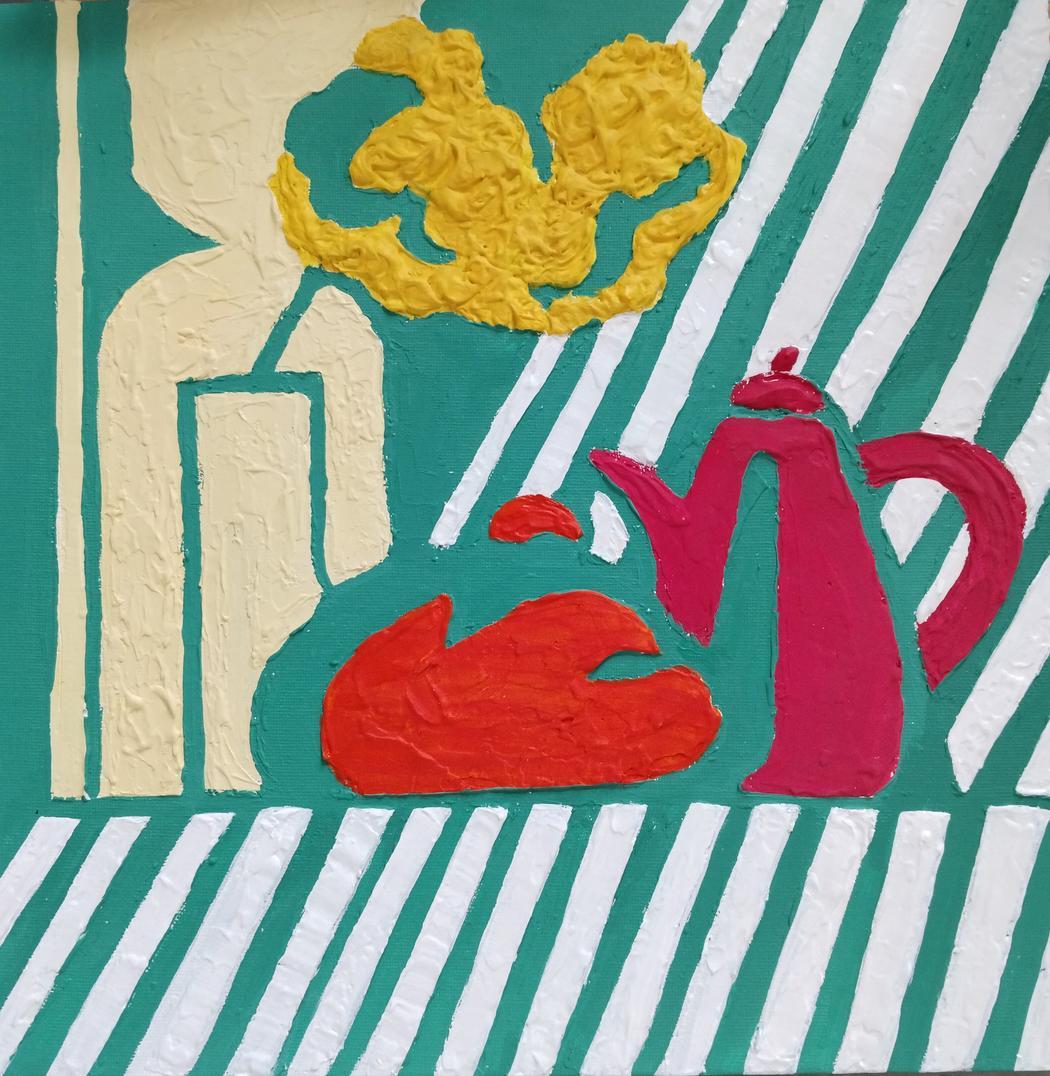 Victoria Kobylskova | Impulse In Green | 2025
Many of your compositions transform everyday objects into bold, almost symbolic forms. Why is stylization important to you?
In my work, I consciously move away from the illusionistic copying of reality. I simply find it boring to redraw what already exists — I want to create something new. For me, stylization is a tool for translating the everyday into the language of pure symbols. I enjoy generalizing forms, turning a familiar object, such as a teapot, into a geometric color field and freeing it from everyday visual noise. In this way, I leave space for the viewer to enter into a direct dialogue with color and form, beyond the domestic narrative.
How has your education in decorative and monumental art influenced your approach to composition and form?
This education has given me perhaps the most important thing — an understanding of the plane. I do not try to depict a window into the world, or an illusion; I work with the surface as an independent space. Monumental art teaches you to work with silhouette, mass, and composition as a rhythmic structure in which every element supports the entire work. Decorative art has also given me the courage not to be afraid of ornament and large color fields — I think not in shades, but in broad blocks of color.
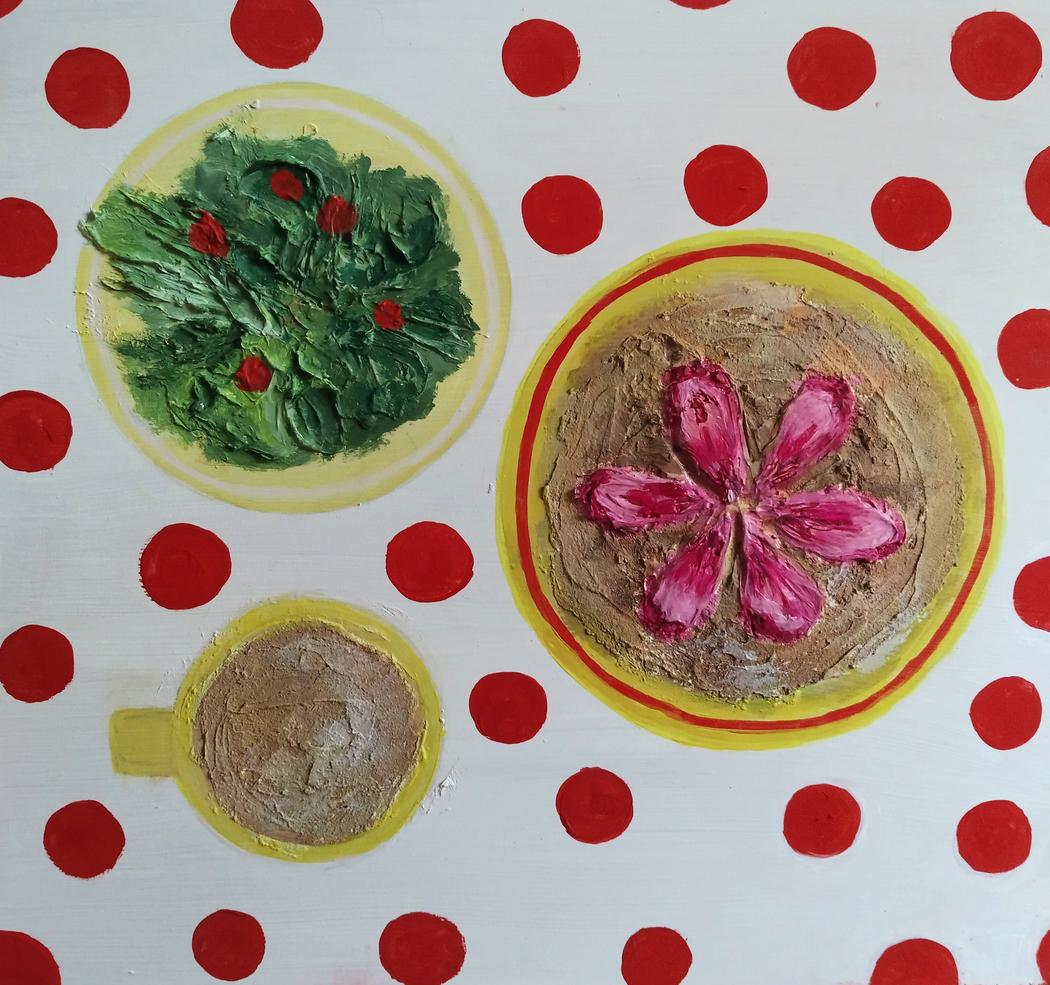 Victoria Kobylskova | Sandy Snack | 2025
You work with tempera paint and texture paste. What attracts you to these materials?
Tangibility is very important to me. Texture paste is my way of giving a painting relief. When I apply it, I can control whether the surface will be smooth or uneven. This creates a play of shadows in real space, which changes depending on the lighting. Tempera attracts me because of its matte quality, density, and brightness. Unlike oil paint, it does not shine. It can be applied very densely, making the brushstroke raised, or diluted to an almost watercolor-like transparency. This gives me great freedom in creating that very “pulsating” texture.
In your works, geometric forms often interact with recognizable objects. How do you balance abstraction and recognizability?
Essentially, I analyze the form of the object: I consciously remove everything secondary and search for the visual boundary at which the object still remains recognizable, but has already become a geometric color field. This is where the balance lies: I leave just enough for the viewer to recognize a “teapot,” while still perceiving it as part of a rhythmic structure rather than as an everyday object.
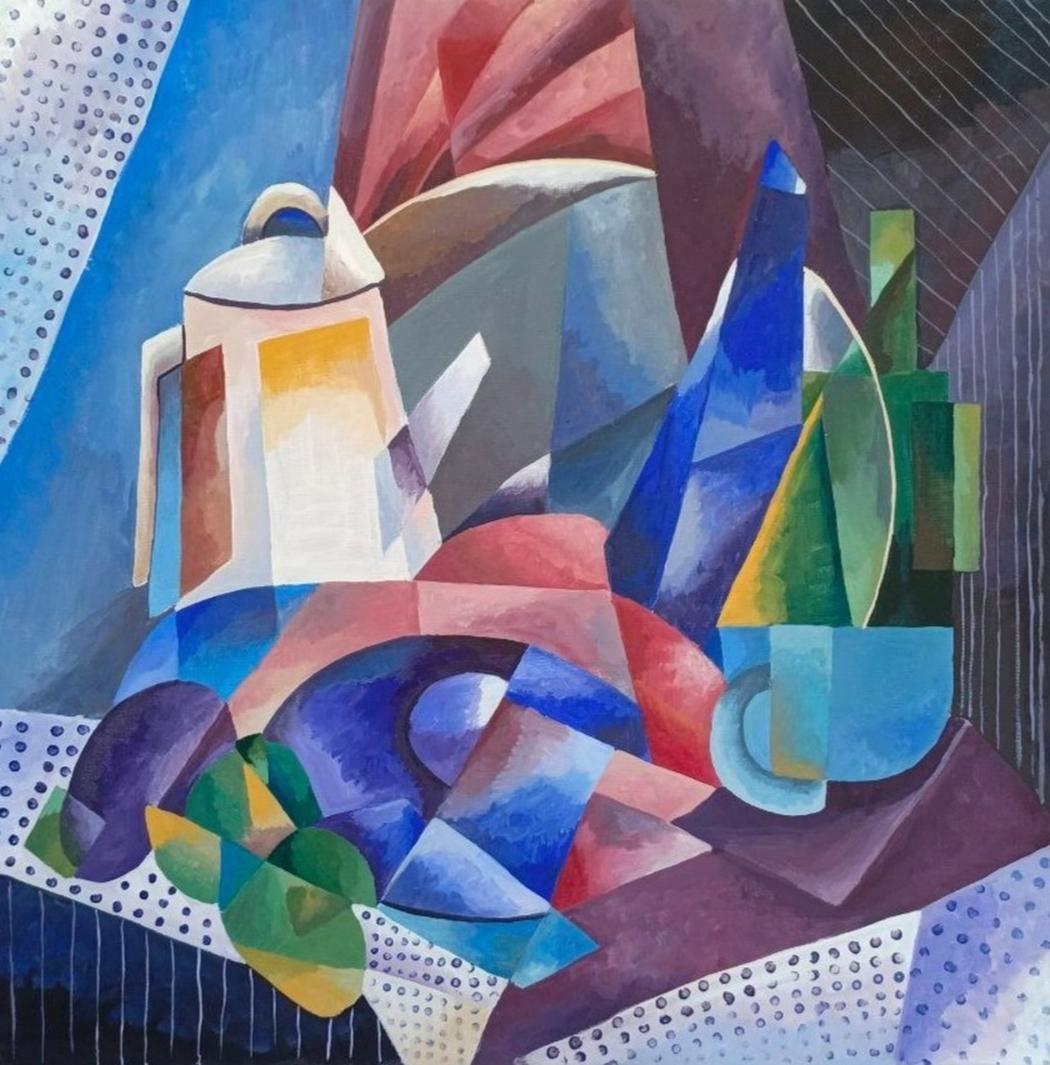 Victoria Kobylskova | Distortion | 2024
Do you want the viewer to read your works emotionally, decoratively, symbolically, or intuitively?
I would like the viewer to perceive my works intuitively and emotionally. Of course, I want the beauty of the decorative pattern to please the eye. But it is much more important to me that the viewer feels the vibration, the energy embedded in the colors and relief. Symbolism can remain in the background. I do not want people to decode my works like a puzzle; I want them to surrender to the flow of color and texture, to allow themselves to emotionally “switch on” to this rhythmic wave. If a painting evokes in the viewer a physical sensation of pulsation or a certain mood, then contact has been made.