Marsi Pedroche
The horse appears as a central symbol in your work. What first drew you to this animal as an artistic subject?
What first drew me to draw horses as an artistic subject was their character and personality. Horses are like any living being to me; they each have their own spark. But horses specifically not only have their own heart or mind, they also manage to reflect the inner state of their rider or person. In this case, it would be the spectator to any of my artworks. Also, another thing that drew me to choose horses as an artistic subject was the experience I had with them thanks to horse riding.
In your practice, horses seem to represent freedom, resilience, and emotional strength. How do you personally connect with these qualities?
Over time, I’ve come to understand freedom and resilience as the ability to adapt without losing one’s essence, but rather being able to move through life with trust and determination. I see this reflected in horses, who have also shown that freedom and resilience can coexist with vulnerability rather than oppose it. For emotional strength, I would think it is to remain open and sensitive without allowing fear to dictate one’s actions; to move through uncertainty while continuing to grow, as well as having the courage to acknowledge one’s emotions rather than suppress them, and having the freedom to choose to do so. Like horses, who have shown me that these qualities are not contradictory, they are highly sensitive animals and yet they continue to trust, connect, and move forward despite uncertainty.
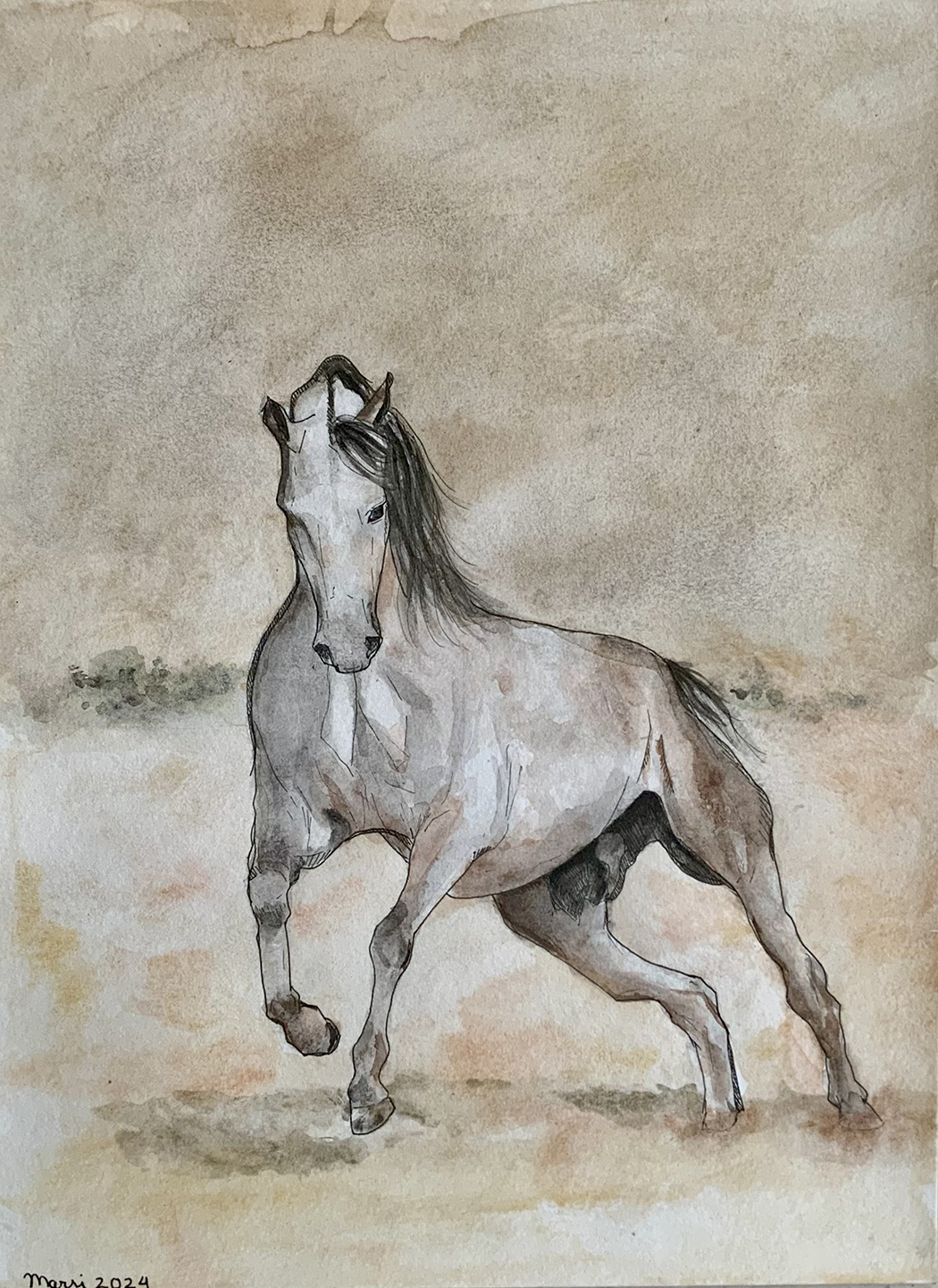 Marsi Pedroche | Ace | 2024
Your recent exhibition KAIROS explored the idea of being present in the “here and now”. How does the figure of the horse help you express this sense of presence?
Horses are a great example of living on the here and now, not only through their nature but instinctively. In a world where we are constantly pulled towards the past or the future, horses serve as a reminder to return to the present. The reason I choose “KAIROS” is because of its meaning here and now, the Ancient Greek concept referring to a meaningful present moment. While preparing the exhibition, I often focused on what was still ahead rather than appreciating what was unfolding around me.
In many ways, “KAIROS” became a personal reminder that the future is shaped through the present, and the only moment we truly experience is the one we are living right now. Through the instinctive presence of horses. I wanted to invite viewers to pause, reconnect with that awareness and simply allow themselves to be present. Looking back, seeing people gather, connect and genuinely enjoy the exhibition made that message feel all the more meaningful.
You were born in Spain and are now based in Mexico. How have these two cultural environments influenced your artistic vision?
Growing up between Spain and Mexico has deeply influenced both the way I perceive the world and my artistic vision. Through my own experience, I have come to associate Spain with a passion for life, strength of character, and determination, while Mexico has taught me the value of nobility of spirit: generosity, dignity, and the quiet strength that comes from leading with humanity. Although these cultures are distinct, I have always seen them as profoundly complementary, each enriching the other in its own way, and in turn enriching me.
I explored this balance in Alma Ibérica, where the horse embodies both power and nobility. While some viewers may simply see a white horse against a red background, for me, the color red is a great representation of passion and strength, just as the white and grayish colors of the horse are more down-to-earth, making them more relatable to nobility. The horse has always possessed a remarkable ability to reflect aspects of our own humanity. Through it, I explore how qualities that may seem opposing at first glance can coexist harmoniously. I feel deeply grateful to have been shaped by both cultures, as I would not be the person or artist I am today without either of them.
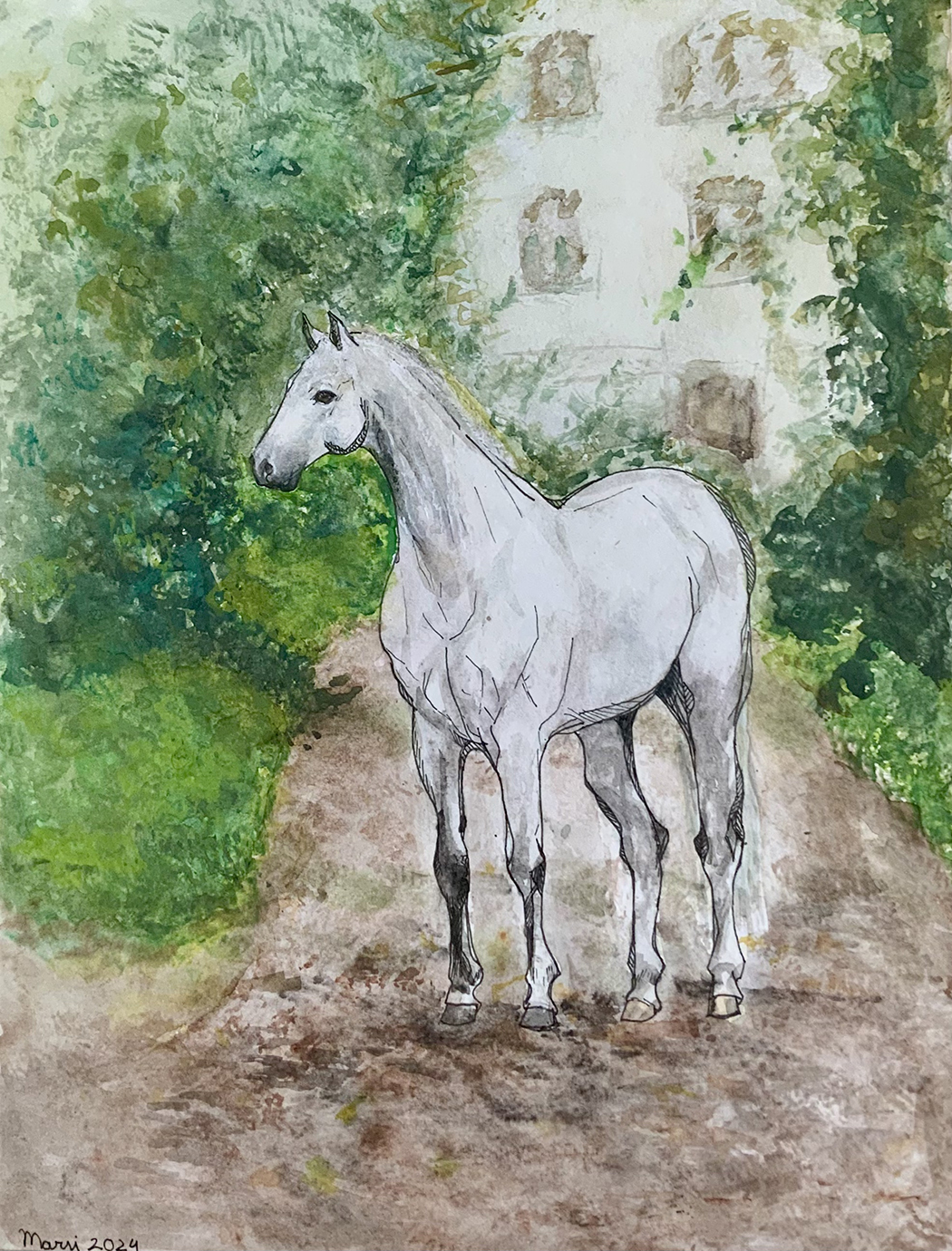 Marsi Pedroche | Arezzo | 2024
Your work combines watercolor, ink, acrylic, mixed media, and sculpture. How do you decide which medium best suits a particular idea or emotion?
The choice of medium is often an intuitive process for me. Sometimes an idea arrives already carrying a certain material quality, while other times I discover it through experimentation. I try to find the balance between intuition and intention, considering what each piece needs in order to communicate most authentically. Whether it is the fluidity of watercolor, the immediacy of acrylic, the depth of oil, or the presence of texture, each medium offers a different way of giving form to an idea.
Your works often explore the connection between humans and nature. What do you think animals can teach us about ourselves?
I believe animals can teach us a lot of things about ourselves by becoming reflections of our own inner state. Through my experience with horses, I have learned that they often respond not to how we wish to present ourselves , but to what we genuinely carry within us. A person may appear calm or confident on the outside, yet horses have a remarkable sensitivity to authenticity. In that sense, they invite us to become more aware of our emotions, intentions and the way we relate to the world around us. They also remind us of the beauty of genuineness. Animals move through the world without pretense, inviting us to reconnect with who we are beneath expectation, fear and the need for approval. As a result, they encourage us to approach life with greater honesty, passion and the freedom to embrace our true selves more fully.
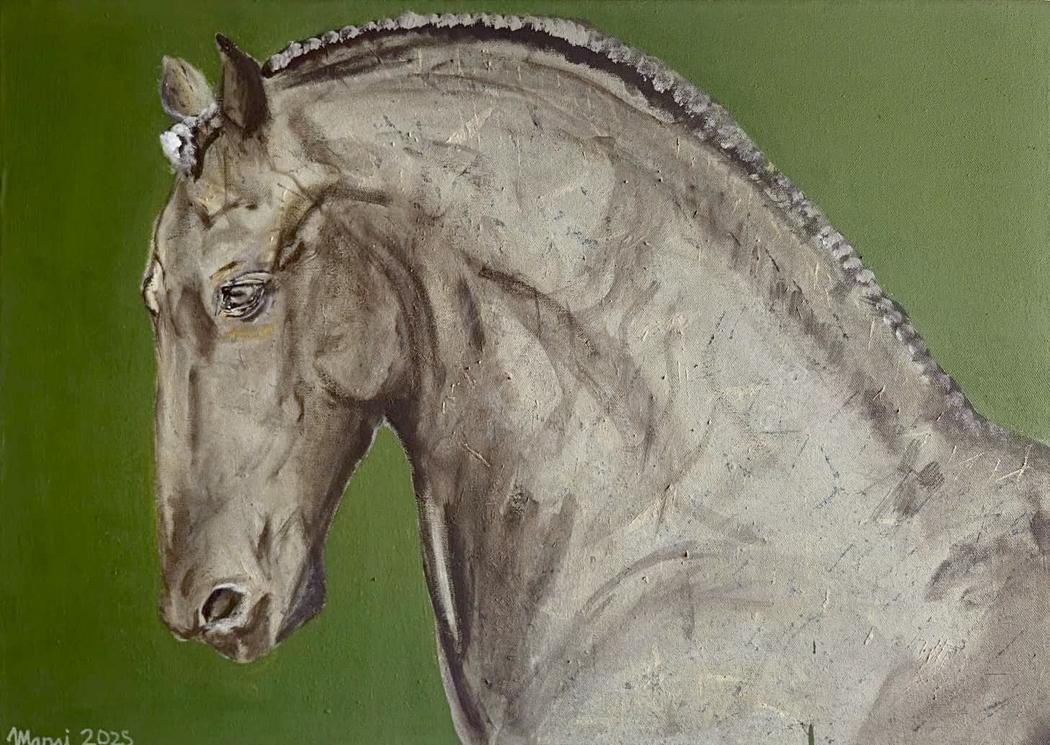 Marsi Pedroche | Corfú | 2025
How important is observation in your process? Do you work from real horses, memory, imagination, or a combination of these?
Observation is fundamental to my process. My artistic relationship with horses began through horse riding, so much of my understanding of them comes from direct experience and careful observation. While memory and imagination also play an important role shaping a piece, most of the horses I paint and draw are rooted in real life references. For me, observation is not only anatomical accuracy, but also about understanding their presence, movement and individuality.