
Necmi Enes KIŞ
You describe repetition and rhythm as central elements of your artistic practice. What first drew you to these ideas, and what do they allow you to express?
When we look around today, it is possible to see repetition and rhythms everywhere in life. From this perspective, I am inspired by today’s uniformity and the way our society and environment proliferate from a ‘meta-object’ that repeats the exact same things. By multiplying these objects as a means of expression, I position people to be more visible and accepting toward the objects I use.
In Entropi Negentropi, the human figures appear in repeated or mirrored pairs. What is the relationship between these figures, and do they represent different psychological states?
No, I don’t look at the figures’ emotions at first glance in my artwork; rather, I wanted to employ the repetition of two opposing sexes. The mirrored appearance is related to contrast and coexistence.
The title refers to entropy and negentropy – forces of disorder and order. How do these opposing concepts shape the meaning of the painting?
I chose a title that harmonizes with the presence and repetition of these two opposing figures, just as I utilized meaning through form in the painting. Furthermore, the glowing light in the background references the end and the beginning of the universe.
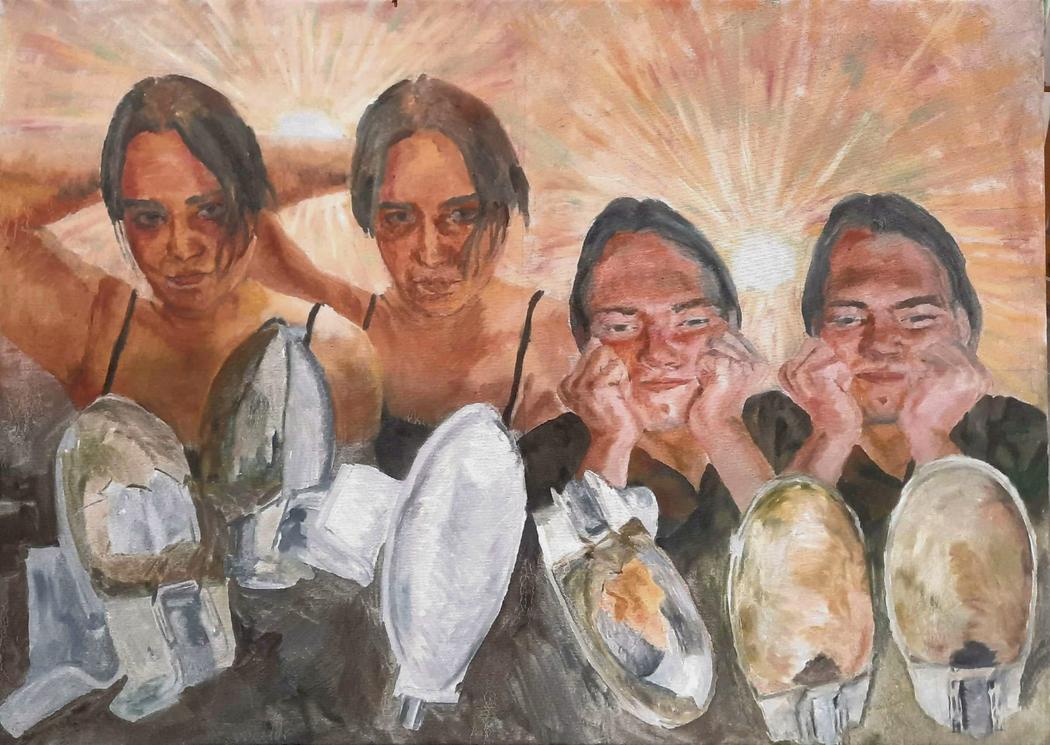 Necmi Enes KIŞ | Entropi Negentropi | 2026
Repetition in your work creates both visual harmony and a sense of tension. How do you balance regularity with disruption in your compositions?
I seek order in my paintings through contrasts and hierarchical arrangements. Mathematically, I aim to achieve balance through similarities, such as harmony and symmetry, combined with the repetition of units and rhythm.
The figures in this painting seem introspective, tired, or emotionally distant. What kind of inner experience were you interested in portraying?
I attempted to symbolize a gaze that turns the inner world inside out, but most importantly, one that immerses the viewer in a thought-provoking atmosphere.
How do you use the human body, gesture, and facial expression to create rhythm within a painting?
The bodily postures, arm movements, curves, and verticals form a distinct repetition and rhythm, operating independently from the overall composition.
You were born in Malatya and studied in Konya and Ankara. Have these different cities and environments influenced your visual language or choice of subjects?
Frankly, I cannot specify particular influences. In terms of urban scale and opportunities, Ankara is expansive and all-encompassing, while Malatya is a more insular city. Yet, I cannot determine if this contrast has a distinct effect on my phenomenal realm. I encounter certain objects quite often in Ankara, which ultimately yields a richer content in my artwork.