
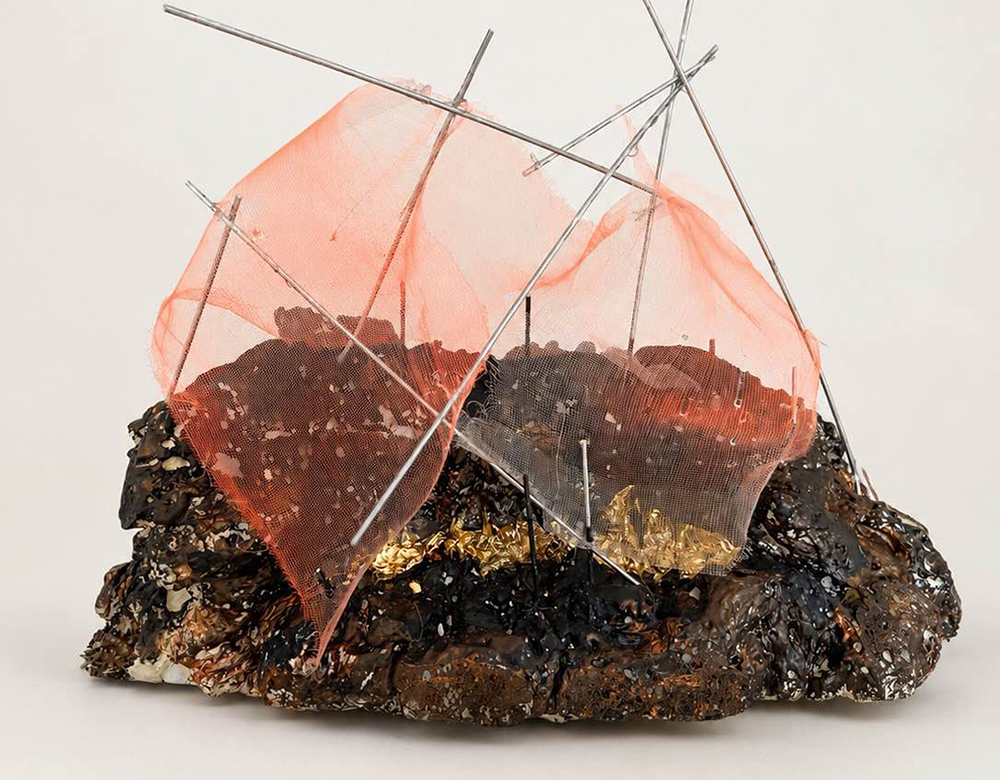
Yuange Sheng
Your background is in architecture. How has architectural thinking influenced the way you approach sculpture and material form?
Architecture taught me to think through relationships rather than isolated objects. During my studies, I became interested not only in how structures function, but also in how they fail, adapt, and accumulate traces over time. This way of thinking continues in my sculptural practice. I often begin with architectural systems—grids, modules, support structures—but instead of pursuing stability or efficiency, I use sculpture to explore what happens when these systems become unstable. Sculpture allows me to move beyond architecture’s practical constraints and focus on processes of transformation. The work becomes a space where structure is no longer fixed but constantly negotiating between order and disorder, construction and decay.
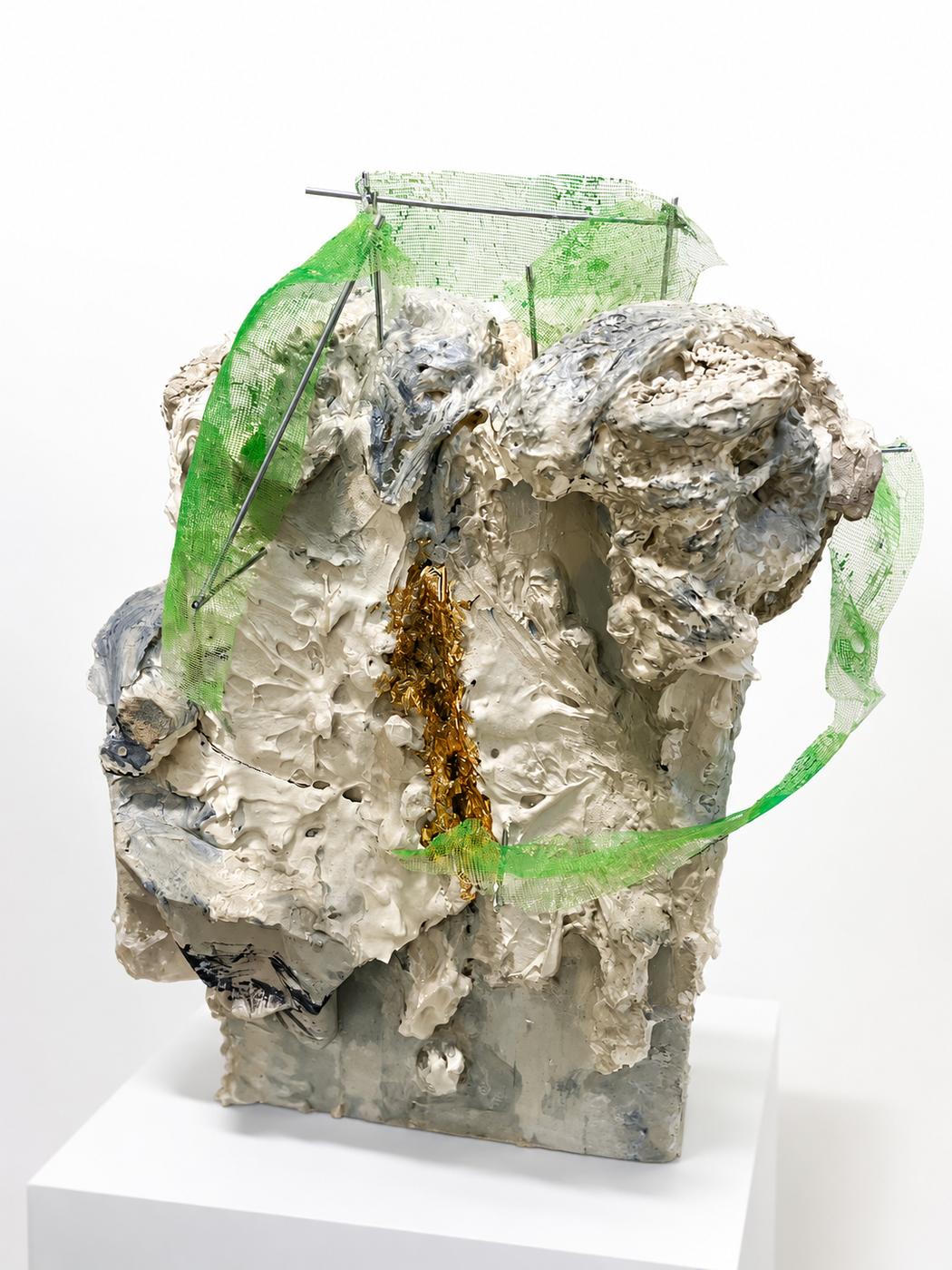 Yuange Sheng | Scaffolding
You often begin with grids, modules, and structural fragments. What attracts you to these systems as a starting point?
Grids and modules are interesting because they represent a desire for control. They are systems designed to organise space, materials, and behaviour. At the same time, they provide a framework that can be disrupted. I am attracted to the tension between the rational logic of these structures and the unpredictable ways they can deform or evolve. Starting from a recognisable architectural language gives the work a sense of familiarity, but as the process develops, these systems begin to break apart, merge, or mutate into something less certain. The grid becomes less a tool of organisation and more a field where different forces interact.
Your works seem to exist between construction and collapse. Why is this tension important in your practice?
I see construction and collapse as inseparable processes rather than opposites. Every structure contains the possibility of failure, just as every ruin contains the potential for reorganisation. What interests me is the moment where these states overlap. In that condition, forms become unstable and open to transformation. This tension reflects how environments, bodies, and social systems continuously change rather than remain fixed. By placing the work between construction and collapse, I want to challenge the idea that architecture or objects can ever achieve a final, stable state. Instead, they remain in a process of constant negotiation.
In this sculptural series, the object appears both architectural and body-like. How do you understand the relationship between structure and the body?
I am interested in the body as a form of architecture and architecture as an extension of the body. Both rely on systems of support, protection, circulation, and repair. In this series, the sculptural units begin as architectural fragments, but through rupture and intervention they start to resemble bodily forms—wounds, scars, organs, or skeletal structures. The steel framework and mesh operate almost like prosthetic devices or stitches. Rather than separating architecture from biology, I see them as sharing similar processes of adaptation and vulnerability. The works occupy a space where structure becomes corporeal and the body becomes architectural.
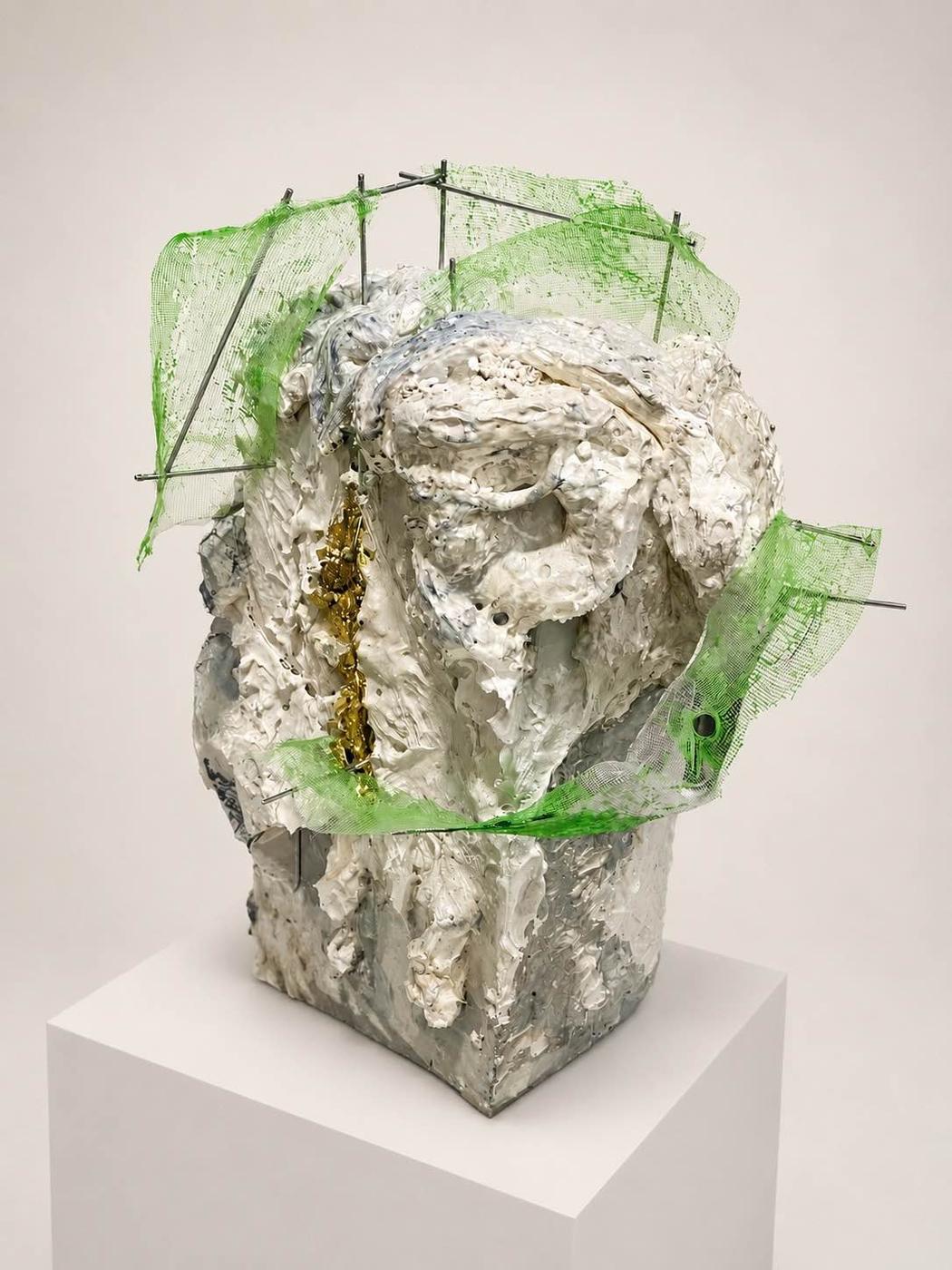 Yuange Sheng | Scaffolding
You describe materials as active agents rather than passive elements. How do concrete, plaster, steel, and mesh “guide” the final form of the work?
I approach materials as collaborators rather than tools. Each material has its own behaviour, limitations, and tendencies. Expanding foam grows unpredictably, mesh stretches and resists, steel imposes linear force, while plaster records pressure and texture. During the making process, I try not to fully control these characteristics. Instead, I allow the materials to respond to one another and influence the direction of the work. Many formal decisions emerge through these interactions rather than from a predetermined plan. In this sense, the final form is negotiated between intention and material agency.
Rather than presenting a fixed object, your work suggests an ongoing process of becoming. How important is instability to the meaning of the piece?
Instability is central to the work because it reflects how I understand both material and life. Nothing exists in a completely fixed state; structures are constantly changing, adapting, and responding to external forces. I am interested in creating forms that appear unfinished or temporarily suspended between different conditions. This sense of becoming allows the work to remain open rather than resolved. Instead of representing a final outcome, the sculpture captures a moment within a larger process. The instability is therefore not a sign of weakness but a condition that enables transformation.
What do you hope viewers feel or question when they encounter these fractured, repaired, and transforming structures?
I hope viewers experience a sense of ambiguity. At first, the work may appear architectural, industrial, or even familiar, but on closer inspection it becomes difficult to categorise. I am interested in creating a space where people question what they are looking at and how it came to be. The fractures, repairs, and exposed interventions suggest histories of damage and adaptation, but they do not provide a single narrative. Instead, they invite viewers to think about how structures—whether architectural, bodily, or social—are continuously constructed, maintained, and transformed. Ultimately, I hope the work encourages a different understanding of stability, one that embraces change rather than resisting it.