

Gabriela Reginata
Your work brings together dermatology, anatomy, and visual art. How did your medical background begin to influence your artistic language?
Medicine trained me to look closely, but art allowed me to look inward. Through years of observing patients, I became increasingly aware that the body is never only physical, it also carries emotion, tension, insecurity, and personal history. That realization slowly transformed the way I approached painting. Instead of treating the body as something anatomical or descriptive, I began using it as a language for exploring human presence and emotional complexity.

Skin appears in your works not only as a physical surface, but also as an emotional and psychological space. What does the idea of “skin” mean to you as an artist?
I see skin as the most intimate threshold of the human experience. It is where the internal and external worlds meet. Skin can protect us, but it can also expose us, emotionally as much as physically. I’m interested in how it absorbs traces of time, touch, fatigue, and memory. In my work, skin becomes less about anatomy and more about sensitivity, perception, and the quiet vulnerability of being seen.
 Gabriela Reginata | Fragile Surface | 2026
Many of your portraits are fragmented, layered, or partially obscured. Why is fragmentation important in the way you represent the human body?
I’m drawn to fragmentation because it feels closer to the way people actually experience themselves. Identity is rarely stable or fully visible; it is layered by memory, emotion, and social perception. By interrupting or partially concealing the figure, I want the body to feel unresolved and psychologically alive rather than complete or fixed. The fragmented image allows space for ambiguity, which I think is essential to the human condition.
Your paintings often balance beauty and vulnerability. How do you approach this tension in your creative process?
I’m interested in beauty that feels fragile rather than perfect. During the painting process, I often build delicate surfaces and then disrupt them through erasure, layering, or distortion. That tension between control and instability is important to me because it mirrors emotional experience itself. I want the work to retain tenderness, but also a sense of discomfort or emotional exposure beneath the surface.
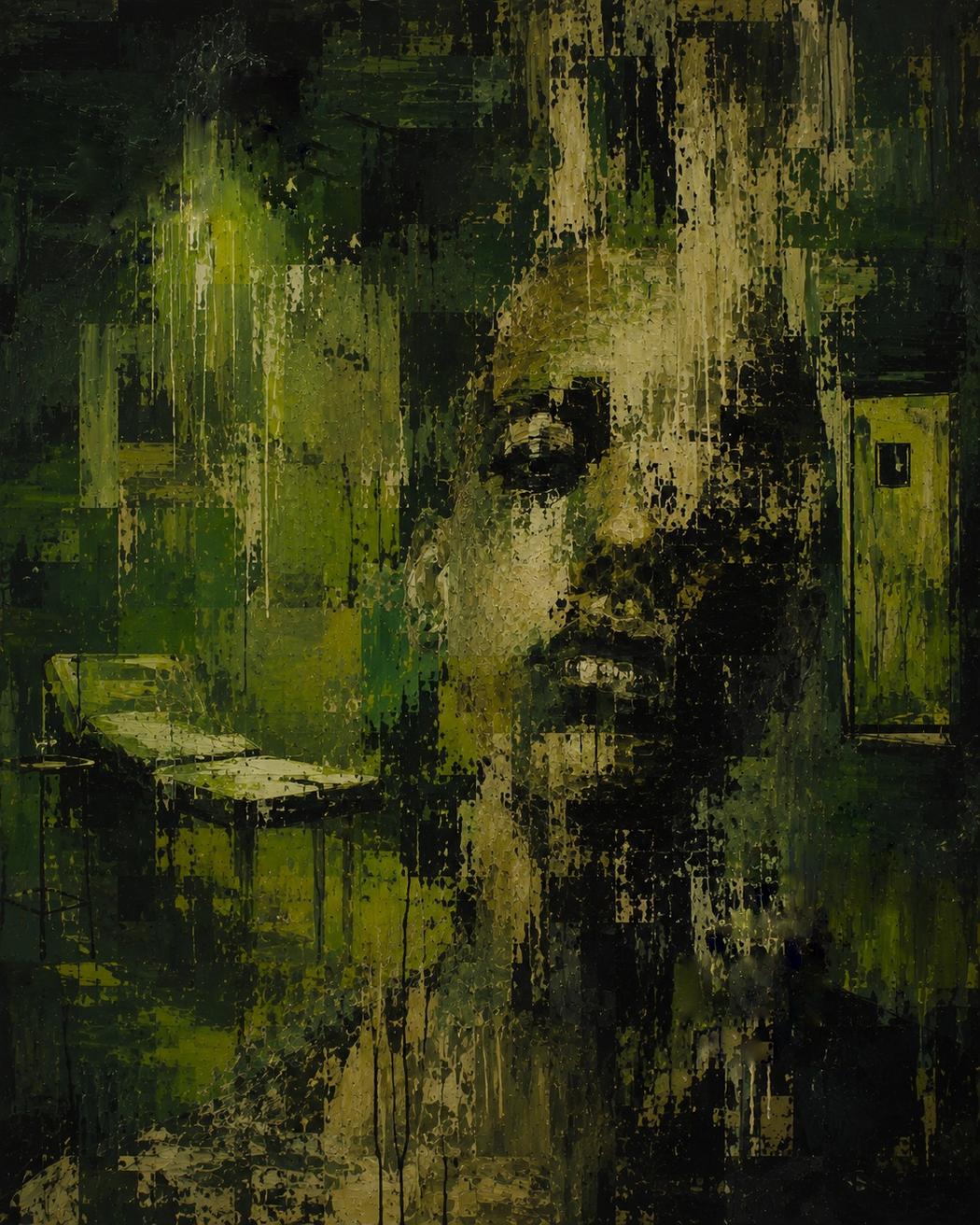 Gabriela Reginata | Green Room | 2025
In your statement, you mention that your works are not meant to document disease, but to translate human experience. How do you avoid a purely clinical reading of the body?
Clinical observation seeks precision and certainty, whereas my work is more concerned with atmosphere and emotional resonance. I intentionally avoid presenting the body as something to be analyzed or diagnosed. Instead, I use abstraction and ambiguity to shift attention toward sensation, memory, and psychological presence. Even though medicine shaped the way I observe details, painting allows me to move beyond the clinical and into something more poetic and human.
How does your experience of observing patients affect the way you understand identity, fragility, and memory?
Working with patients made me aware of how deeply the body shapes a person’s sense of self. Small physical changes can alter confidence, intimacy, and the way someone occupies space in the world. Those encounters taught me that fragility is not exceptional, it is universal. I also became fascinated by how memory seems to exist physically, through posture, tension, scars, or gestures that reveal experiences words often cannot articulate.
 Gabriela Reginata | Lunar Anatomy | 2026
What do you hope viewers feel or question when they encounter your work?
I hope the work creates a moment of pause, a space where viewers become more aware of their own relationship with the body, perception, and emotional exposure. I’m not interested in giving fixed meanings. Instead, I want the paintings to feel open, intimate, and slightly unresolved, so that each viewer can enter them through their own experiences, emotions, and memories.
Leave a Reply
You must be logged in to post a comment.