
Moozhan Gholinataj
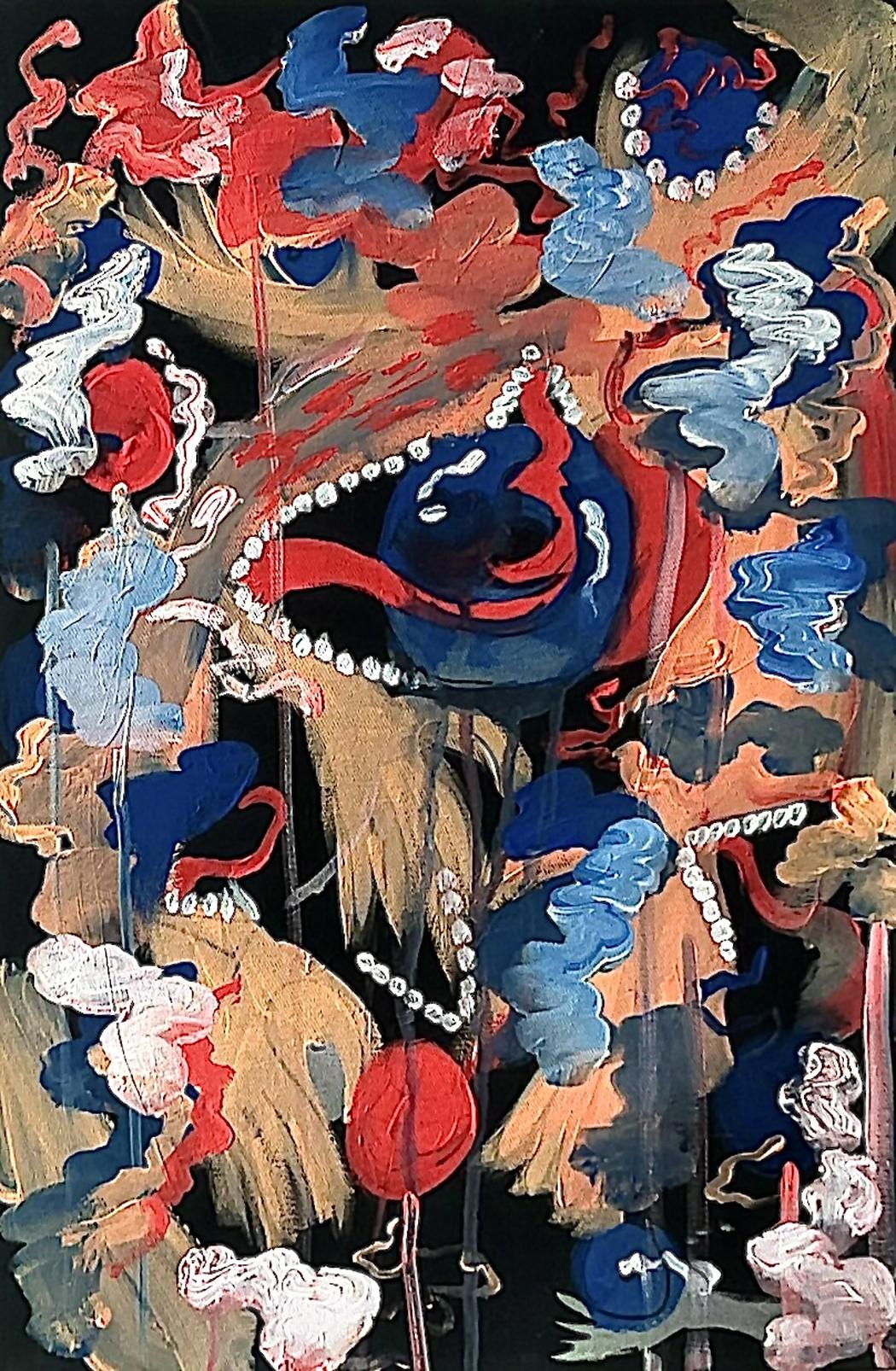 Moozhan Gholinataj | Sky Is Watching You | 2025
Your paintings balance between recognizable human features and abstraction. How do you decide when a figure should remain visible and when it should dissolve into gesture and color?
I let the figure disappear when the emotion becomes too heavy for anatomy to contain. Sometimes a face can carry the weight of a feeling, and sometimes it breaks under it. I am interested in that moment of collapse — where the human form stops behaving like a body and starts behaving like memory, like a wound, like a distortion.
For me, color and gesture are not decorations around the figure; they are extensions of its psychology. A brushstroke can sometimes say more than an eye or a mouth ever could. I keep parts of the figure visible so the viewer has something human to hold onto, but I allow the rest to dissolve because emotions are never experienced in perfect clarity. They blur, fracture, fade, and return. My paintings exist somewhere between recognition and disappearance, because I think that is where the most honest version of a person lives.
Many of your works feel emotionally intense and psychologically charged. What role does emotion play in your creative process?
Emotion is the beginning of everything for me. I do not start a painting with a fixed image in mind — I start with a pressure, a tension, something unresolved sitting inside me. Painting becomes a way of confronting it before it disappears or hardens into silence. Sometimes I feel like I am not painting faces or bodies at all, but emotional states trying to become visible.
I am not interested in creating calm or perfect images. I am more drawn to contradiction, fragmentation, vulnerability — the parts of being human that people usually try to hide. That is why my works often feel psychologically intense. I want the canvas to carry traces of conflict, hesitation, memory, and even violence in the way the layers interact with each other. For me, emotion is not an addition to the work; it is the structure of the work itself. Without it, the painting feels empty, no matter how visually successful it is.
Your background in architecture seems to influence the structure of your compositions. In what ways has architectural thinking shaped your artistic language?
Architecture taught me how to think about tension, rhythm, balance, and structure — not only physically, but emotionally. Even when my paintings appear chaotic or fragmented, there is usually an invisible framework holding them together. I think architecture trained my mind to search for relationships between forms, empty spaces, weight, movement, and direction.
At the same time, painting became a place where I could break away from the precision and control that architecture often demands. In architecture, everything needs to function. In painting, I am more interested in emotional function rather than physical function. But I still carry architectural thinking into the canvas: layering, composition, spatial depth, and the way elements communicate with each other. Sometimes I feel like I am constructing psychological spaces rather than buildings — spaces made out of memory, emotion, distortion, and confrontation instead of concrete and steel.
The faces in your paintings appear fragmented, layered, and constantly shifting. What attracts you to distorted representations of the human figure?
I think distortion feels more honest to me than perfection ever could. Human beings are not emotionally stable or visually fixed creatures — we are constantly shifting between different versions of ourselves depending on memory, fear, desire, pressure, or even the way we are perceived by others. I try to capture that instability. A fragmented face feels closer to the truth of being human than a perfectly controlled portrait.
I am drawn to the moment where a face begins to fall apart but still remains recognizable. That tension interests me deeply, because it mirrors the way identity behaves in real life. We carry contradictions, hidden emotions, fractures, and multiple selves at the same time. Through distortion, I can push the figure beyond documentation and closer to psychology. The layers, smudges, and broken forms become traces of emotion rather than just physical features. In a way, I treat the human face almost like a landscape of pressure, memory, and confrontation.
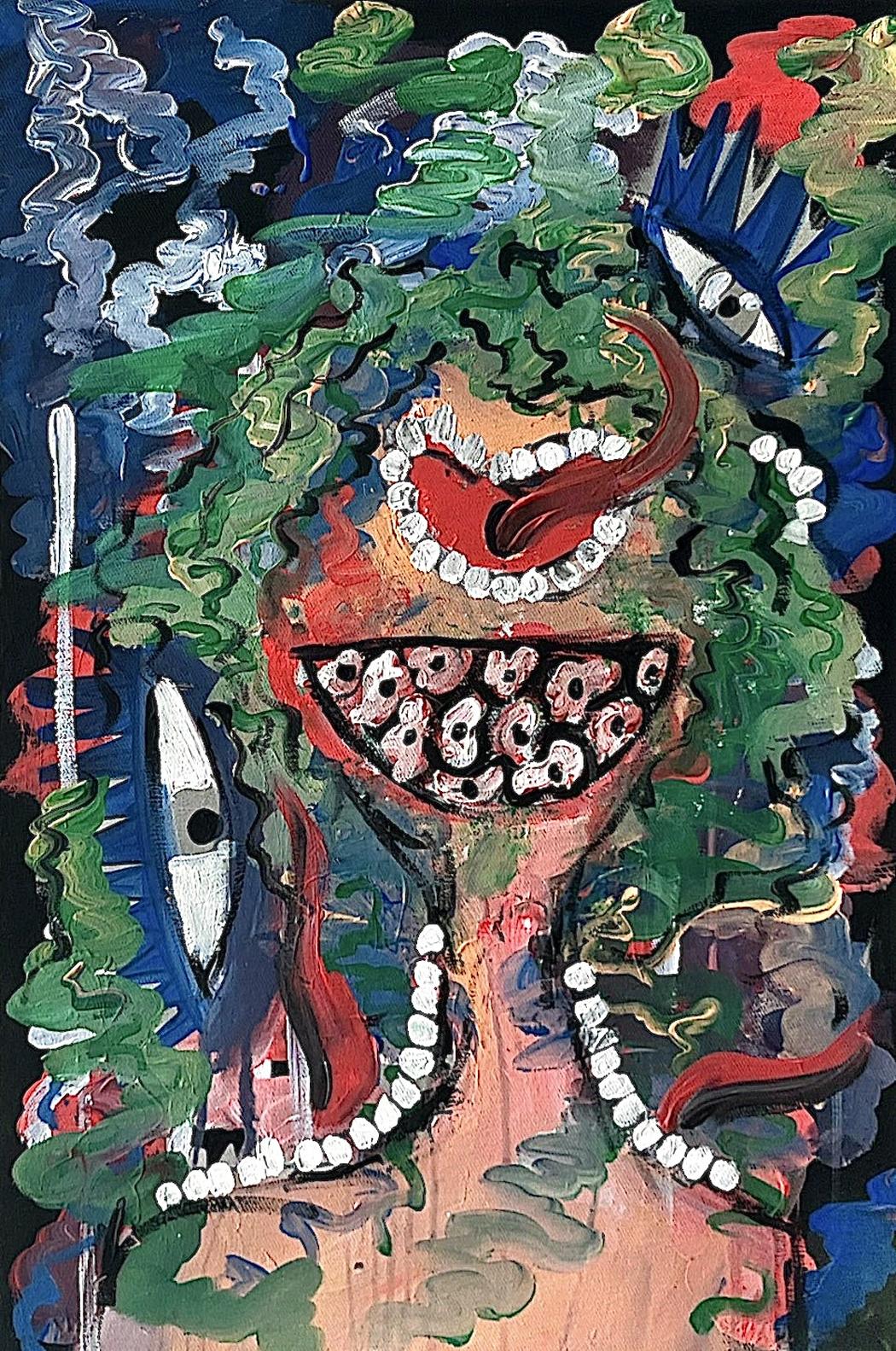 Moozhan Gholinataj | Smile | 2025
Your use of color is bold and confrontational, yet also deeply expressive. How do you approach color emotionally and conceptually?
For me, color is emotional before it is visual. I do not use it to recreate reality — I use it to distort reality until it begins to feel emotionally true. Sometimes a violent red can carry tension better than a facial expression, or a sickly green can communicate psychological discomfort more honestly than realism ever could. I think of color almost like another language operating underneath the figure.
I am attracted to colors that clash, bleed into each other, or create discomfort, because human emotions are rarely clean or harmonious. At the same time, I try to balance confrontation with vulnerability. Even the most aggressive colors in my paintings usually contain something fragile underneath them. Conceptually, color becomes a way of exposing internal states that cannot always be explained through form alone. It allows the painting to exist somewhere between beauty and collapse, intimacy and violence, attraction and unease.
Your paintings often evoke ambiguity rather than clear narratives. How important is interpretation and imagination from the viewer’s side?
Interpretation is extremely important to me because I never want the painting to feel closed or fully resolved. I am not trying to give the viewer a fixed story with a single meaning. I want the work to behave more like memory or emotion — something unstable, fragmented, and open to projection. The ambiguity creates space for the viewer to confront their own experiences inside the painting rather than simply observing mine.
I think the most powerful artworks are the ones that continue changing depending on who is looking at them and what they carry within themselves. That is why I intentionally leave gaps, distortions, and unresolved tensions in my work. I want people to question what they are seeing instead of consuming it passively. In a way, the painting is only completed when the viewer brings their own imagination, fears, memories, and emotional history into it.
Living and working in Istanbul, a city shaped by contrasts and layered histories, does the surrounding environment influence your practice?
Absolutely. Istanbul feels like a city constantly existing between different realities at the same time — between continents, histories, cultures, decay, modernity, chaos, and beauty. I think living in an environment with that much tension inevitably shapes the way I see and create. There is a kind of emotional density in the city that I connect to deeply. Nothing ever feels completely stable or singular here, and I think that sense of fragmentation naturally enters my paintings.
What influences me most is not necessarily specific buildings or locations, but the psychological atmosphere of the city itself. Istanbul can feel overwhelming, intimate, melancholic, aggressive, and poetic all within the same moment. I think my work absorbs those contradictions. Even the layering in my paintings sometimes feels connected to the layered nature of the city — histories existing on top of each other, identities colliding, things constantly being built while other things disappear. Living here has made me more sensitive to tension, contrast, and emotional complexity, which are central to my artistic language.
Leave a Reply
You must be logged in to post a comment.