House of Iris (Grace Farren-Price)
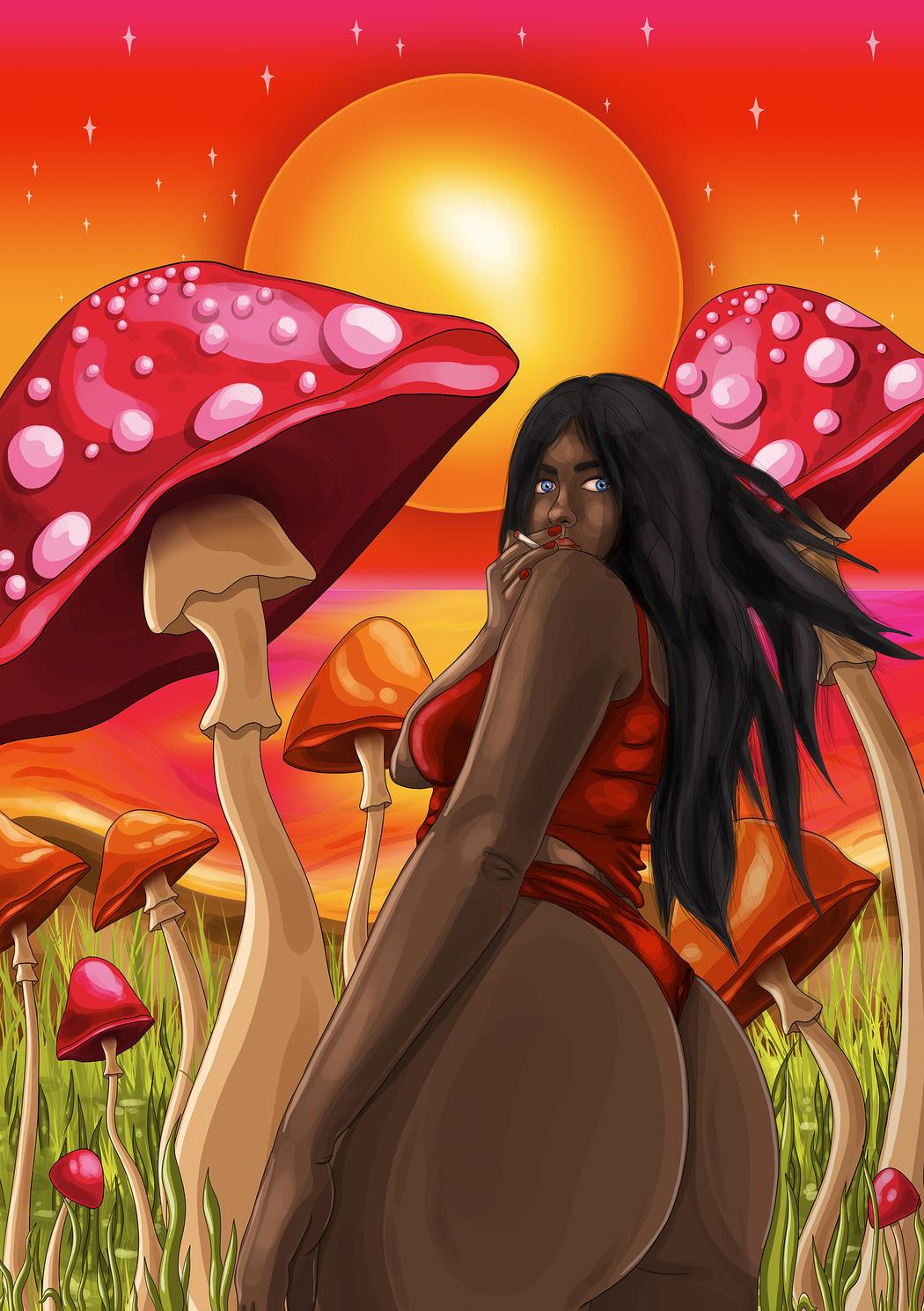 House of Iris (Grace Farren-Price) | Babe | 2024
Your art feels like a vivid dream – full of surreal colors and feminine energy. How do you begin a new piece? Is it born from a vision, a feeling, or a story?
My art starts as a vision in my mind’s eye, although the way this is inspired and developed changes for each piece. There is no singular route or process that I follow, so everything I make tells a different story. Sometimes the concepts or images seem to appear in my mind out of nowhere, other times they are built around a particular element I’m envisioning or contemplating. If there is a particular feeling I want to draw with, I just sit with that feeling in my imagination until I find a place to start. These thoughts often begin with, ‘Wouldn’t it be cool if…?’. Wouldn’t it be cool if you could step inside a forest of human-sized mushrooms? If you could see spectacular planets on the horizon? If mountain ranges were magenta and violet? If a field of grass was so tall it could envelop you? If sun-lit sky was also full of stars? I think it would be sublime. Another common starting point for my work is music, usually a song that I’ve had stuck on repeat that feels like the backdrop to an imaginative realm. It’s never about directly basing the artwork on a song, but a specific song might create the atmosphere I need to become fully inspired by an idea. I also play around a lot with the world as I’m creating it. So perhaps the piece started as one idea in my head and transforms into another as I’m drawing. The digital medium allows for more freedom with that, which I love. As the artist, you’re still only discovering the image as it evolves. I’m not one to have a set plan or sketch before I begin. Instead, I have a rough idea and I’m mostly piecing it together along the way. One aspect that does remain consistent across my work is an expression of fantasy, wonder and escapism. I feel like my drawings are portals into the worlds I dream of stepping into and exploring.
Colour plays a major role in your work. How do you choose your palette, and what emotions do you hope to evoke through these intense tones?
Bright, saturated colours are an essential feature in my art, which is certainly obvious from looking at my work. My use of colour is perhaps somewhat untraditional. I choose my palettes intuitively as I go, and I’m still learning how to do this effectively. This can also become a process of trial and error, figuring out what colours are right for the piece while I’m creating it. That’s another reason why digital art resonates with the way my mind works – mistakes can be learned from yet still ‘fixed’. When people comment on the vivid colours in my work, I simply explain that being surrounded by them brings me joy. Living in a space filled with colour feels just like looking out at a blue sky on a summer day – the world itself feels like a brighter place to be. That’s what I’m hoping my art can bring to other people’s lives, too.
The female figure appears often in your art – powerful yet serene. What does femininity mean to you in the context of your creative world?
I do love centring my art around female figures, and not only because they are beautiful. The empowerment of women that has continued to evolve over my lifetime is so important to me as a woman myself. Particularly the movements I’ve seen around confidence, body positivity, and self-love. My art focuses on the female form as that’s where I resonate with my own experiences and struggles. The places I draw are the reflections of the female figure(s) who resides within them. Drawing an idyllic, trippy or dreamy landscape is one part of the enjoyment, but having a subject inside that world adds another layer of depth. It turns a landscape into a story, each woman with her own unique personality and vibe that draws you into her realm. It gives context to the world she is in and really brings life into it.
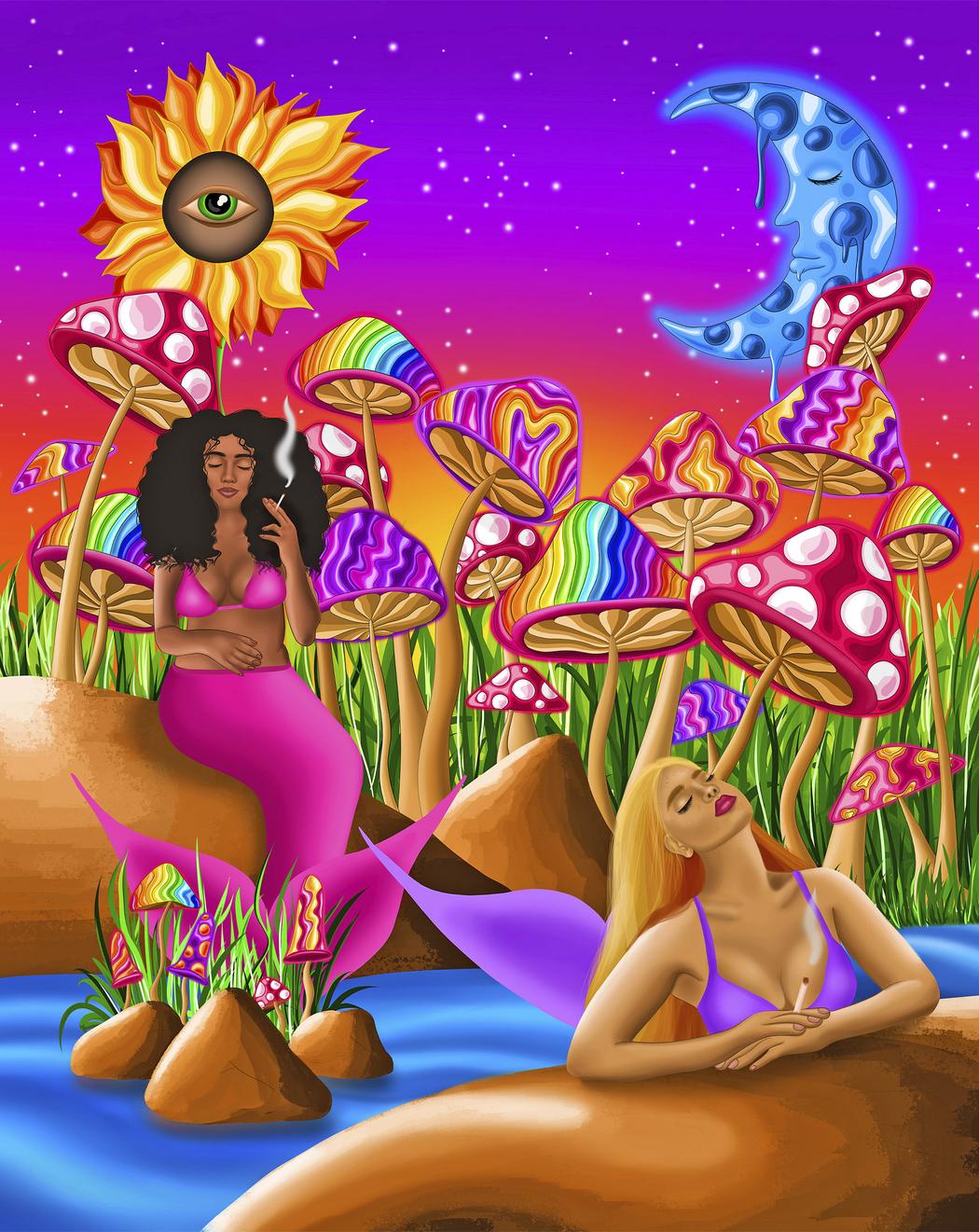 House of Iris (Grace Farren-Price) | Day Dreamers | 2024
Many of your compositions feature mushrooms, celestial skies, and giant flowers. Are these recurring motifs symbolic for you, or do they emerge intuitively?
The world of my art is always full of celestial, magical elements and it can be hard to put the ‘why’ behind this into words. It’s about the feeling of it all for me – the excitement and imagination. The realms I draw are the places I wish I could step into, and drawing them is the closest I can come to that. I suppose the way they emerge in each piece feels both intuitive and symbolic. Intuitive in the sense that these elements seem to be revealing themselves to me as I draw, and symbolic in that they represent imagination, dreams, spirituality, and a connection to nature’s inherent beauty.
Your worlds feel like portals – half fantasy, half meditation. How does mindfulness influence your creative process?
It’s really the creative process that influences my mindfulness. I was a very anxious child and I’m still quite an anxious adult. Although I’m learning to push through fear more as I get older, this growth is not linear. A lot of my personal anxiety involves ruminating and fixating on intrusive thoughts of all the things that could go wrong in life. So, in a sense anxiety is the very opposite of mindfulness. Making art is one of the rare times where I get a break from these thoughts, particularly in sessions where I enter a ‘flow’ state. When I’m so focused on the piece and its details, it takes me outside of myself for a while and my mind doesn’t have the opportunity to throw negative thoughts at me. Plus, the process of seeing something come to life is so rewarding and generally gives me all the good feelings. Sometimes there is frustration when things aren’t quite working in a piece, but I generally find these moments to be engaging challenges to problem solve. So, I’d say that my creativity allows me to be more mindful, and in doing so, the mindfulness allows me to be focused on my creativity. They feed each other in that way.
What do you find most rewarding about working digitally, and what do you miss from traditional painting techniques like acrylics or watercolour?
Working digitally was an incredibly discovery for me, something that really resonated from when I first started around 2020. It’s an interesting medium because it involves mixing traditional art techniques with an entirely different digital skillset. I’ve used computer software since childhood to create images and videos, so it feels relatively intuitive for me but I’m still always discovering new digital techniques. I work in Photoshop which is a bitmap/raster software, as opposed to vector software which I find many artists tend to use instead. The advantage of vector graphics is that the piece can be scaled up and down without any quality loss, but I’m happy to sacrifice this flexibility as I love being able to draw the same way I would on a piece of paper. There are so many other reasons that I love the digital medium too. First, being able to mix incredible vibrant colours and experiment with such ease. Another huge advantage of this medium is, in all honesty, the magical ‘undo’ button that gives me room to make mistakes and changes without stress. It takes away the pressure for everything to be perfect in the first go. Another fantastic part of the digital medium is the unlimited copies I can print without worrying about protecting the precious original – because there really isn’t one. Sometimes I do like to spend time making art through more traditional methods. Mainly drawing, watercolour or acrylic paint. It’s a different thing for me – less about creating the final piece and more about the process. What I love and occasionally miss about these more traditional mediums is the break from staring at a screen, the ease of set-up in any location, and most of all the connection with real materials. For sure there is something very grounding about a piece of paper or canvas that can’t be replaced. I have space for both in my practice but ultimately the digital medium is where I’m most excited and focused.
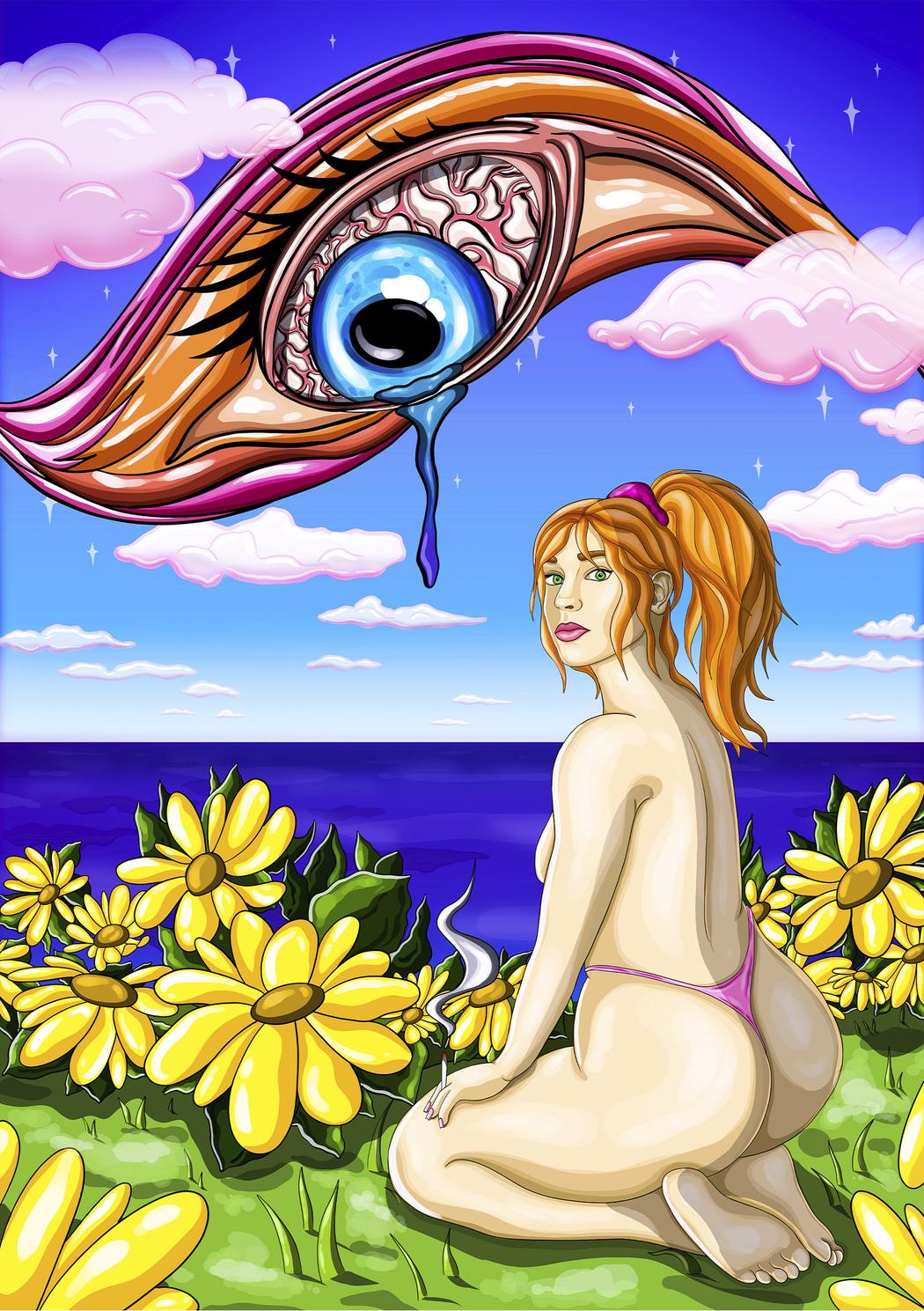 House of Iris (Grace Farren-Price) | Eye Of The Tide | 2024
You mentioned that creating art puts you into a flow state where everything else fades away. Can you describe what that experience feels like?
The flow state is something exceptional that I have been lucky to experience many times in my practice. Explaining this properly goes back to psychology – I’m currently completing my bachelor’s degree. I can recall a lecturer explaining ‘flow’ as a state where you are so engaged in an activity that you lose your sense of time, exhaustion, hunger, and are just totally immersed in the task at hand. It was this moment where I realised that flow is exactly what I (often) experience when creating art. The flow state has also been shown to correlate with mindfulness, so it’s really an extension of the concept of being in the present moment. For me, the experience feels like falling asleep or getting to the end of a long drive – it’s a different state of consciousness that you suddenly ‘wake up’ from, wondering where all the time has gone. I don’t enter the flow state every time I sit down to draw, but when it does happen it’s very special and rewarding. For anyone who worries like me, finding something creative to immerse yourself in could be well worth a try to give your mind a break and connect with the present.
Leave a Reply
You must be logged in to post a comment.