
Shubei Zheng
You describe your artistic practice as growing from music, storytelling, and emotional expression. How have these different creative languages shaped the way you think visually?
I believe every visual image carries a story or sentiment, and every image has its own tone. When I look at a piece of art, I can almost imagine a particular piece of music, a beat, or a melody that belongs to it. The relationship also works in reverse. When I have a theme or subject in mind that I want to create, there is often already a corresponding tone, melody, or shade in my mind. That feeling eventually finds its way into the drawing through my lines, strokes, techniques, shading, and composition. In that sense, I don’t just think about how a drawing should look. I think about how it should sound and how viewers would feel looking at it.
Storytelling has taught me to think about visual art as a form of communication. A compelling story needs focus, meaningful details, a sense of narrative, and compassion for the people who are receiving it. I think visual storytelling requires the same sensitivity. Every element in a drawing needs to have a reason for being there, while the smaller details can give viewers something to discover and connect with emotionally. I want my work to communicate something without explaining everything. Of course, different people can have different interpretations based on their own life experience and mental status.
Emotional expression has perhaps shaped me most deeply. I often begin with a feeling rather than a purely visual idea. I think about what an emotion might look like if it could exist as a space, a line, a shadow, or an object. Sometimes something as simple as distance, emptiness, fragmentation, or a familiar object can carry a great deal of emotional weight. I am especially drawn to the emotions that are difficult to put into words: nostalgia, longing, tenderness, loss, and the feeling of remembering something that no longer exists in quite the same way. This is also why I am drawn to black and white. Without colour telling the viewer how to feel, there is more room for personal interpretation.
As a primarily self-taught artist, how has learning outside a formal art-school environment influenced your technique, intuition, and sense of artistic freedom?
To be honest, I don’t have a professional way of measuring my own technique because I don’t come from a conventional art education background. I took some drawing lessons when I was a child, and I have had some exposure to art through my education, but most of what I do today has developed through observation, experimentation, and simply drawing.
That may be one of the biggest disadvantages of being a self-taught artist in the professional art world. I don’t always know the formal terminology for what I am doing, or whether my approach would fit within a particular established technique. But at the same time, I think it has given me an unmatchable kind of freedom.
I never learned to think that there is only one correct way to make a drawing. I don’t have a set of rules in my head telling me that a particular technique is necessary before I am allowed to express an idea. If I want a line to be delicate, fragmented, rough, repetitive, or almost imperfect because that is what feels right for the subject, I allow myself to follow that instinct. The technique serves the emotion, rather than the emotion having to fit within the technique.
I am less concerned with whether something is academically “correct” and more concerned with whether it feels truthful to what I am trying to express. I have learned not to let the possibility of criticism dictate what I create.
For me, drawing is deeply personal and almost spiritual. I often think of my artwork as a way of documenting my thoughts, memories, observations, and emotions. Most of the time, I am not consciously trying to create something for an audience. I am simply trying to give a visual form to something that exists inside me.
I don’t think creativity has rigid rules. Of course, there is always more to learn, and I value learning. But being self-taught has allowed me to discover my own visual language along the way. That sense of freedom, intuition, and personal connection is something I would never want to lose.
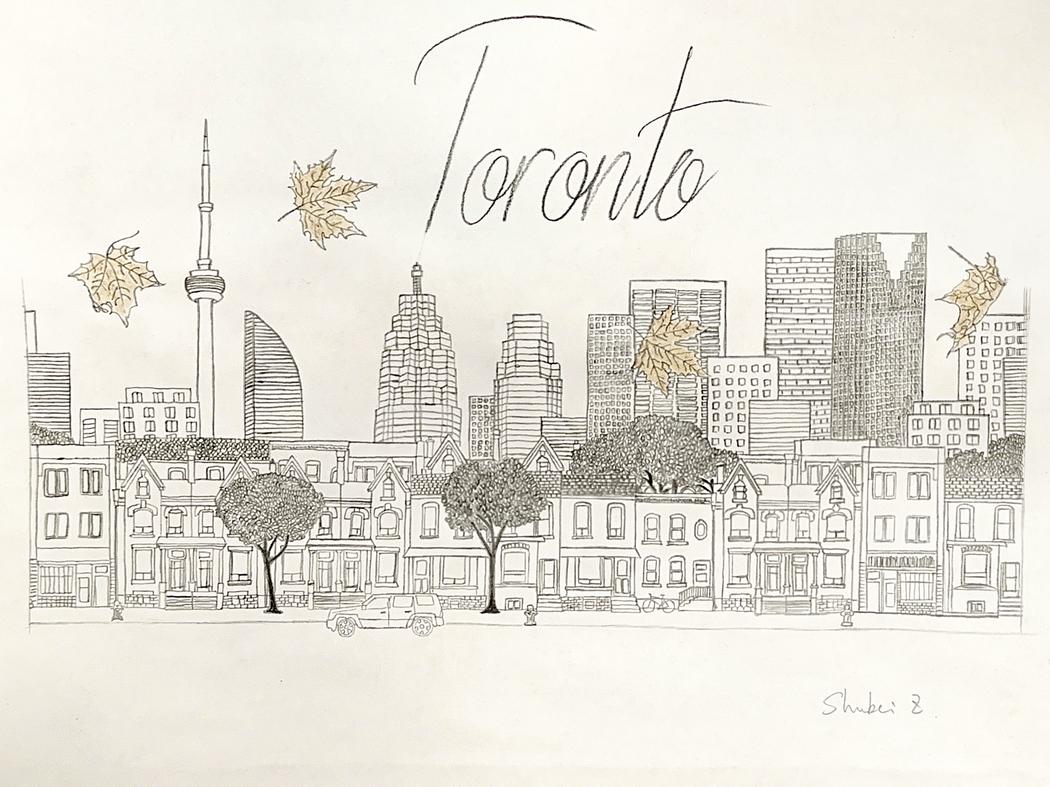 Shubei Zheng | Toronto Cityline With Coffee Colored Maple Leaves | 2025
You often work in black and white because it allows viewers to bring their own emotional “colour” to an image. In Toronto Cityline with Coffee Colored Maple Leaves, however, you introduce subtle touches of colour. What led you to this decision, and how does colour change the emotional atmosphere of the work?
As I mentioned earlier, my drawing process is largely intuitive and improvisational. I don’t always begin with a fixed plan for how a piece should look.
With Toronto Cityline with Coffee Colored Maple Leaves, the subtle touch of colour felt natural because of the subject. I’m from Toronto, the golden maple leaves immediately evoke Canadian autumn for me. I wanted to capture that familiar Toronto fall atmosphere, but I didn’t want the colour to overpower the drawing. A small amount of warm, coffee-toned colour was enough to give the piece a richer and more tactile feeling of autumn while allowing the black and white elements to remain the foundation.
The colour also has a personal meaning. The coffee I used was actually from a local coffee roaster that I visit regularly. So although the coffee creates a visual effect in the drawing, it also connects the work to a real place and part of my everyday life. I like that the material itself carries a small piece of the experience I was trying to capture.
In that Toronto cityscape, historic residential buildings are placed against a modern skyline, while maple leaves drift across the composition. Is the work primarily a portrait of the city, a personal memory, or a reflection on belonging and change?
I would say the work is more a reflection on belonging and change.
I came to Canada only14 years ago, so I consider myself a relatively late immigrant. Unlike people who have grown up in Toronto, or families who have lived here for generations, I didn’t personally witness many of the stages of the city’s history. There is a certain part of Toronto’s past that I can only know through what’s been preserved.
Fortunately, Toronto has done a remarkable job of preserving many of its historic buildings and neighbourhoods. When I walk through these areas, I feel that I can somehow encounter traces of an earlier Toronto. At the same time, the modern skyline reminds me that the city is constantly transforming.
That contrast exists in the same city, but they represent different moments in time. The maple leaves moving through the composition add another layer of transition. They are beautiful and familiar, but they are also temporary. They appear, change colour, and eventually fall.
In that sense, the drawing is also connected to my own experience as an immigrant. I arrived in Toronto and gradually built a life here, while the city itself continued to change around me. I may not share the same history as someone whose family has been here for generations, but over time, I have developed my own memories and emotional connection to this place.
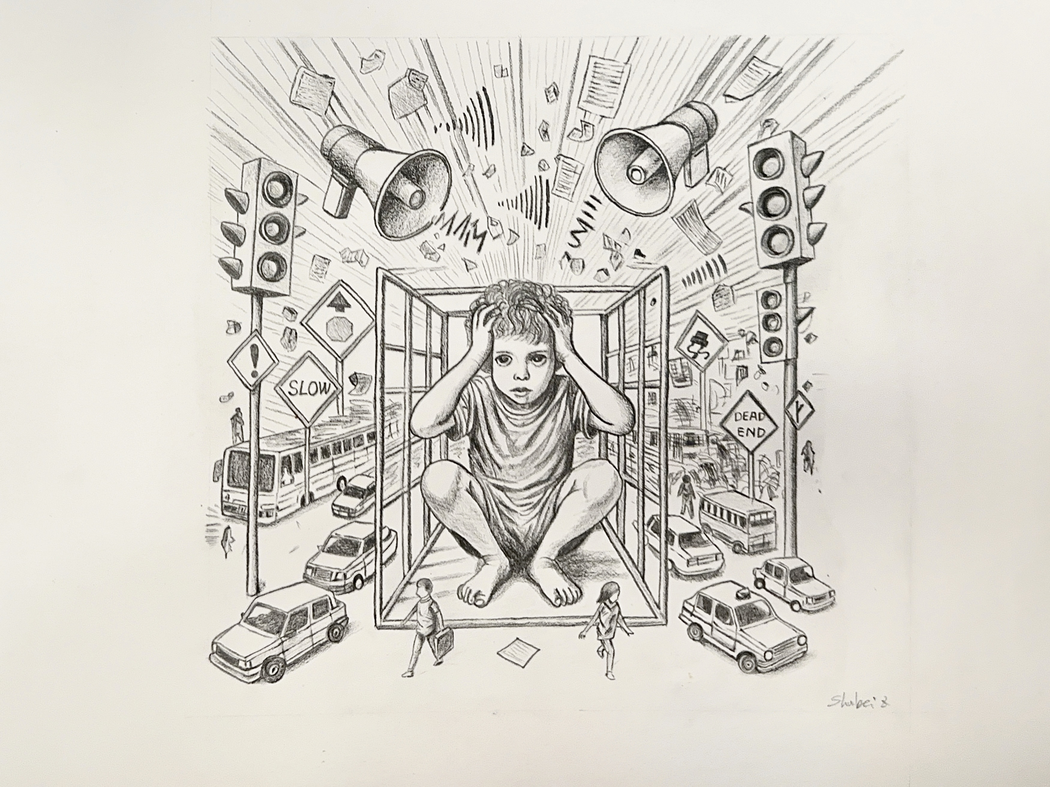 Shubei Zheng | Stormy World | 2025
Your works move between carefully observed architecture and more unstable, psychologically charged spaces. How do you negotiate the tension between control and chaos when constructing a composition?
I think the most important aspect of a work is the message or emotion I want it to convey. That comes before questions of technique or composition. Once I understand what I want the viewer to feel, many of the visual decisions begin to follow naturally: how controlled the composition should be, where the tension or chaos should appear, which elements belong in the image, and where I want the details to shine.
When I am drawing architecture, for example, I may be very controlled with perspective, structure, proportion, and details because that precision allows the character of the building to emerge. But when I am trying to express something more psychologically unstable, I may deliberately allow the composition to become fragmented, crowded, distorted, or less predictable. In those moments, the disruption itself becomes part of the message.
So my process is less about imposing a predetermined composition and more about listening to what the work needs. The emotion tells me where control should exist and where it needs to break down. In that sense, composition becomes another form of storytelling: every line, empty space, detail, and disruption has the potential to contribute to the emotional narrative.
What qualities of graphite and ink – pressure, repetition, erasure, texture, or physical resistance – are especially important to the emotional meaning of your drawings?
What I see in graphite and ink is its unique hint of modesty and subtlety. They don’t demand attention through colour or spectacle. They allow me to build an image through small details, delicate lines, texture, repetition, and changes in pressure, while still leaving a great deal of space for the viewer to enter the work themselves.
I think that restraint is important to the emotional meaning of my drawings. I don’t always want an emotion to be presented very directly. Sometimes I would rather allow the viewer to discover it gradually. A softer line, a denser area of texture, or an empty space can say something without explaining exactly what it means.
There is also something inherently nostalgic to me about working in black and white. It reminds me of an old photograph, a black and white memory, or an old movie. There is a quietness to it that I find emotionally powerful.
Perhaps most importantly, graphite and ink leave room for interpretation. Because there is less visual information telling the viewer exactly what to feel, they can bring their own memories and emotions into the work. I like that my drawing can remain relatively low-key while still holding something intricate underneath the surface.
In that sense, the physical qualities of graphite and ink are not just technical tools for me. Their restraint, subtlety, and ability to capture both detail and silence are part of the emotional language of my work.
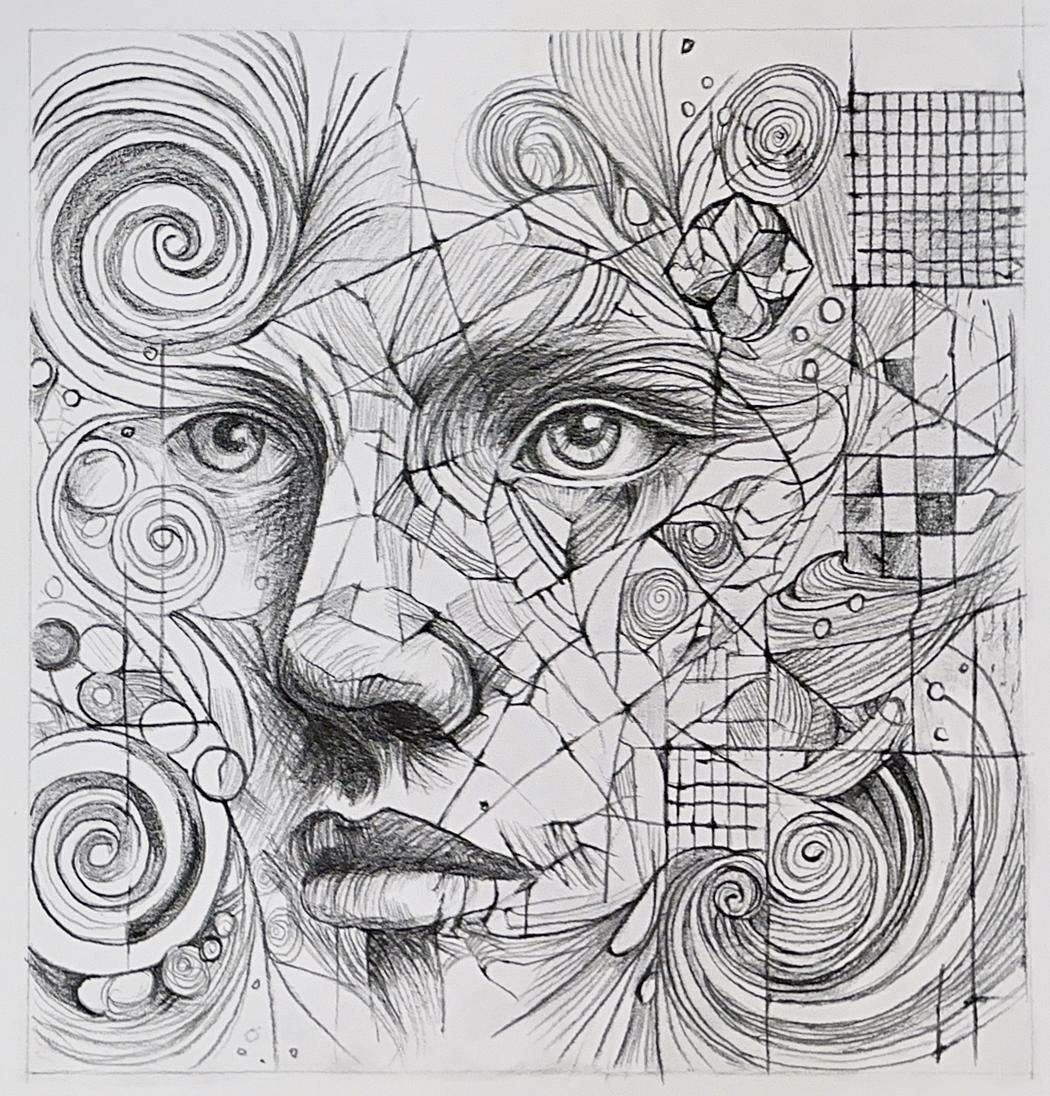 Shubei Zheng | Splintered Identity | 2025
You also work as an actor in theatre, film, and commercial projects. How has performing influenced the way you create characters, frame scenes, and suggest narratives within a single still image?
Performing art has probably influenced my visual storytelling in a very simple way: think of every drawing as a scene.
When creating an image, think of it were a live scene in a film or on a stage, what would it look like? What happened just before this moment? What is happening now? And what might happen immediately after? Even though a drawing captures only one still moment, I want there to be a sense that something exists beyond the frame.
Acting has also made me more attentive to small details. On stage or on camera, a gesture, a look, a pause, or the way a person occupies a space can communicate something without words. I think about visual art in a similar way, except for one being still and one being in motion.