
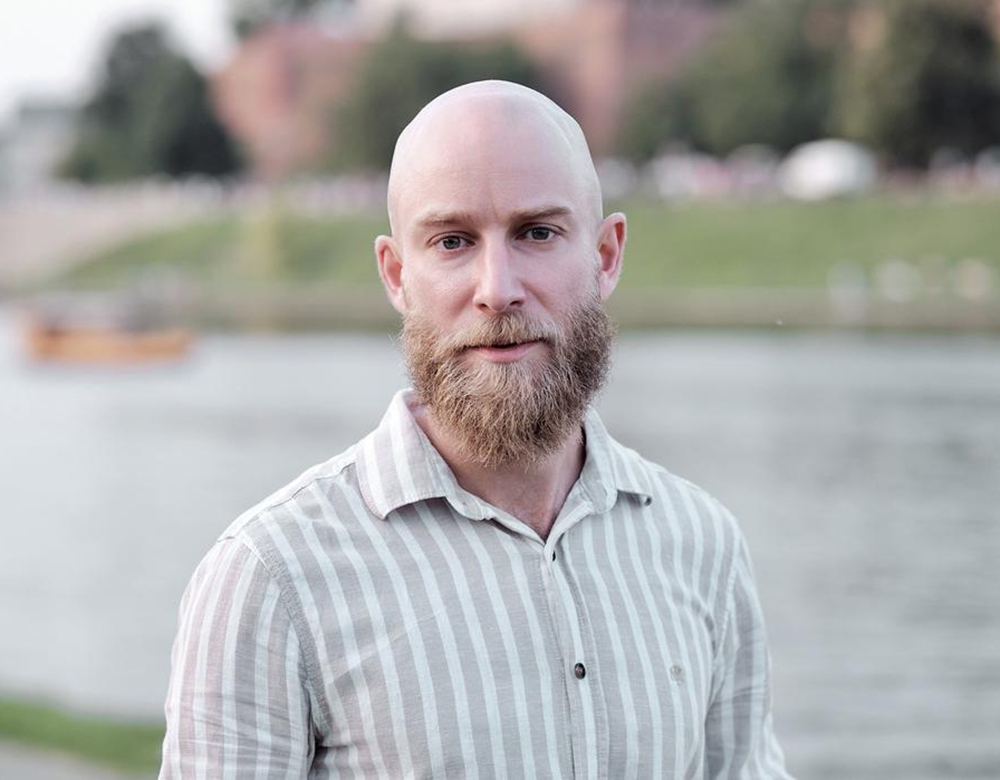
Benoît Flamérion
You describe your approach as “stylized realism”. How did this visual language develop, and at what point did you realize that the balance between realistic observation and cartoon exaggeration had become central to your practice?
Drawing has always been part of my life as I’ve been holding pencils for as far back as I can remember. Very early on, I started copying comics and cartoons like Asterix or the Looney Tunes. That energetic, silly, expressive style was my first visual language.
The more academic side came later. After moving to Poland, I started taking art classes based on still-life observation and copying old masters. That developed my understanding of perspective, volume and light. At that point, I was obsessed with accuracy : getting the proportions right, capturing likeness, making everything “correct”. It really built my discipline.
Once I felt technically confident, something still felt missing. The portraits were accurate, but missing “soul”. They didn’t really feel like me. So I started to play by exaggerating eyes, simplifying lines, pushing certain features, and adding graphic textures. Because the structure was solid, I could afford to have fun with it.
I didn’t plan this mix of realism and cartoon. It just happened. At some point I realized I wasn’t choosing between the two anymore : I was using both, and it felt more honest than sticking to just one. That’s when I started calling it “stylized realism.”
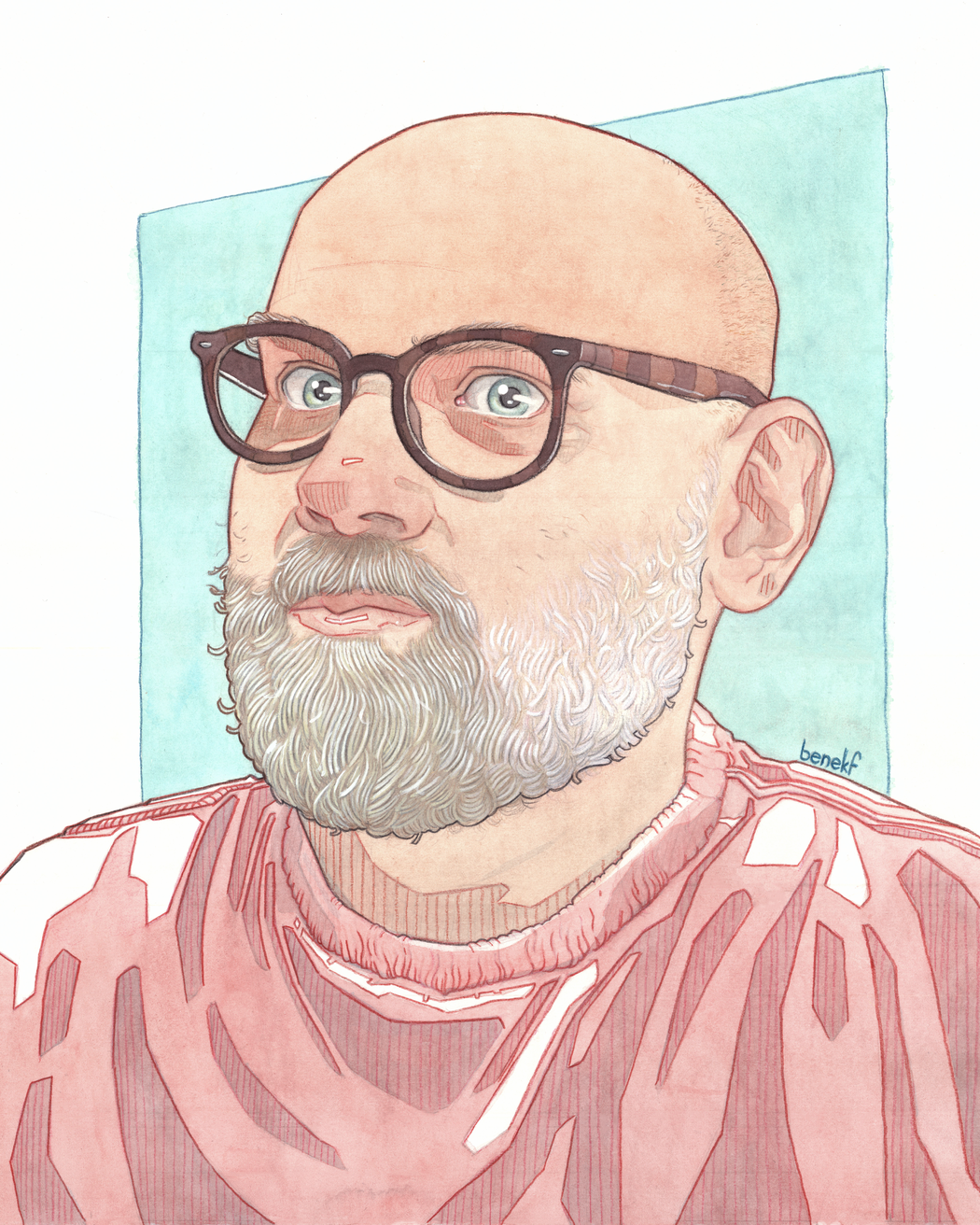 Benoît Flamérion | Radoslaw | 2026
Your work often begins with recognizable forms but quickly moves into something more imaginative and theatrical. How do you decide which elements of reality to preserve and which ones to distort, exaggerate, or reinvent?
My process is quite simple. It starts with an idea, an inspiration, a story that begins to form in my head. Then I browse references : photos from my phone, images from the internet, other artists’ work. I sort out which characteristics will be useful for the way I want to tell the story.
I start with the foundation, making sure it’s solid. Once that’s in place, I start playing : adding details, exaggerating proportions, pushing certain elements. I really let the creative flow come in and I let it go. At this point, I don’t follow any rigid process, it just happens like this.
It’s effortless, because I know I have the academic skills to feel comfortable. That foundation is what allows me to have fun.
Humor is very present in your work, but it often exists alongside nostalgia, cultural memory, or careful observation. What role does humor play for you as a way of looking at people and the world around you?
Sarcasm is kind of my language, so humor naturally finds its way into my work. But it’s never just humor for the sake of it. It’s layered with everything I am : my past experiences, my background, my interactions with people, what I read, what I see. I have an almost inexhaustible source of inspiration.
I often start with a serious topic, like nostalgia or culture, and then turn it into a moment or a cliché with a humorous twist. There’s no deep meaning or gravity in my art. Even if I take art very seriously, I always want to integrate some silliness or fun. It’s a form of warmth that makes the work feel real, human, and sensitive.
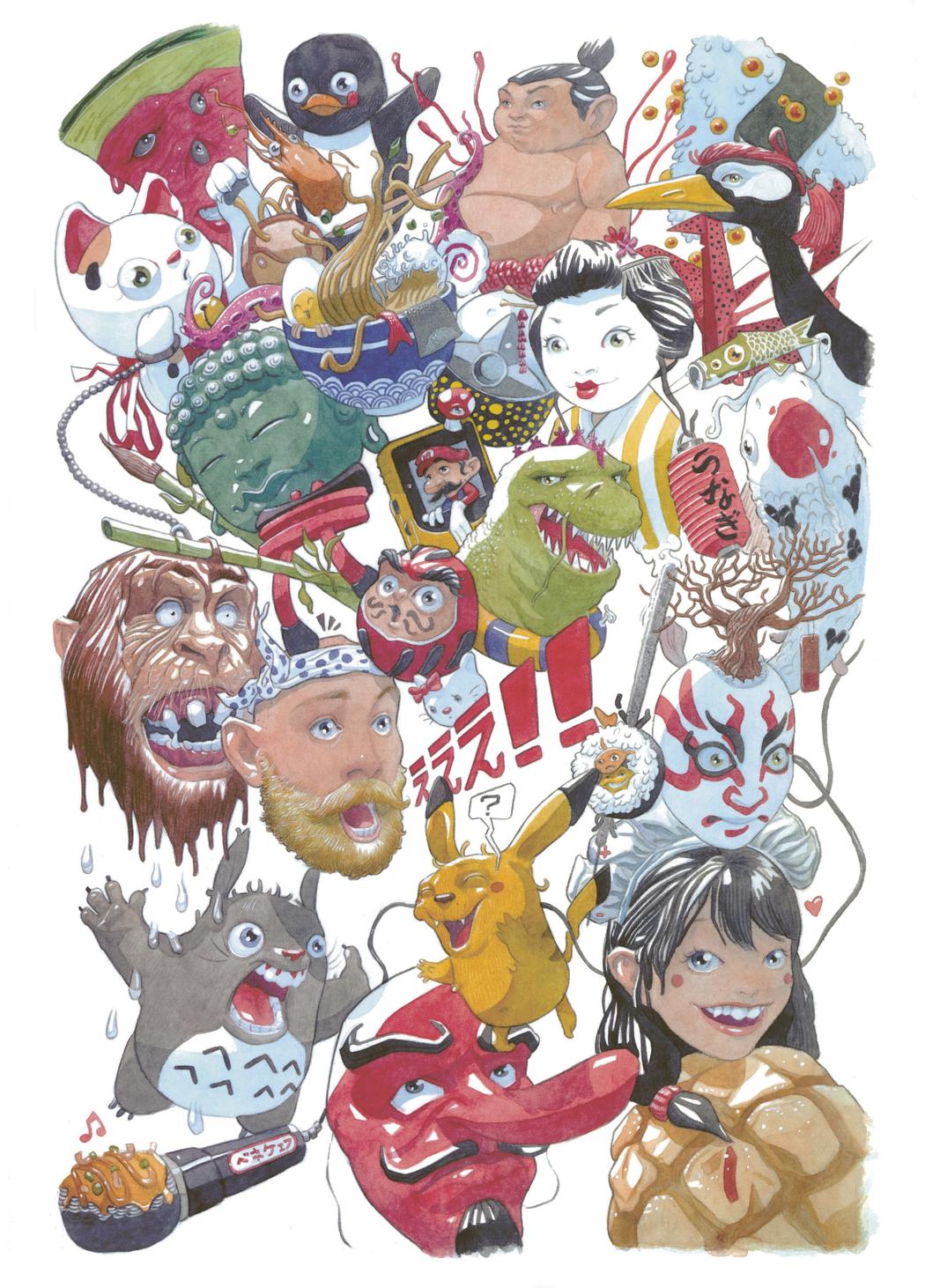 Benoît Flamérion | 40 Days Of Japan | 2026
You mention the influence of Franco-Belgian comics as well as classical painting. These traditions seem very different in their visual language. How do they meet within your work?
On the surface, they do seem very different. Comics are direct, graphic, often humorous, while classical painting is more about light, volume, and a certain gravity. But for me, they share a common concern : how to tell a story through an image.
From comics, I took the clarity of line, the expressiveness of faces and movement. From classical painting, I learned to observe more carefully and to think about light as a way of modeling form and composition.
In my work, these two influences meet in the way I construct a scene. I might use the graphic clarity and exaggerated expressions of comics, but I’ll build the shapes in an academic and realistic way. The result is that you can grasp the scene quickly, but there’s also room to look more closely and discover subtleties.
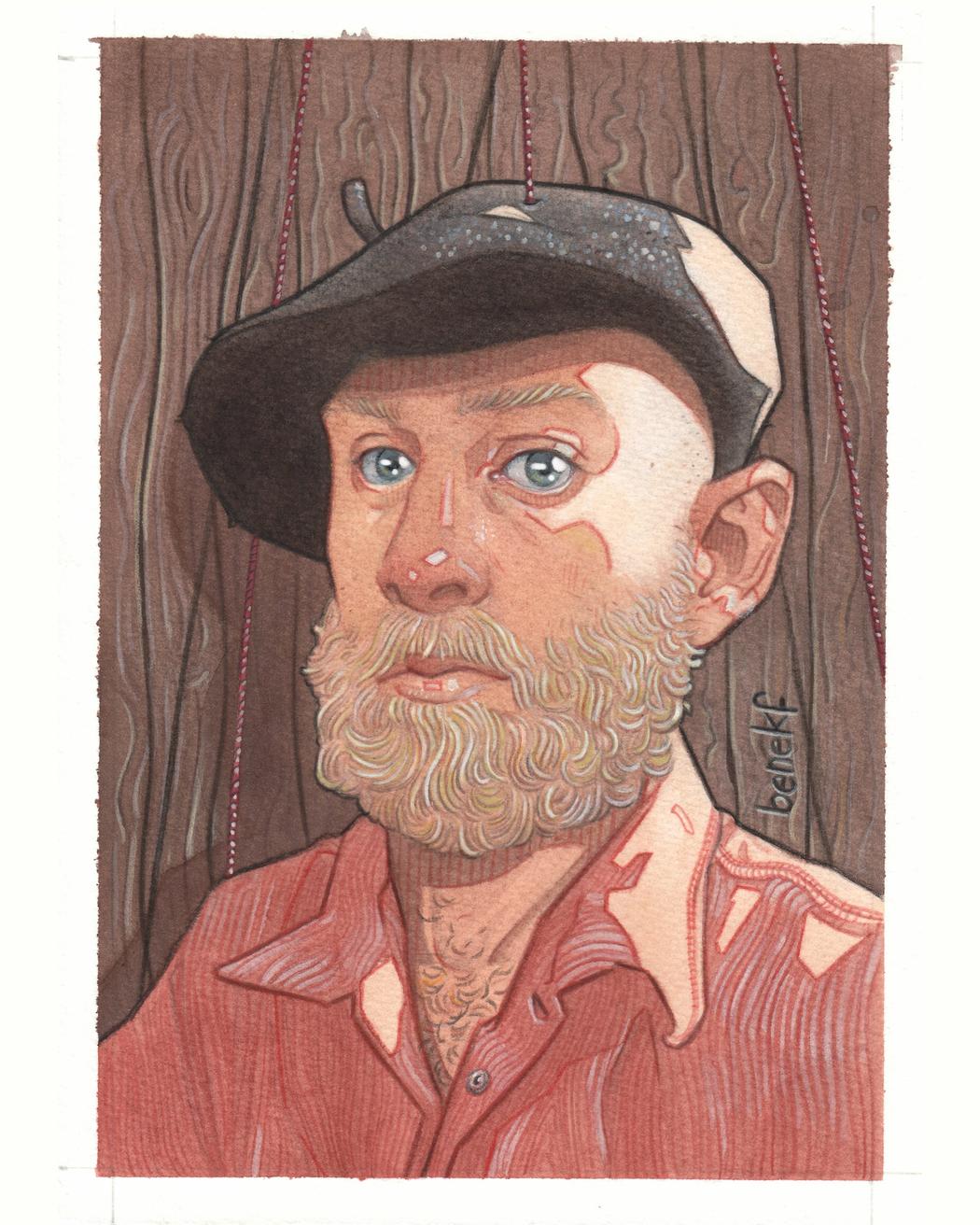 Benoît Flamérion | Autoportrait | 2026
Living in Kraków as a French artist appears to have introduced Polish culture and everyday life into your imagery. How has living in Poland changed the subjects, characters, or visual references that appear in your work?
Moving to Kraków was a turning point, both in my life and in my work. At first, everything felt new and slightly foreign, and that sensation of being an outsider made me observe more intensely.
Over time, Poland became my everyday reality and naturally found its way into my drawings. Traditions, art, history, legends, patterns, language, the way people live and interact… everything started to filter through.
Living here also shifted the emotional tone of my work. There’s a warmth and a certain melancholy in Polish everyday life that resonates with me.
At the same time, I grew up in France and I’m completely French, steeped in French culture, with my own references, my family, my friends. That part of me never disappears. Being between two cultures gives me a kind of double perspective, allowing me to see both the similarities and the differences. That tension is very fertile for storytelling.
Watercolor, gouache, and colored pencil each offer very different qualities of transparency, opacity, and precision. How do you use these materials together, and how much does the choice of medium influence the atmosphere of a work?
Even if my creative flow is somewhat chaotic, with many ideas popping into my head at once, I am very deliberate when it comes to the medium I use. Each material helps me craft a specific effect, and I care about controlling each step.
I almost never do preliminary research or separate sketches. I draw directly on the canvas to keep a certain spontaneity. Once the drawing is done and detailed, I start layering watercolor. I build between five and ten light layers, letting the transparency of the medium create depth gradually.
Between layers, I sometimes use oil-based colored pencils to refine and clean the lines, making sure I don’t lose the initial drawing. As a final touch, I like to use the opacity of acrylics or gouache to add more details, and I return to colored pencils for fine-tuning until I reach a result that satisfies me. In the end, I have a very clear and detailed work that captures the mood I wanted to express.
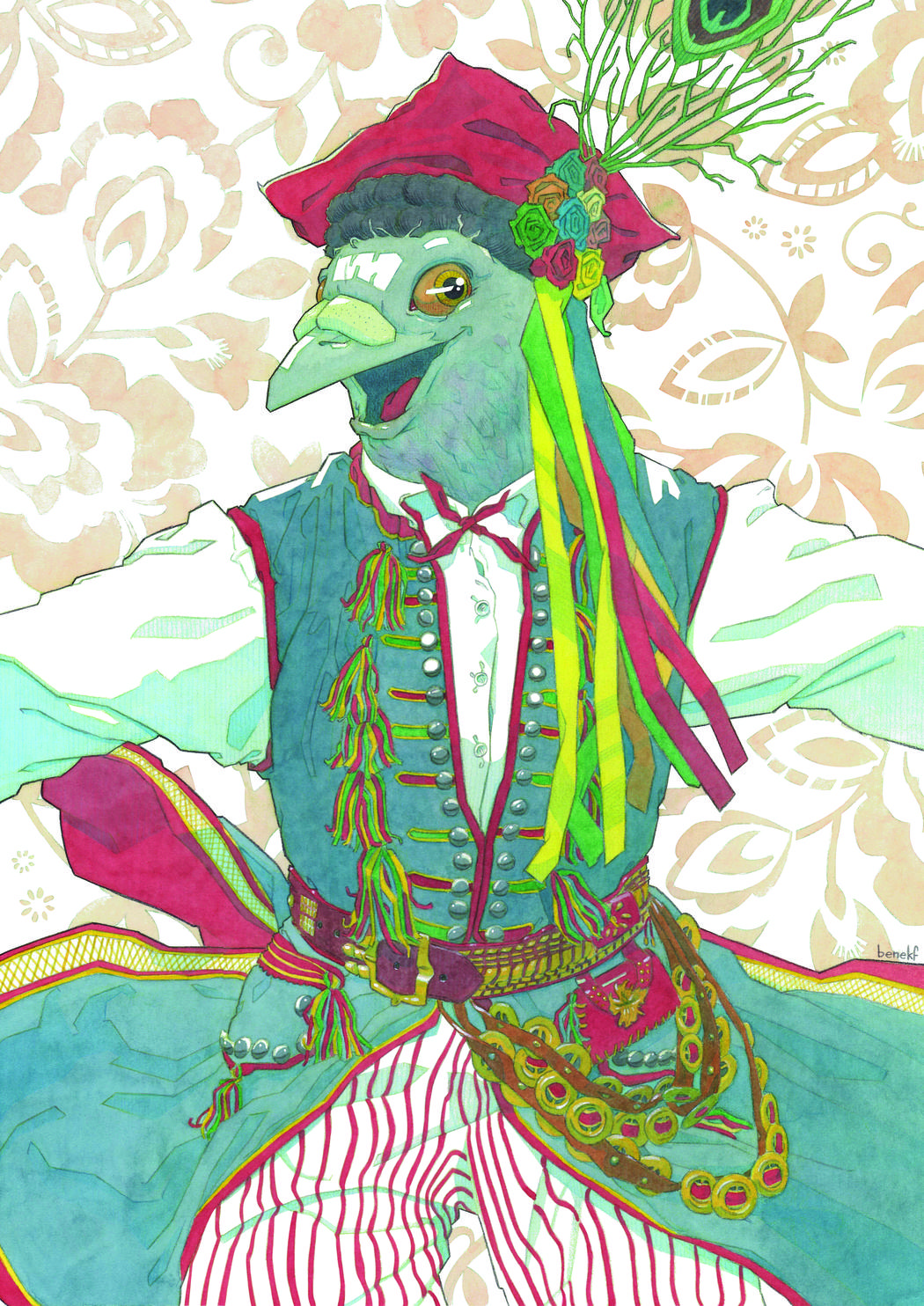 Benoît Flamérion | Meanwhile On Rynek | 2025
Your crowded compositions invite the viewer to keep discovering small details, expressions, and references. Do you deliberately design your images to be read slowly, almost like visual stories, rather than understood at a single glance?
Yes, that’s very intentional. I like the idea that an image can be experienced over time, like a short story or a scene from a film. When I compose a drawing, I think in terms of layers: there’s the main action, readable at first glance, and then secondary actions, small gestures, background details that only appear when you look more closely.
I want the viewer to feel invited to explore the image, to move their eyes around and discover new things each time. These elements create connections and add meaning. They turn the image into a kind of visual narrative where you can keep finding new entries.
This also reflects how I see everyday life: as something dense, slightly chaotic, but full of little stories happening at the same time. A crowded composition is a way to capture that richness and complexity, and to encourage a slower, more attentive way of looking.