
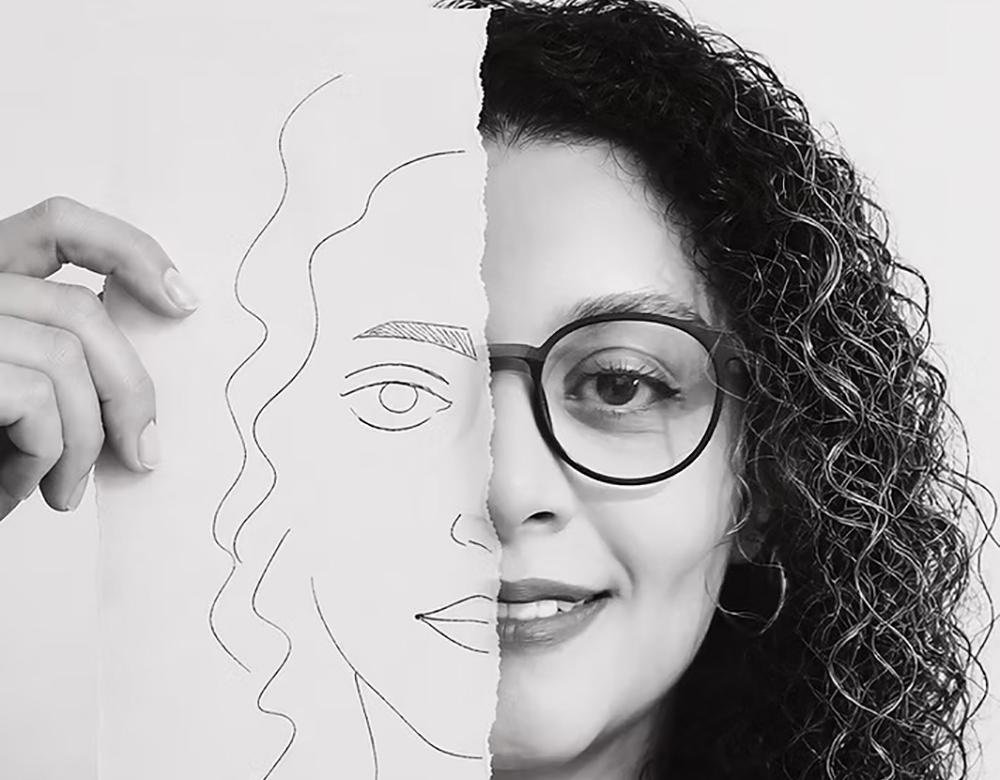
Star (Najmeh) Khani
Critical Review: The Weight of Arrival
by Anna Gvozdeva
Star (Najmeh) Khani’s The Weight of Arrival is a mixed-media photography project in which Brighton’s historic buildings become sites of encounter rather than neutral records. Developed during Fabrica’s Making Space residency in July 2026, the work begins with black-and-white architectural photographs, removes selected details to create blank apertures, and then fills or frames these absences with hand-drawn imagery. The sequence is clear – observation, erasure, reimagining – but its effectiveness lies less in the stated theme of migration than in the visual tension Khani creates between the monumental and the fragile.
The strongest image centres on St Bartholomew’s Church. Khani photographs the facade from a low viewpoint, allowing the dark brick mass to press upward and beyond the frame. Within its great circular opening she places an intricate imagined landscape of rooftops, figures, plants, clouds and a bird, while the artist’s hand remains visible at the edge, pen touching the image. This decision is particularly successful. The hand prevents the drawing from appearing as a seamless fantasy and makes authorship, labour and revision part of the subject. The church is not merely illustrated; it is actively renegotiated by someone learning how to inhabit a new city.
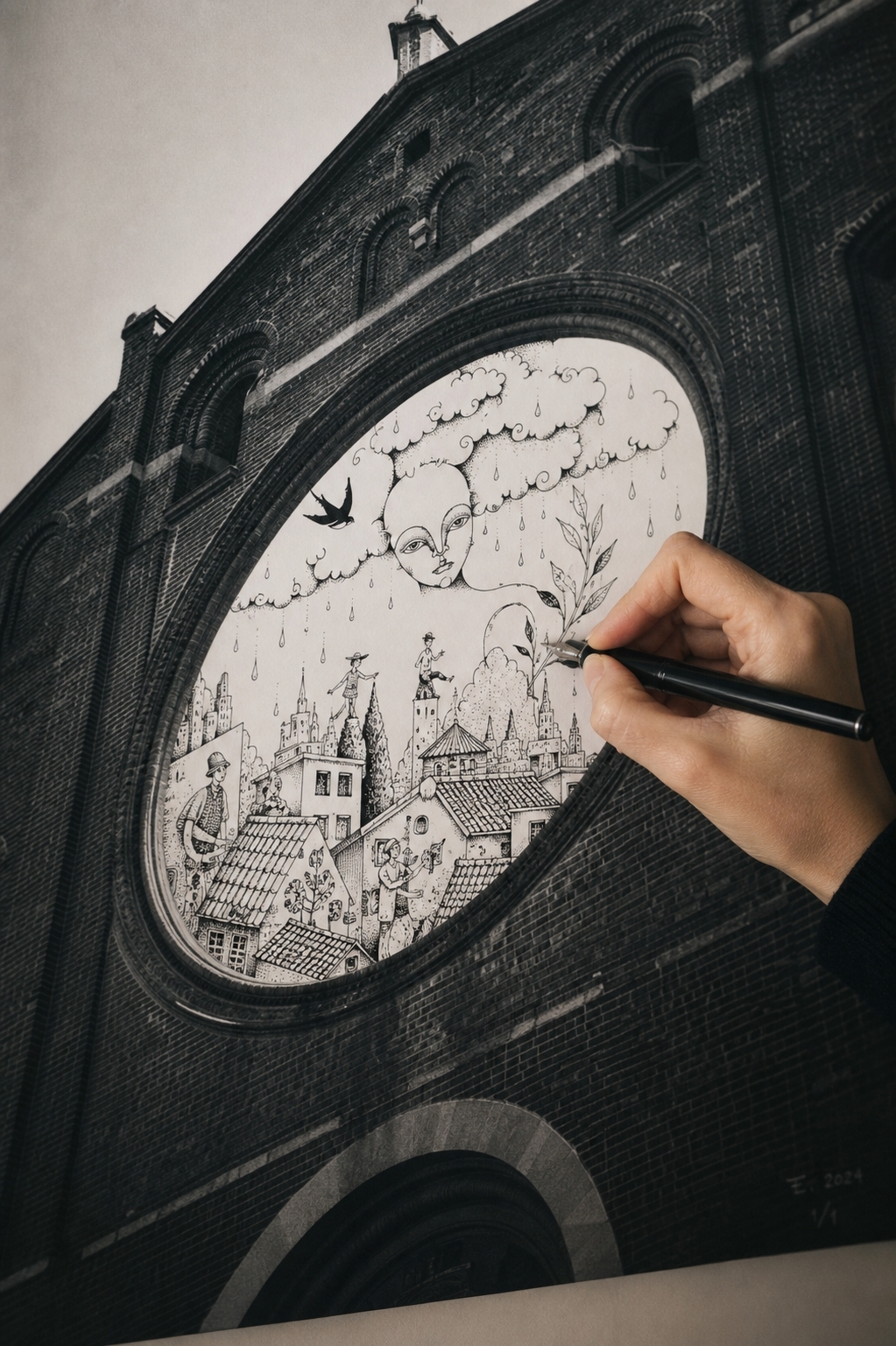
Formally, the work is accomplished. The monochrome palette binds photograph and drawing while retaining a productive difference between them: dense tonal blacks give the architecture physical and historical weight, whereas the fine linework feels provisional, mobile and vulnerable. The circular window operates convincingly as both architectural feature and psychological portal. Khani also uses scale well. The hand is intimate and immediate, the building almost overwhelming, and the small drawn inhabitants occupy an intermediate world of memory and projection. These relationships give the project emotional clarity without requiring explanatory text.
Nevertheless, the work is most persuasive when it resists its own symbolism. Clouds, birds, plants, miniature houses and solitary figures are accessible motifs, but they can also slip towards a familiar visual language of nostalgia and displacement. In places, the immaculate white voids created by erasure risk reading as graphic placeholders rather than absences with real emotional force. As the series develops, Khani could strengthen it by allowing the material and architectural character of each site to determine a more distinct intervention. If every building follows the same progression from photograph to void to illustrative dreamscape, the method may become formulaic. Greater friction – through incomplete erasures, differences in scale, traces of the original structure, or drawings that refuse narrative resolution – would complicate the work and deepen its critical edge.
The Fabrica residency context is well suited to a project about arrival because it foregrounds process, encounter and the provisional status of the installation. Yet the project’s long-term quality will depend on whether it can move beyond the autobiographical premise and make viewers feel that architecture is also shaped by collective histories, exclusions and uneven access to belonging. Khani has already established a coherent and visually distinctive foundation. The Weight of Arrival is a thoughtful, technically controlled and emotionally resonant body of work whose best images transform documentary architecture into a contested space between permanence and reinvention. Its current directness is a strength; introducing more ambiguity and site-specific resistance would make it an even more substantial artistic achievement.