
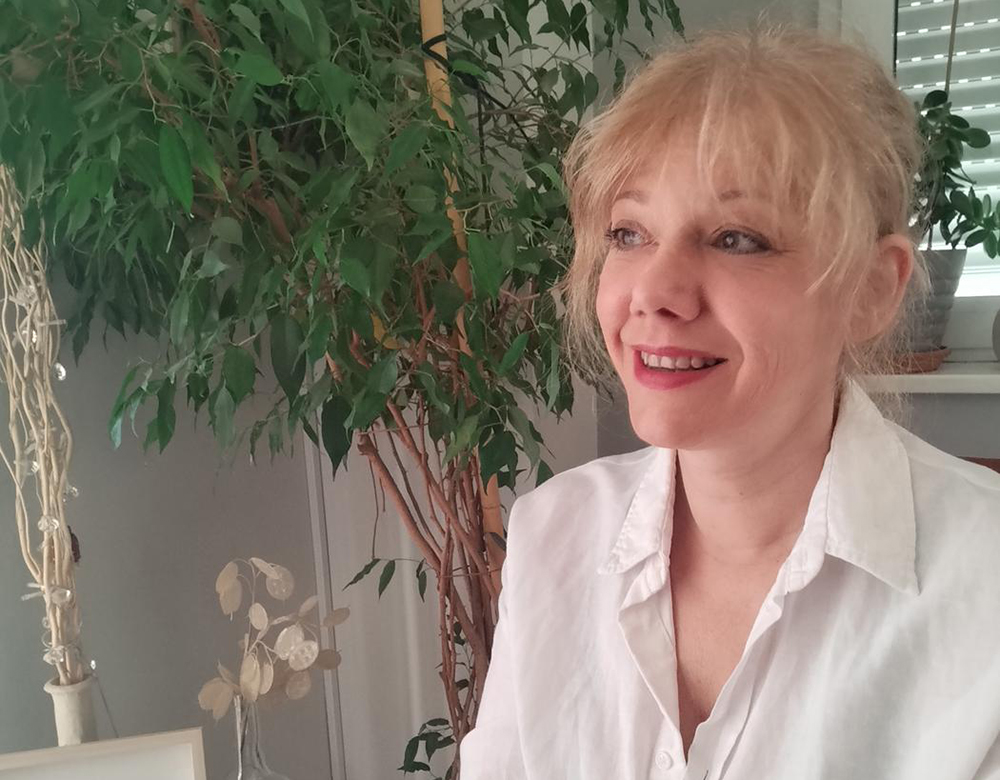
Tatjana Danilovic
You have spent thirty years working in architecture, a field defined by structure, measurement, and precision. When did you first feel the need to create art outside those professional boundaries, and what did painting give you that architecture could not?
Actually, drawing came first. Back in elementary school, I used to fill the pages of my notebooks by writing lessons starting from the very first page, and drawing from the last page moving toward the front. When the lessons and the drawings met in the middle, I began to seriously think about what would be better for making a living. I decided to become an architectural engineer, which created a huge distance between me and painting or drawing. It was only 12 years ago that I decided to look for that childhood spark again, because I felt I needed it once more. During Covid, while working from home, I decided to seize the moment and dedicate myself to painting continuously. It was a freedom that allowed me to make mistakes; I worked for my own soul, giving myself permission to paint whatever I wanted, even if it turned out unappealing, flawed, or ugly, knowing the public never had to see it. In architectural design, mistakes are not welcome, and the building you design is immediately exposed to criticism for as long as the building stands. Rules are imposed, and that is just how it has to be.
You describe your artistic practice as a conscious departure from straight lines, geometry, and technical perfection. Do you feel that your architectural training still enters your artworks unconsciously through composition, balance, or the way you organize space?
Absolutely, and that can be both an advantage and a disadvantage. Architecture taught me balance, a sense of space, simplicity, and practicality. There, just like in painting, an author faces the fear of the blank page, but in architecture, the imposed constraints actually serve as a starting point for the designer, and that is where the advantage lies: regulatory lines, plot size, orientation, investor demands, the type of building, and so on. Breaking free from these constraints is the real challenge, because in painting you have a blank paper or canvas and its edges… everything else is a matter of free will, and that is where the question arises… What now?
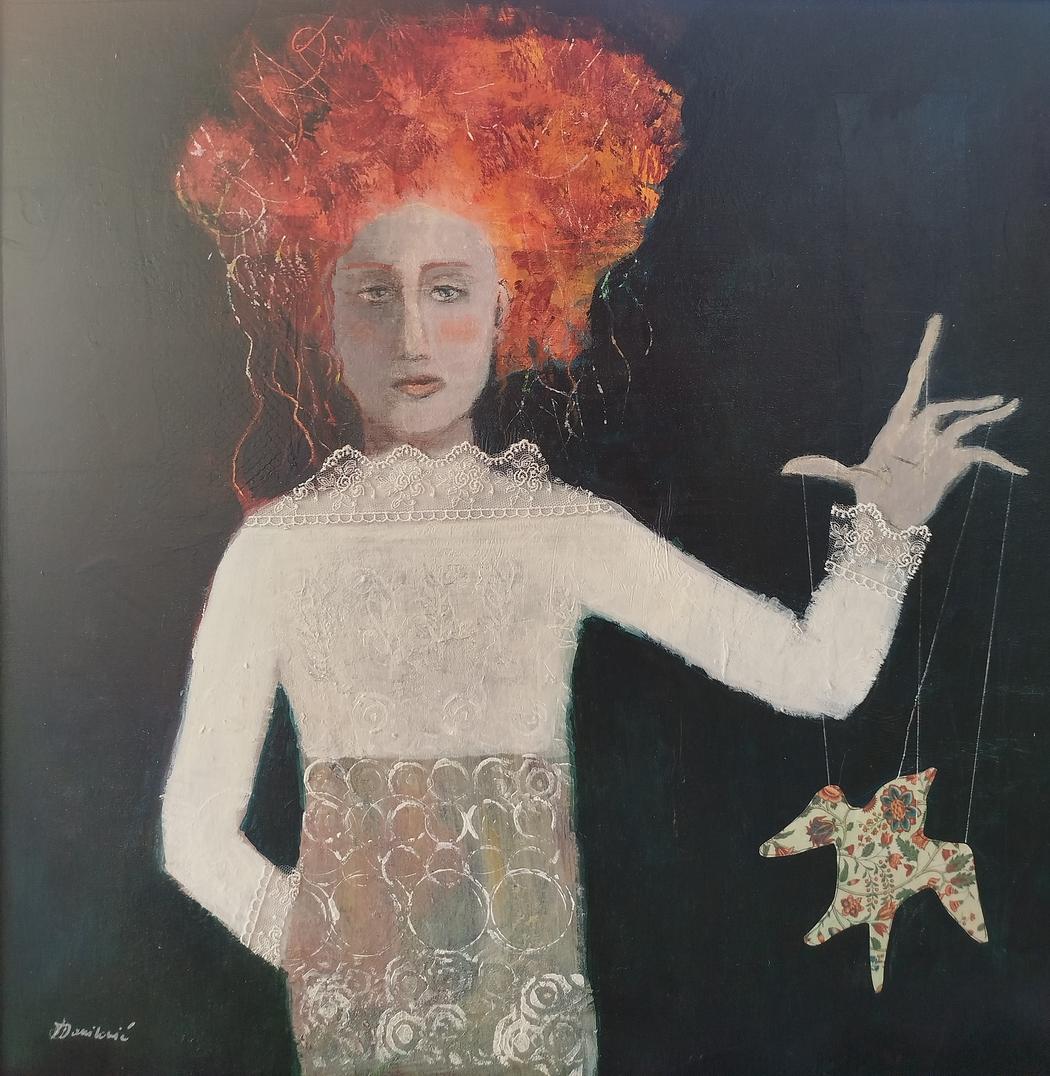 Tatjana Danilovic | The Doll | 2026
Your practice moves between printmaking, mixed media, collage, and acrylic painting. How do you decide which technique or combination of materials is most appropriate for a particular idea?
Good question. Even I sometimes wonder what I would prefer, and most often, it is a combination. I always think of printmaking and the black line first, perhaps because drawing is my first love, and probably also because of my profession. What I love most about printmaking is the element of surprise, but also carving lines, the impression of different materials when doing collagraphy, and spreading paint with a roller and other tools in monotype. But there comes a moment when I long for vivid, thick colors. However, due to a lack of adequate studio space, I often have to opt for techniques that make less of a mess, so I reach for collage or watercolor instead. That is also one of the reasons why the formats of my works are small.
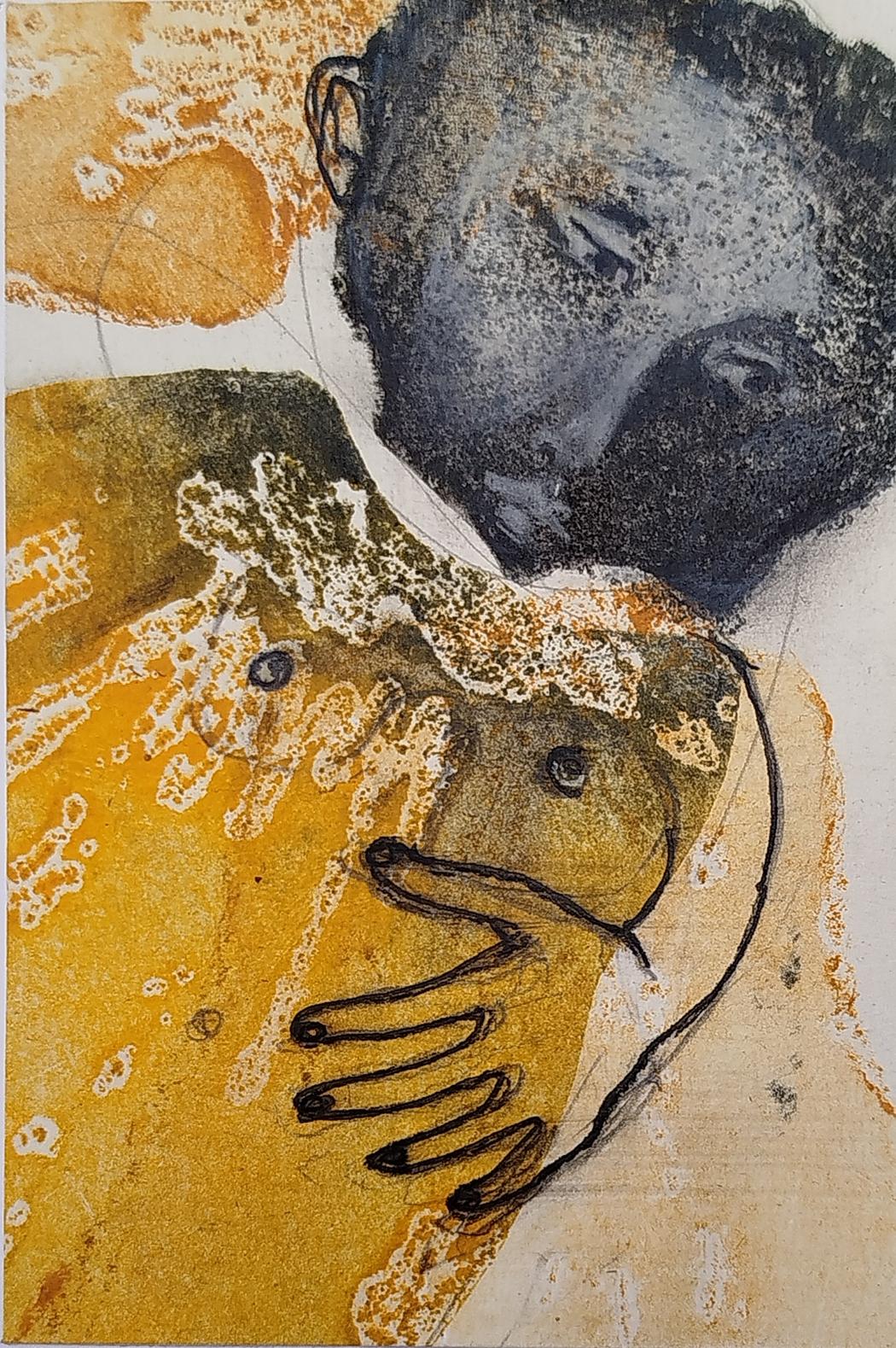 Tatjana Danilovic | Melancholy | 2026
Texture and layering play a significant role in works such as Sunrise and Sunset. What interests you about building an image through traces, overlapping surfaces, and partially obscured forms rather than through a clearly defined representation?
I have never liked explicit expression because it lacks poetry and mysticism. An exact replica of nature or a human face is a matter of good technique, but if the inner experience of both the artist and the viewer is missing, then art itself is missing. In my view, it is the hint, the sense of anticipation in art that intrigues and sparks your imagination. Something must be left to the viewer as well, giving them the opportunity to experience and ‘complete’ the artist’s work within their own mind and soul. Overlapping layers always give depth to a painting, and somewhere out there, in that depth, there is always something for the viewer, whatever they wish to find. Personally, I love it when some light breaks through all of that.
You have said that your process is guided more by discovery than by a predetermined outcome. Can you describe how one of your works typically develops? At what point do you know that an unexpected accident or imperfection should remain in the finished piece?
For instance, I feel a desire to paint a piece using golden-yellow and dark navy-blue colors, still not knowing what I want to paint, but I take the oil paints and a roller and apply the first layers of those two complementary colors just to quench that initial thirst. Next come the lines and fast strokes that bring in dynamism. At this stage, you can catch a glimpse of the direction I might head in. Once I have enough elements, I start to notice what is lacking and what is excessive, and after letting the piece rest in a drawer for a while, I decide to be brave: I cut the painting in half, place the bottom section on top, and flip it. I rejoin those two pieces into a collage and get a landscape. Later, I will add some details with chalk or pastel as a finishing touch. That moment of recognition, realizing you have captured exactly what pleases both your eye and your soul, is priceless. An unexpected accident is often a happy accident, as it serves as a turning point in many of my works, leading me in a completely new direction.
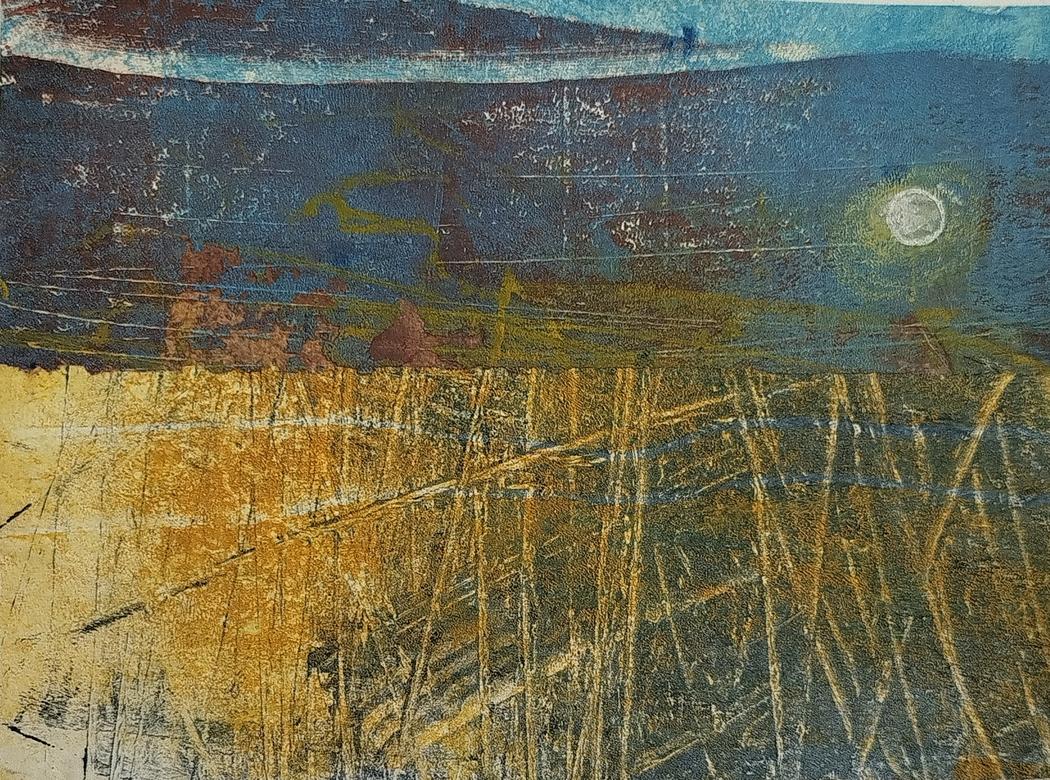 Tatjana Danilovic | Sunrise | 2026
Architecture often begins with a plan, while your visual art embraces unpredictability. Has working as an artist changed the way you think about architecture – or, conversely, has architecture shaped your understanding of artistic freedom?
Art has allowed me to embrace my own inherent aesthetic and to realize that the principle of contrast in color and materials is a universal thing. It has taught me that not everyone has to like what I do and that I have the right to authenticity. In practice, architecture and working with materials have taught me how substances behave and helped me understand their limitations. Achieving freedom requires a vast amount of learning and knowledge, and that is a lifelong process.
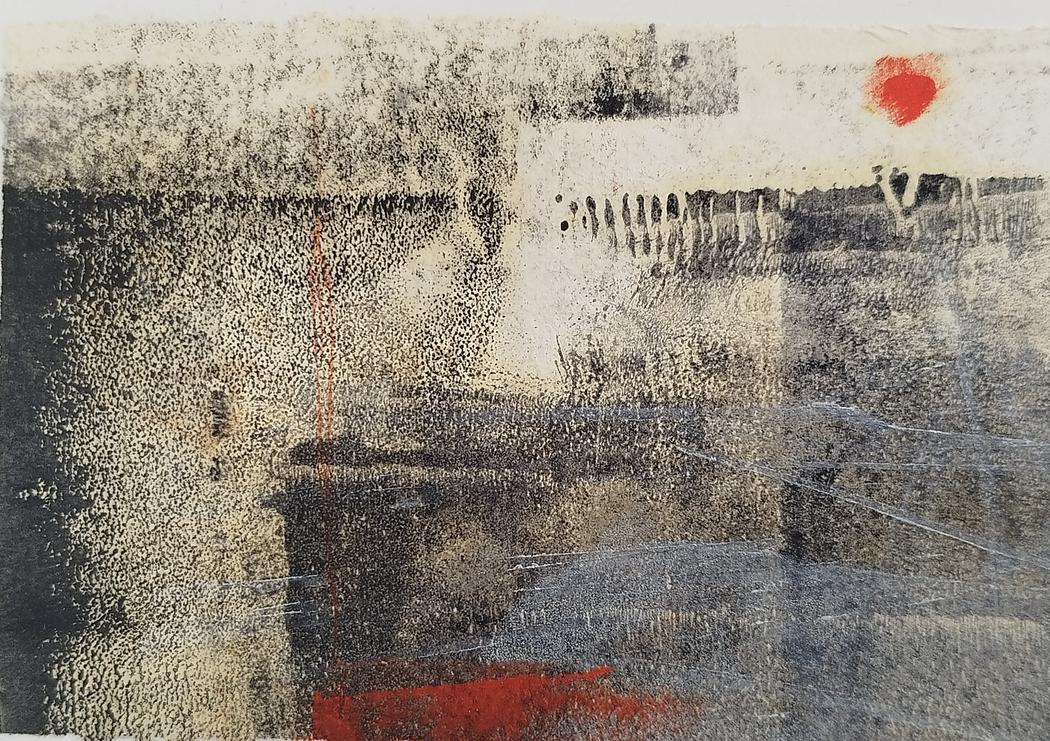 Tatjana Danilovic | Sunset | 2026
As your painting practice becomes increasingly visible through exhibitions, how would you like it to develop from here? Are there particular materials, scales, themes, or forms of experimentation that you would like to explore next?
First of all, I would like to have more time and space to dedicate myself to art as much as I want. There is one area I have been thinking about for some time now, and that is sculpture. I am certain that I will try it, even if I have to work with toothpicks and modeling clay…