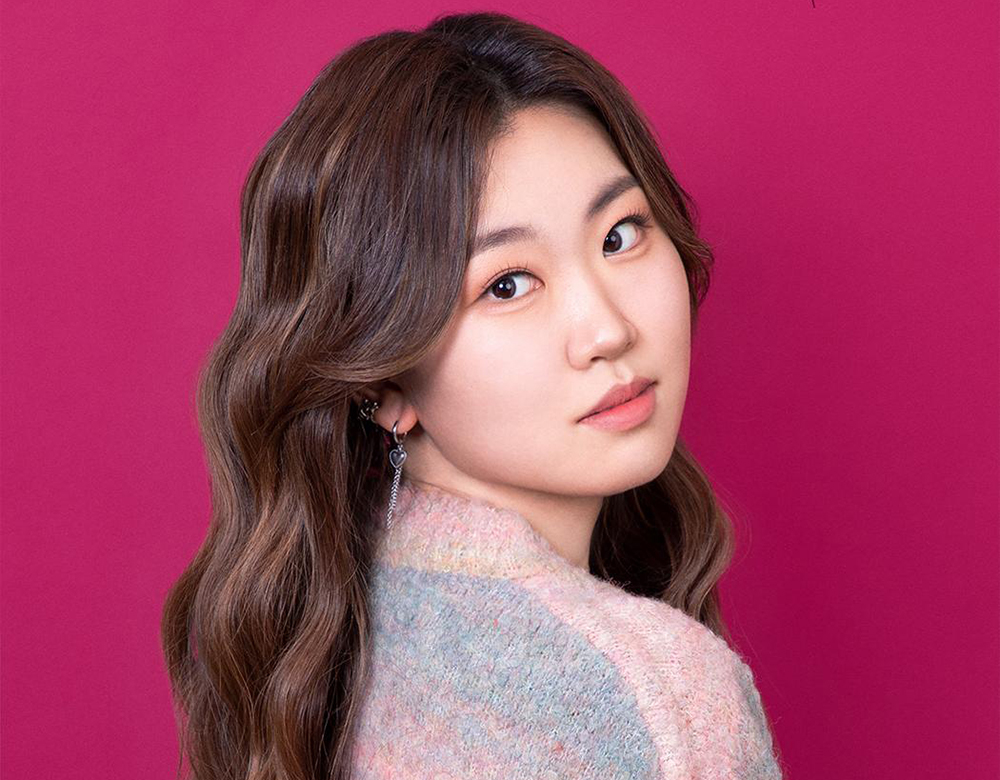
Won Ji Lim
Your practice centers on hypervigilance as a bodily condition shaped by anticipation, anxiety, and the desire for control. When did you first realize that these personal patterns could become the foundation of your artistic language?
When I moved to the United States for graduate school, my anxiety and desire for control became much more intense. Leaving behind a familiar language and environment and entering a new institutional and social context seemed to heighten my need to keep everything organized, predictable, and under control.
Whenever professors or fellow students visited my studio, they would often comment on the walls covered with meticulously aligned notes and the materials carefully arranged along the lines of the floor. These behaviors had always felt completely normal to me, but seeing them through other people’s eyes gave me the opportunity to reconsider them. I began to understand that they were not simply working habits, but physical manifestations of anxiety.
From that point on, I stopped viewing these behaviors as something I needed to hide or correct. Instead, I began to see them as a language that could be observed and explored. The acts of aligning, repeating, securing, and preparing for every possible outcome became the starting point for examining how anxiety and hypervigilance are expressed through the body.
You describe actions such as aligning, securing, knotting, and repeating as temporary attempts to contain uncertainty. How does repetition function for you during the making process: as a source of reassurance, tension, exhaustion, or something else?
Repetition gives me a temporary sense of stability. Repeating the same action over and over can become almost ritualistic, creating the feeling that I am briefly containing uncertainty through physical labor. As long as my hands continue moving and the pattern remains consistent, I feel as though things are being brought into order.
At the same time, repetition produces another form of anxiety. The desire to prevent even the smallest deviation or mistake gradually becomes stronger, and when an error occurs, I feel compelled to begin the process again. An action that starts as a way of creating reassurance can therefore generate further tension and compulsion.
For me, repetition is never simply comforting. It exists in a constant state of movement between reassurance and tension, control and failure, concentration and exhaustion. That contradiction has become one of the central structures of both my making process and the work itself.
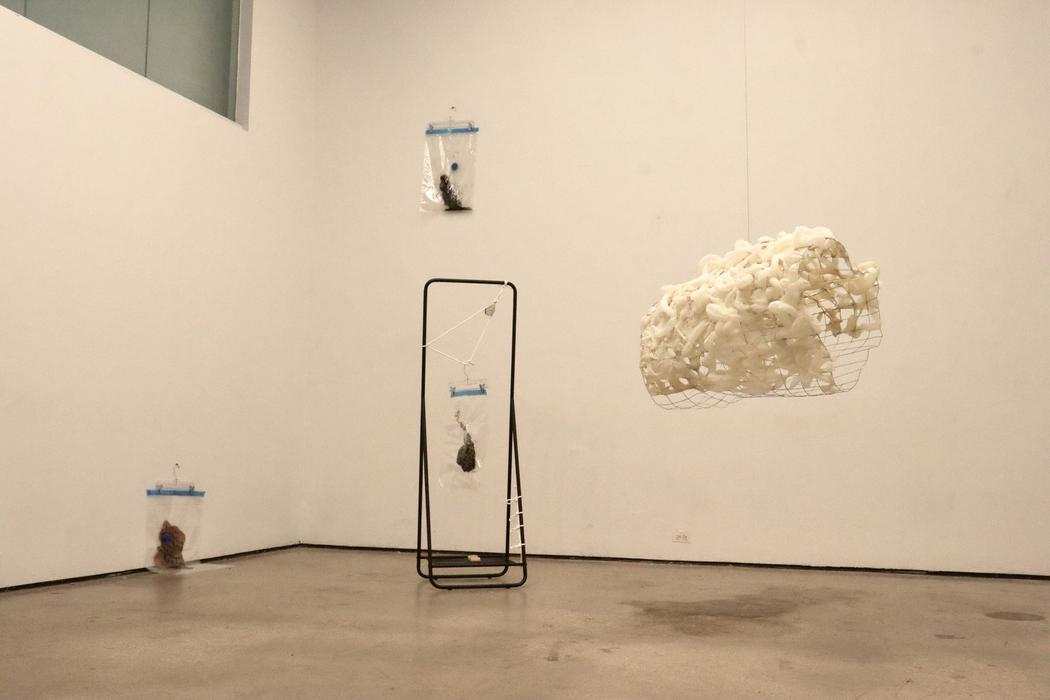 Won Ji Lim | Something Takes Space | 2026
Many of your installations begin with structures that appear rational and controlled, yet gradually reveal instability. What interests you about creating systems that seem ordered but are never entirely secure?
The first thing I encountered that appeared ordered but was never truly stable was myself. For a long time, I was more accustomed to avoiding or concealing my anxiety than confronting it directly. I worked hard to appear calm, organized, and in control, while beneath that surface there was a constant fear that everything might collapse.
When I finally began to look directly at that contradiction, I became interested in how the effort to appear stable could actually contain an even greater accumulation of anxiety. I also realized that this was not an experience unique to me. Many people create routines, rules, and systems in order to endure uncertainty in their everyday lives.
The structures in my installations reflect this condition. They may initially appear solid and rational, but their stability depends on knots, tension, gravity, repeated adjustment, and continual maintenance. I do not think of order as a completed or permanent state. Instead, I understand it as something provisional that must be constantly managed in order not to collapse.
Materials in your work are allowed to stretch, sag, contract, decay, loosen, and transform. How much control do you retain over these changes, and at what point do you consciously allow the material to take over?
My primary material is hog casing, an animal intestine that becomes a soft and translucent membrane when soaked in water. While it is pliable, I fill it with air, soil, liquid, fruit, or other organic matter, seal it, place it within carefully constructed systems, or repeatedly bind and knot it.
My control largely ends at that point. I establish the conditions and structures within which the material can change, but I do not fully determine the form that will emerge afterward. Once the installation is complete, the membrane stretches, contracts, sags, changes color, decays, or deforms in response to gravity, humidity, temperature, time, and the condition of the matter contained inside it.
I do not regard these transformations as damage or failure. Instead, I see them as moments when the material moves beyond my control and begins to produce its own form. My role is not to define a final appearance, but to create the conditions in which the material can continue to act and transform after I have finished working with it.
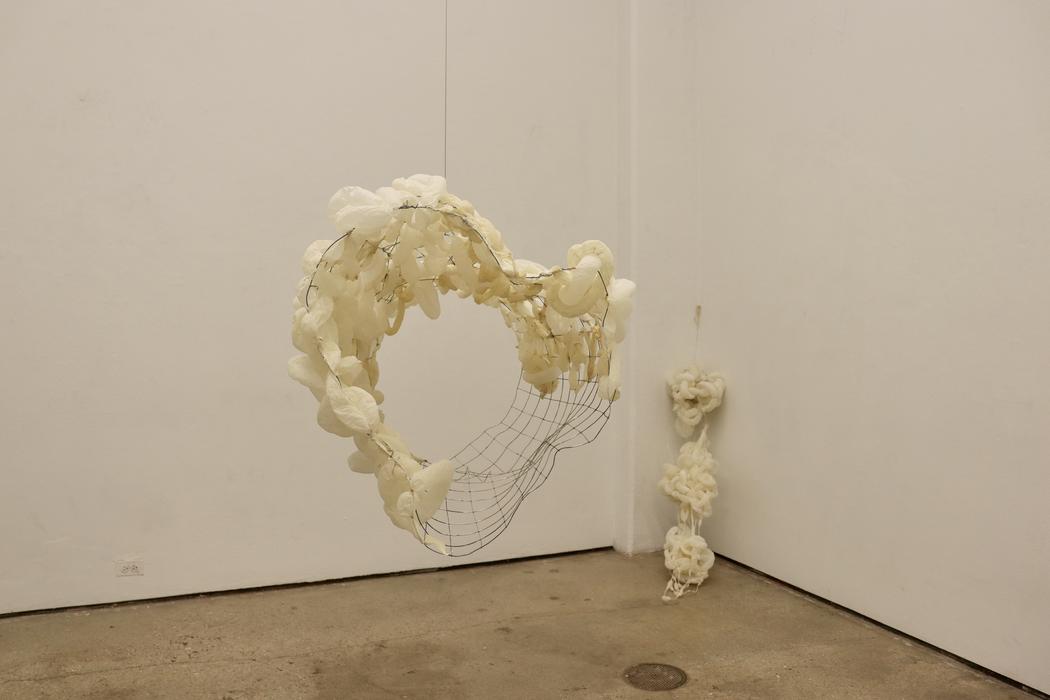 Won Ji Lim | Held At The Edge | 2026
Your background is in ceramics and glass, while your current practice incorporates rope, wood, organic matter, membranes, metal, and other materials. How has your training in ceramics and glass influenced the way you understand material behavior today?
Looking back, I think I was already more interested in transformation and collapse than in fixed or completed forms during my undergraduate studies. Ceramics and glass are often associated with hardness, durability, and permanence, but I was especially drawn to the moments when materials deformed, collapsed, or reached an unexpected state inside the kiln.
I experimented by dipping found objects in clay slip and firing them directly, or by coating metal objects with thick layers of slip and glaze before placing them in the kiln. Some materials burned away completely, while others collapsed, twisted, or produced unpredictable surfaces and structures through their reactions with heat.
These experiments taught me to understand materials not simply as passive tools for realizing my intentions, but as active agents that respond to heat, time, and environmental conditions. At the same time, I began to feel limited by the fact that firing ultimately fixes a changing material into a single state. The kiln allows transformation to occur, but it also brings that transformation to an end.
This realization led me toward organic and biological materials that could continue changing even after the work was installed. The careful observation of material behavior, the acceptance of failure, and the willingness to work with uncertainty that I developed through ceramics and glass still remain fundamental to my practice today.
Although your work originates partly from personal experiences of anxiety, you also connect hypervigilance to surveillance, productivity, uncertainty, and social expectations. How do you move from an intimate psychological experience toward these wider social conditions without making the work overly illustrative?
My work began with an examination of my own anxiety, but over time I realized that anxiety is not simply a private or individual experience. Many people living in contemporary society carry different forms of anxiety shaped by the sense of being watched, the pressure to remain productive, the fear of falling behind, and the uncertainty of the future. These conditions continuously affect both our daily behavior and our bodily awareness.
Although these anxieties arise from different circumstances, I believe there are similarities in how we respond to them. We organize ourselves, create schedules and rules, and push ourselves into stable frameworks in order to function as if we were coherent and controlled systems. Yet that stability is not naturally given. It is maintained through repeated self-management, surveillance, tension, and adjustment.
Rather than representing these social conditions through direct symbols or recognizable narratives, I try to embed them in the structure and behavior of the materials. Structures held together by tension, knots that could loosen, membranes that continually deform, and materials repeatedly aligned or secured all indirectly express these conditions.
It is important to me that the work remains open enough for viewers to connect it to their own experiences. I do not want the installation to deliver a single explanation. Instead, I want it to create a situation in which the sensations of anxiety and control can be recognized physically and interpreted through the viewer’s own perspective.
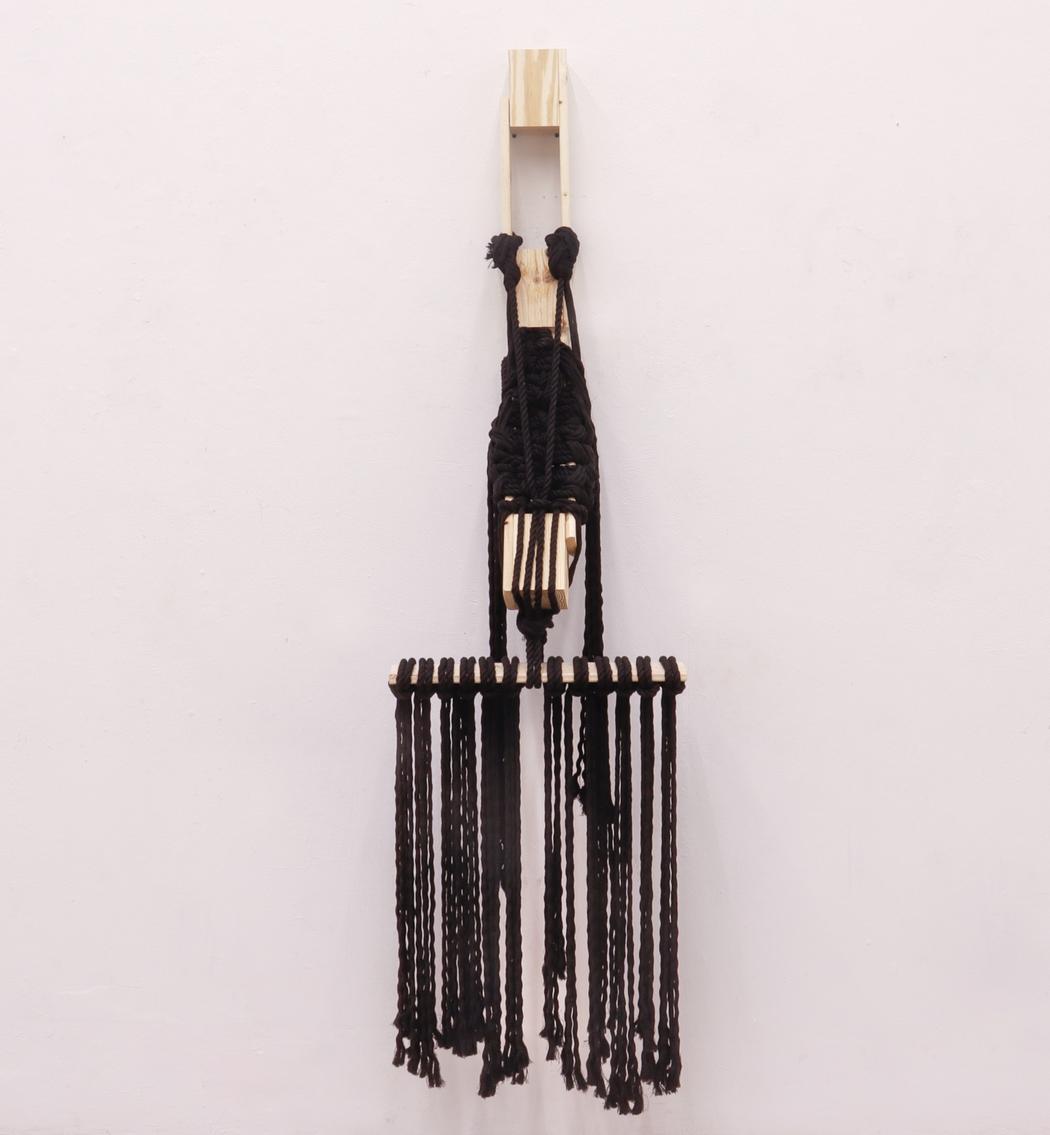 Won Ji Lim | Between Knots | 2026
Your installations often place viewers in situations where stability feels provisional rather than guaranteed. What kind of physical or emotional awareness do you hope emerges when someone spends time with your work?
I want viewers to experience the tension and instability of the work through their bodies rather than only observing it visually. In some installations, viewers are invited to touch the materials or stand beneath the work according to the spatial arrangement I have created. At that moment, they are no longer simply observers maintaining a safe distance. Their bodies become part of the system of weight, tension, gravity, and potential transformation.
The work is not actually dangerous, but standing beneath something suspended or tightly held in place can naturally make the body tense and become more aware of its surroundings. I am interested in this subtle physical response. The mind may understand that the situation is safe, while the body begins to anticipate other possibilities.
Through this experience, I hope viewers can briefly confront forms of anxiety that they may normally suppress or overlook. I also hope they can begin to see anxiety not only as a negative emotion that must be eliminated, but as a bodily condition through which we continually sense our environment, other people, and the uncertainty of the future.