
Qingruo Zhao
Could you tell us about your background and what first drew you to motion design and animation?
I am a New York–based motion designer and animator specializing in documentary, nonfiction, and narrative-driven visual communication. I studied Computer Arts at the School of Visual Arts, and over the past several years I have worked across studios including Hornet, Carbon, and Bigstar, contributing to projects for Disney+, Netflix, Peacock, Google, and other global platforms and brands.
What first drew me to motion design was its ability to integrate illustration, graphic design, music, editing, and countless technologies into a single expressive language that achieves what no individual discipline can on its own. I was initially attracted to its diversity and playful nature—the way simple elements could be combined to create direct, immediate expression. Over time, I became more interested in motion not just as decoration, but as a storytelling structure, and eventually as a system for communication. This shift led me toward more intentional, structured approaches to visual storytelling, where clarity and meaning are built through motion rather than added onto it. I’ve also come to value—and take pride in—its capacity for emotional resonance and shared experience, where my work becomes a way to connect people through feeling as much as through information, often expressing empathy in ways that go beyond language.
How has living and working in New York influenced your visual language and creative perspective?
New York has had a major influence on how I observe, compose, and think about visual rhythm. The city is constantly placing different eras, cultures, languages, textures, and design systems next to one another. You might see hand-painted signage beside a digital billboard, a newly installed high-end brand poster next to torn poster-wall material, or a highly polished brand environment beside something completely improvised and personal.
New York really contains every style and artistic language you can imagine. In my early years here, I was constantly absorbing everything I saw—studying, collecting, and breaking down different visual approaches—and gradually integrating them into my own work. I’ve always felt like I’m being continuously inspired, continuously learning, and continuously evolving through that process.
That contrast has made me more comfortable combining visual languages that might initially seem unrelated. My work often balances precision with spontaneity, structure with playfulness, and polished design with more tactile or human details. I think that reflects the experience of living in New York, where things rarely feel visually uniform.
Working here has also taught me how to communicate within highly collaborative and fast-moving environments. Motion design is rarely created in isolation. I work closely with directors, designers, producers, and clients, and New York has pushed me to become more adaptable without losing my own point of view. It has helped me understand that a strong visual language must be distinctive, but it must also function within a much larger storytelling system.
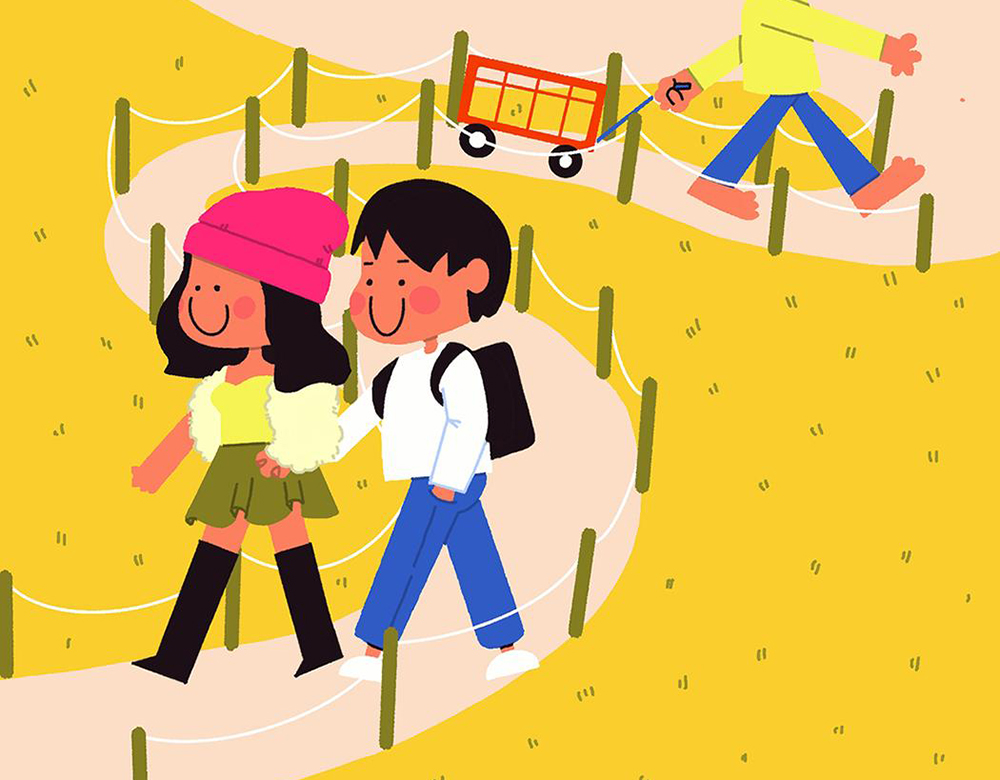
 Qingruo Zhao | Little Island | 2023
What does your creative process usually look like, from the first idea to the finished piece?
My process usually begins by identifying the central communication problem. Before thinking about style, I ask what the audience needs to understand, feel, or notice, and where they may become confused or emotionally disconnected. This is especially important in documentary and nonfiction projects, where the material can be dense, and the visual design must support rather than overwhelm the story.
From there, I begin collecting references and organizing the project into visual principles. I look for recurring ideas, emotional shifts, archival textures, character traits, editorial patterns, and opportunities for visual continuity. I often create style frames, motion tests, or small visual systems before fully developing a sequence. These early experiments help establish rules for typography, color, transitions, composition, image treatment, and rhythm.
Once the visual language is established, I develop the motion design, timing, pacing, sound, and narrative emphasis, using the edit as a guide for how the design should behave. The final stage is often about refinement rather than addition. I pay close attention to small details—how long an audience needs to read something, how an image enters or exits, whether a transition feels emotionally appropriate, and whether the system remains consistent across the entire project. My goal is to make the final work feel intuitive, even when the process behind it is highly complex.
Your work often feels playful, warm, and carefully composed. What emotions or experiences do you hope to communicate through it?
Outside of client work, I’m drawn to work that feels thoughtful without becoming emotionally distant. Even when dealing with complex information, I want the audience to feel invited into the story rather than positioned outside of it.
Playfulness is one way I try to create that sense of openness. It can make information feel more approachable, reveal personality, or introduce a small sense of discovery. Warmth is just as important, especially when the work touches on real people, personal histories, or emotionally sensitive material. More than anything, I want people to feel in a good mood when they’re watching it, and to sense that care behind the design.
At the same time, I’m very intentional about composition. Every decision—scale, spacing, movement, color, and timing—shapes how a moment is understood. I hope my work communicates curiosity, empathy, and clarity, and ideally leaves the viewer not only understanding the information more easily, but also feeling a little more connected—and a little lighter—after experiencing it.
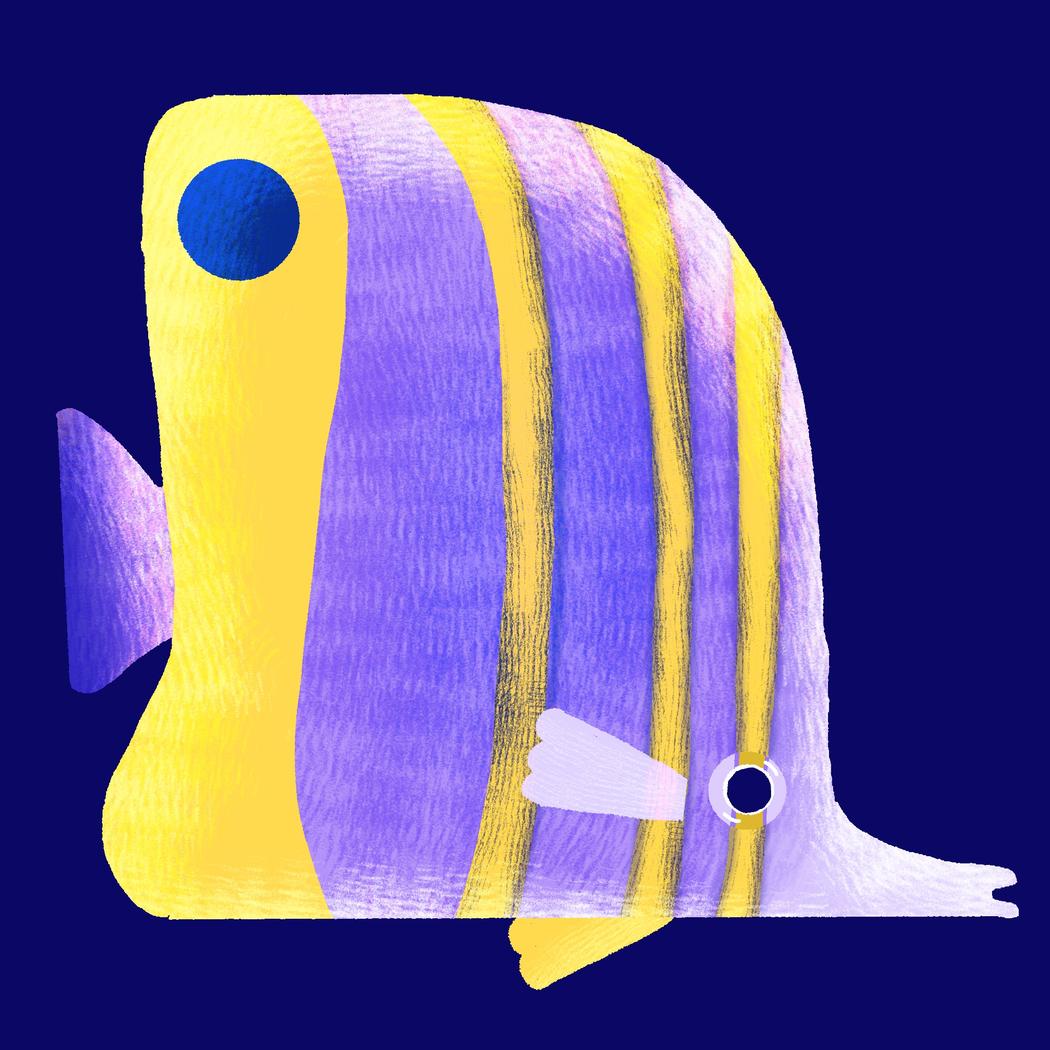 Qingruo Zhao | Fish | 2025
Where do you usually find inspiration for your characters, colors, forms, and everyday narratives?
A great deal of my inspiration comes from observation. I pay attention to internet memes, everyday moments, and beautiful photographs of both people and landscapes; I try to capture the emotions of the present and express them through my work.
For characters, I am interested in imperfection and personality. A slightly unusual posture or exaggerated reaction can communicate more than a polished or idealized figure. I often look for gestures that feel recognizable but not generic.
My approach to color and form depends on the emotional structure of the project, and color inspiration comes from the emotions I want to convey. Sometimes I draw from archival materials, handwriting, printed ephemera, children’s artwork, or analog media.
I also find inspiration in the tension between systems and accidents. I enjoy creating clear visual rules and then introducing moments that feel surprising, handmade, or slightly unpredictable. That balance often gives the work its personality.
How has receiving an Emmy Award affected your confidence, career, or understanding of your own creative practice?
Receiving an Emmy Award for Outstanding Motion Design as part of the team behind Jim Henson: Idea Man was an important milestone in my career. The project was directed by Ron Howard and involved an extraordinary creative legacy, so contributing to it already felt meaningful. The recognition confirmed that motion design can play a substantial narrative role in documentary filmmaking, rather than functioning only as visual enhancement.
Personally, the award gave me greater confidence in the value of my approach. Much of my work focuses on subtle decisions: how archival material is organized, how a transition supports an emotional shift, or how a graphic system helps audiences navigate a story. These contributions are not always immediately visible, because successful design often feels natural within the film. The Emmy helped validate the importance of that behind-the-scenes thinking, and I feel I am encouraged to create!
 Qingruo Zhao | Bowls Come From Different Friends | 2024
What are some of the greatest challenges you have faced as a motion designer, and how have they helped you grow?
One of the greatest challenges has been learning how to contribute my own perspective within an already established field, particularly documentary storytelling. I often start from the details—breaking down dense, complex material and organizing it into clear categories—so I can better understand the underlying structure of the story. From there, I try to build a visual system that brings order to the information while still respecting its emotional nuance. This approach allows me to maintain visual consistency while also embedding my own animation language into the work.
Another challenge has been balancing authorship with collaboration. A motion designer may have a strong visual idea, but the final work must support the director’s vision, the editor’s structure, the producer’s constraints, and the audience’s needs. Learning when to advocate for an idea, when to adapt it, and when to remove it entirely has made me a stronger designer and collaborator.
In an industry where visual styles are increasingly saturated, creating work that feels fresh and unexpected has become more difficult. The arrival of the AI era is both an opportunity and a challenge, pushing me to continuously integrate new tools, software, and features into my workflow. I try to create through making mistakes and learn from those mistakes as part of the process, embracing uncertainty and looking forward to the unknown outcomes it can lead to.