
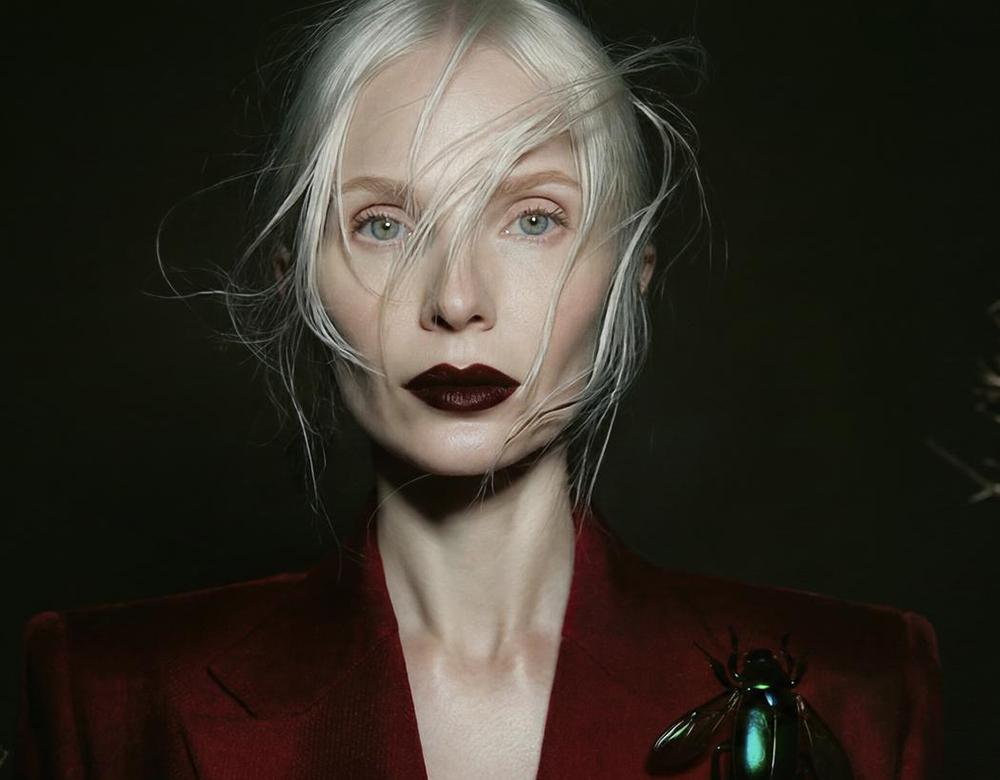
Alena Tuition
When did you first become interested in art?
A sense of beauty lived in me long before I had a name for it as art. I noticed what usually goes unseen: a crack of light on an old wall, an unexpected fold of fabric, a texture that could be read like a sentence. At some point I stopped simply looking and started asking — why does this move me.
That question led me to artists. Kuindzhi’s light, which seems to breathe from inside the canvas. Bosch’s strangeness, where the ordinary world turns itself inside out. Magritte’s mystery, which never answers directly. Modigliani’s elongated necks and faces — as if the body stretches beyond ordinary anatomy to hold something too large for an ordinary form. I was never interested in technique. I was interested in what they lived through while painting — what they were thinking in the moment the brush touched the canvas.
I understood something then: art isn’t what the eye sees. It’s what the artist managed to live through and left inside the image, like a letter with no addressee. The viewer finds it by accident — and suddenly recognizes something about themselves.
Today’s world moves so fast that we’ve forgotten how to stop in front of beauty. Frost forming a pattern on glass that melts before we finish looking at it. A hand’s shadow on a wall in the instant a light switches on too abruptly to notice gently. A drop clinging to the edge of a glass longer than seems physically possible. We rush past these things because they seem too small to matter. But it’s in that smallness that the life we keep missing actually lives — while we chase what feels “significant.”
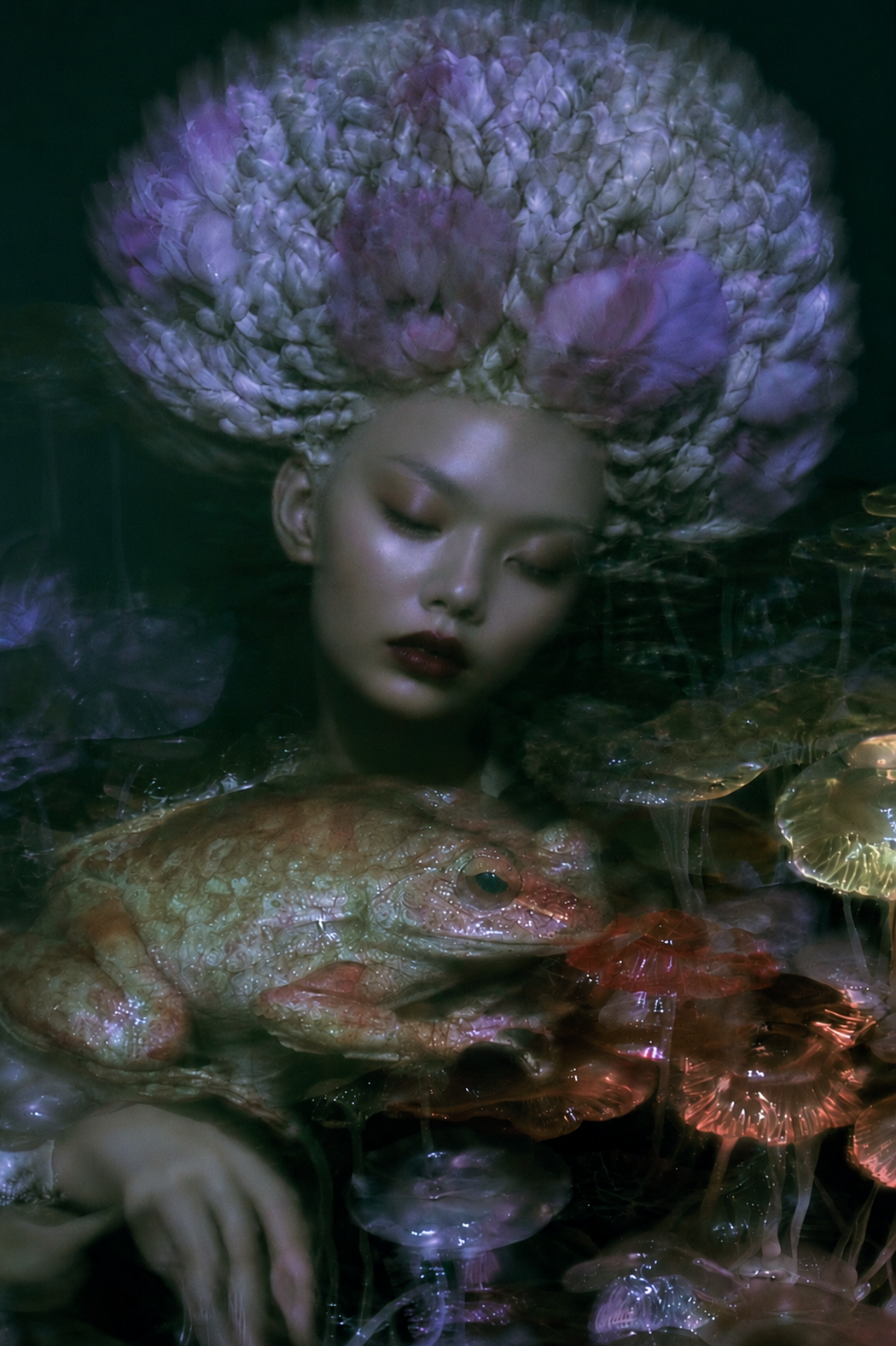 Alena Tuition | Keeper Of The Pond | 2026
What led you to work with AI-generated imagery and video?
For a long time, I didn’t consider myself a creative person. My professions had nothing to do with art. But feeling things deeply — that was always in me, it simply had no outlet.
At some point I realized I wanted to release what had been building inside me, and to show people that art can take many forms. Every new technology leaves its own mark on the history of art — and almost always meets resistance from those used to the previous language. The same happened when photography entered our lives: many painters at the time insisted it wasn’t art, just mechanical copying of reality. Time proved otherwise.
I don’t know how to paint with a brush. But AI gave me a way to say what I think and feel — and perhaps not only me. It became my instrument of self-expression. Not a replacement for the brush, but a new language for the same ancient need: to speak.
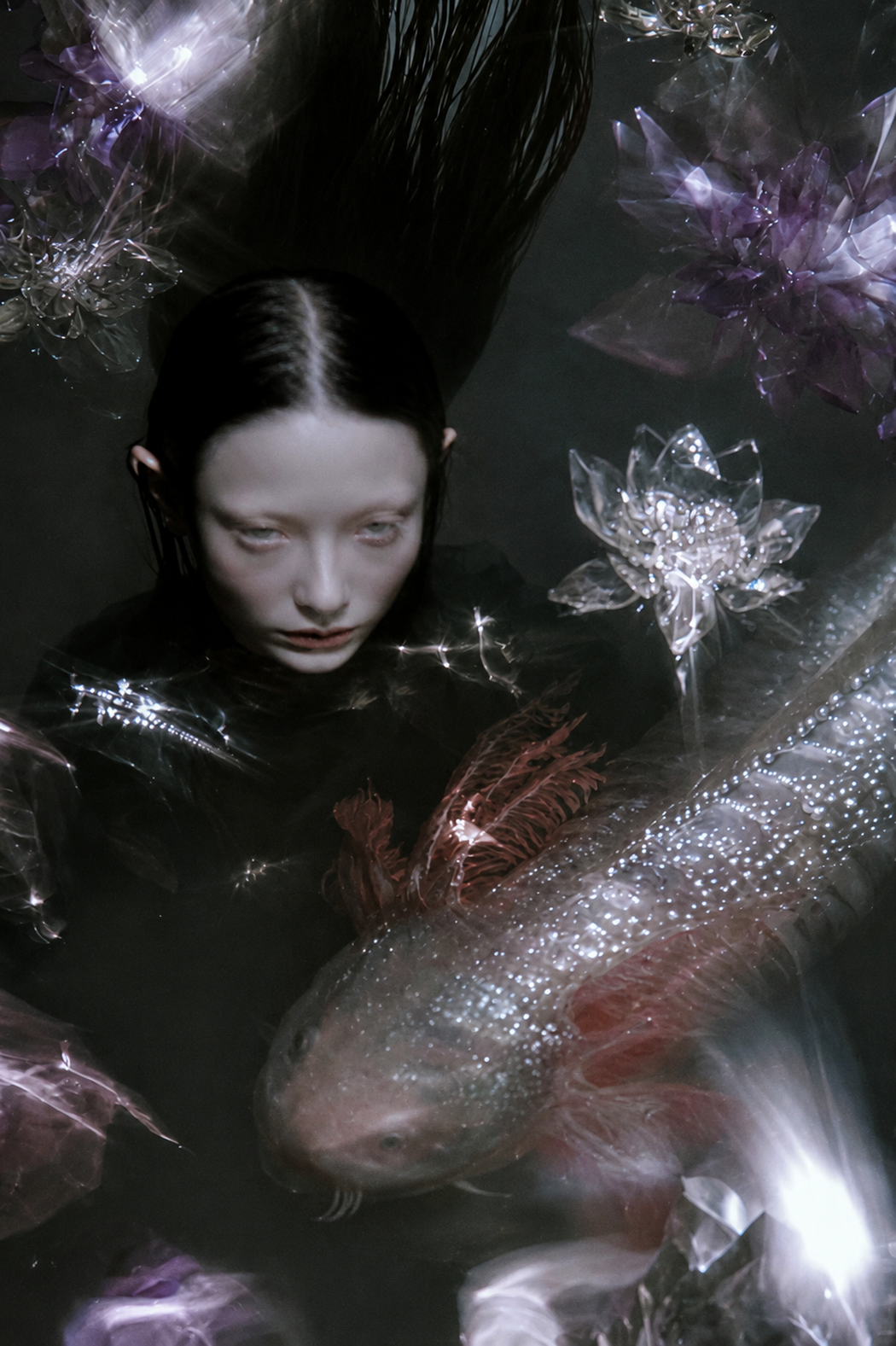 Alena Tuition | Daughter Of The Underwater | 2026
What inspired you to create this series?
I’ve long been struck by how culture decides in advance what we should love and what we should fear. A swan — a symbol of purity and grace — is meant to be adored. A snake — a symbol of danger — is meant to be feared. An axolotl, a frog, a ferret — creatures usually overlooked entirely, too small and strange to symbolize anything at all. I wanted to strip away these ready-made labels and show the same thing underneath all of them: closeness, trust, stillness — regardless of what label culture had already attached to the creature.
In every frame, the woman doesn’t confront the animal, nor does she simply admire it from a distance. She shares its state — whether it’s a creature we’re taught to exalt, one we’re taught to ignore, or one we’re taught to fear. The bond remains a bond, whether it’s dangerous, beautiful, or unnoticed.
The textures grew from the same idea — the blurred line between human and nature. Glass flowers that look as if grown from ice. Mother-of-pearl that behaves at times like fabric, at times like scales, at times like feathers. Fur that in one frame reads as winter, in another as unease. I wanted the viewer not to immediately know where the costume ends and the creature begins, where the creature ends and the woman begins. That is my language of couture — not an ornament on the body, but its continuation.
The inspiration came from a simple question: what if closeness has nothing to do with how beautiful, dangerous, or visible a creature is?
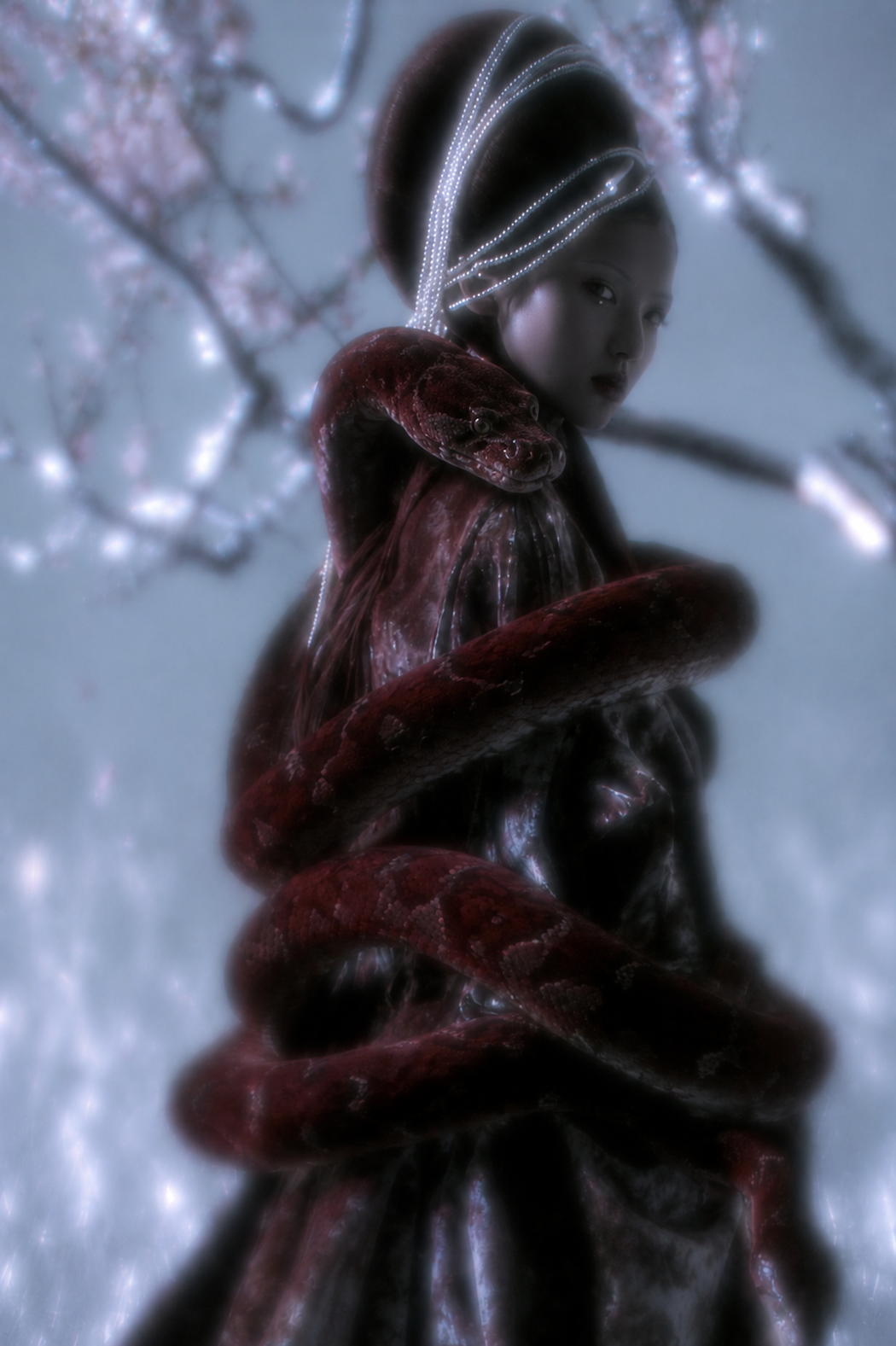 Alena Tuition | Skin He Didnt Shed | 2026
Do you begin with a clear image in mind, or does the work change during the process?
It depends. Sometimes I already know the theme I want to raise — it lives inside me for a while before becoming a frame. Other times, everything starts from a single detail — a symbol, a fabric, a material, an event — about which I know almost nothing. And that not-knowing becomes the entry point.
That’s when I go into deep research. I look for hidden meanings, cultural codes, the history of origin — why a symbol came to exist, what it meant across different eras, what trace it left behind. I gather references the way one gathers shards of a single mirror, until an entire picture forms inside me: what the material will be, how the light will fall, what posture the body will take, what movement of fabric will speak louder than words.
Behind every element of the composition lies an emotion — not random, but earned through that immersion. Light carries unease or tenderness. Texture carries memory or threat. Posture carries submission or power.
I choose color with particular care — for me it isn’t decoration, but another layer of meaning. I’m not interested in familiar combinations. I’m interested in finding strange, almost ill-fitting tones and watching how they clash or, instead, fuse with the texture. Color reaches the viewer’s subconscious before they have time to think.
Only when all these emotions find one another does the final composition emerge — no longer a set of details, but a complete statement in which nothing can be removed without losing its meaning.
How do you choose the animals that appear in your images?
I don’t choose by beauty or by how recognizable an image is. I look instead for a creature capable of holding a specific mood of the frame — the character of its gaze, the texture of its skin or fur, the way it can physically settle against the woman’s body.
Sometimes the animal arrives first — I see it and understand what kind of woman should stand beside it. Sometimes it’s the reverse — there’s already a finished image of a woman, and I search for who could meet her in a way that feels inevitable rather than staged. What matters is that the bond reads as a given, not as an idea added afterward.
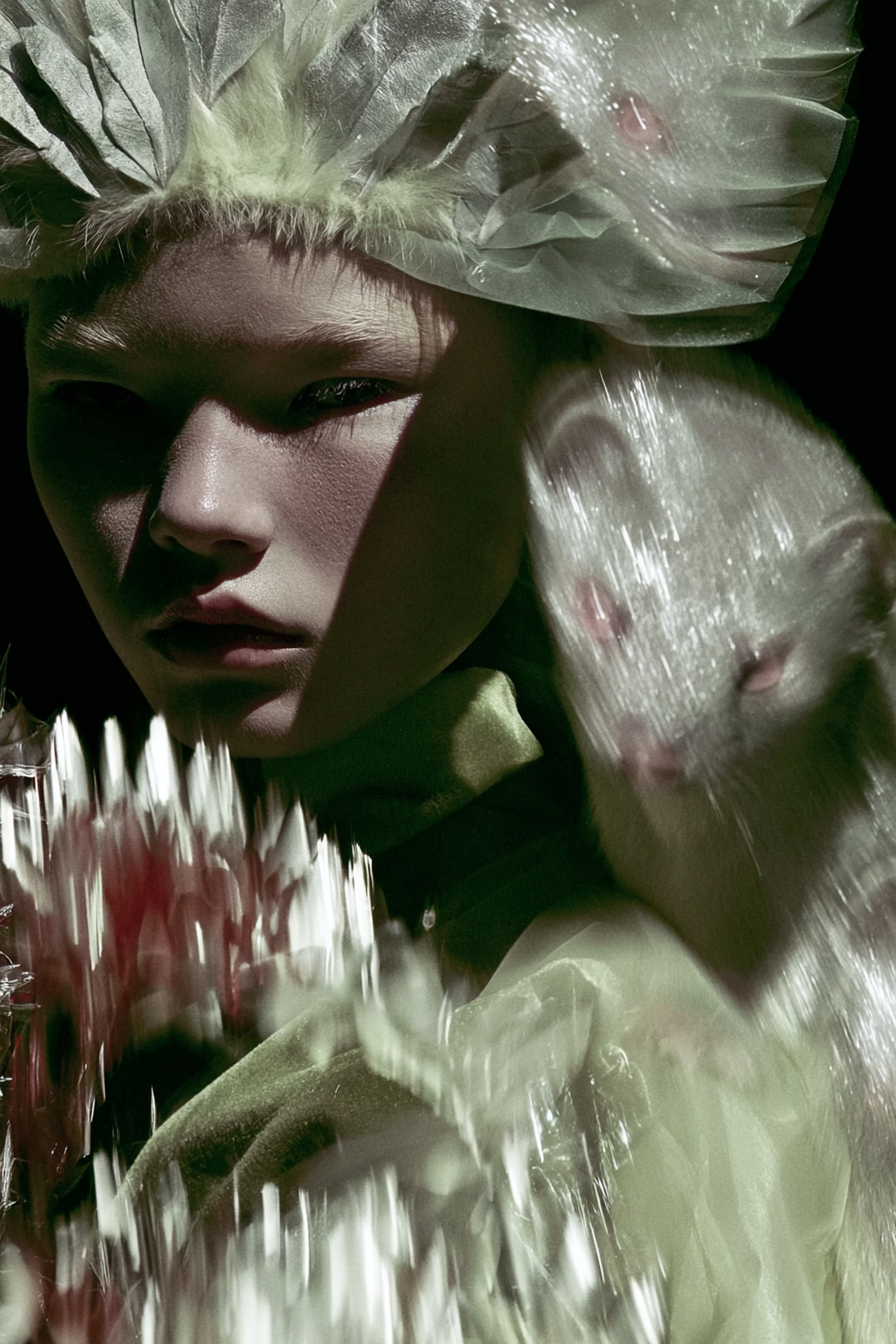 Alena Tuition | Winters Ally | 2026
Why are fashion and couture aesthetics important in your images?
Because fashion is an art form too often underestimated. Every couturier, in creating a look, still returns to the same sources — painting, architecture, an era — to find a way to say what cannot be said in words. Silhouette, fabric, cut: these are a language no less precise than a brushstroke or the composition of a frame.
Every collection is a way of speaking to its viewer. Not selling an object, but conveying a state. That’s why couture lives inside my images not as decoration, but as a full creative partner in meaning — carrying the same emotional weight as the light, the posture, or the creature beside the woman.
What I find especially valuable about fashion structures is that they can be transferred directly onto the human body. The architecture of a collection, born first in a designer’s imagination, eventually settles onto living skin, breathes with movement, becomes a second nature. I work with fashion not because it’s beautiful. I work with it because it’s one of the few languages of art you can wear — and carry on your body as a statement.
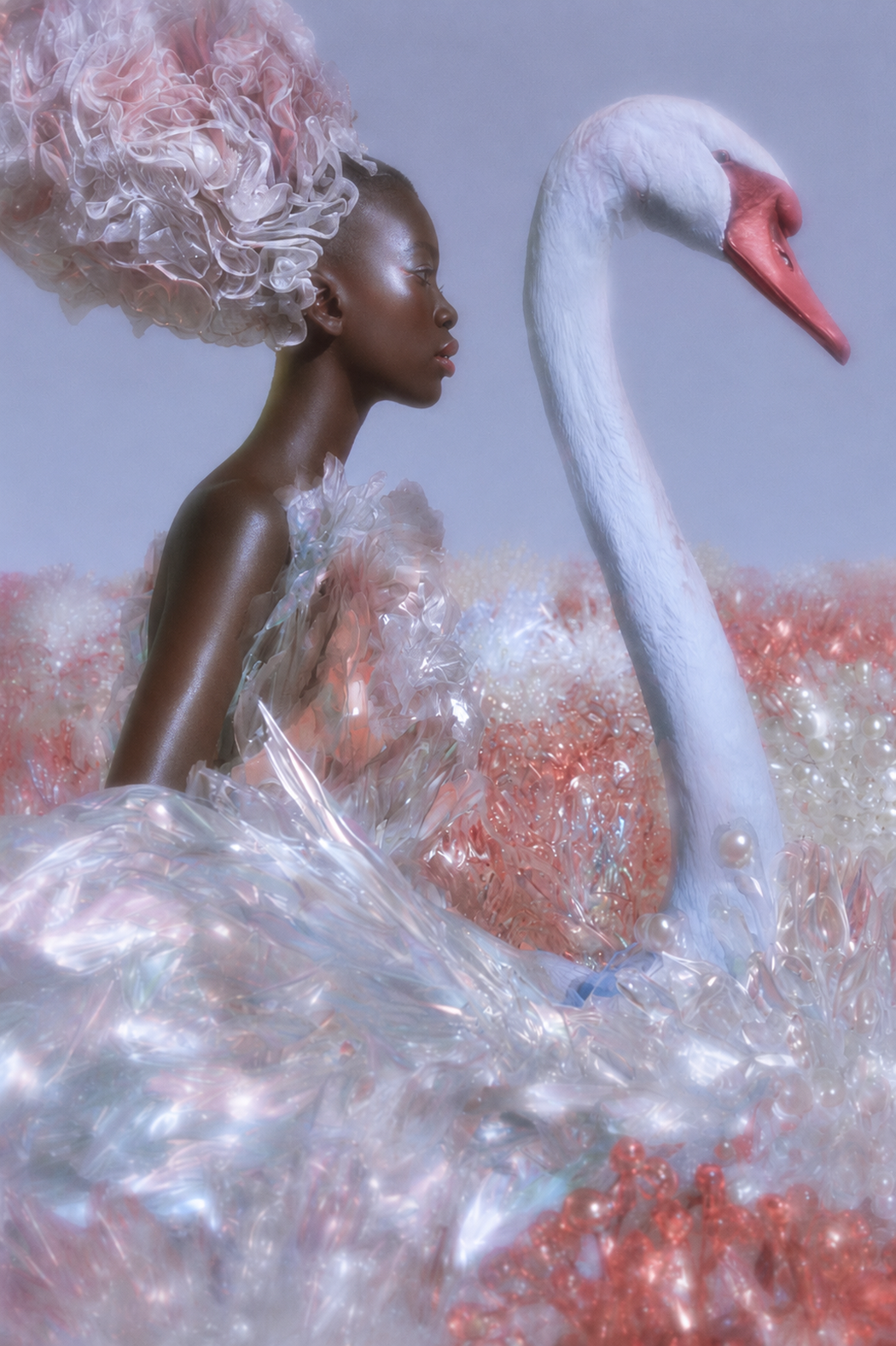 Alena Tuition | Swans Confession | 2026
How do you want viewers to feel when they look at these portraits?
I want the viewer to doubt, even briefly, their own reflex — what counts as beautiful, what counts as frightening. In these portraits, the snake doesn’t threaten, the axolotl doesn’t repel, and the swan is more than a symbol of purity. Every creature becomes as equal a presence as the woman beside it.
What matters to me is catching the moment when something repellent turns, almost without warning, into something mesmerizing — when the viewer notices they’re looking not with unease but with curiosity, and can’t quite pinpoint when that shift happened. That’s the very displacement I work toward: beauty as not a matter of correct form or familiar symbol, but the capacity to stay close to what we’re trained to keep at a distance.
If, after seeing these images, someone’s inner sense of “this is frightening” tips — even for a moment — toward “this is beautiful,” I’ve done what I set out to do.
And perhaps that’s the deepest thing I want this series to say: we’re capable of feeling more than we allow ourselves to. To notice, to pause, to feel — that is the small thing every person is capable of giving back to the world. Not a grand gesture. Just attention to what’s already beside us.