
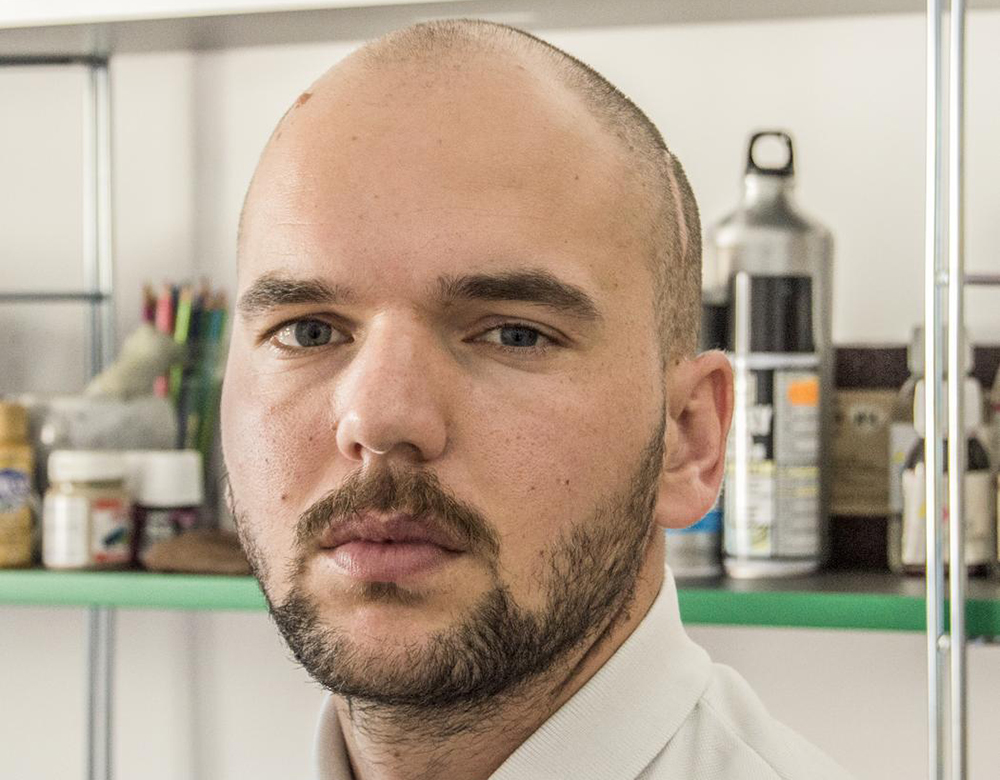
Gabriel Mateus
You originally trained in Architecture. How has this background shaped the way you construct space, perspective, and atmosphere in your paintings?
I would say that Perspective, Proportion and Composition have influenced me the most. Not only do I try to represent space with a reasonable degree of technical accuracy, I also tend to focus on choices that emphasize the clarity of spatial hierarchy: foreground, middle, background. I also tend to use a similar structure to organize my spatial view of the scene: Up=Sky, Left=Distance, Right=Home, Down=Earth.
When constructing space, I do not try to paint something that could eventually be built, as I would as an Architect. Instead, I use the freedom of painting to ignore practical constraints and focus primarily on atmosphere: how a space is entered, crossed, and paused within. There is also a tendency towards reduction without loss of structure. I like to strip away detail while preserving intent. I think it is this selective abstraction that allows the spatial truth of a space to remain intact.
Your works often contain sparse architectural environments. What attracts you to empty or almost empty spaces?
Sparse spaces reduce distraction. As a result, what remains becomes structurally readable. I also think that emptiness amplifies the atmosphere. With few objects present, light, scale and proportion carry greater emotional weight.
From a psychological point of view, I would say that sparse environments often function like paused systems. They feel as if something could happen there, but has not yet, or has just passed. That ambiguity between presence and absence creates a sense of suspended time. The space also seems to anticipate human occupation, but its emptiness removes the human figure and allows the space itself to become the protagonist.
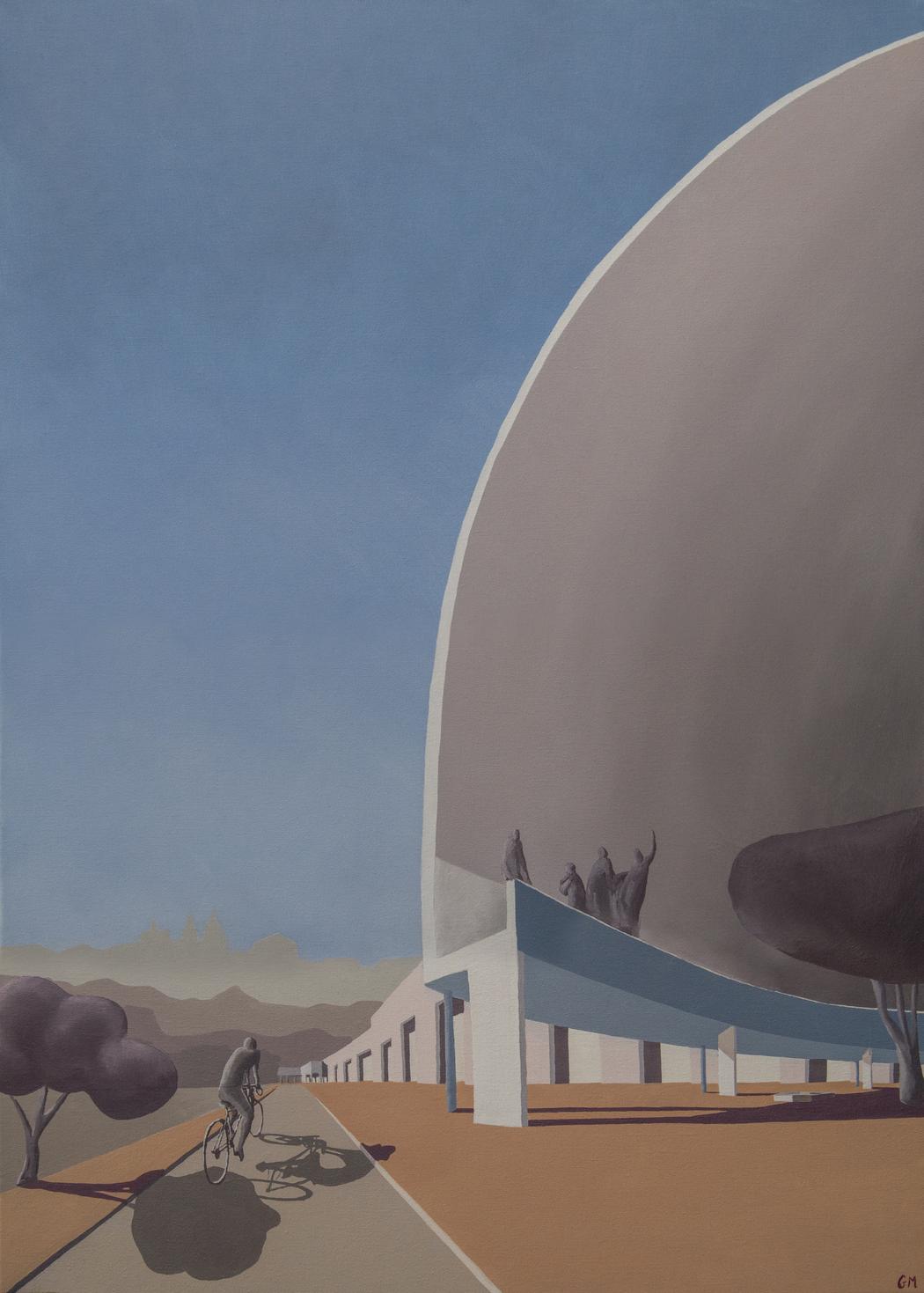 Gabriel Mateus | Semicupula Do Bairro Da Malagueira | 2021
There is a strong sense of silence and stillness in your paintings. Is emotional quietness something you consciously seek in your work?
There is definitely a sensitivity to quietness in my work, but I do not approach it as my primary means of achieving a particular emotional state. Rather, it emerges from the way I chose to construct spaces, often simplified architectural environments in which most narrative noise has been removed by default. What remains is light, proportion and structure, and these elements naturally carry a sense of stillness. I try to develop and enhance the emotions that arise during the process. Because I am naturally drawn to spaces where silence is what remains once everything non-essential is removed, I often find myself shaping the space in response to an emotion that emerged while making the work.
In that sense, the atmosphere is not predetermined, it is discovered and refined throughout the process.
In Butterfly Chair in Empty Courtyard, the chair becomes the central figure of the scene. What symbolic or emotional meaning does this object hold for you?
The courtyard represents an architectural condition waiting to be used, whereas the chair suggests the trace of use or the anticipation of it. It implies that someone has been there, or will be, but refuses to confirm either. That subtle tension aligns naturally with my interest in still sparse spaces.
The chair also represents a soft interruption of architectural order. Courtyards tend to be bounded and controlled: introducing a chair brings comfort rather than structure. It can function like a human figure inserted into a system that is otherwise impersonal.
The chair further implies pause: the moment of rest between movements. In an empty courtyard it becomes less about sitting and more about the possibility of stopping. Space is no longer merely something to pass through, it becomes a place where one might remain, even if only for a moment.
Many of your compositions feel minimal, but they also suggest a possible story. How do you balance abstraction with narrative?
As the space emerges, narrative begins to appear through the process of simplification. As elements are reduced, the viewer starts to project ideas of use, time, and presence onto the space. I like to keep the composition open enough to suggest a situation without fully describing it.
I am drawn to this minimal context that remains psychologically active. While I simplify space, I am interested in the point at which that simplicity begins to imply a story without requiring me to define what that story is.
In my work, I see abstraction as a method of reduction, and narrative as something that emerges in the gap between what is shown and what is implied or withheld.
Your works seem to invite the viewer to slow down and observe small details. What kind of experience would you like viewers to have when looking at your paintings?
Since the spaces I paint are often reduced and quiet, there is less immediate information to process. This allows light, proportion, and shadow more time to register. If there is an ideal viewing experience, I would say, it is a kind of gradual observing. At first, the image might feel simple or still, but over time it begins to open up, and the viewer becomes aware of spatial relationships and subtle shifts that were not obvious at first glance.
I like the idea that the painting does not fully explain itself immediately but instead rewards attention. The viewer is not just recognizing a space, but spending time inside it, in a way.
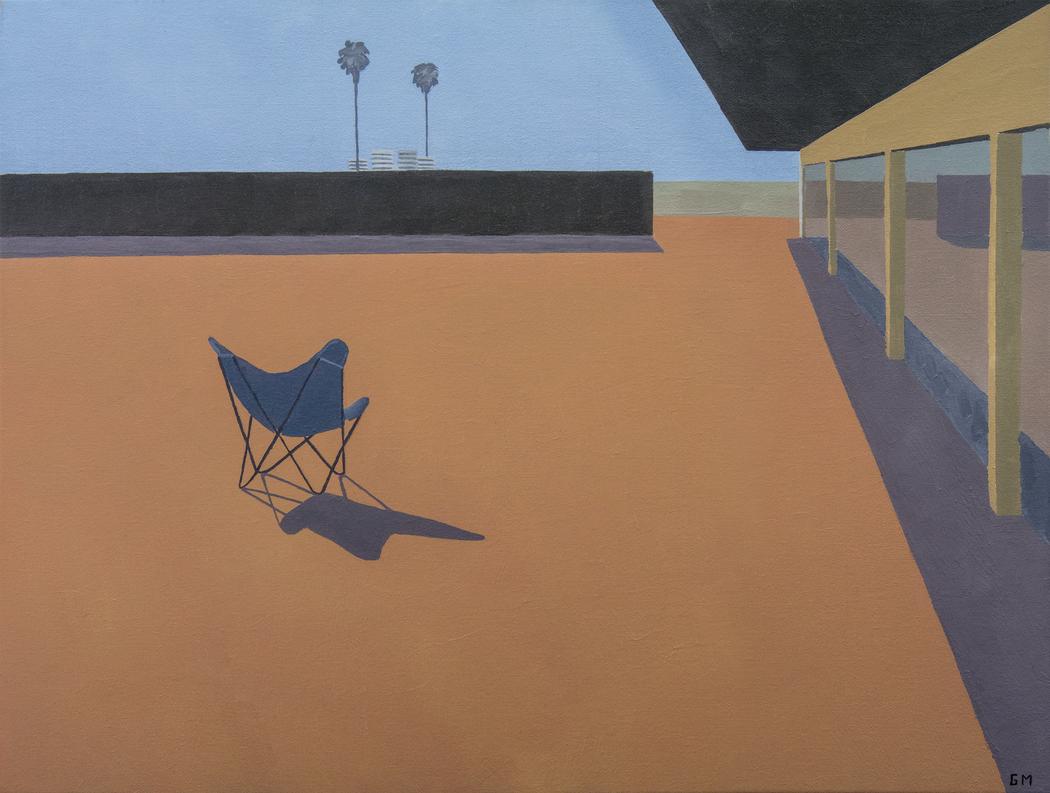 Gabriel Mateus | Butterfly Chair In Empty Courtyard | 2025
Do you usually begin with a real place, a memory, a photograph, or an imagined composition?
In the painting Butterfly Chair in Empty Courtyard, there was no specific place or memory behind the image. The space was entirely imagined and emerged through a composition structured around the Fibonacci sequence.I was exploring the possibility of using golden proportions to shape architectural space. I carried out several studies before arriving at this particular composition.
In the painting Semicupula do Bairro da Malagueira I began with a drawing by the Portuguese architect Álvaro Siza Vieira, for a building that was never built. I became interested in exploring the drawings associated with a project that remained incomplete. It was fascinating to engage with a neighborhood that had been extensively designed and documented, yet only partially realized.
I felt naturally drawn to the idea of using painting as a means of exploring how the unbuilt parts of the project might have appeared had their construction been carried through. In this sense, painting became a way of occupying the space between architectural intention and physical reality.
Leave a Reply
You must be logged in to post a comment.