
Karen Schaschwary Brinker
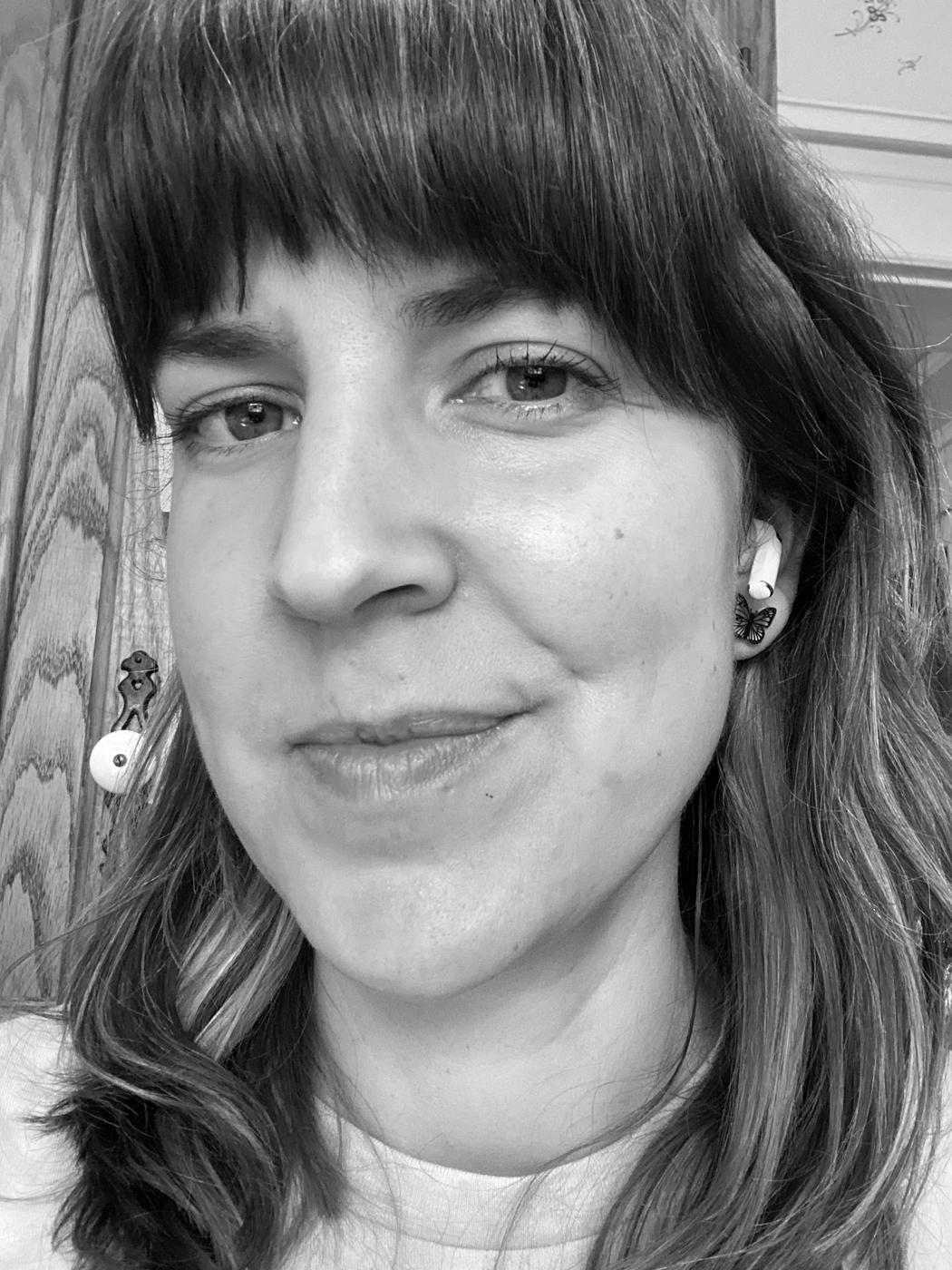
Your work transforms everyday papers – school worksheets, packaging, and mail – into vibrant compositions. What draws you to these humble materials, and how do they shape the emotional tone of your pieces?
At first, I was drawn to these materials simply because they were the most available. Worksheets, packaging, and mail cover my dining room and coffee tables, my school desk, and even find their way to my bedside table and between the fibers of my living room rug! This ephemera is a loud and persistent part of my visual life. It is easy to ignore or become desensitized to such things, but my urge to create pushed me to notice them more closely and to question how they might function within my artmaking. As a teacher and a mother, finding time (and energy) to run to the craft store can feel impossible. If I want to create, I need to look at what is already around me. These everyday materials, once overlooked, became both my medium and my solution.
The emotional tone becomes maternal, experimental, and domestic. My art can sometimes appear to be like a junk journal entry, documenting and layering specific moments.
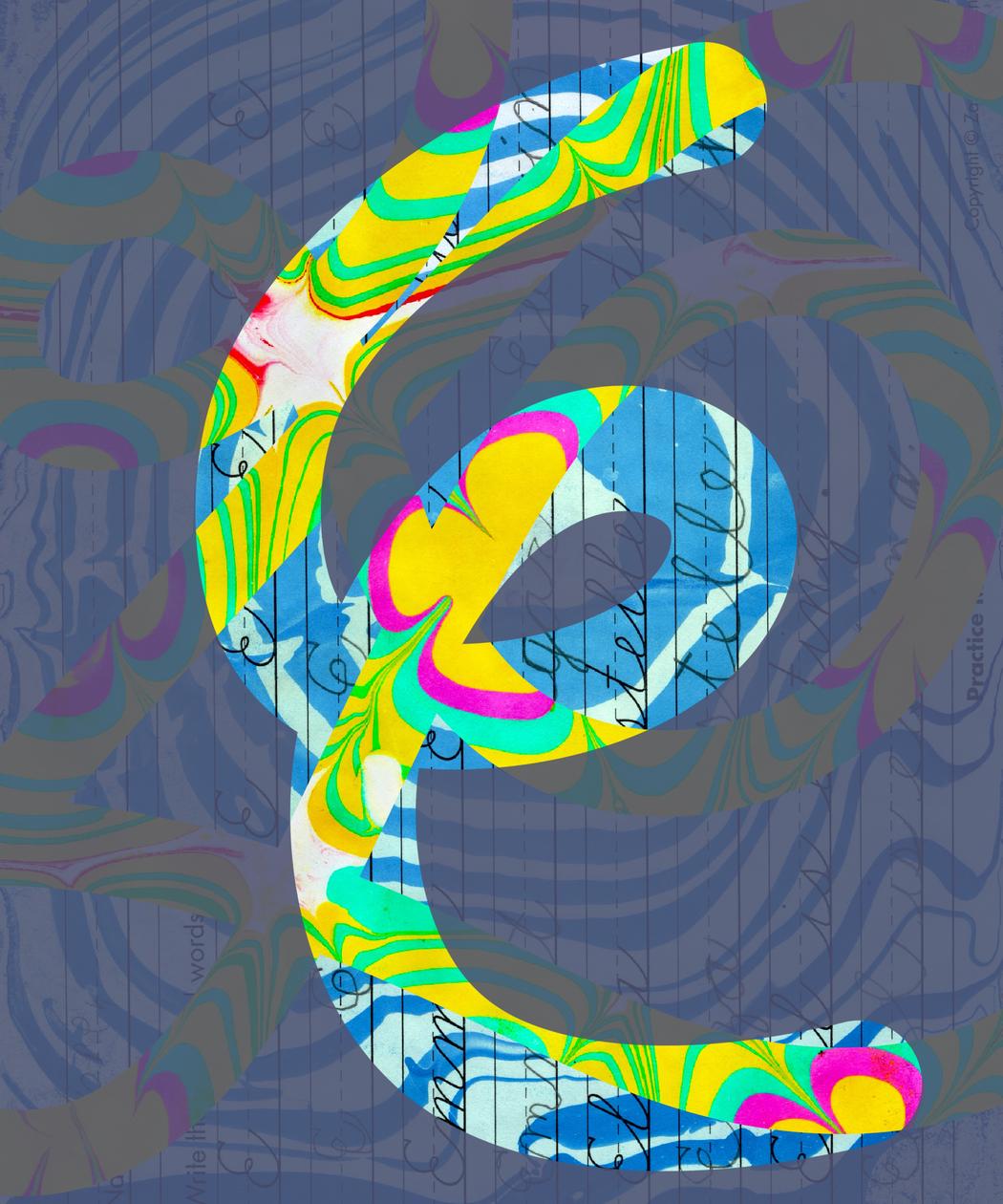 Karen Schaschwary Brinker | E3E | 2025
Suminagashi (water marbling) plays a central role in your practice. What fascinates you about this technique, and how does the element of chance influence your creative decisions?
I’ve always been drawn to artforms that carry an organic, unpredictable quality. I took many ceramics classes as an undergraduate student for that reason. That same sensibility is what draws me to suminagashi, the ancient Japanese practice of water marbling.
There’s something inherently powerful about water. We all know the experience of sitting at the edge of a lake or ocean and watching waves roll in. I grew up swimming in lakes, and water has always felt almost spiritual to me. It taps into something instinctual and deeply human. Working with ink on water carries that same quiet intensity. The surface looks still, but it is alive and responsive.
I’ll admit I’m a bit obsessed with artistic processes, sometimes to the point of neglecting the finished product. Creating in a fluid, intuitive way simply feels good. My first encounter with this kind of movement-based abstraction was through pour painting, which is adjacent to suminagashi. I was working with a group of preteens, and we poured layers of colorful liquid onto cardboard, watching the paint pool, separate, and merge on its own terms. I was just as enthralled as they were. The act of observing what the material “decided” to do felt collaborative rather than directive.
Eventually, I discovered suminagashi and ordered inks and rice paper to experiment with at home. There isn’t an abundance of accessible information about the practice, its history is layered and, at times, deliberately guarded, so much of my understanding has come through trial, error, and close observation. I’m fascinated by how subtle shifts in ink density, breath, or paper type completely transform the result. The meaning of the work changes with those shifts: bright, energetic marbling layered over a school worksheet can highlight playful moments in my son’s writing, while muted tones read as contemplative or solemn.
Chance plays a central role in my creative decisions, not as chaos, but as partnership. I introduce the materials, but I don’t fully control them. That same openness carries into my collage practice. I rarely begin with a rigid plan. Instead, I let color relationships, textures, and fragments suggest their own connections. I’ve learned that overthinking in the moment tends to kill my motivation.
Perhaps that ease comes from years of making art with children. When you create with kids every day, you learn to trust experimentation. Those neural pathways are well worn in my brain. The spontaneity that suminagashi demands feels less like risk and more like returning to something deeply familiar, a practice of paying attention and allowing the material to speak.
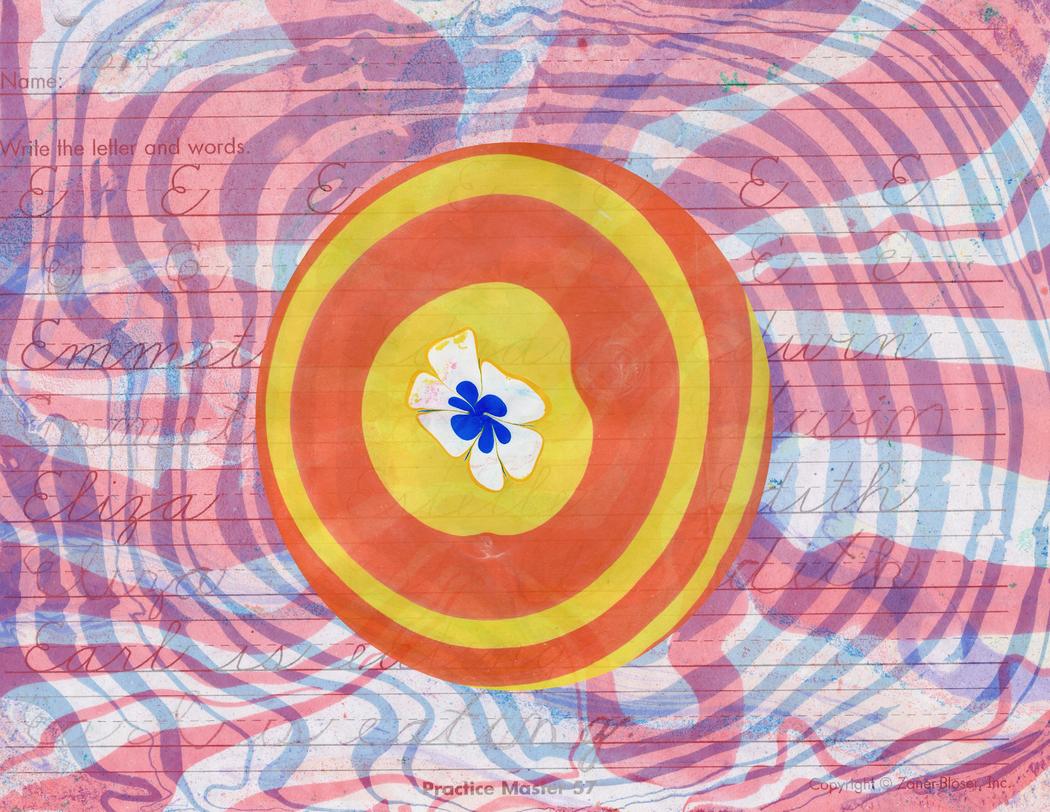 Karen Schaschwary Brinker | Soup | 2025
As both a mother and an elementary art teacher, how do these roles intersect with your studio practice? Do classroom experiences directly inspire specific works?
It’s all braided together. Art is life is motherhood is teacherhood, etc. I came to understand this more clearly through the work of Jorge Lucero and his book Teacher as Artist in Residence. His powerful perspective felt like permission to think of all I do as some type of art or creative work.
My work looks more broadly at the beauty and chaos of teacher-Mom life. The overlapping responsibilities, the noise, the tenderness, the constant negotiation of time and attention. From a distance, the collages can read as layered compositions of color and movement. But up close, each fragment carries a precise memory. I can point to a mark and tell you that a mom friend from summer camp gave me those paint markers, or a friend from college mailed me a stack of carefully chosen stickers from her job at a posh stationery store in Chicago. The practice cursive worksheet came home the same day my oldest finished his class’ read aloud chapter book. A looping doodle was rescued from my classroom recycling bin. (I ask my sons and students for their permission to use their discarded papers in my art.)
These fragments hold exchanges, conversations, milestones, and small gestures of care. When I collage them together, I’m not just arranging shapes, I’m layering moments. The work becomes a record, a way to document the emotional texture or vibe of a particular season in my life.
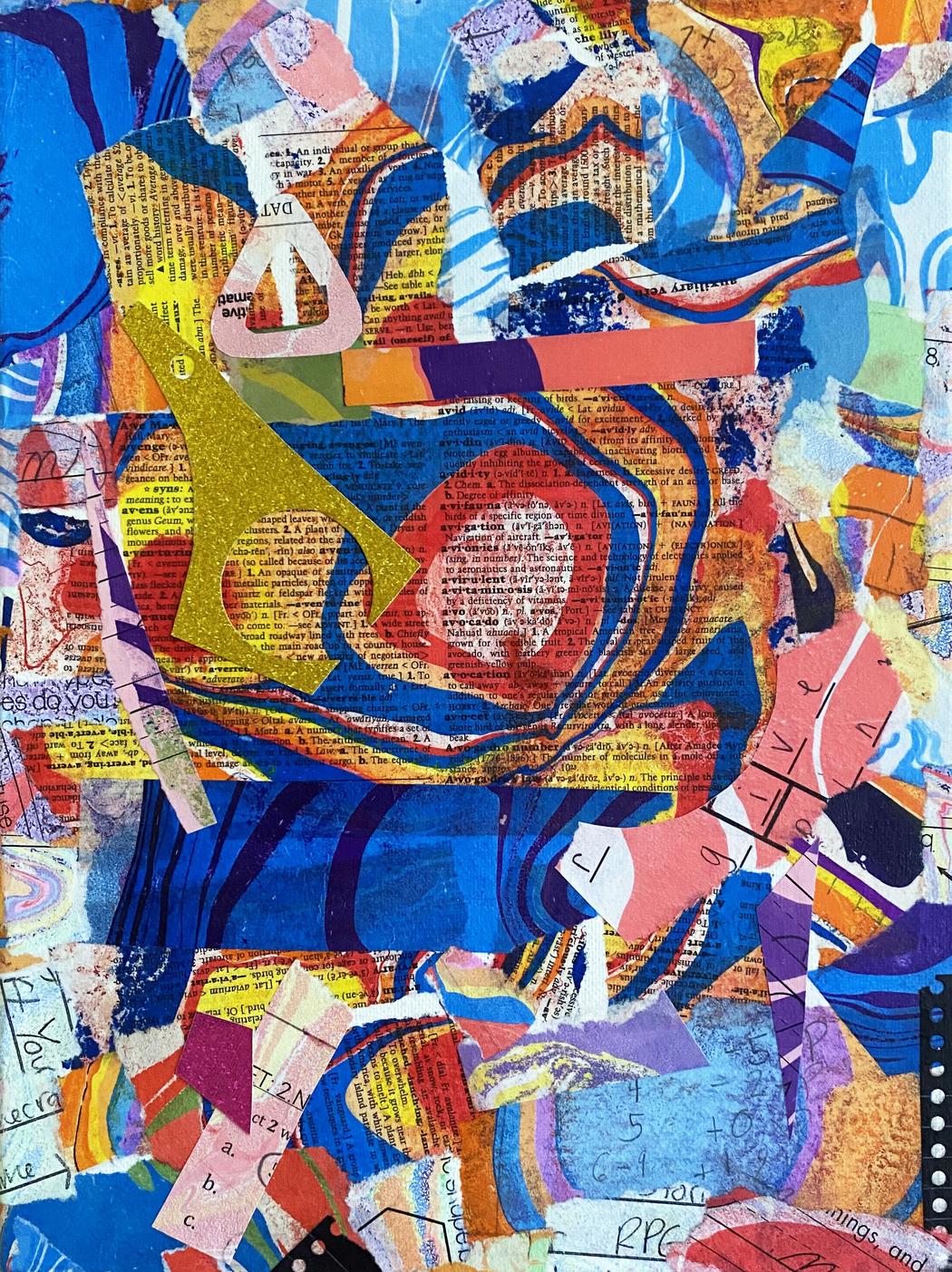 Karen Schaschwary Brinker | Ernie | 2024
Many of your collages balance chaos with careful composition. How do you know when a piece has reached equilibrium?
This is a great question. I’m not sure I have a definitive answer yet. I suspect most artists would admit that knowing when a work is finished often feels like an educated guess. Sometimes the ending is circumstantial. For example, I’m tired, there’s a deadline, or I’ve simply run out of time, money, or materials. Other times, I sense that any additional mark-making begins to dilute the meaning rather than deepen it. The composition starts to feel overworked, and restraint becomes the final gesture.
Occasionally, maybe one out of every ten works for me, there’s something closer to a spiritual clarity. A quiet but unmistakable moment of recognition of “Yes, that’s it!” Nothing too dramatic happens, but the artwork feels internally resolved. Like further intervention would feel intrusive.
Your work often incorporates fragments of text and handwriting. What role does language – spoken or written – play in your visual storytelling?
The text I include in my work often serves as a focal point that draws the viewer in. Just like water, writing or words tend to draw us in. Sometimes it functions purely as an engaging visual pattern; other times, I use it to emphasize or amplify the meaning of the piece. For example, I recently printed a concentric design over a dictionary page that reads “ripple” and used a cursive E worksheet to guide the flow and shape of the other cut pieces in a collage. In my collage Heartstrings, I layered a dictionary segment about hearts with the cursive words “zoom” and “zap,” reflecting the electric energy of love.
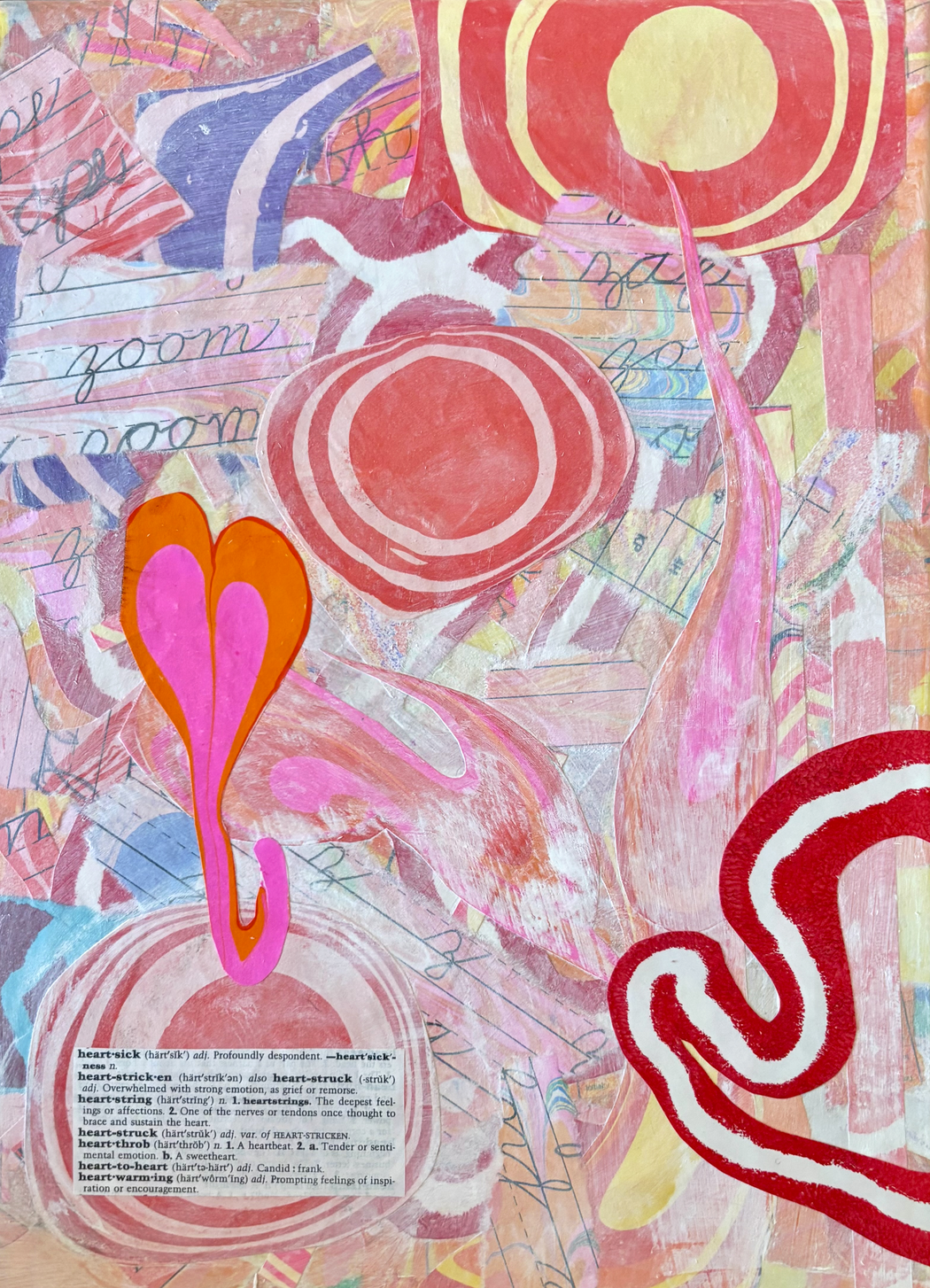 Karen Schaschwary Brinker | KRSB Heartstring
Sustainability and repurposing are central to your work. Do you see your practice as a form of environmental or cultural commentary?
I often think about the relationship between art and environmentalism. It genuinely pains me to throw away dried-out plastic markers and broken crayons almost every day. I believe a great deal of art can be made from materials that already exist, and artists of all kinds should consider that. I follow a Suminagashi artist, Jeppe K. Ringsted, who creates work using puddles from around the world and is very intentional about using natural inks that won’t harm the environment. I plan for my next inks to be of that kind. I say this while fully aware that artists are not the primary drivers of environmental damage. Still, artists help shape consumer culture, and we can play a role in nudging it toward sustainability.
I also think artists should embrace imperfection, especially in the age of AI. I’ve noticed a growing tendency to leave in mistakes and to share or explain the process more transparently, almost as a way of proving that a human hand was involved. As a teacher, I see students constantly battling impossible standards and perfectionism, so I deeply value this shift toward finding meaning in imperfection.
Culturally, my work also reflects what it feels like to be a mother and a teacher, whether society is ready to hear that or not. I’m regularly rejected by galleries, and I sometimes wonder if my aesthetic is considered too feminine or too child-like. Teachers, who are often women, understand how undervalued we are in the United States. Society often wants us to be small, to just be of service, and not take up any additional space. I also recognize that my work isn’t highly polished, and that may be part of it. It’s pushing me to consider where I want my art to exist in the world. I suppose the luxury of having a day job is there isn’t significant financial pressure to appeal to anyone but myself.
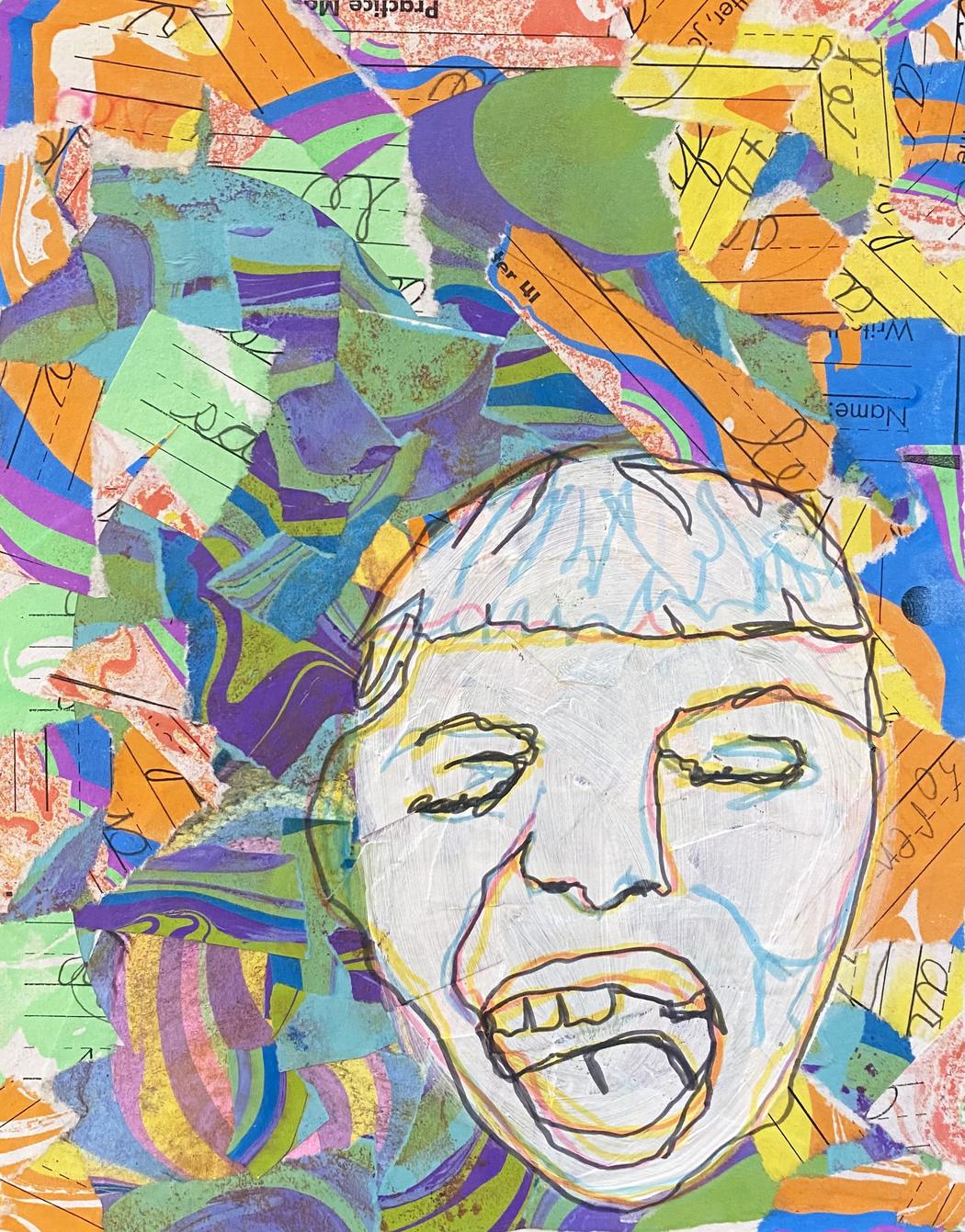 Karen Schaschwary Brinker | Lost Tooth | 2025
What have your students taught you about creativity that has changed the way you approach your own art?
My students, along with my own two children, constantly remind me how joyful artmaking can, and should, be. They also show me, in endless ways, that we are all always learning and growing, which feels like a tremendous gift. I laugh when a student with challenging behaviors produces the most astonishing work. My teacher friends and I talk about this all the time: you try to be frustrated with the child, but then you look at what they’ve created and are swept up in awe (and curiosity about where it even came from).
I’m always fascinated by what the children around me notice, from rocks on the ground to the way I enter the room, and it inspires me to be a more careful observer. Lastly, children are remarkably resilient (generally speaking), and they remind us not to take life too seriously. If you mess up, you just get up and try again.
Leave a Reply
You must be logged in to post a comment.