Yue Zhou
Exploring Yue Zhou’s Where the Room Ends
By Tabitha Ysart Green
From 26th October to 2nd November 2026 Yue Zhou’s solo exhibition Where the Room Ends was presented at Gallery 46, London. Supported by London Art Collective, this exhibition delves into “the boundary of the room”, investigating the room as a space which carries daily life, accumulating memories, emotions, habits and traces left by others, and questioning where our living spaces begin and end.
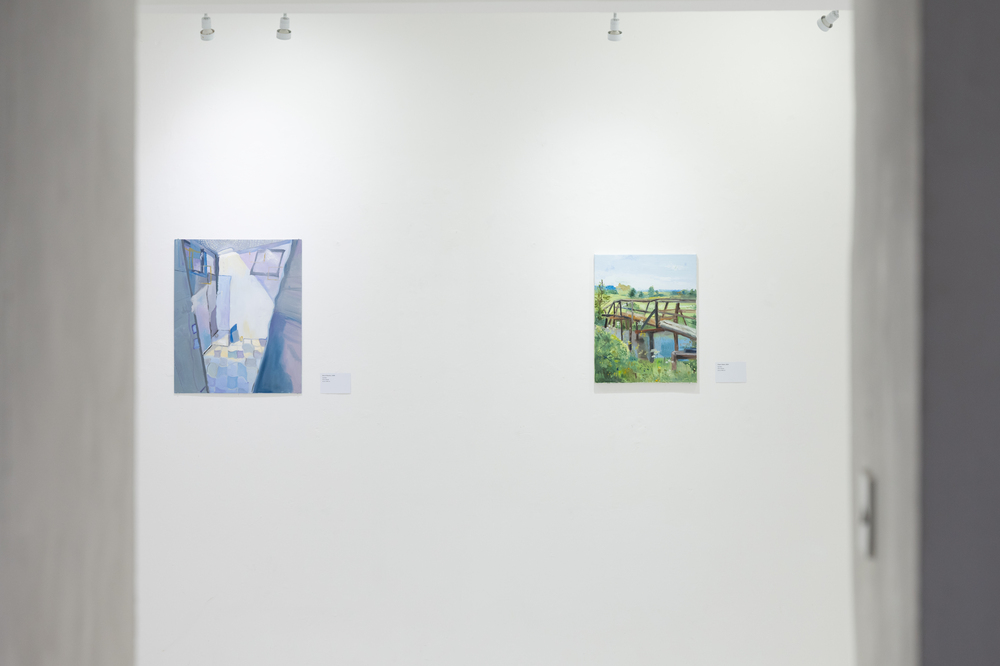
View from Where the Room Ends at Gallery 46. Image courtesy of Yue Zhou.
Zhou is a contemporary artist working mainly with oil on canvas, acrylics and watercolours. She draws on her own intuition, emotion and everyday perceptions for her compositions, and uses cool tones, light, space and subtle colour relationships to construct psychological landscapes that lie between reality, memory and dreams. For Zhou, painting is more than a depiction of the external world. It is a way of perceiving the world, organizing experiences and responding to her inner self. In her works, subjects and scenes remain in a state of open narrative, inviting viewers to project their own memories and emotions during the viewing process, and to reconsider the subtle and fluid connections between humanity and the world.
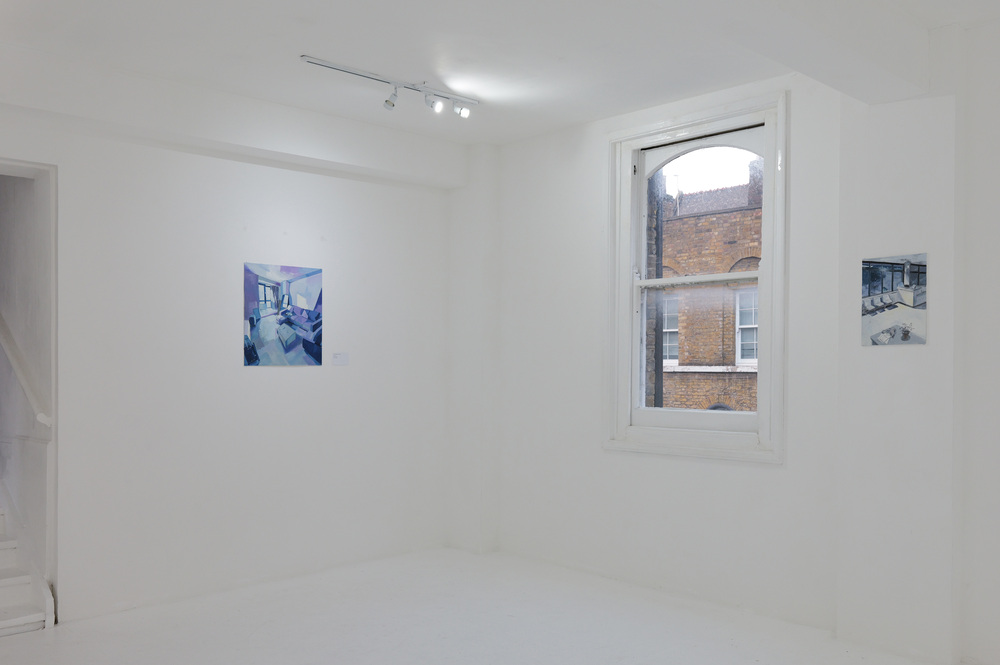
View from Where the Room Ends at Gallery 46. Image courtesy of Yue Zhou.
The exhibition is centered around the series titled End of Rooms (2025-2026). This set of five paintings displays a series of interior scenes in which memories, emotions and the experiences of others constantly intertwine. Zhou implements layering as a medium through which to display how reality and imagination interplay within these spaces, turning them from simple interior scenes into psychological spaces. She breaks down the original boundaries of space, causing familiar places to take on unstable and multifaceted appearances. She explores the multiple lives which a room may live through time, and how these lives, and the people who have lived within them may interact in extra-temporal spaces. The works thus pose the question: when different life experiences converge within the same space, to whom does the room truly belong? And where exactly are its boundaries? Displayed within the exhibition space the artworks take on a further layer of fracturing, providing windows into spaces that the viewer does not and cannot occupy, and adding another life, another purpose, to the space.
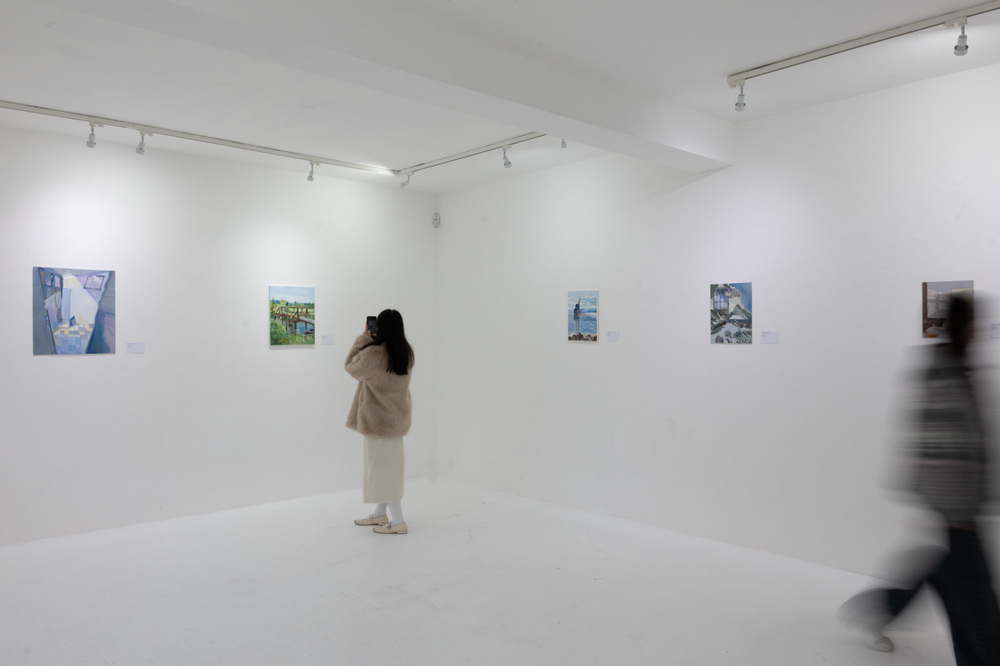
View from Where the Room Ends at Gallery 46. Image courtesy of Yue Zhou.
The End of Rooms series is accompanied by four other works; Another Window (2025), Before Becoming (2024), Indoor Weather (2025), and Green Green (2025). Indoor Weather acts as a transitional piece, shifting the focus of the exhibition to the inner state of individuals, while still addressing the nature of indoor spaces and how they interact with the people who live within them. It explores how an individual’s interior space, both physically and mentally, can be shaped by their environment and activities, and the natural mirroring which occurs between a person and their home environment. Another Window transforms the canvas into a window through which one may see another way of viewing the world, rather than a one-to-one representation of it. In this piece Zhou continues her almost surrealistic way of presenting the world by blurring the lines between reality and the image and allowing the real world and the depicted scene to respond to one another. Before Becoming creates another alternative view of the world, imagining the future rather than representing the present. It occupies a space between reality and a dream, like our wishes for the future grounded in the present; an exercise in preparation or manifestation.
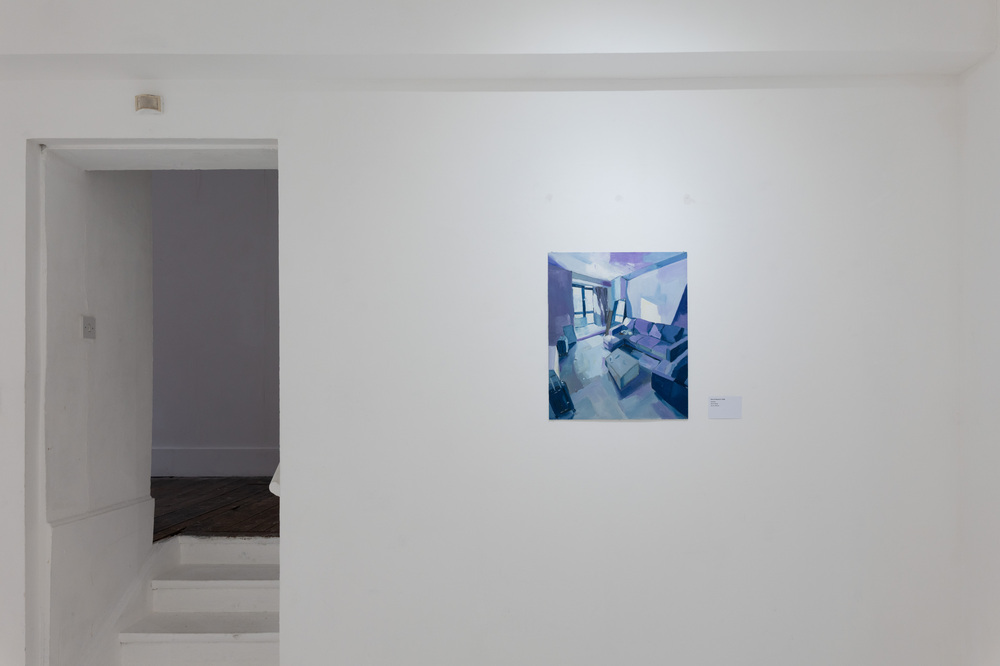
View from Where the Room Ends at Gallery 46. Image courtesy of Yue Zhou.
Where the Room Ends explores how people live, remember and imagine in unsettled spaces, reflecting contemporary living: shared kitchens, other people’s food in the fridge, unfamiliar bathroom lights, open suitcases, unopened letters and unclaimed dishes. It suggests that as living spaces change, the boundaries of the room become blurred, extending into the past, present and imagination.