

Irina Berlizova
Your background includes law, art history, and psychology. How did painting become your chosen form of expression, and how do these different fields inform your practice today?
I have been painting for more than twenty years, so painting is a significant part of my life—one that has developed alongside my education and professional career. I studied art history at the Russian State University for the Humanities, attended Veronika Kalacheva’s art school, and studied portraiture under the guidance of Polina Ishkhanova. Over time, a range of themes emerged that I continue to explore today: the inner world of the individual, cultural memory, and the relationship between people, the objects around them, and the spaces they inhabit.
Each of these areas has its own place in my practice. Law is part of my professional background. Art history helps me understand the relationship between artistic language and the culture of its time. Psychology supports my interest in people, their emotions, experiences, and inner contradictions. Painting allows me to approach these themes through image, colour, and material, while preserving what is difficult to express fully in words.
You explore the relationship between a person’s inner world and their surroundings. How does your interest in psychology influence the way you develop an image or convey an emotional state?
I’m interested in how a person’s inner state manifests itself outwardly, and how the surrounding environment, in turn, influences their perception of themselves. In portraiture, this is connected to themes of vulnerability, corporeality, and the ambiguity of emotional experience. But a person can also be explored through the objects they choose to surround themselves with.
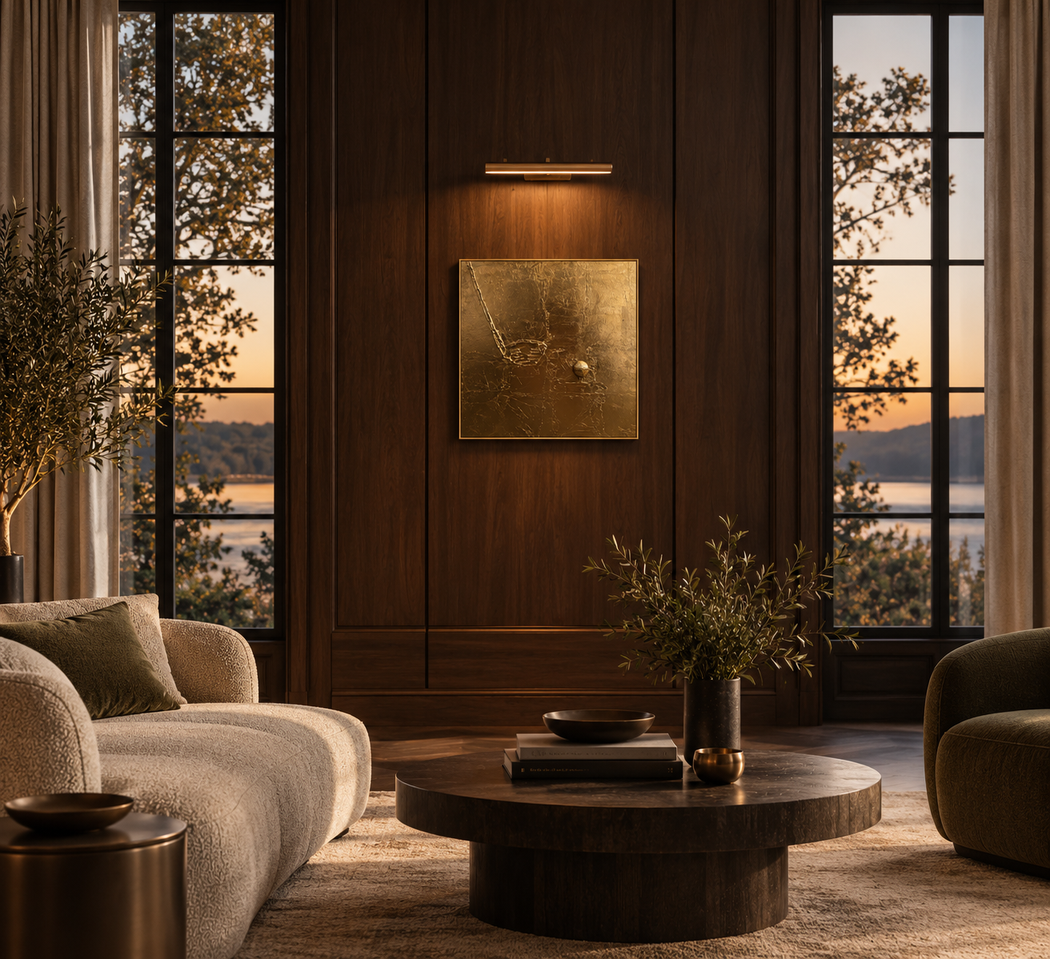
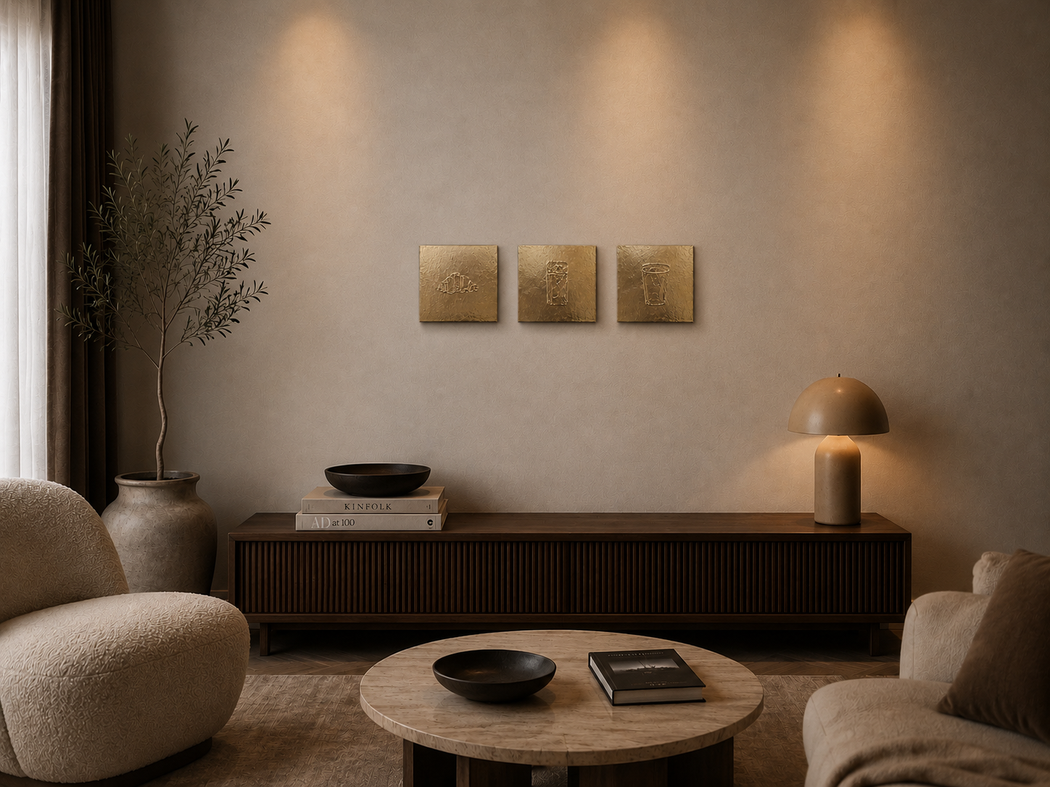
For example, in my series The Aesthetics of Gold, I turn to familiar images—a phone, coffee, a croissant, golf. They become symbols of a particular lifestyle, success, and belonging to a certain social circle. Here, the psychological dimension emerges through the relationship between a person and an object: what we choose for ourselves, what we want to communicate about ourselves to others, and what we elevate or even idolize.
In a painting, the emotional state is conveyed by the work as a whole: its composition, depth of color, density of the surface, and the balance between calm and active areas. That is why texture and material are just as essential to me as the depicted subject itself.
You describe your artistic language as a combination of contemporary restraint and the aesthetics of the old masters. Which artists or historical traditions are especially meaningful to you, and how do you reinterpret their influence?
I am particularly drawn to traditions that bring together craftsmanship, careful attention to materials, and the relationship between an artwork and the space it inhabits. In the aesthetics of the Old Masters, I am attracted to the depth of colour, the complexity of the painted surface, and the carefully constructed composition. Another important area of my interest is Russian decorative and applied art, especially embroidery and ornament.
In the series Interweaving Traditions, the cross-stitch gradually transforms into a square, a pixel. Part of the ornament is made with real thread, before transitioning into painted geometry. Gold leaf with a greenish patina evokes the aged gold of icons, the metal of church domes, and traces of time on everyday household objects.
I am interested in how a familiar form changes when transferred into a different material and context. What remains of embroidery when the fabric disappears? Does an ornament retain its connection to manual labour when it begins to resemble a digital image? It is from these questions that my reinterpretation of tradition emerges.
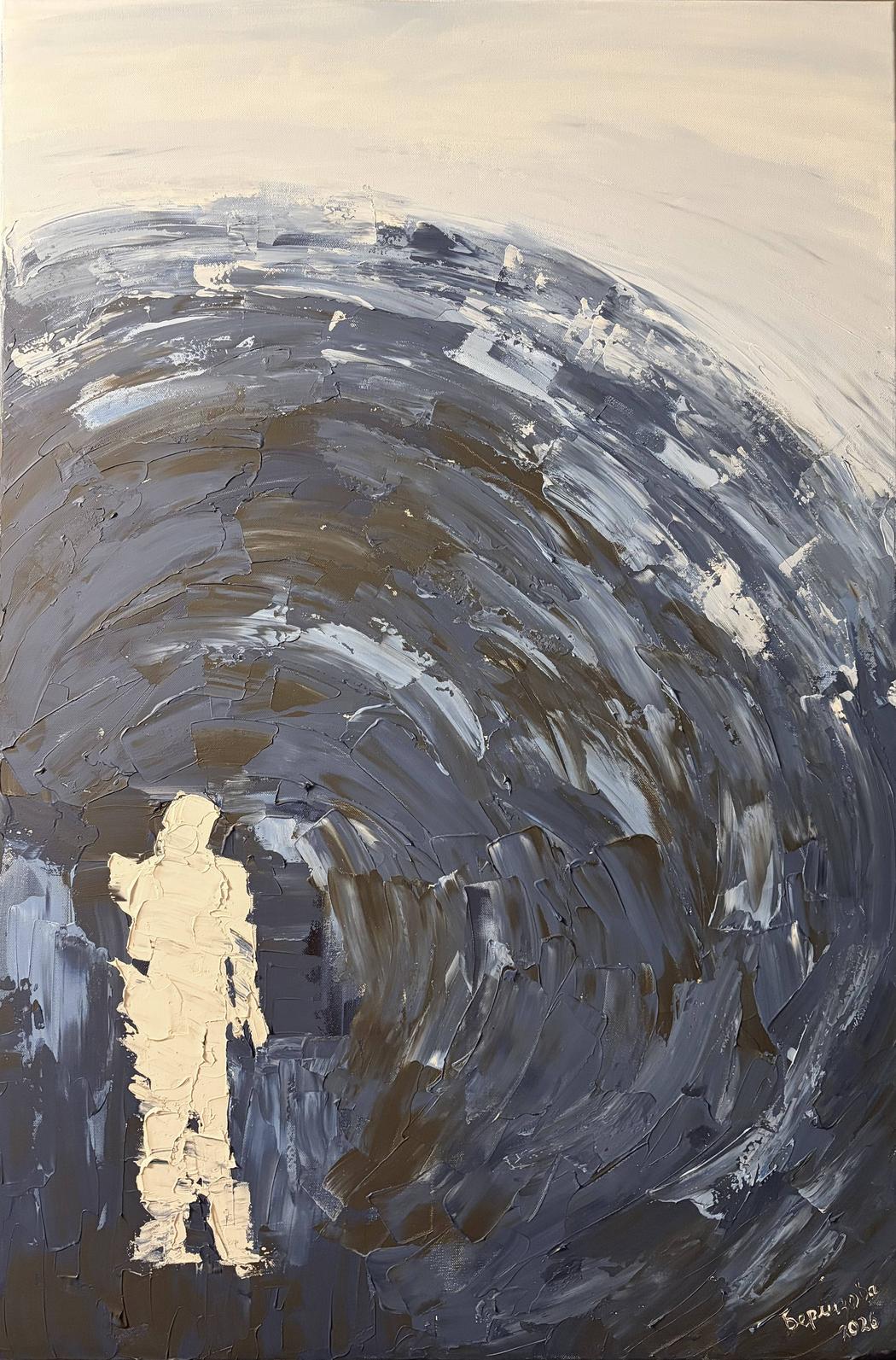 Irina Berlizova | Hyperjump
You want your paintings to become part of an architectural space while retaining their independence. What allows a work to enter into a dialogue with a room without losing its own voice?
The dialogue begins with composition, scale, colour, and light. A painting can support the rhythm of a space, add depth to it, or become a focal point around which attention is gathered. What matters to me is how the artwork is perceived within the room as a whole, as well as what reveals itself to the viewer when they come closer.
The independence of a painting comes from its content and its own artistic structure. It should have a theme that remains meaningful beyond the specific interior in which it is placed. In the Interweaving Traditions series, this theme is cultural memory and the transformation of traditional craft forms into a contemporary language; in the Aesthetics of Gold series, it is our relationship with objects and symbols of status.
I want people to be able to live with a work for a long time: to notice how its surface changes under different lighting, to return to its details, and to discover new connections with their own experiences. For me, this is an important part of the emotional space of a home.
People purchase my existing paintings, but I also enjoy creating commissioned works for specific spaces and collaborating with architects and interior designers. This approach makes it possible to create a sense of completeness within the environment that surrounds a person, while also filling the paintings with meanings that resonate throughout the entire project.
Metal leaf and textured surfaces play a prominent role in your work. What expressive possibilities do these materials offer, particularly as the light and the viewer’s position change?
Metal leaf and relief make light an active participant in the work. As the lighting changes, the metallic surface can become brighter or more subdued, while the texture emerges through shadows. As the viewer moves, the relationship between these areas changes, and with it, the overall impression of the work.
At the same time, a single material can serve different conceptual purposes. For example, in the Aesthetics of Gold series, gold leaf emphasizes the almost sacred significance of ordinary objects. In the Interweaving Traditions series, by contrast, the patinated surface is associated with memory, time, and the history of objects.
What matters to me is precisely this connection between the physical properties of the material and the content of the work. Shine, roughness, layers of paint, or embroidered thread offer different ways of experiencing the image, even before the viewer begins to interpret or explain it.
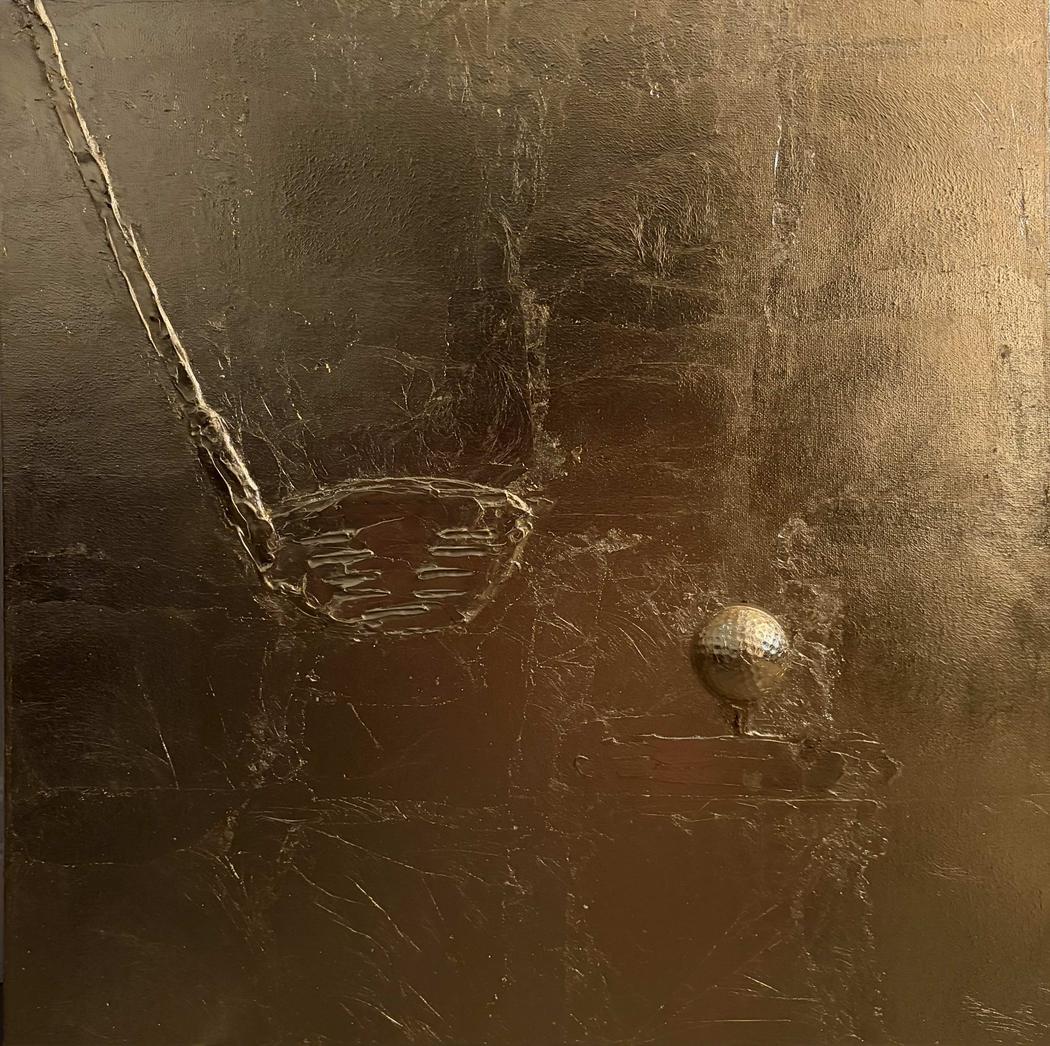 Irina Berlizova | Success
Your works move between recognizable subjects, abstraction, and ornament. What determines the visual language and materials you choose for a particular idea?
The choice depends on what the idea is built around and what is important for the viewer to see or understand. In the Aesthetics of Gold series, the objects need to remain recognizable; without that, the dialogue about habits, status, and lifestyle would be lost.
In the Interweaving Traditions series, gold recedes into the background and becomes more of a setting, while the ornament takes centre stage, because it is the ornament that carries the connection to craftsmanship and cultural memory. The use of real embroidery has a specific meaning here: it preserves the presence of handwork alongside geometric forms that resemble pixels and digitalization.
Abstraction allows me to focus on the relationships between colour, rhythm, texture, and the very sensation of space. I work with different means of expression, but they are united by one theme: how a person perceives themselves and the world through images and the material environment.
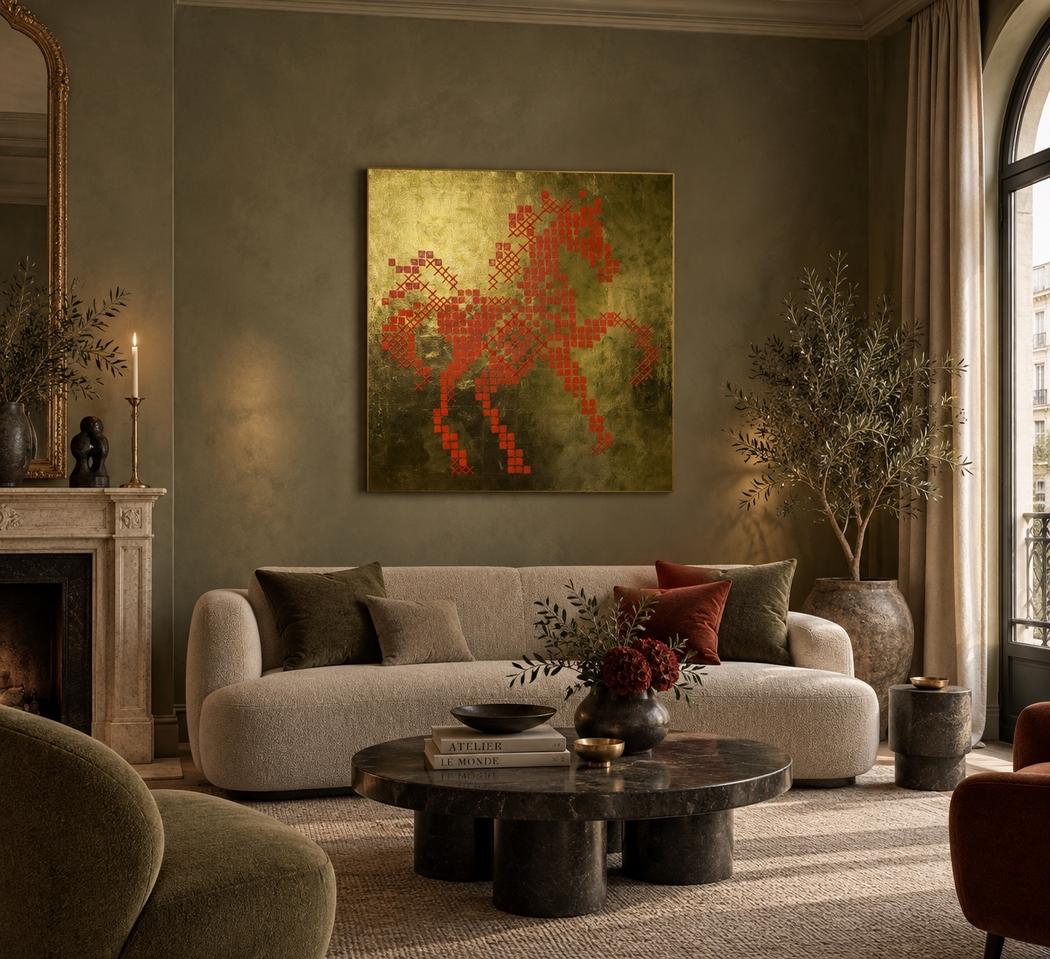 Irina Berlizova | The Home Guardian Interior
You value the possibility of a painting revealing new meanings over time. Has a viewer’s interpretation ever helped you discover something unexpected in your own work?
It is important to me to leave room in a painting for personal interpretation. I introduce a theme and choose the means through which it takes shape, but the viewer comes to the work with their own memories and associations—and sometimes even with a certain professional bias. I always find it fascinating to hear what different people think a painting conveys or what they believe the artist intended to say. Even when the artist has expressed something very directly in the work, and even when the painting is accompanied by an artist’s or curator’s text, everyone still sees something of their own.
I have one painting called Hyperjump. It was conceived as a work about a modern man standing at a crossroads, on the verge of transformation, with the surrounding space pressing in on him. At one of the exhibitions where the work was shown, the curator was convinced that it was about my own depression. That interpretation was completely unexpected to me, but of course it made me think. I did not discover any depression, but in today’s world of ubiquitous antidepressants, it is always reassuring to have one’s mental health confirmed.
Even an ornament can be perceived through memories of home and family belongings, through an interest in tradition, or through its resemblance to digital graphics. All of these possibilities are embedded in the work itself, but their meaning will be different for each person. For me, for example, cross-stitch embroidery brings back memories of my grandmother, who taught me how to embroider, while for someone else it may simply be an interesting contemporary trend—which is something I kept hearing at my most recent exhibition.
That is why I relate strongly to the idea that our reading of a painting can also change over time. The work itself remains the same, but a person begins to notice something different in it depending on their experience and their state of mind.