Nikolina Karoulla
You grew up in Cyprus, a country deeply marked by division. How has this experience shaped your understanding of home, identity, and belonging as an artist?
Growing up in Cyprus, a country deeply marked by division, has shaped the way I understand home, identity, and belonging, both personally and as an artist. For much of my childhood, the division was simply part of everyday life. I thought it was normal to see soldiers, checkpoints, and the UN between the two sides, and I never really questioned why. It was only as I grew older that I began to understand the history and pain behind the reality I had grown up with. When I was 18, I was in my grandfather’s garage in Nicosia, where my grandmother also had her office, and I came across an old photograph of my grandfather dressed as a soldier. I was shocked, as I had never imagined him as someone who had been part of the war. When I asked him about the photograph, he told me that he had been a soldier during the conflict. I then asked my grandmother about what they had experienced, and she told me that, at the time, only my mother had been born, while her two younger siblings had not yet come into the world. She remembered having to take shelter in a bunker, while my father remembers military planes flying overhead. Hearing these stories changed the way I saw my own country. Afterwards, I travelled to the other side of Cyprus, and strangely, it did not feel like home, even though it was still my country. I encountered abandoned houses that seemed frozen in time, with chairs, dining tables, and personal belongings still inside, as if the people had left one day and never returned. I also saw Christian Orthodox churches that had been abandoned and left to slowly collapse. These places stayed with me because they felt like physical traces of memories that had never completely disappeared.
As an artist, I think these experiences have strongly influenced what I am drawn to and how I make work. I find myself interested in the traces that people leave behind, in abandoned spaces, objects, memories, and the silence surrounding things that are difficult to speak about. I am interested in how a place can hold the memory of people who are no longer there, and how something as simple as a chair, a table, a photograph, or a building can carry an entire history. My relationship with Cyprus has therefore become quite complex. It is a place I deeply identify with and call home, but it is also a place where I have experienced a sense of unfamiliarity within my own country. As an artist, I use this tension as a way of exploring identity, memory, displacement, and belonging. Rather than trying to give a single answer to what home means, my work allows me to question it and to look at what is remembered, what is forgotten, what is left behind, and how these things continue to shape who we are.
While living in the Netherlands, you discovered a photograph of your grandfather as a soldier. What did this image awaken in you, and how did it change the direction of your artistic practice?
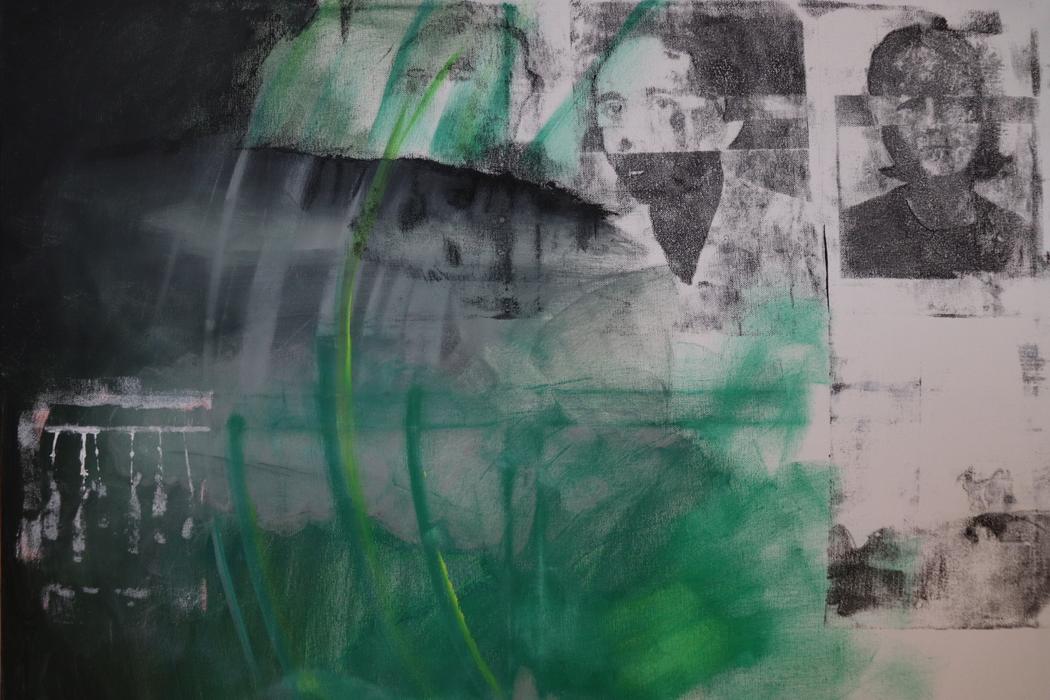
I did not discover the photograph while living in the Netherlands. I found it when I returned to Cyprus, my home country, after having first moved to the Netherlands. I was in my grandfather’s garage in Nicosia, where my grandmother also had her office, when I came across an old photograph of him as a soldier. Until that moment, I had never really seen a clear direction for my art. I was making work, but I did not know what I was searching for. Something about that photograph changed that. It opened a part of my family history that I had never truly understood, and suddenly all the stories I had grown up around, the division, the war, the fear, the silence ,became something much more personal.
The photograph awakened something in me that is difficult to put into words. It created a wound that I did not know I carried. I felt torn apart by the emotions and memories connected to it, and I became deeply afraid of returning to my own country because I knew that going back would mean confronting all of these feelings again. At the same time, that pain gave me direction as an artist. I became determined to speak about the suffering, fear, loss, and emotions that had been hidden within my family and within the landscape I grew up in. It was all I could think about, day and night. I wanted to show not only what happened historically, but what remains inside us afterwards , what is passed down through families, what is left in abandoned homes, and what happens to a person when they realise that something they thought was normal was actually a history of trauma.
In a strange way, I felt that I had finally found myself in my art. I found something that felt honest and deeply connected to who I am. But finding it also meant losing something. I think I lost a certain innocence, the innocence of being a child who believed that the divided world I grew up in was simply the way the world worked. The photograph made me see my home, my family, and even myself differently. So, although it was painful, it became a turning point in my artistic practice. It gave me a subject, but more importantly, it gave me a reason to make art: to try to understand the wounds that I inherited, and to give form to emotions and memories that are sometimes too painful to put into words.
Your works incorporate personal and archival photographs. How do you select these images, and what makes a particular photograph meaningful enough to become part of a painting?
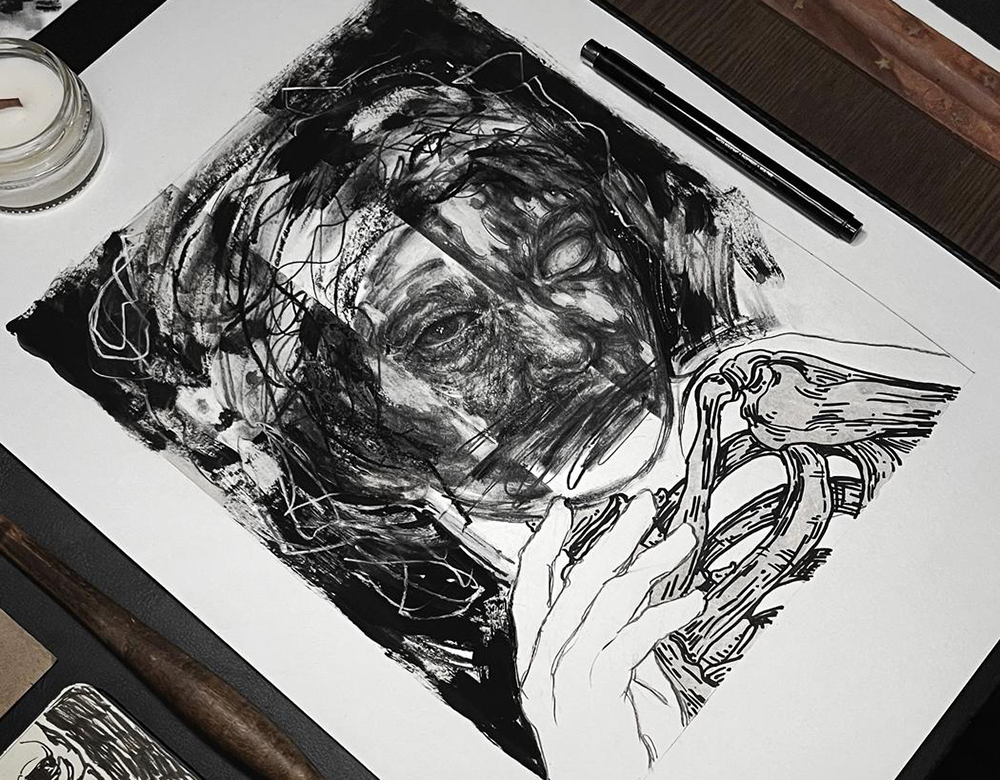
Most of the photographs I use come from my grandparents on my mother’s side. I specifically asked them to give me everything they had so that I could scan their entire photographic archive and then slowly decide which images felt important. I did not want to choose photographs simply because they were visually interesting. I had conversations with my grandfather, my grandmother, and my mother about the photographs, asking them what they remembered from those moments. I would write down the memories that they could recall most vividly, and those conversations became almost as important as the photographs themselves. I then translate the photographs through transfers, jelly-plate printing, and painting, sometimes keeping the details very clear and sometimes allowing them to disappear. The clarity of a face, for example, can depend on how vividly a memory has survived. In this way, the image becomes a record not only of what happened, but of how that moment is remembered.
Some photographs also come from my own personal archive. These can be moments that I know are important to me, even if I cannot completely grasp or put into words why. One example is *Terminal Nostalgia, which came from a very powerful experience with my grandmother on my father’s side while she was passing away. In her final moments, she began telling us stories from her childhood with such extraordinary detail that I was completely struck by how intensely those memories had remained with her. I began to understand that perhaps, at the end of our lives, certain memories return to us with an intensity that is impossible to predict. It made me think about the moments from my own life that I might remember most intensely at the end of mine. In the work, I brought together photographs from my own life as a way of imagining those memories returning. Some images are covered in deep red, almost as if the paint has scratched or wounded the photograph, reflecting memories that carry pain. Others remain black and extremely clear, highlighted with green, almost like thoughts suddenly appearing through the mind. Even though the painting itself is made with harsh, gestural brushstrokes, I wanted these fragments to feel like the way memory actually moves through the mind—sometimes sharp and immediate, sometimes fragmented, and sometimes almost impossible to hold onto.
What attracts you to combining painting and printmaking rather than working within a single medium?
This is also why I feel the need to work between painting and printmaking rather than remaining within a single medium. A photograph is already a record of a moment, but when I manipulate it through printmaking and then interfere with it through paint, it stops being only a document and becomes something closer to a memory. I am interested in that space in between what actually happened and how we remember what happened. Memory is not only visual; it can be a colour, a smell, a texture, a sensation, or even something that we cannot name. Printmaking allows me to preserve, repeat, distort, layer, and partially erase an image, while painting allows me to respond emotionally and intuitively to what remains. The two mediums therefore create a dialogue between evidence and interpretation, between what is remembered and what is felt. I am essentially trying to record moments in time, but not as a camera would. I want to record them as they exist inside the mind—how clear they are, how they change, what colours they carry, what disappears, and what continues to return. For me, the space between painting and printmaking is where that transformation of a photograph into a living memory can happen.
The photographic figures in your works are often partially obscured, fragmented, or absorbed into painted layers. Does this concealment represent gaps in memory, family silence, emotional protection, or something else?
I think the concealment in my work represents many things at once, but most importantly, it reflects the way memory actually exists inside us. A memory is rarely complete. Some parts remain incredibly clear, while others become blurred, fragmented, or completely inaccessible. This is particularly important to me when working with my family’s photographs. There are moments that my grandparents or my mother can remember with extraordinary detail, while other parts of the same story have disappeared, been forgotten, or perhaps were never spoken about. Growing up, there were many things my parents did not talk to me about, perhaps because they wanted to protect me from the more painful parts of their experiences. I think that silence also became a kind of inheritance.
When I obscure a face, cover a photograph with paint, or allow an image to disappear into the surface, I am not necessarily trying to hide the person. In some cases, I am trying to show the emotional weight of what cannot be fully seen or understood. Sometimes a face needs to disappear because the memory itself has become unclear; other times, covering it makes the figure feel even more present, because you become aware of what is missing. I am interested in that tension between revealing and concealing. The painted layers can act almost like a protective skin over a photograph, but they can also feel like a wound, something that has grown over an experience without completely healing it.
I also think about how photographs themselves can create a false sense of certainty. A photograph tells us, “this happened,” but it cannot tell us exactly what that moment felt like, what was happening outside the frame, or what that person carried inside them. By fragmenting and painting over the photograph, I can move beyond the historical record and into the emotional memory of the event. The missing parts become just as important as the visible ones. In that sense, concealment is not only about forgetting or silence; it is also about protection, trauma, imagination, and the limitations of what can be remembered or communicated. I want the viewer to experience the uncertainty themselves and to feel that they are looking at something that is partly accessible and partly beyond reach. For me, that space between what is visible and what is hidden is where memory becomes most truthful.
Your practice connects intimate family stories with the broader history of Cyprus. How do you balance personal experience and collective memory without allowing the work to become purely documentary?
I think the personal and the collective are inseparable in my work. I begin with my family because that is the history I have access to most intimately, but I am not trying to document my family’s story or recreate the history of Cyprus exactly as it happened. Instead, I use these personal memories as a starting point to explore something larger: how history is carried by individuals, how it is passed from one generation to another, and how it continues to exist in places, objects, photographs, and even in the things that are left unsaid. The stories my grandparents and parents told me are deeply personal, but they are also part of a much larger experience shared by many people in Cyprus.
I also think there is something universal within even the most intimate family archive. A photograph of a wedding, a funeral, a child being born, a family gathering, or a moment of celebration belongs to one particular family, but the emotions connected to those moments are something we can all recognise. We may not have lived the same story, but we have experienced our own versions of love, loss, happiness, grief, or the feeling of watching someone we love grow older. This is what interests me about inviting the viewer into my work. I don’t want them to simply see my family or my memories. I want them to be able to find something of themselves within them.
This is where the transformation through painting and printmaking becomes important. I take something that is factual, such as a photograph, a person, a place, or a remembered event, and allow it to become something subjective. I distort it, obscure it, layer it, remove parts of it, and respond to it through colour and gesture. I am not interested in presenting the photograph as evidence or asking the viewer to understand exactly what happened. I am more interested in what the photograph makes me feel and what it might make someone else feel. A family photograph can therefore move beyond being a document of one particular person and become a vessel for ideas of loss, displacement, fear, nostalgia, love, or belonging.
In this sense, I see my paintings almost as emotional records rather than historical records. I am trying to capture how history and memory live inside the mind rather than simply how they appear in an archive. Cyprus and my family are the entry points, but the emotions are what I hope the viewer carries away. If someone stands in front of one of my paintings and feels anger, sadness, happiness, grief, nostalgia, love, or even something they cannot quite name, then for me, I have achieved what I wanted to do. I don’t need the viewer to feel exactly what I felt or to understand the story in the same way I do. I want the work to create a space where their own memories and emotions can surface. Although our families and experiences are different, there are certain moments in life that we all share in some form. That is where the personal can become collective, not because our stories are the same, but because the emotions within them can be recognised, felt, and carried by someone else.
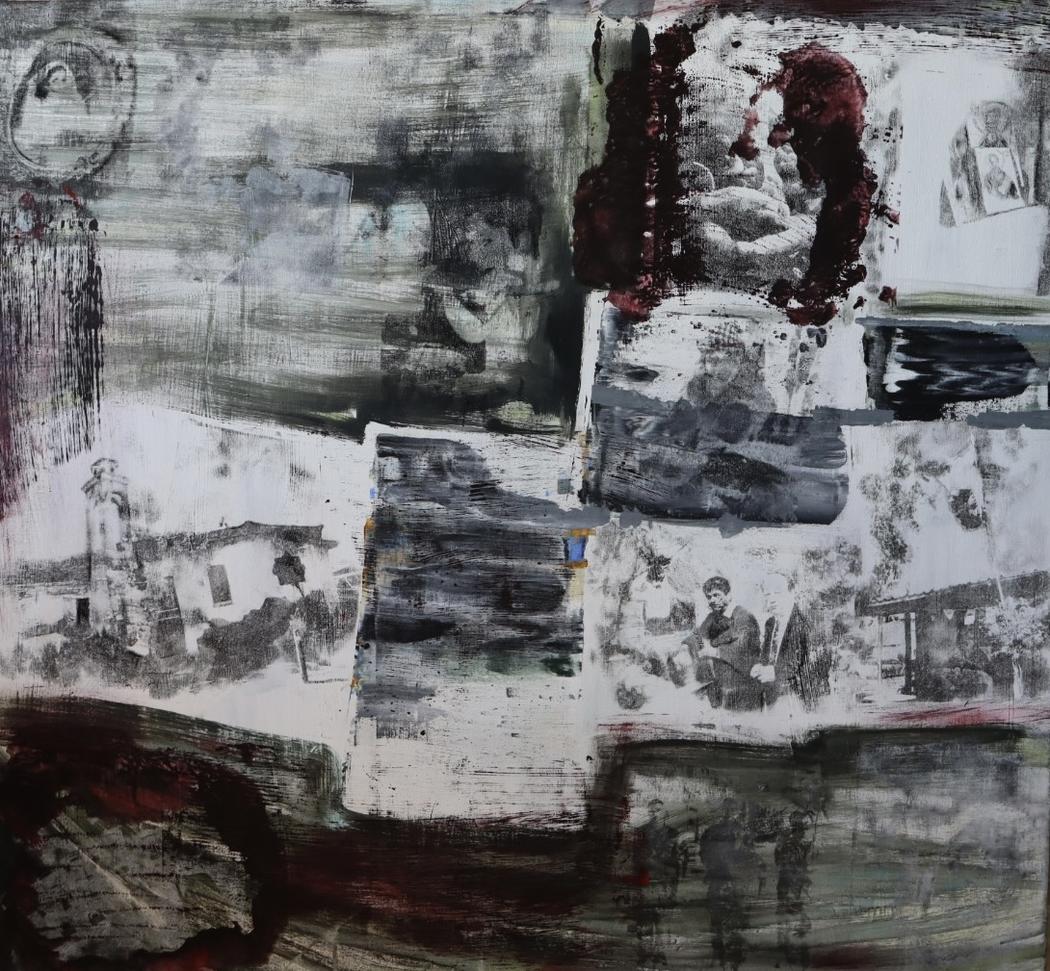
Nikolina Karoulla | Terminal Nostalgia
You want your art to be felt rather than simply understood. What kind of emotional or imaginative space would you like viewers to enter when encountering your work?
I want the viewer to enter the work without feeling that they have to understand a specific story or know the history behind every image. I want them to feel something before they begin trying to understand it. My work comes from very personal memories and experiences, but once it leaves me and becomes a painting, I feel that it should be open to the viewer’s own interpretation. I want the photographs, colours, textures, and fragments to create a space where their own memories can surface.
When someone looks at one of my paintings, I would like them to feel as though they have entered a memory that is not completely their own, but somehow reminds them of something they have experienced. It could bring back a person, a place, a smell, a colour, a moment of happiness, or something painful that they have not thought about for a long time. I am interested in that moment when you cannot completely explain why something affects you, but you feel it emotionally or even physically.
For me, it is a little like getting goosebumps. Sometimes you hear a piece of music, remember something, see an image, or experience a certain moment and suddenly you get goosebumps. You might not even know exactly why your body reacted that way, but you know that something reached you. That is the kind of response I hope my work can create. I am not necessarily looking for the viewer to understand everything I am trying to communicate. If the painting creates a feeling that they cannot immediately explain, that is meaningful to me.
I don’t want to tell the viewer what they should feel. If one person feels sadness, another feels anger, another feels nostalgia, and someone else feels happiness or comfort, all of those responses are meaningful to me. Even if they feel something completely unexpected, I feel that the work has succeeded because it has created an emotional reaction. I want the paintings to become a meeting point between my memories and theirs.
In a way, I want to create a space between remembering and imagining. The images are real and come from real people and moments, but the way I manipulate them through painting and printmaking allows them to become something less fixed. I want the viewer to wander through that uncertainty and fill the gaps with their own imagination. For me, the most powerful experience is when someone stops trying to figure out exactly what the painting means and simply allows themselves to feel. If I can create that moment where they get that feeling, almost like goosebumps, then I feel that I have done what I wanted to do.