
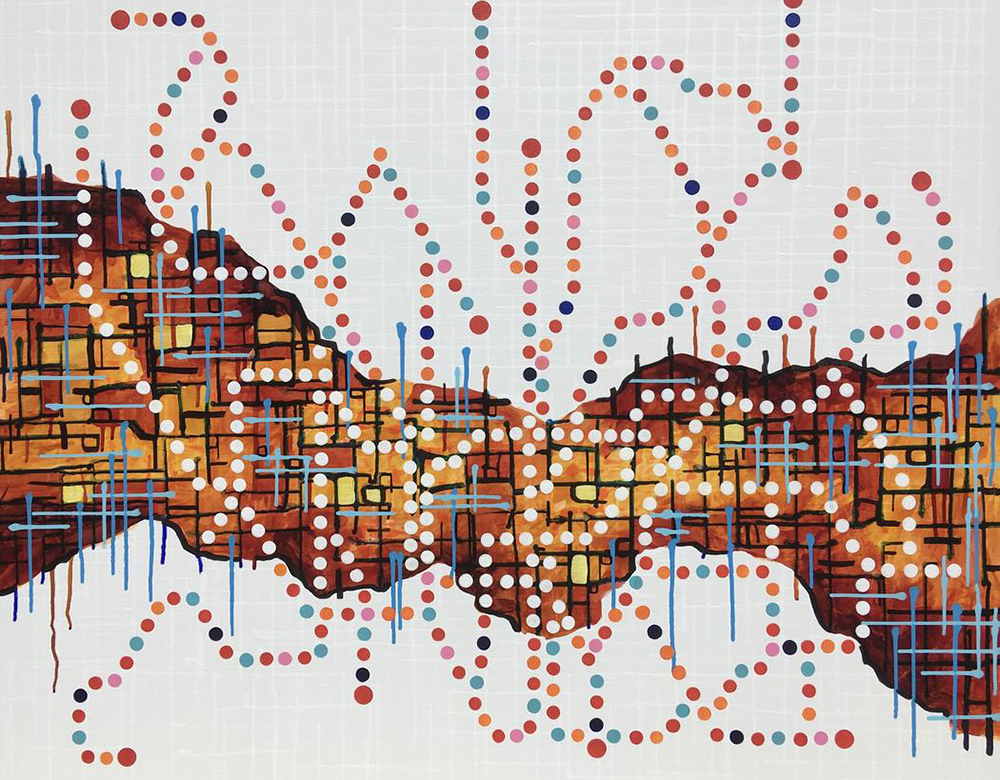
Mike Fullarton
Your recent work transforms maps and transport networks into abstract visual compositions. What first drew you to maps as a source of artistic material?
The map paintings actually developed quite naturally from an earlier series of abstract pixel paintings. Those works were built around repeated marks and patterns, and I became interested in how quite simple elements could gradually build into something much more complex.
At some point I began experimenting with maps as an underlying structure. I’ve always found maps visually interesting anyway – the lines, symbols, colours and systems they use to turn something incredibly complicated into something understandable. I realised they gave me a framework that I could work with and then gradually break apart.
Transport maps were particularly interesting because they already contain a kind of rhythm and movement. Once I started painting them, I became less interested in the map as information and more interested in the patterns that could emerge from it. That was really the beginning of the series.
In works such as Barcelona Metro, Manhattan Subway, and Rome Metro, the original transport systems are still present, but they are no longer immediately readable as conventional maps. How do you decide how much of the original geography to preserve and how much to transform?
I like the original map to remain somewhere underneath the painting, but I’m not concerned with it being completely accurate or readable. It’s really a starting point.
Usually the routes and general structure give me the initial composition. From there I start responding to the painting itself. Certain areas become denser, some lines disappear, colours overlap and new shapes emerge. At that stage, making the painting work visually becomes more important than remaining faithful to the original geography.
I like the fact that someone might initially see the work simply as an abstract painting and only later realise that there is a real city underneath it. Once you know that, I think you start looking at it differently and perhaps trying to find your way around it.
Circles and dots appear repeatedly throughout your paintings and have become a distinctive part of your visual language. What do these forms represent for you – stations, people, movement, or something more abstract?
They originally developed through the pixel paintings, so they weren’t consciously intended to represent anything specific. I was interested in repetition and in how large numbers of small marks could create rhythm, density and movement across a surface.
When I began making the map paintings, circles also made obvious sense as stations and points of connection, so the two visual languages came together quite naturally.
I still don’t think of every circle as literally representing a station or a person, though. Sometimes they suggest crowds or movement through a city; sometimes they are simply part of the composition. I quite like that ambiguity. A very simple repeated shape can start to suggest lots of different things depending on its scale, colour and surroundings.
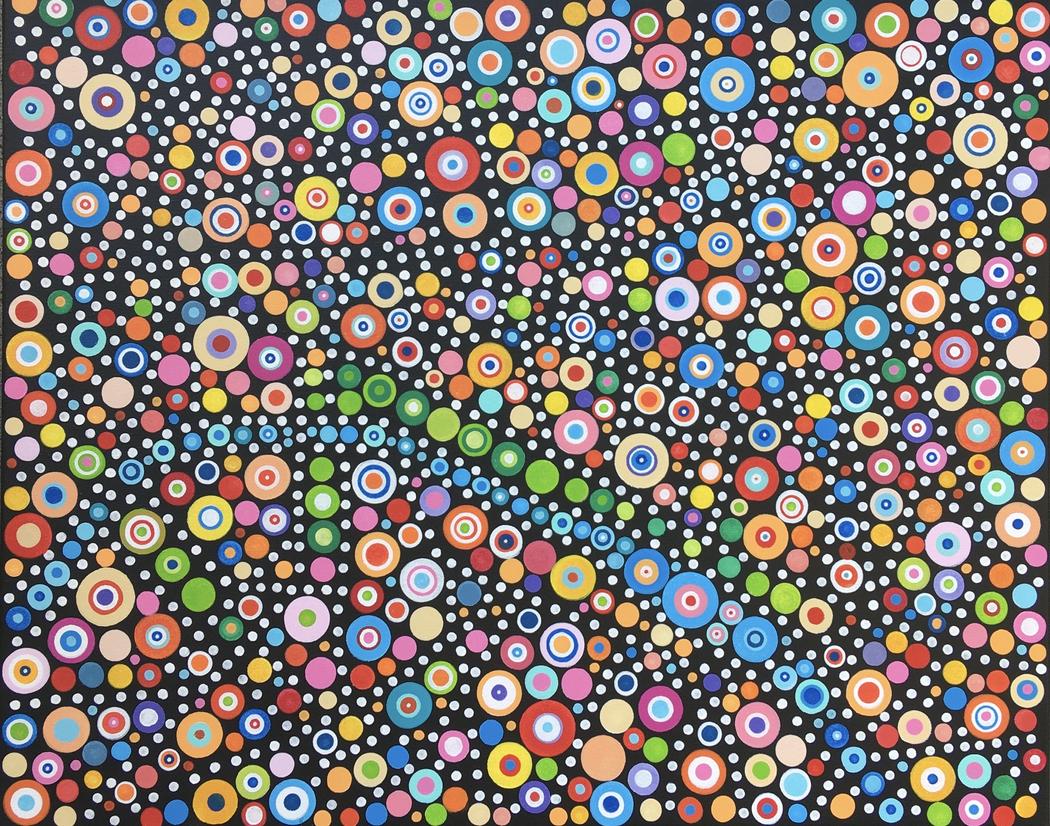 Mike Fullarton | Paris
Each city seems to generate a very different palette and atmosphere. How do you choose the colours for a particular city, and to what extent are they influenced by your own memories or impressions of the place?
My own experience of a city definitely influences the way I approach each painting, although that doesn’t always mean simply choosing colours that I associate with the place.
Barcelona is a good example. I’ve visited several times and I find it quite an overwhelming city – the crowds, the density of the buildings and the strong geometric structure of the city itself. Interestingly, that made me want to approach the painting in a slightly more restrained way. I allowed more open space into the composition while still suggesting the density and structure underneath.
Manhattan produced almost the opposite response. When I visited New York, I spent a lot of time walking the streets as well as travelling on the subway, and what stayed with me was the incredible sense of energy everywhere I went. Manhattan Subway became much more vibrant and densely layered as a result.
With Rome, I visited during the summer, and my memories are very strongly connected to the heat and intensity of the city, but also to its history and culture. The colours developed from that combination – warmth, age, vibrancy and the sheer amount of visual information you encounter there.
So I’m not trying to create a literal colour portrait of each city. It’s more about allowing my memory and experience of the place to influence the atmosphere of the painting. Two people can experience exactly the same city very differently, and I like the fact that the paintings reflect my own response rather than trying to describe the city objectively.
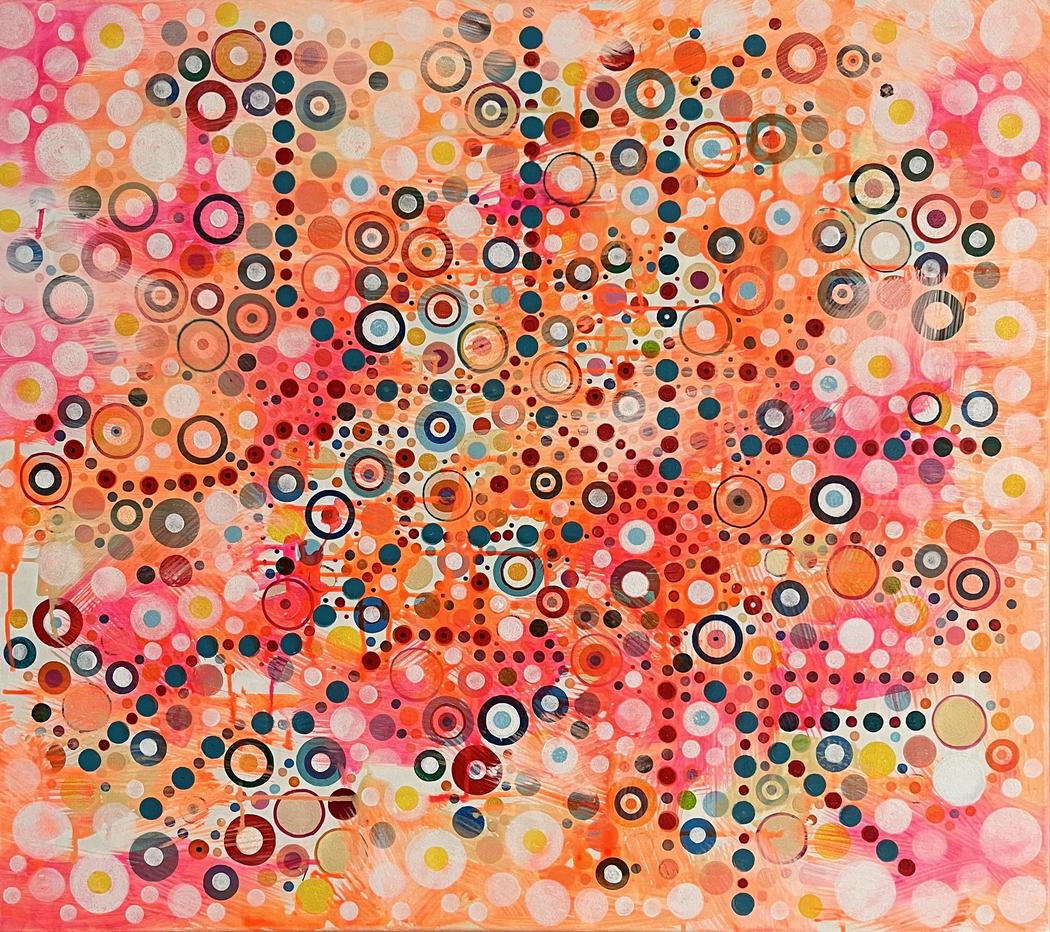 Mike Fullarton | Rome Metro | 2020
Your compositions often move between a sense of strict structure and apparent spontaneity. How do you balance the predetermined geometry of a map with intuitive decisions made during the painting process?
That tension is probably one of the things I enjoy most about making them.
At the beginning there is quite a lot of control because the map gives me an existing structure. But as the painting develops, I deliberately allow myself to move away from it. I work in layers, and there are always decisions that happen because of something unexpected – a colour interacting with another colour, a mark appearing where I hadn’t planned it, or an area suddenly needing to become quieter or more intense.
I think if I controlled everything from beginning to end, the paintings would become too much like designs or diagrams. Equally, if I abandoned the map completely, I would lose the structure that makes the work interesting to me. The painting happens somewhere between those two things.
You describe your work as reflecting movement, memory, and the experience of being within a city. Are you interested primarily in the physical structure of cities, or in the emotional and psychological experience of navigating them?
Probably increasingly in the second.
The physical structure gives me something concrete to begin with, but what interests me more is how differently we experience the same city. A map presents a place as something fixed and objective, whereas our experience of it is anything but that. We know cities through journeys we make repeatedly, places we avoid, neighbourhoods we associate with particular people, and memories attached to very specific locations.
That connects with another part of my practice, my Memory Paintings, which explore how memories change each time we recall them. I think there is a relationship between the two bodies of work. Both start with something that appears to be fixed – a place, an image, a map – and then explore how our own experience changes it.
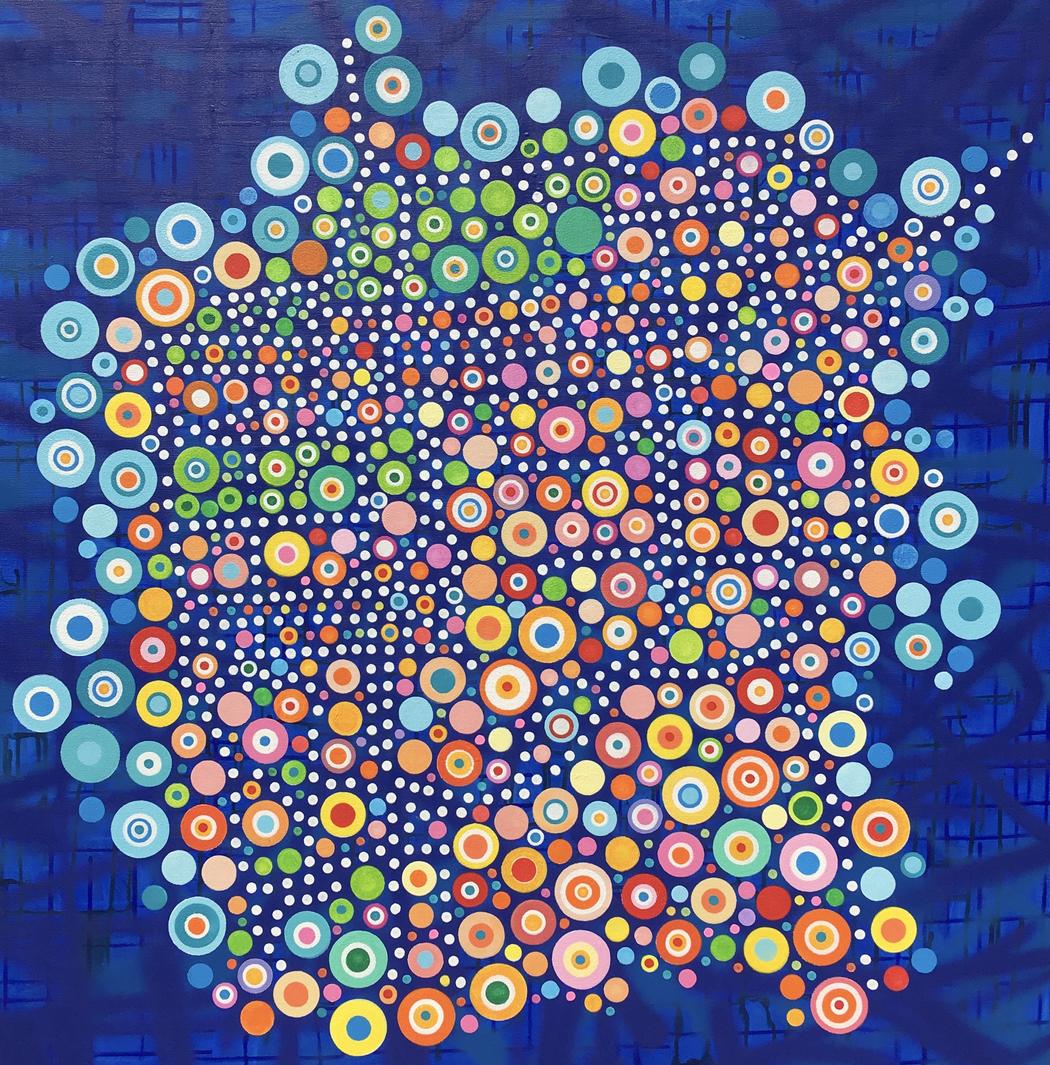 Mike Fullarton | San Francisco | 2020
You are a Scottish artist who has lived in Kraków for more than twenty years. How have your experiences of living between different cultural and geographic contexts influenced the way you think about place, belonging, and urban space?
Living in another country for such a long time has probably made me more conscious of place than I would otherwise have been. Kraków has been home for over twenty years, but Scotland is still a very important part of who I am, so the idea of having connections to more than one place feels completely normal to me.
It also makes me interested in what actually makes somewhere feel familiar. It isn’t necessarily the landmarks that appear on a tourist map. Often it’s much smaller things – a particular route you take regularly, a street corner, a tram journey, or simply knowing instinctively how different parts of a city connect.
Perhaps that is one reason maps continue to interest me. They appear to give us an objective description of where we are, but they can never really describe our relationship with a place. Two people can look at exactly the same map and see completely different cities because of the experiences and memories they bring to it. That gap between the mapped place and the experienced place is something I find very interesting.