
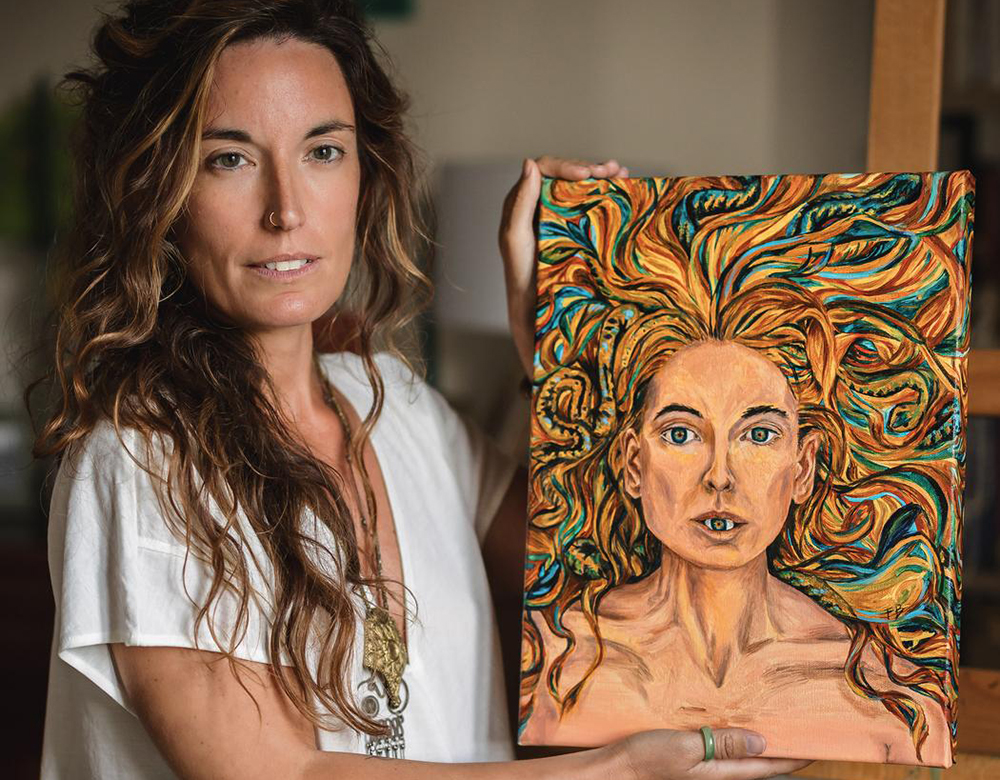
Federica Barletta
Your work seems deeply rooted in dream imagery and the unconscious. Can you describe how a dream transforms into a painting in your process?
It is difficult to describe and, at the same time, remarkably simple. I dream images, and then, standing in front of the canvas, I trust my hands. It is a completely unconscious process: automatic, in a way, but never random.
Sometimes, starting from an impression that came to me in a dream, the composition and the colours seem to emerge naturally as the work develops. Other times, I simply reproduce exactly what I saw.
There is nothing random about this process. On the contrary, I spend a great deal of time reflecting on my dreams, trying to understand what they mean. It is that meaning that guides my hand.
Even when we are awake, the mind continues to work instinctively, although in a different way from when we dream. It adds, removes, and reshapes elements of the dream while remaining faithful to its underlying meaning. After all, when we recount a dream —perhaps for the second or third time— we can never be entirely certain that we have not added or omitted something, unconsciously drawing on other memories or associations.
My creative process follows a similar path. The original impulse remains unchanged, and so does its meaning. What gradually emerges on the canvas —the gestures, the composition, the choices of colour— are not conscious inventions but decisions that already existed within me. It is like returning to the same river to draw water: the water is never the same, but its source remains unchanged.
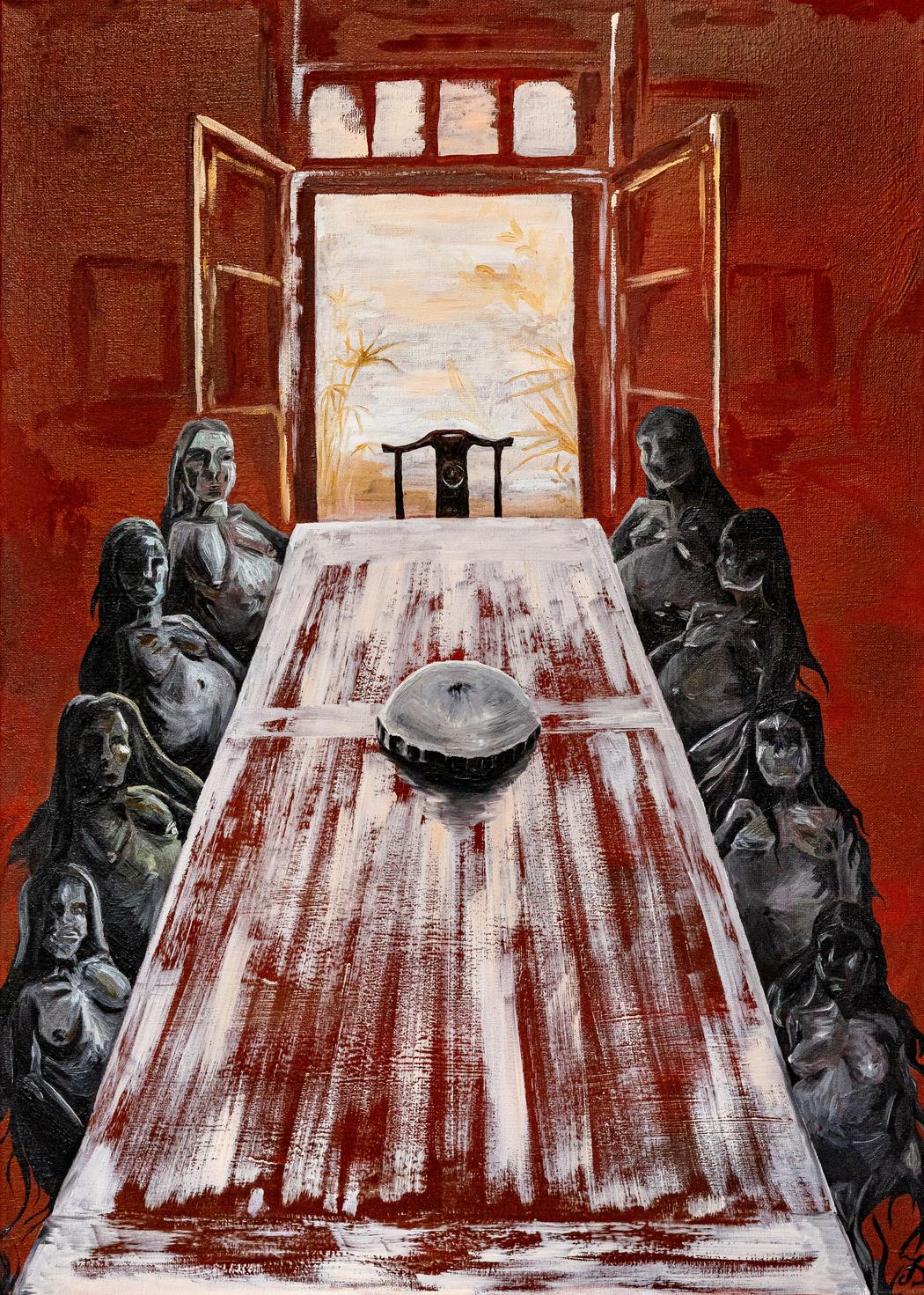 Federica Barletta | Concistoro Delle Madri
In “Concistoro delle Madri”, the viewer is invited to take the empty seat. What kind of participation or reflection do you hope to evoke in the audience?
“Concistoro delle Madri” is a deeply important work for me because of the reflection I was called to undertake when these ancestral figures appeared to me in a dream and invited me to sit among them.
The work explores the power and place of women today. Eight figures, reminiscent of the prehistoric female figurines commonly known as “Venus figurines”, sit around a table. At its centre lies a plaster cast of a pregnant womb. The ninth seat —as there are nine months of gestation— is intentionally left empty for the viewer.
At first glance, the work may seem to be about pregnancy. In reality, its meaning extends much further.
The figures themselves are the starting point. For a long time, the so-called Venus figurines were interpreted simply as representations of beautiful women, their significance reduced to their relationship with men and their fecundity. More recent scholarship, however, has suggested something far more profound. They were not only images of women, but embodiments of the divine.
It is precisely this shift in perspective that I want to evoke. I am interested in the woman who exists not as a wife, mother, or daughter, but as an individual whose value is wholly intrinsic. She may become any of these things —or freely choose not to. None of these roles defines the totality of who she is.
The power I refer to is both generative and creative. The image of the pregnant womb alludes to this idea, but its meaning extends far beyond biological motherhood. It is the capacity to create in the broadest sense: to create care, kindness, harmony, beauty, and art —to bring into the world something that did not exist before. That, to me, is a profound form of power.
Ultimately, the work is a meditation on the true power of the feminine —a power that is often underestimated, yet immense in its transformative potential. My hope is that anyone willing to take that empty seat at the table, and courageous enough to enter into that dialogue, will experience the work as a moment of recognition.
You explore the concept of the sacred feminine beyond biological definitions. How do you personally interpret this energy in your work?
The concept of the sacred feminine runs through my most recent body of work. It is rooted in the celebration of what it means to be a woman, and of everything that this entails. It is a proud reclaiming of those qualities and traits that are often used to diminish the feminine: sensitivity, empathy, and instinct.
I claim the right to be moody, to act impulsively when I choose without feeling the need to justify myself. I am not suggesting, of course, that women are only this —but rather that we can be this too, without shame.
For me, beginning this cycle of works meant exposing a side of myself that I had previously silenced, because I considered it too creative and therefore, within a traditional social framework, frivolous. It is precisely this unveiling that, for me, constitutes a celebration of the feminine.
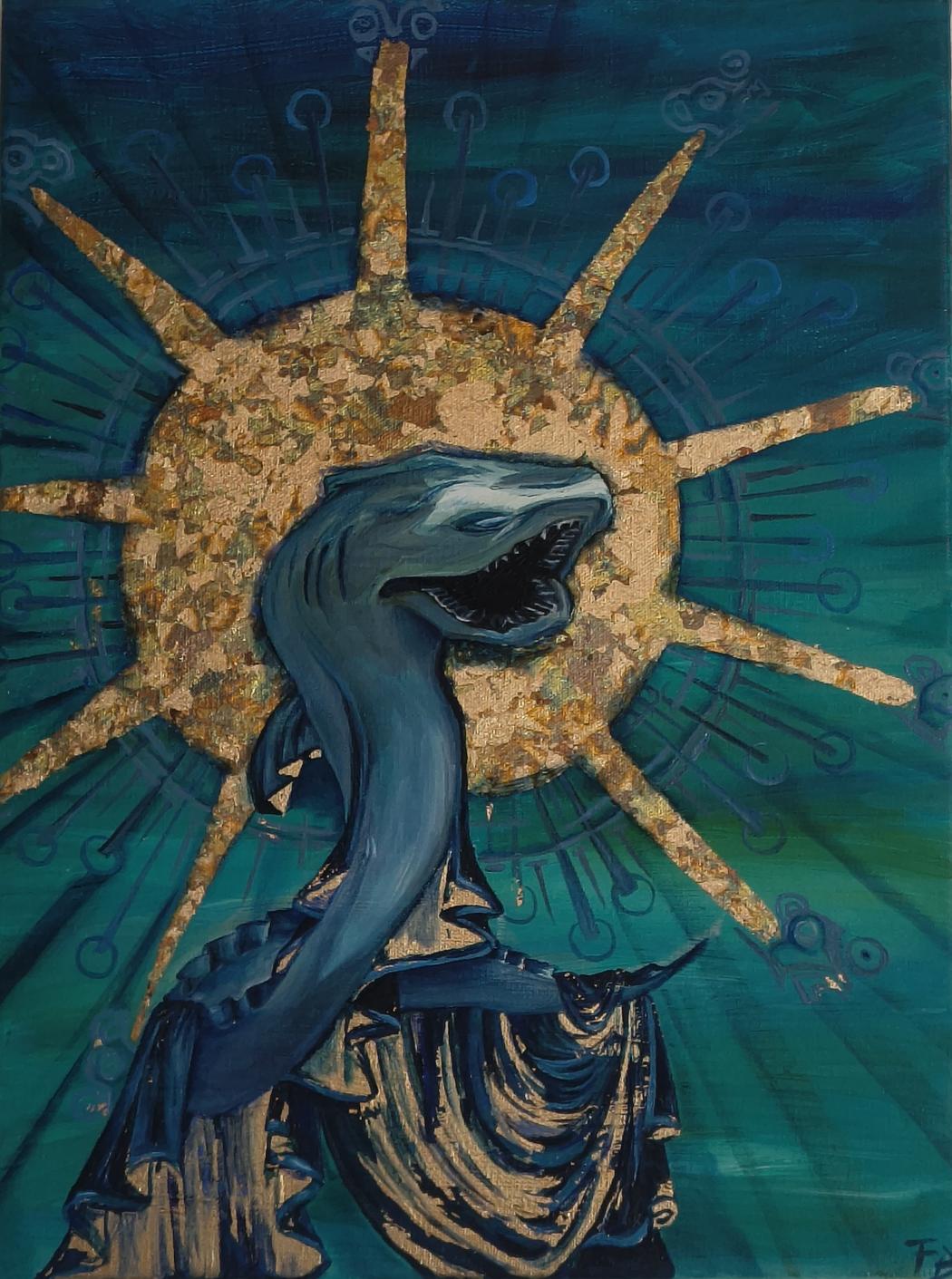 Federica Barletta | Tiamat
Jungian archetypes appear to play an important role in your practice. Which archetypes resonate most strongly with you at this stage of your journey?
This is a very complex question, because an artistic journey is constantly evolving. Even now, I find myself in a completely different place from where I was when I painted “Concistoro delle Madri”.
The archetypes I have explored in my works so far are numerous and varied. The one dearest to me is undoubtedly the Great Mother, who recurs throughout much of my work. She is the primordial force of the feminine: the symbolic union of two opposites —on the one hand, nurture, rootedness, and creative and generative power; on the other, the terrible indifference of nature and the relentless passage of time.
In my work “Kore”, which also originated from one of my dreams, I explore the archetype of the Maiden. Here, youth embodies infinite possibility, joy, and lightness, while standing in contrast to the awareness of mortality, which, in turn, also carries the meaning of rebirth and resurrection.
In “La Matta”, the second painting in my triptych on instinct, alongside “La Divoratrice” and “La Disubbidiente”, I examine the archetype of the Fool or Jester. To me, it represents the zero point of all possibility: that which cannot be categorized and is therefore free from every convention and every rule.
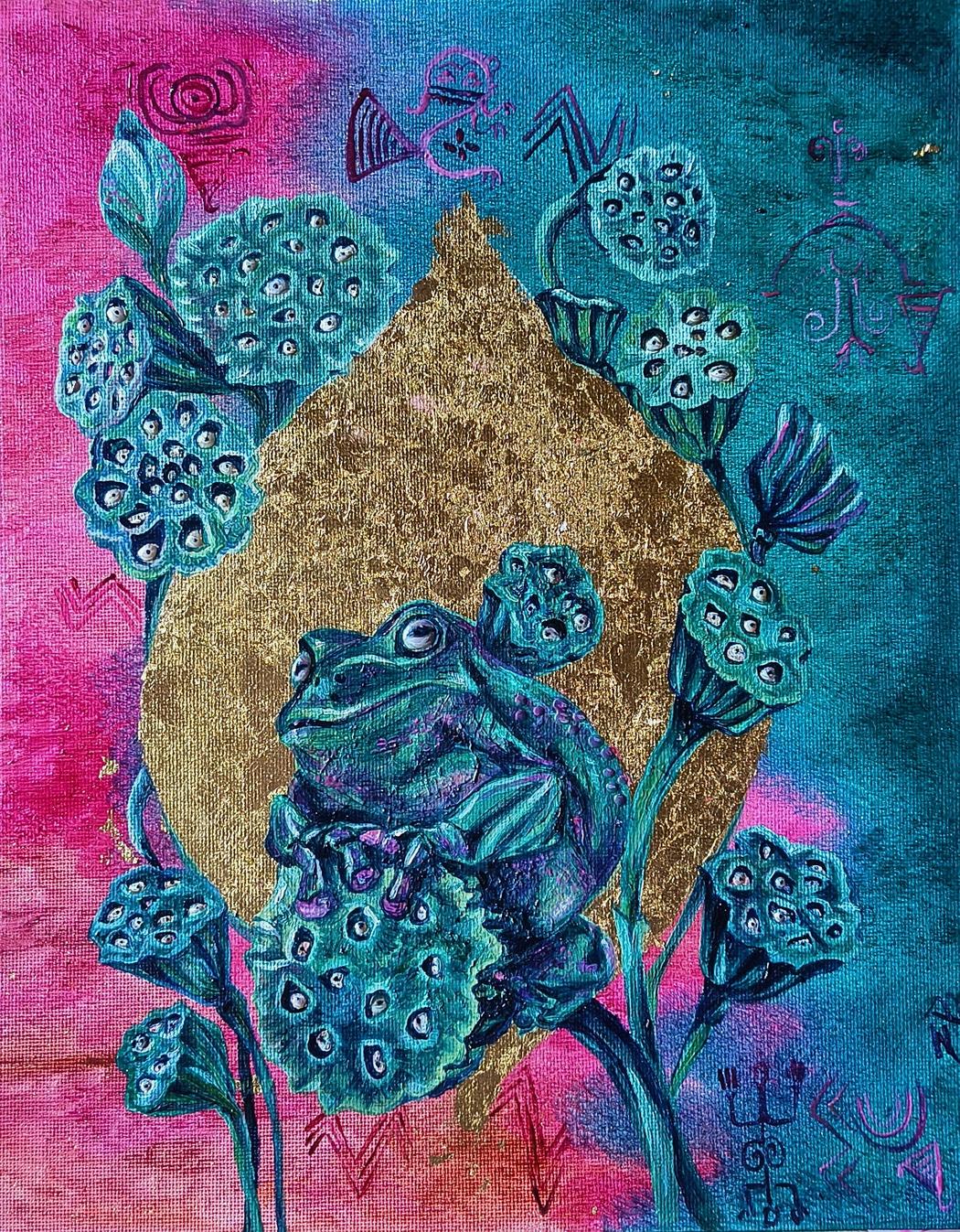 Federica Barletta | La Matta
The recurring presence of serpents in your paintings is striking. What do these symbols represent for you on a psychological or intuitive level?
Snakes are, in fact, a fundamental symbol in my practice. Although they are not exactly snakes in a literal sense, they appear more as marine creatures with serpentine forms. They are the beings that first began to populate my dreams over ten years ago, and that started to stir something in the depths of my unconscious.
Since then, I continue to dream about them, but they are no longer hostile. For me, they represent a primordial force —the original divinity that dwells within each of us. They embody an ancestral feminine power that lives in the dark caves of the deep, to which it has been relegated, and rendered monstrous in the eyes of the world.
It is the monstrous feminine that we must reclaim with pride.
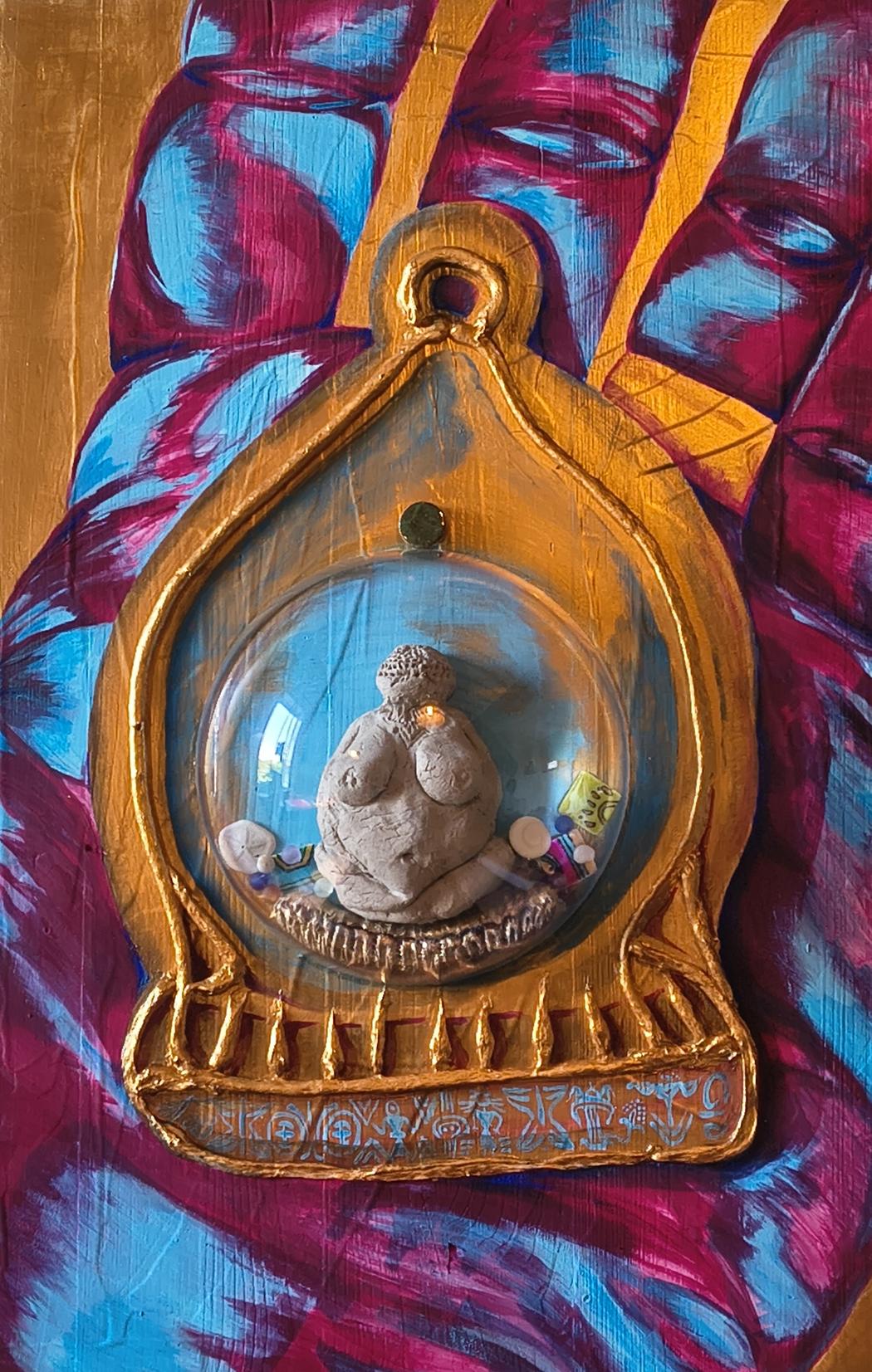 Federica Barletta | Amuleto
After stepping away from painting for years, what was the moment or realization that brought you back to art?
It has not been a sudden shift, but a process unfolding over time. Everything began with dreams. The decisive moment, however, came later —through a personal life choice and, above all, through the loss of someone dear to me who had deeply wished for me to return to painting.
There was a period, which lasted several years, in which I completely rejected painting and art in general. Gradually, I began to create again, but very slowly, limiting myself to one work per year, often connected to my travels, which I would refine almost obsessively in pursuit of extreme realism.
Then, partly due to the pressure of the dreams and the events I have mentioned, I felt able to express myself more freely. As my subjects became more abstract, my mode of expression also loosened, pushing me towards a more instinctive and frequent practice. It is at that moment that I locate a true turning point in my creative process.
Today, alongside the body of work rooted in dream analysis, my research focuses on symbolic representation, favouring a highly evocative iconography with saturated colours and the use of gold and silver. I have also returned to a practice connected to travel, though in a very different way than before. I now gather impressions while travelling and freely reinterpret them through my own lens of meaning.
For example, in “Amuleto”, I allowed myself to be “contaminated” by the Thai practice of creating personal amulets and made my own three-dimensional version, containing a small clay figure of a goddess representing the sacred feminine.
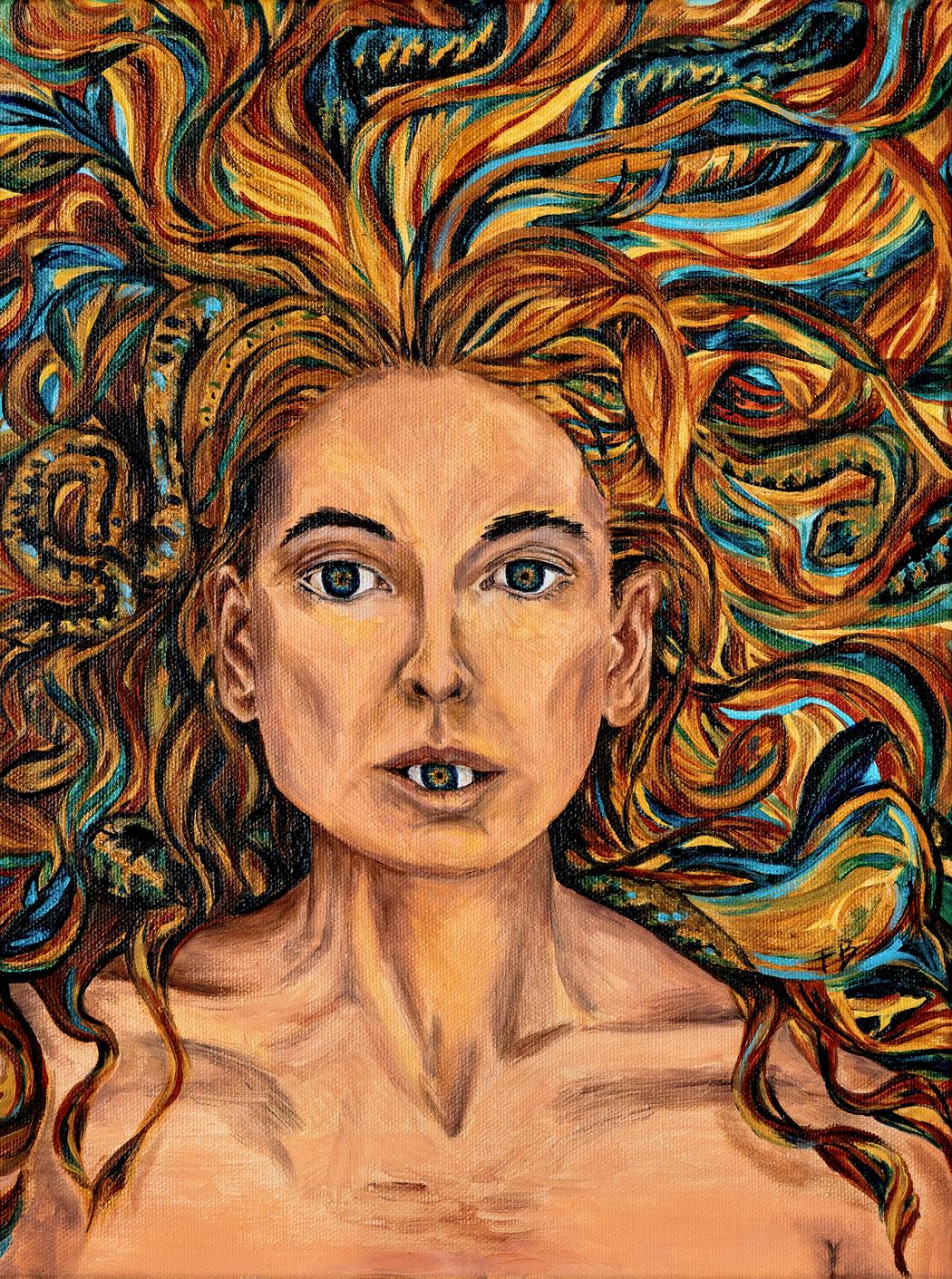 Federica Barletta | Il Quarto Occhio
Your paintings feel both deeply personal and archetypal. How do you balance your individual experience with universal symbolism?
What I represent —especially when I start from dreams— is the echo of collective unconscious, and therefore already speaks the language of archetypes. The fundamental impulse I begin from is not the result of rational elaboration or deliberate choice; rather, it is a balance inherent in the very nature of symbols, which reflect archetypal experiences.
Symbols, then, are a point of departure for reflection. I work extensively on them, attempting to explore them as deeply as possible in order to grasp their multiple layers of meaning. When I approach the canvas, the primary idea of the work —or at least the central image— remains that initial intuition. However, I then try, more or less consciously, to expand it, composing the work gradually as I paint, introducing additional elements or ideas that resonate with the same archetypal meanings.
In this sense, I balance my inner experience with a universal archetypal language. I try to go beyond the most personal meaning of the initial idea in order to reveal its more universal qualities —those expressed through archetypes and capable of communicating with everyone, transcending individual experience.