
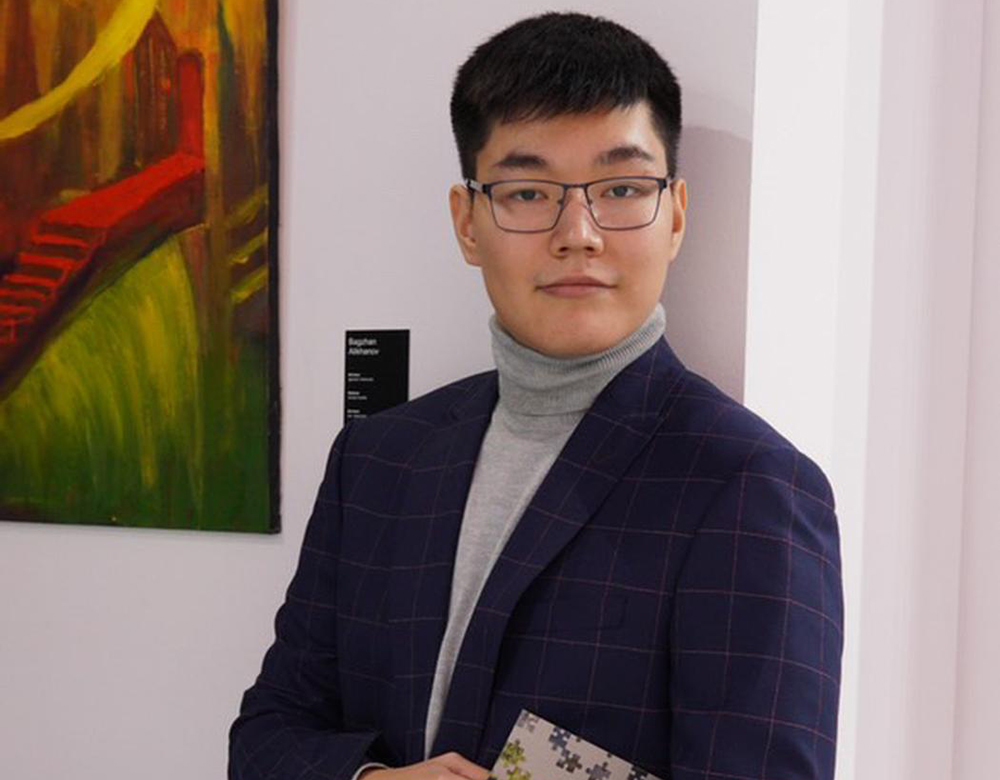
Bagzhan Alikhanov
Your paintings often bring together history, mythology, personal experience, and contemporary life. How do you decide which ideas or themes are strong enough to become the starting point for a new series?
I don’t always begin a painting with the intention of creating a series. Sometimes a single painting comes first, and only later do I realize that the idea has more possibilities and that I want to continue exploring it. At that point, it can develop into a series.
For me, a series is not something I create simply for the sake of having a series. It develops when a particular theme continues to interest me and I feel that one painting is not enough to explore it fully. Each new work can reveal another aspect of the original idea and sometimes even lead me in an unexpected direction.
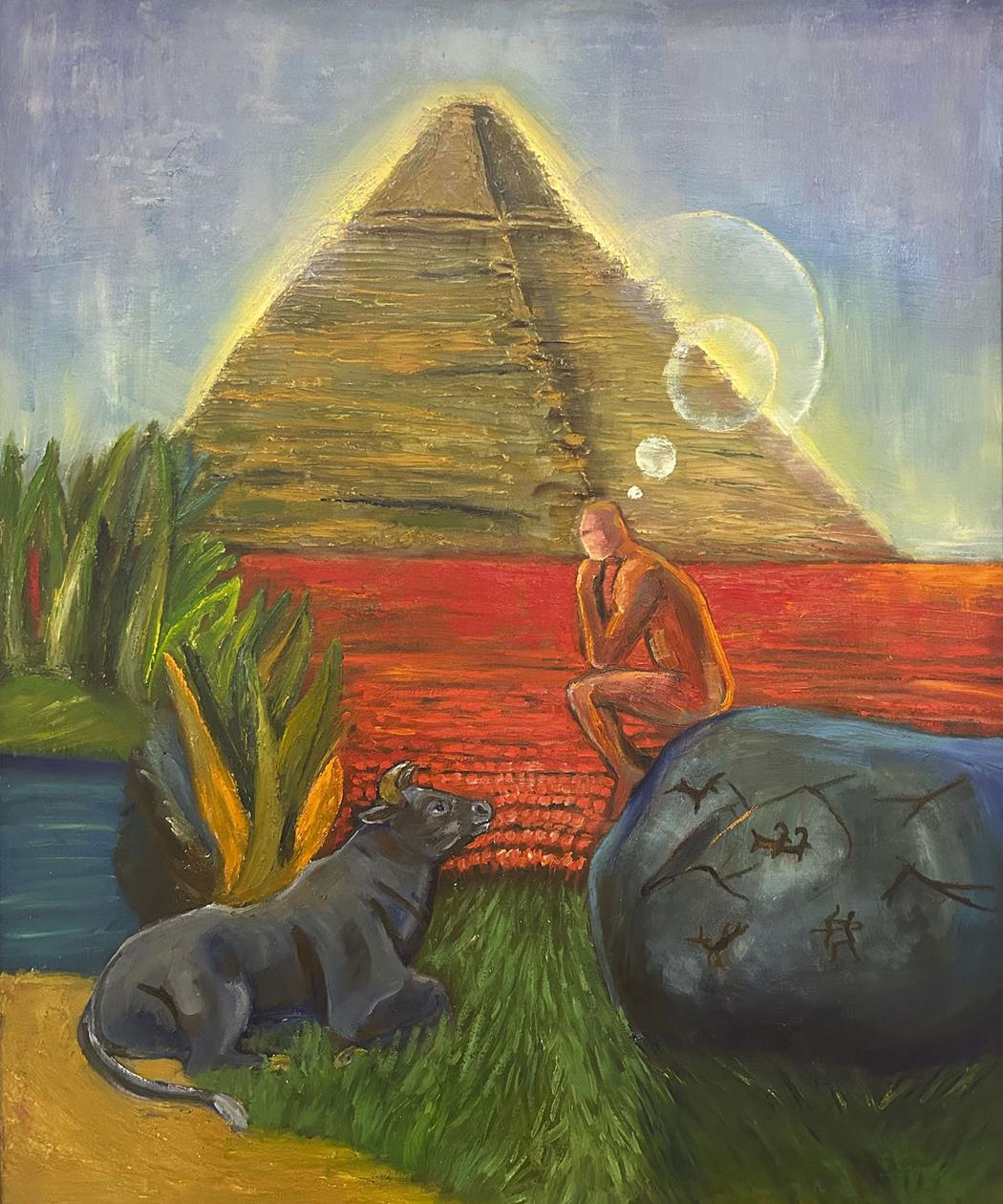 Bagzhan Alikhanov | Dialogue Of The Ages | 2025
You describe painting as a space for interpretation rather than a way of illustrating fixed narratives. How important is ambiguity to you, and how much freedom do you want to leave to the viewer?
Ambiguity is present in my work, but I do not deliberately make every painting ambiguous. Some works have a more direct meaning, while others leave much more space for interpretation. Sometimes this is intentional, and sometimes it happens naturally during the process of painting.
For example, some works from my Kipchak series are relatively clear in their subject. You can see a blacksmith forging a mask, for example. But other works contain many different symbols and possible meanings. In «Mother», I bring together elements that represent different periods of time — traditional yurts and a woman in a traditional headdress alongside monuments and statues that can be associated with the future. Other works, such as «Waiting» and «Dialogue of the Ages», are much more ambiguous and even absurd. I don’t necessarily want the viewer to find one correct explanation for them.
I also don’t think of my paintings as stories that need to be read like literature. As one of my professors once told me, “We are not writers.” I think this is important. A painting can suggest a situation, a feeling, or a question without explaining everything that is happening.
So I try to leave enough space for the viewer to think and make their own connection with the work. Sometimes they may understand something I intended, sometimes they may find a completely different meaning, and sometimes they may simply experience the image without trying to explain it. All of these reactions are valid to me.
Kazakh cultural heritage and the visual language of the steppe appear throughout your practice. How do you approach these references without turning them into simple historical reconstruction or nostalgia?
I don’t always use Kazakh cultural references in my work, but I also don’t think I can completely separate myself from them. They are part of where I come from and, naturally, they influence the way I see the world.
At the moment, I am interested in finding a balance between my cultural heritage and contemporary visual language. I want to combine Kazakh symbols, images, and cultural references with ideas and visual approaches that belong to the present.
For me, this is not about reconstructing the past exactly as it was. I want to take elements from my cultural heritage and use them to create something new. In that sense, I am more interested in imagining a possible future with Kazakh symbolism and cultural language than simply reproducing the past.
Nostalgia can certainly be present in some of my works, especially when I deal with subjects connected to my own heritage, but I don’t want nostalgia to be the only meaning. I want these references to remain alive and capable of changing as I continue to develop them.
I also want these symbols and metaphors to remain meaningful and memorable over time. I would like them to continue to resonate with people not only a year or two after they are created, but perhaps twenty or even seventy years later. I know that it is impossible to know whether a work will achieve that kind of longevity, and perhaps it is still too early to say, but this is something I aspire to through my painting.
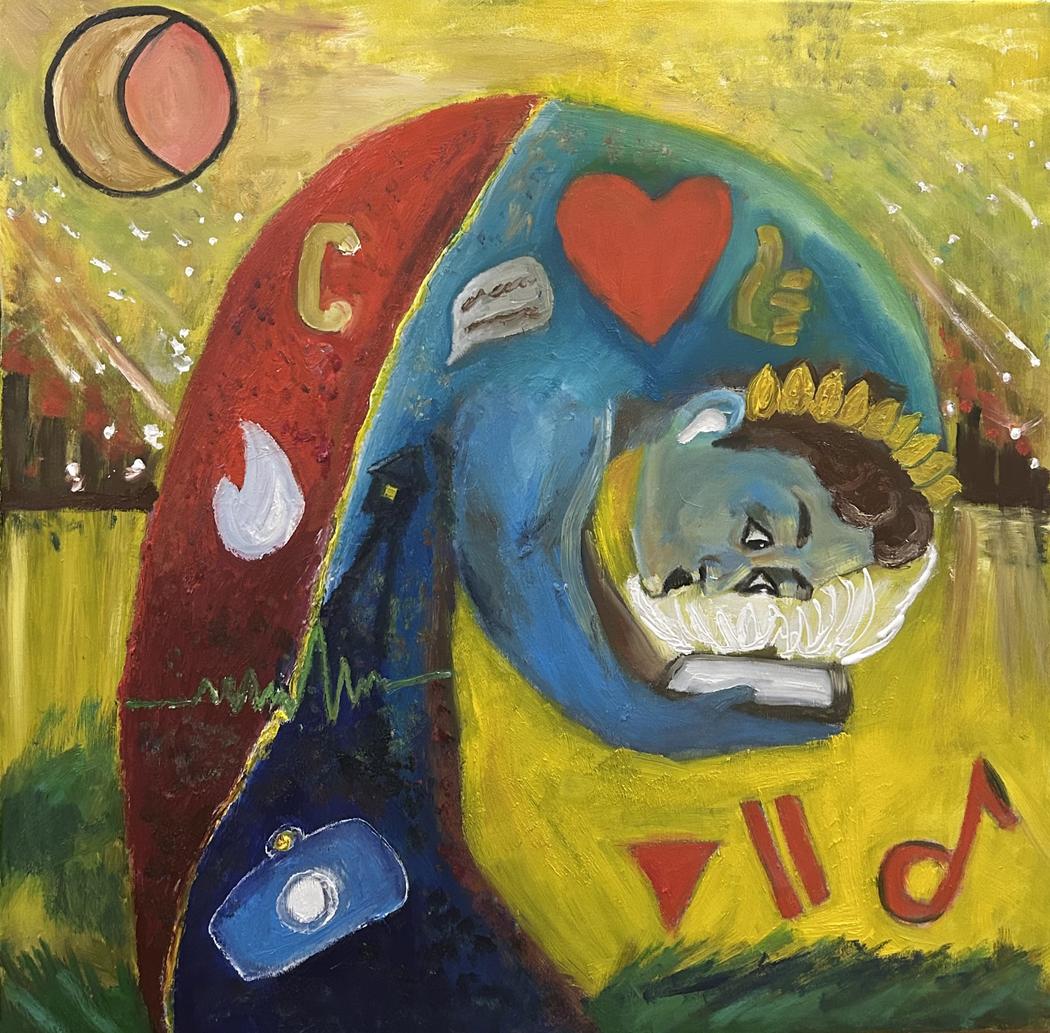 Bagzhan Alikhanov | Cult Of The Screen | 2025
Many of your compositions seem to place different periods of time within the same visual space. What interests you about creating a dialogue between the past, the present, and imagined futures?
I think the uncertainty of the future is one of the things that interests me. I often wonder what my own future will look like — who I will become, what I will achieve, and how I will get there. Sometimes these questions make me think about how much of our future is shaped by what we have already done in the past.
But I don’t always consciously begin a painting with the idea of bringing different periods of time together. Sometimes an image or a composition comes to me very suddenly, almost like an impulse, and only later do I understand that the idea of time has become an important part of the work. Sometimes the composition simply feels as though nothing other than different periods of time could exist within it.
So the relationship between the past, present, and future is not always something I plan beforehand. Sometimes it is a question I discover only after the painting has begun to take shape. I think uncertainty itself can be productive in this way.
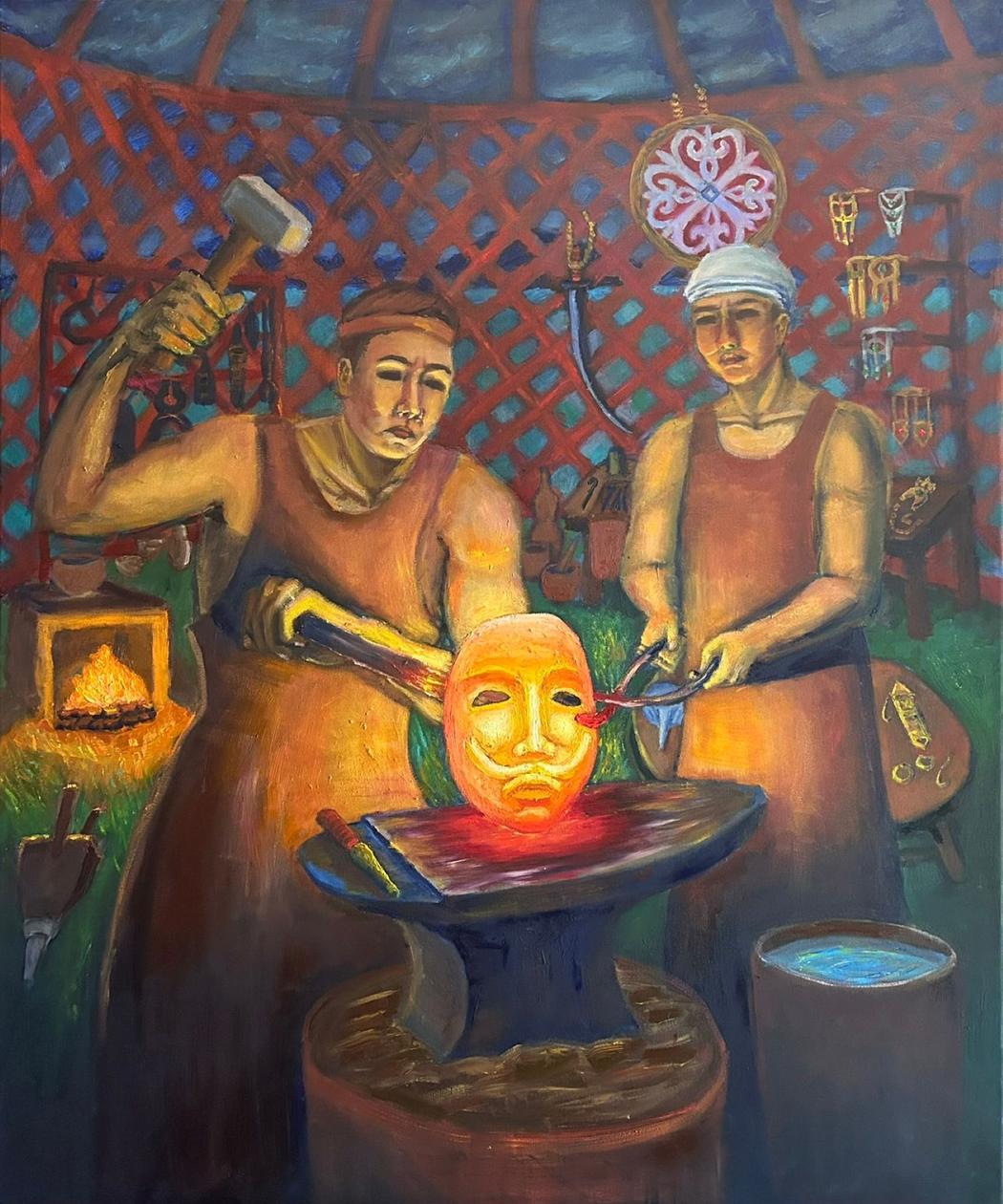 Bagzhan Alikhanov | Blacksmiths Of The Steppe | 2025
Symbolic objects, animals, tools, costumes, and architectural forms frequently appear in your paintings. How do you develop this symbolic vocabulary, and do certain symbols return across different series?
Some symbols may reappear in my work, but I don’t want them to have exactly the same meaning every time. Each painting has its own meaning, and the symbols within it work together specifically for that particular painting.
I also try not to repeat the visual language of one painting too closely in another. Even if I use something as ordinary as a tree, a bicycle, or a certain type of weather again, I try to make it look and function differently. I don’t want the viewer to feel that they are simply looking at the same painting in a different form.
For me, the meaning of the painting itself is more important than the symbolism of individual objects. Symbols can guide the viewer toward an idea, but they do not necessarily explain the entire work.
Some symbols, however, have a more specific cultural or historical meaning. For example, the mask that appears in some of my Kipchak works refers specifically to the Kipchak people, based on a historical form associated with them. Other objects can refer to archaeological discoveries, burial sites, rock art, or other elements of real history. At the same time, some symbols are created specifically for the subject of a particular painting.
So I think my symbolic vocabulary is still developing. Some elements may return in the future, but I want each new work to have its own visual language and its own meaning.
You work primarily with oil, but the surfaces of your paintings can feel very different from one work to another. What interests you most about the physical process of painting and the possibilities of the medium itself?
What interests me most is the way oil allows me to work with colour, texture, and layers. I especially like contrasting and vivid colours while keeping them close to reality, as well as working with broad brushstrokes and visible texture.
My technical approach has changed over time. I used to work much more impasto, while my paintings have become less heavily textured. I still value texture, but I try to make it serve the painting rather than become its main focus.
I usually work in layers, and the way the paint changes as it dries can influence what I do next. I also enjoy details, but I don’t think everything needs to be equally detailed. Sometimes a broad brushstroke can say more than a carefully finished detail.
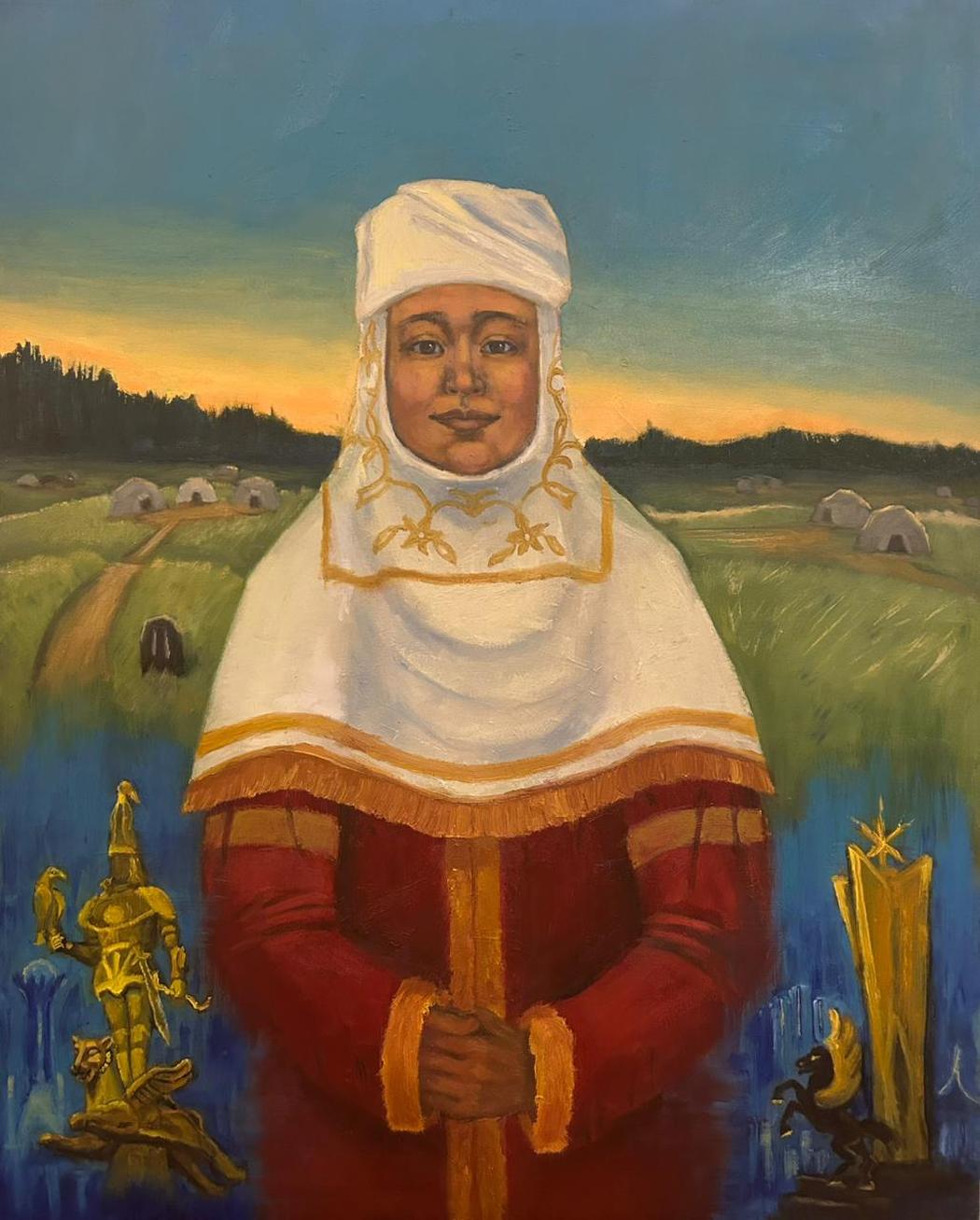 Bagzhan Alikhanov | Mother | 2025
Your work often deals with collective history and cultural memory, yet many scenes also feel intimate and personal. How do your own experiences enter paintings that address broader historical or social questions?
I think personal experience enters most of my paintings, although not always directly. Sometimes it comes from something I see in everyday life, sometimes from a personal feeling, and sometimes from an image or idea that appears unexpectedly and stays with me.
Painting is also one of the ways I slow down and step away from the world around me. I simply enjoy painting itself, and sometimes that feeling is enough to make me start a work.
For example, «Cult of the Screen» began with a simple observation on a bus. Almost everyone around me was looking at their phones, and for some reason this image stayed in my mind. Later, it developed into a painting about our relationship with screens and the world around us.
My Kipchak works are connected to me in a different way. The idea for the mask appeared very spontaneously. I first created an oval shape while looking at the sun, and only later recognized something familiar in it — a form that reminded me of a Kipchak mask. Because I am of Kipchak heritage, this unexpected connection led me further into the subject.
I think this is how many of my paintings begin. Something catches my attention, but I don’t always immediately know why. Sometimes I understand the connection only while working on the painting, or even after it is finished. Perhaps that uncertainty is part of what makes the process interesting for me.