
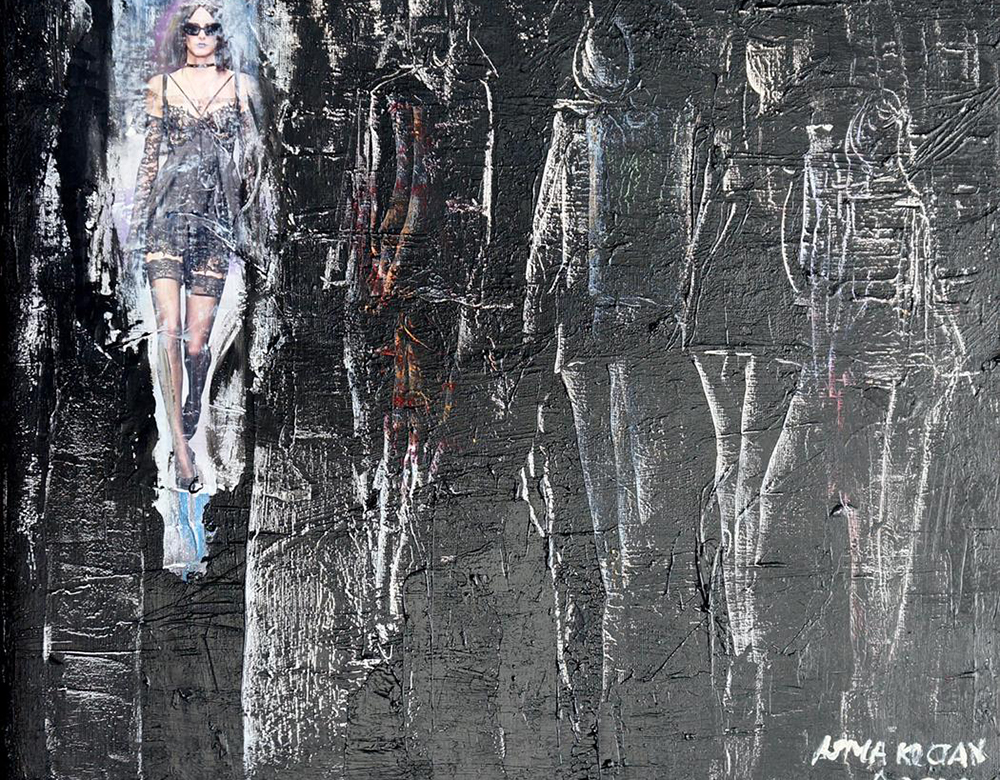
Asma Kocjan
Your artistic practice grew out of your experience as an international model. At what point did the fashion world become not only your professional environment, but also a subject you wanted to examine through art?
„ Fashion was my first visual language „
As an international model, i experienced beauty, glamour and constant transformation from the inside.
When i turned fully to painting, i realized that i was no longer interested in representing fashion itself, but in exploring what lies beneath it.
I still love fashion , it remains an endless source of inspiration for me. But in my paintings, fashion is no longer the destination- itis the doorway into questions about identity, memory and human presence.
Having experienced the fashion industry from within, how do you balance criticism of this world with your personal attachment to it and the influence it has had on your identity?
I don‘t see my relationship with the fashion world as a contradiction. Fashion has been an important part of my life, and i remain deeply fascinated by its creativity, craftsmanship and ability to communicate without words. It taught me to observe details, proportions, textures and the power of visual expression.
My paintings do not criticize fashion itself. Rather, they explore the space where appearance meets reality.
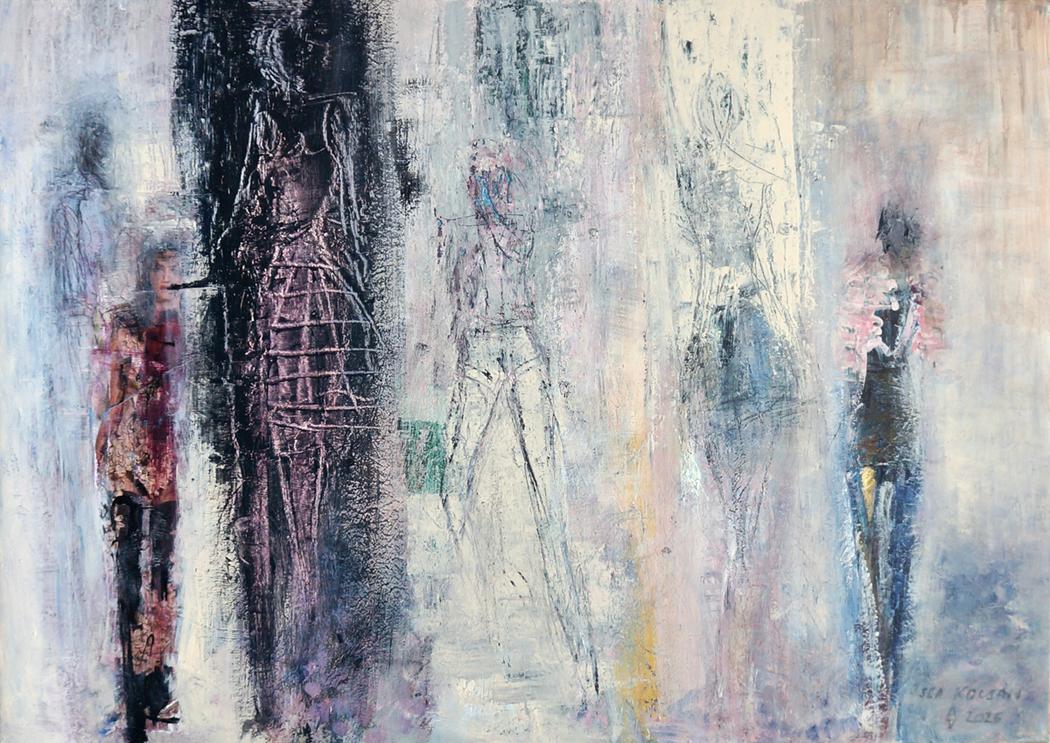 Asma Kocjan | Staged Presence | 2026
The figures in your paintings are often anonymized and reduced to silhouettes. Why is it important for you to conceal their individual identities rather than depict recognizable personalities?
I am less interested in portraying a specific person than a capturing a human presence. By reducing my figures to silhouettes or partially concealing their identities, i create space for the viewer‘s own memories, emotions and experiences.
I am not painting a portrait of someone. I am painting a state of being.
Concealment and revelation appear repeatedly in your work. Do you see the process of adding, covering, and removing layers as similar to dressing and undressing the human body?
Yes, there is definitely a connection, although i see it more as a metaphor than a literal comparison .
The process of building a painting through layers resembles the way we construct our own identities.
Every layer is like a memory. Even when it disappears from view, it continues to shape the painting.
You combine acrylic paint with photographs, fabrics, newspaper fragments, grids, and other materials. How do you decide which materials belong in a particular work, and what meanings do they carry for you?
I never choose materials simply because they are visually interesting. Every material has its own history, texture and cultural associations.
Before it becomes part of painting, I ask myself whether it contributes to the story the work wants to tell.
I collect visual impressions wherever i go. I collect stories!
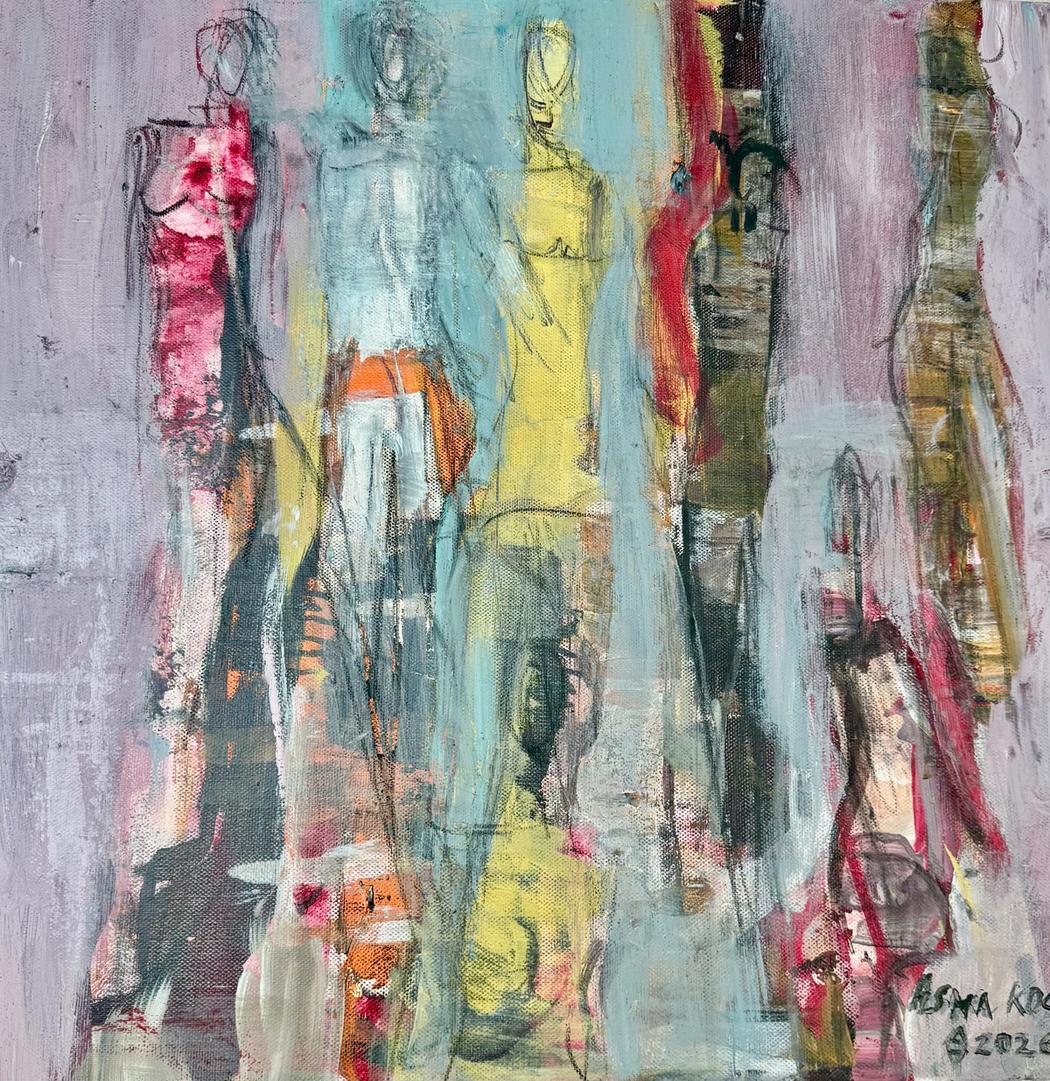 Asma Kocjan | Urban Flow | 2026
The titles of your works offer viewers a point of entry without fully explaining the images. At what stage of the creative process do your titles usually emerge, and how do they shape the interpretation of a work?
For me, a title is never simply a description of what can already be sewn. It is an Invitation to enter the work a particular emotional or poetic perspective, while still leaving room for personal interpretation.
Most of my titles emerge towards the end of the creative process.
A title should not answer the painting. It should begin a conversation with it.
You have observed that the art world is increasingly becoming similar to the fashion world. Which qualities do you find most troubling in this convergence, and what questions would you like your paintings to raise about visibility, beauty, consumption, and change?
I believe there has always been a dialogue between art and fashion, and i don‘t see that as something negative. Both have the power to reflect their time, shape cultural identity and communicate visually.
Ultimately, i hope my paintings ask a simple but essential question: What do we truly seen when we look beyond the painting?
I don‘t want my paintings to compete for attention. I want them to reward attention.