
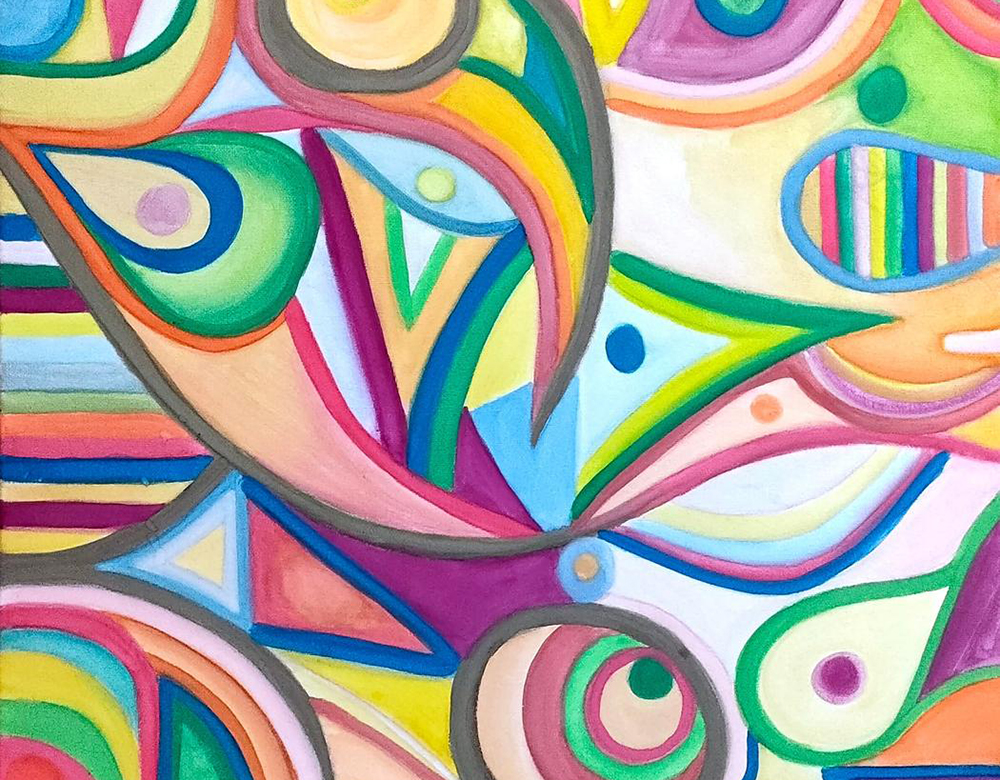
Meriem Arabi
You are trained as a theoretical physicist, while your visual language is highly intuitive, colorful, and surreal. How do these two worlds, science and art, influence each other in your practice?
Theoretical physics is an extremely mathematical field. In his book The Logic of Scientific Discovery, the Austrian philosopher Karl Popper outlines his definition of a scientific theory. Following his reasoning, mathematics leans more towards a purely creative process than a rigid reflection of reality. Because of this, I like to believe that intuition plays a major role in theoretical physics, which makes it coherent with my artistic side.
Your work often feels like a translation of invisible forces into color and form. Do concepts from physics, such as energy, particles, space, or vibration, consciously appear in your paintings?
A lot of people actually point that out to me, even if I don’t always see it myself. If certain physics concepts do appear in my art, they aren’t intentional, but it makes complete sense given my background. I’ve found that it’s much easier for me to create when I don’t overthink the process. For me, painting is more of a spontaneous outlet.
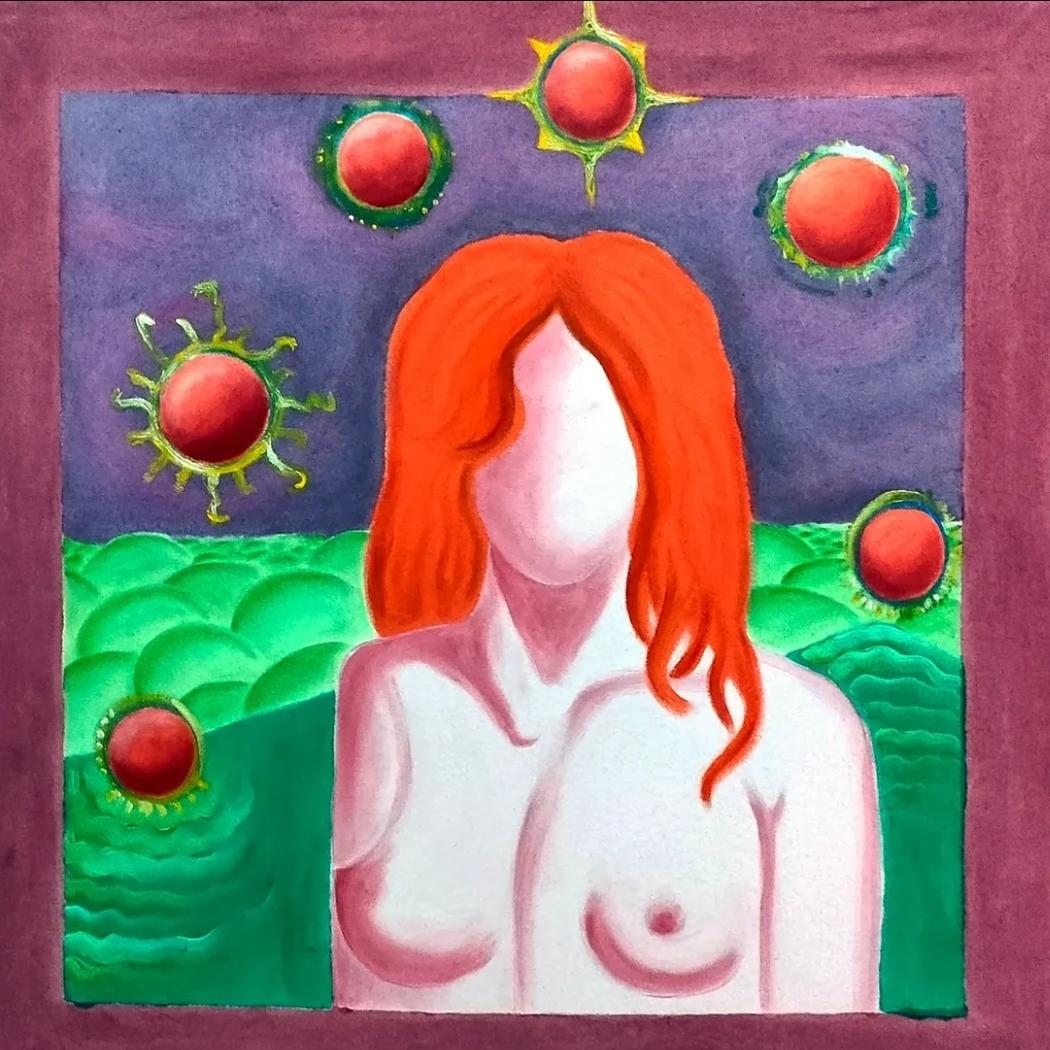 Meriem Arabi | Psycho Tropical Self | 2024
You describe your artistic process as freestyle, often not knowing where the next stroke will take you. How important is spontaneity in your work?
If art is an expression of your deepest feelings, prioritizing spontaneity is only natural. I process my thoughts and emotions through painting. In my experience, the more spontaneous a painting is, the more it speaks to me. I do sometimes wish I could paint something more structured and intentional and be satisfied with it, but since I’ve never taken formal classes, I’ve learned entirely through trial and error. Right now, I’m studying art concepts on my own because I think my style will benefit from them. It’s a bit of a challenge for now, but I’m definitely getting better.
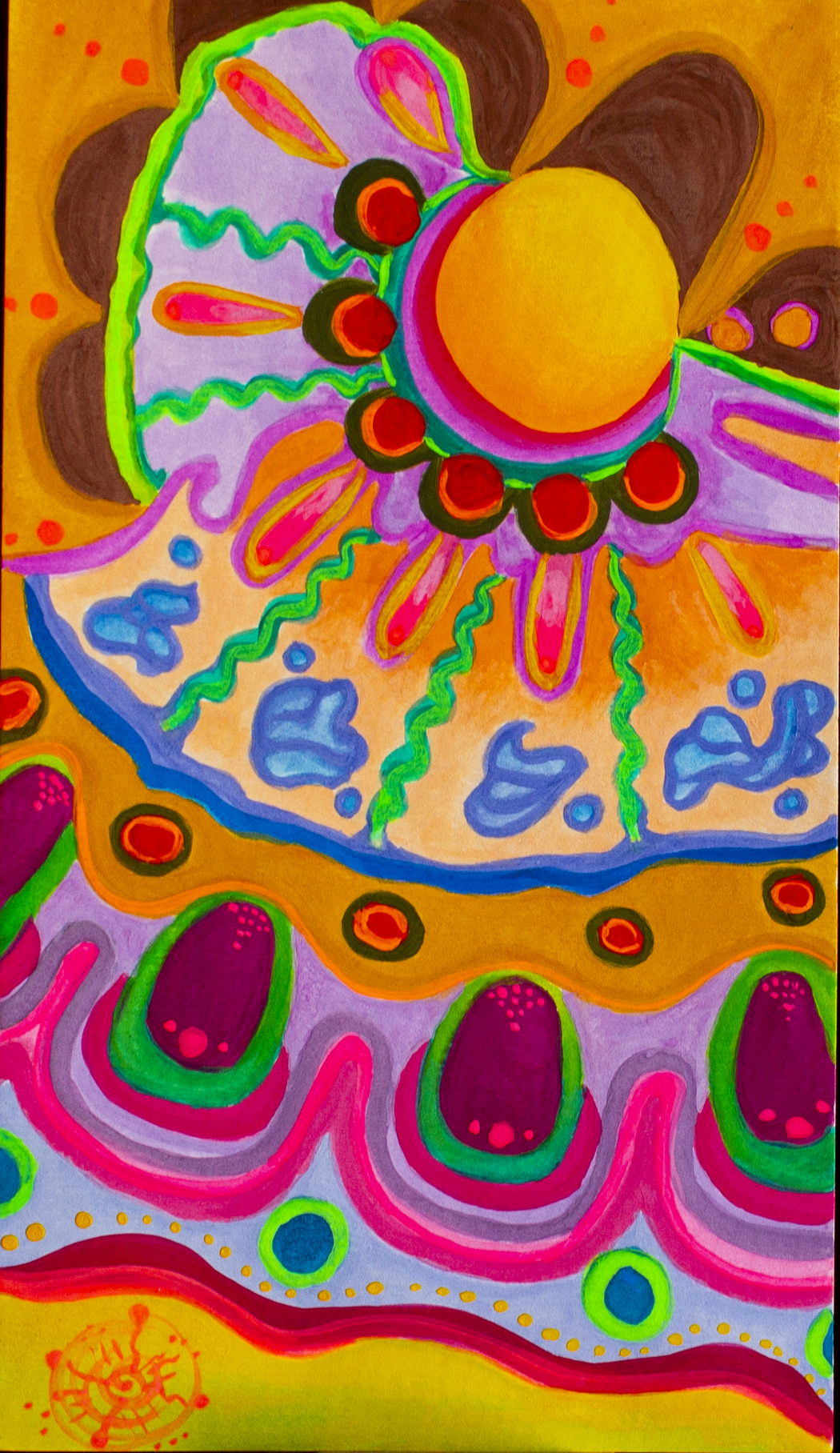
Your self-portrait does not show a traditional face, but rather a psychological landscape. What does portraiture mean to you beyond physical resemblance?
People aren’t solely defined by their physical features. There’s always more to a person than meets the eye, and even if the world is objectively the same, everyone perceives it differently. So, the most important thing to capture in a self-portrait isn’t just a literal likeness, but your own perception of what surrounds you. In my self-portrait, I feel like the focus is as much on the environment around me as it is on my own figure.
Your color palette is very vivid and bold, often combining intense pinks, greens, yellows, blues, and oranges. How do you choose colors, and what emotional role do they play?
I am a very sensitive person, and I like to see that as a good thing because it means I feel everything so deeply, whether it’s ecstasy, grief, or the entire spectrum of emotion in between. The vibrant colors in my paintings are a direct expression of that intensity. They are bold and alive, just like everything I feel inside
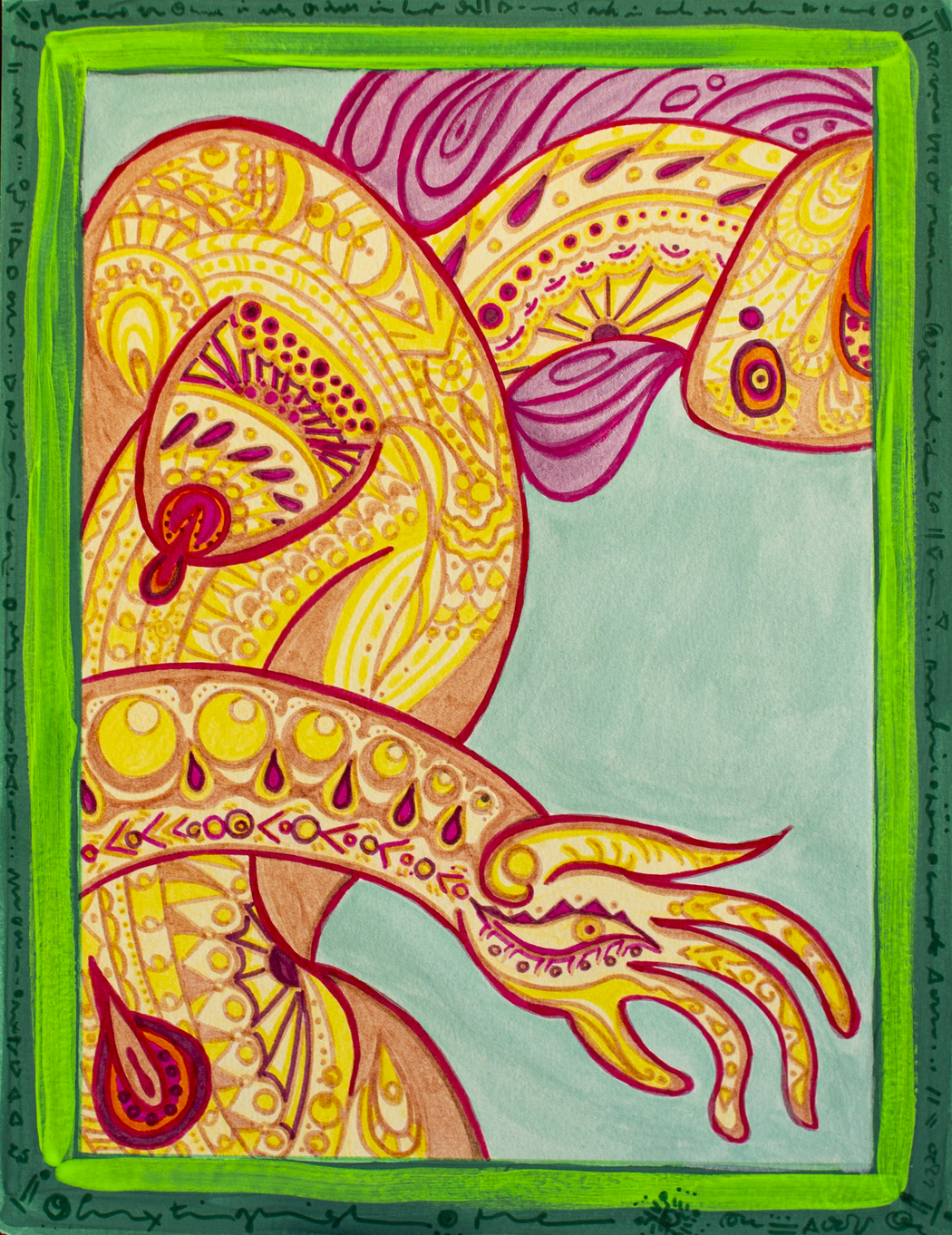 Meriem Arabi | Female Abstact | 2023
You mention that you draw inspiration from everything around you. Are there particular places, memories, books, films, scientific ideas, or cultural influences that return often in your art?
Growing up, fantasy books and movies held an immense place in my life. I remember thinking that reality was so boring compared to the worlds I was reading about or watching on screen. I’ve always loved Tolkien’s works, among others. I also vividly remember discovering Salvador Dal´ı in the Gothic streets of Barcelona when I was ten years old, which definitely left a lasting mark on me. Ultimately, I don’t think I draw inspiration from specific, isolated things; it’s more that everything I’ve ever loved and admired blends into something subtle that is lodged in my subconscious, which eventually finds its way out onto the canvas.
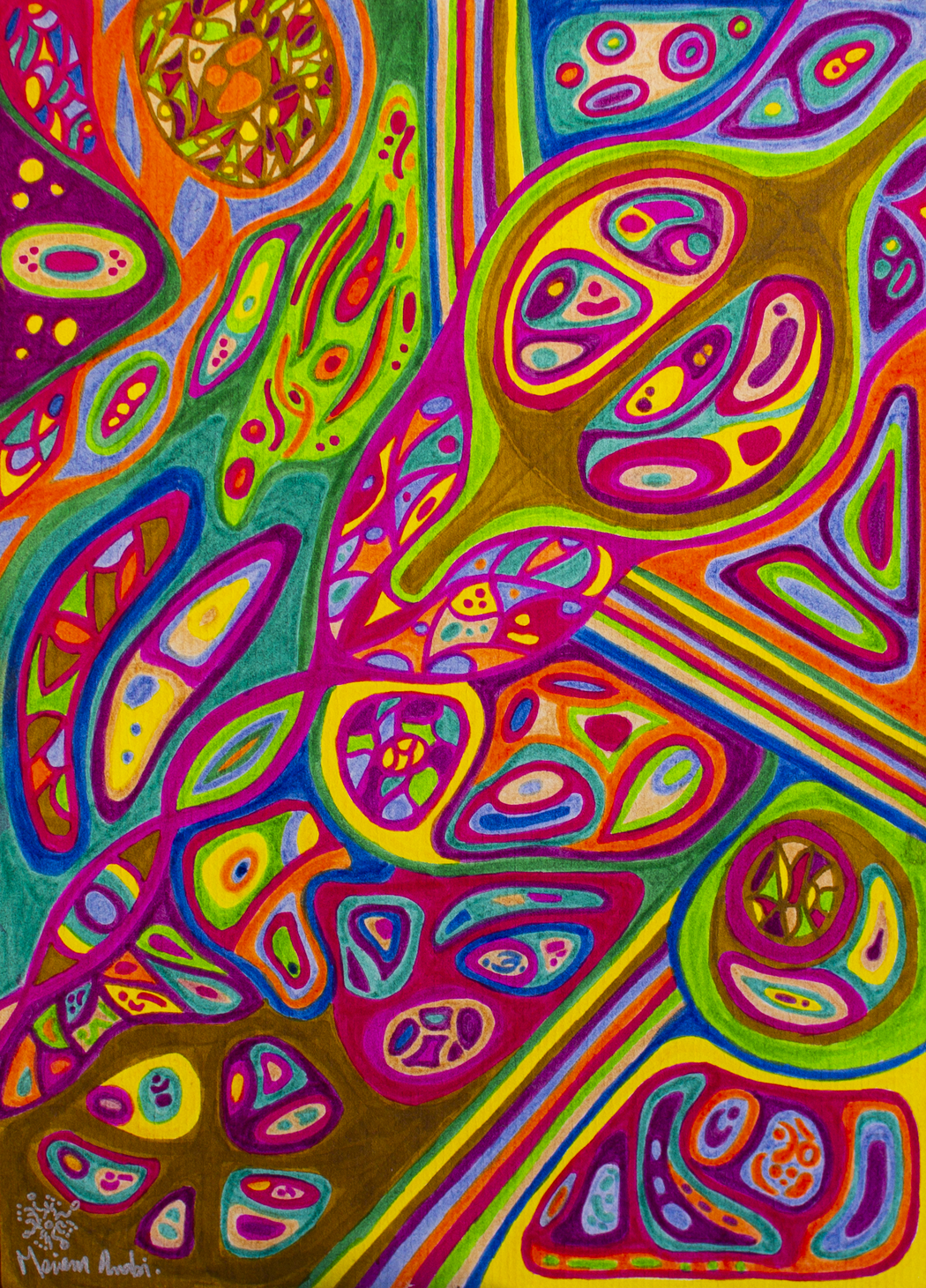 Meriem Arabi | Intrinsic Ecstasy | 2021
As both a physicist and an artist, how do you imagine your practice developing in the future? Are there themes or experiments you would like to explore next?
Right now, the most important thing for me is to continue my studies. I’m hoping to find a PhD position and contribute to research in astroparticle physics someday. While doing that, I’ll also be looking for an environment that allows me to flourish both artistically and personally. Once I have even more time to dedicate to my passions, I’d like to develop some cohesive painting series around specific themes and eventually exhibit my work in a way that creates a complete visual universe.