
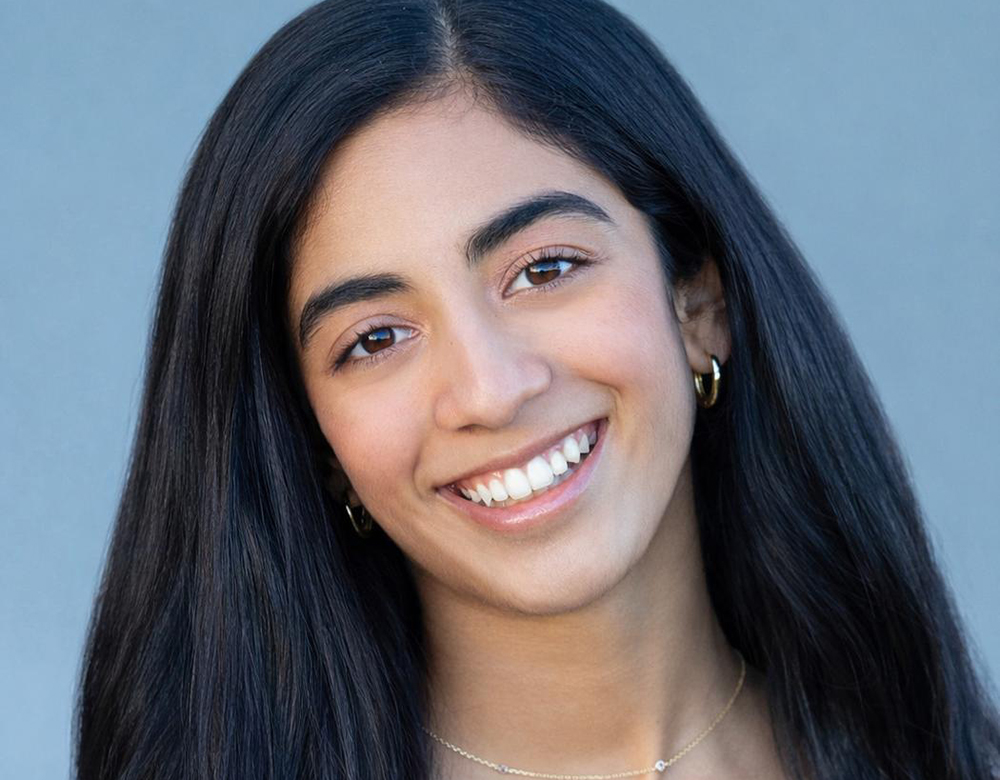
Sailee Charlu
Your work explores heritage, memory, and cultural multiplicity. How did your experience as a second-generation Indian American shape the emotional foundation of your art?
Growing up between two worlds means you are never fully claimed by either. That in-between space, where you are too American for one room and too Indian for another, becomes the emotional architecture of everything I make. My art lives on that threshold. The figure in Painless Thorns holds herself inward, eyes closed, as if listening for something just beneath the surface of her own skin. That posture is a memory. It’s what it feels like to carry a heritage you weren’t given a complete map to. Yet, you reach for it anyway, with your whole body.
You describe yourself as Indian by heritage, American by assimilation, and Latin by immersion. How do these three cultural spheres coexist within your visual language?
For most of my adolescence, they didn’t coexist at all. These spheres competed, each one pulling at a different part of me and leaving me feeling like I was perpetually failing at all three. I would speak Spanish with my school community and feel genuinely at home, then walk into a family gathering and feel like a stranger enveloped my culture I hadn’t fully been given access to, then return to school and slip back into the American version of myself that asked the fewest questions about my true identity. This constant code-switched between alternate lives was emotional and exhausting in a way I didn’t have words for. When I started making art seriously, I used this tension as material instead. The cacti in Painless Thorns serve as the visual representation of what happens when you spend years unable to explain yourself across three worlds simultaneously, and you build walls instead. The figure isn’t hiding out of shame, but a deeply practiced self preservation when you’ve been asked one too many times to justify why you are the way you are.
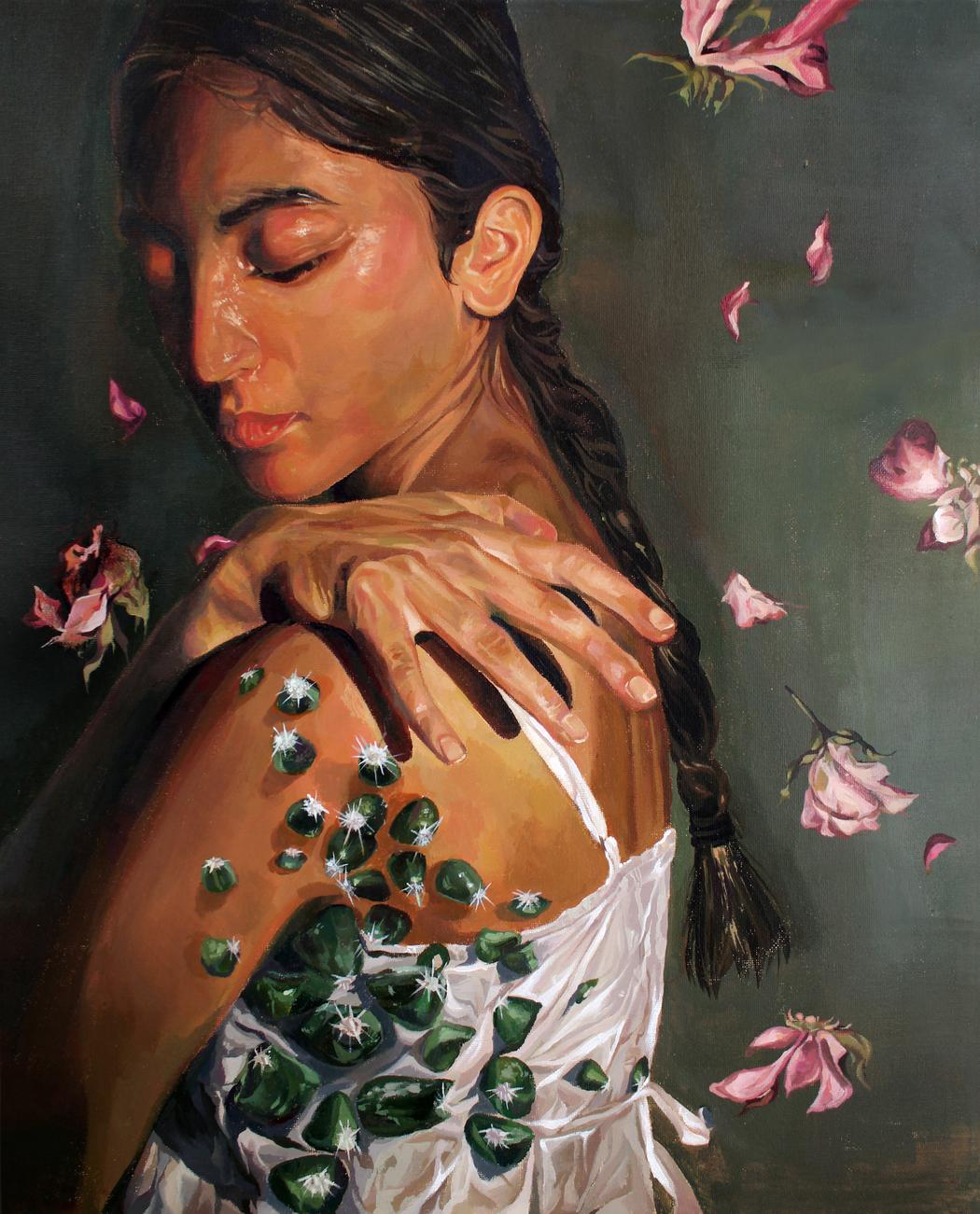 Sailee Charlu | Painless Thorns
Language plays an important role in your artist statement. How do spoken words, silence, and broken language influence the way you create images?
Growing up with broken Tamil shaped how I see communication in a way that’s hard to overstate. I could feel the weight of what my grandparents were saying without being able to fully enter the conversation. I understood enough to know when something was tender or tense, but not enough to respond. So I spent a lot of my childhood watching and reading beneath the surface of words, a habit of observation translating into how I pain. I became far more interested in what the body communicates than what we explicitly communicate. In my piece, the face is turned away,, and all the emotional information comes from the posture: the tension in the shoulder, the hand pressed into skin. This was a deliberate choice rooted in a lived experience of language being incomplete, of meaning having to find other routes to travel. Silence, in my family and in my art, has never meant the absence of communicate. It has always meant the communication is happening somewhere harder to reach.
In Painless Thorns, the body appears both delicate and wounded, with cactus-like forms emerging from the skin. What does this image reveal about vulnerability and protection?
The most important decision I made in this painting was that the cacti grow from within her. Instead of attacking her from outside, they are something she produced from her own skin over time. That distinction is the emotional core of the entire piece because that is exactly what my own guardedness felt like: a slow, almost unconscious cultivation of armor that happened so gradually I didn’t notice until it was already part of me. When I was younger, most confused about the multiplicity of my cultural identity, I became cold and closed off, convinced that shutting down was safer than risking being seen and still not belonging. This painting doesn’t judge that. Her hand rests gently on her shoulder at the same time as the thorns emerge, tender toward her securities even as she begins to reckon with the cost of it.
Flowers and thorns appear together in your work. What does this contrast mean to you emotionally or symbolically?
The falling lotuses are what I genuinely wanted to offer people for most of my life, warmth, openness, and the unguarded version of myself that I kept carefully out of reach. They are soft and pink and alreadying loosening from their stems, able to understand the complexity of my identity instead of adhering to every inherited standard. The cacti are what I showed my loved ones during those years: hard-edged, self-sufficient, something beautiful in its own rights but impossible to hold without getting hurt. What I most wanted this painting to communicate is that I had learned through enough small experiences of rejection and misunderstanding that the warm version of me needed protection.
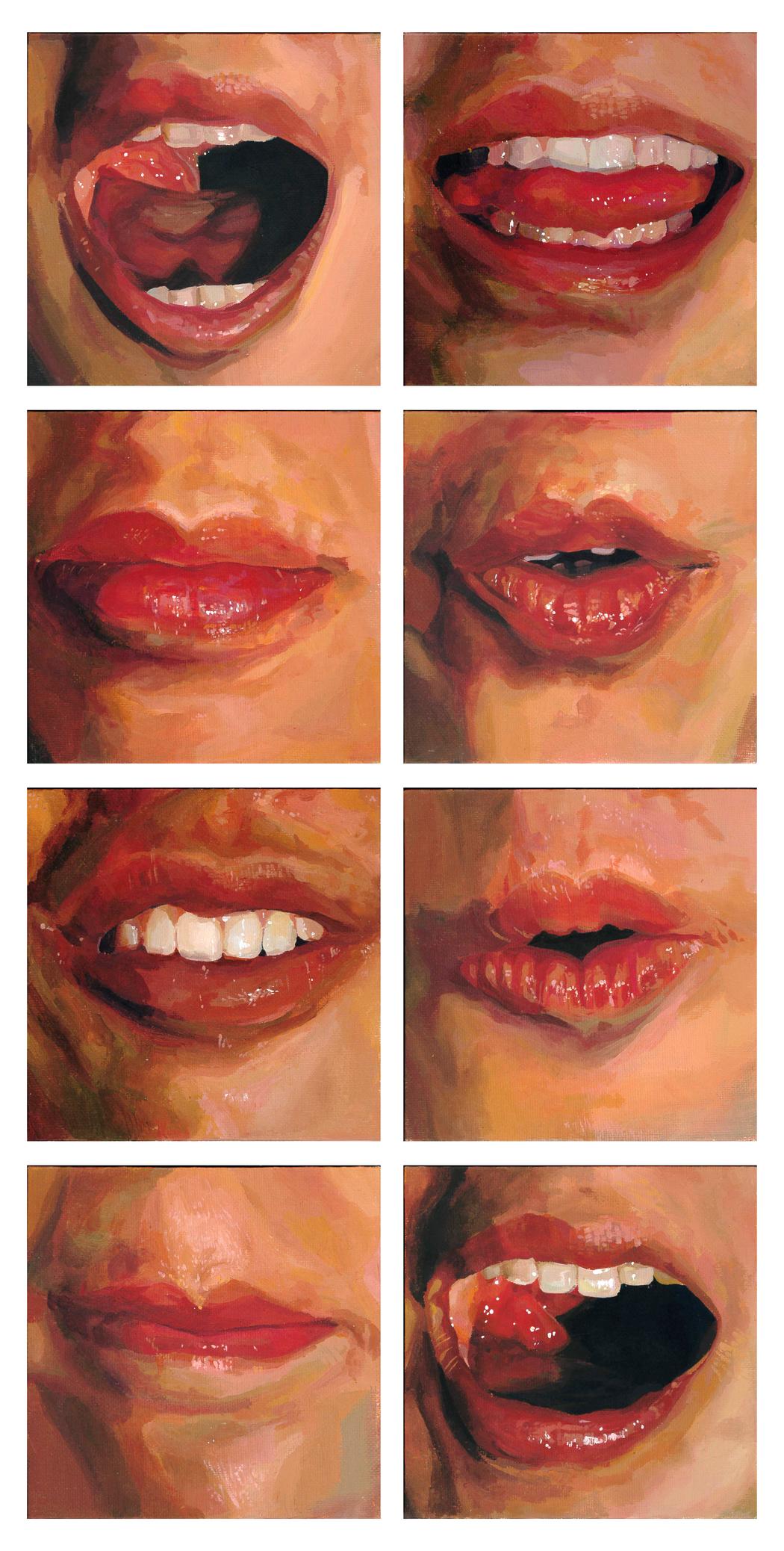 Sailee Charlu | The Sound Of One Heart | 2026
Your work speaks about feeling like an outsider and learning to reconnect with communities. Has making art changed the way you understand belonging?
This process required me to paint my own figure, which meant spending weeks making deliberate decisions about how to render my own skin, posture, the way my hand rests against my shoulder. I had become so used to presenting different versions of myself in different contexts that I had stopped asking which one was actually mine. Working on this piece forced me to confront the exhaustion I have been carrying from treating my multiple identities as competitors. When I began sharing the work, people who shared none of my cultural background still responded with recognition, still saw something in the figure that connected to their own experience of withholding themselves. Art allowed me to realize that belonging doesn’t require someone to share your exact story. It requires telling your story honestly enough that the feeling underneath it becomes visible to someone else.
What do you hope viewers from different cultural backgrounds will feel or recognize when they encounter your work?
I hope viewers recognize the experience of walking into a room and making an instant calculation about how much of yourself is safe to bring in with you, is not an experience isolated to them. This idea of self-editing leaves you feeling like a stranger to yourself. For me, that experience was shaped by culture, language, and growing up between communities that didn’t fully overlap. What I hope they feel is that their armor they wear comes from real experiences and real pain. We shouldn’t be ashamed of it, but take the first step towards being more open.