
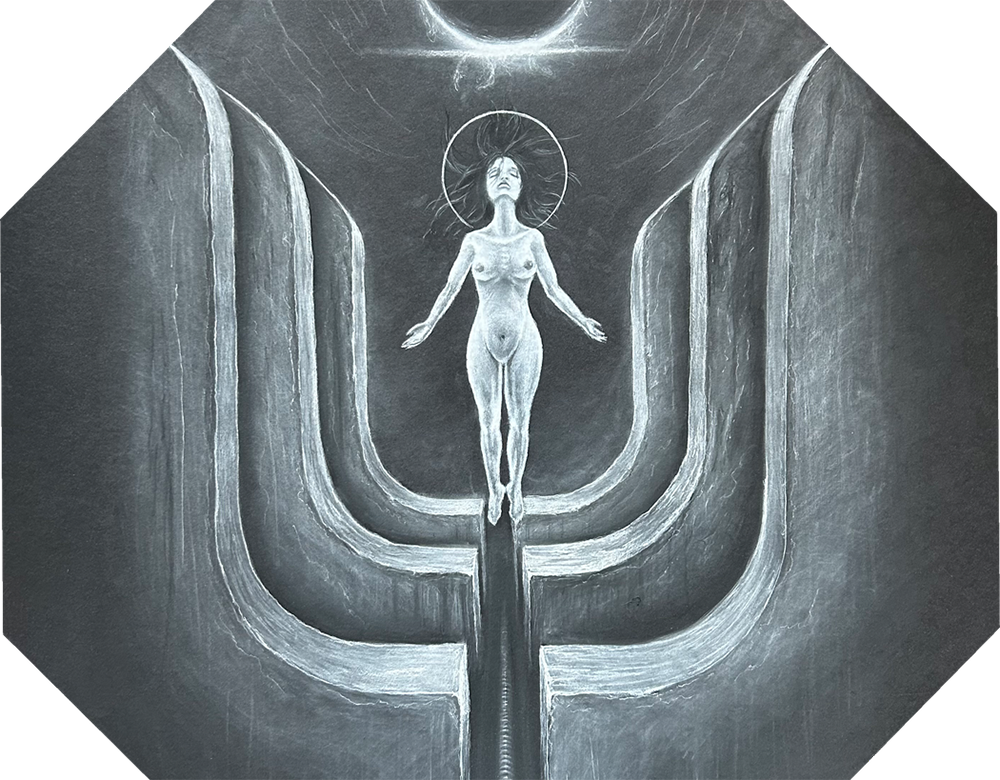
V Holecek
Your artist statement describes you as a “multi-disciplinary visual artist and existential shitposter”. How important is humor, irony, or self-mythology in the way you present yourself and your work?
I don’t know how much humor figures into my work necessarily, although it definitely finds its way into the mix. Its a matter of personal conviction that I cannot take anyone seriously who already takes themselves seriously enough for both of us. I admittedly have a low threshold for pompous twats.
My mythology, on the other hand…I do get some enjoyment at the possibility that I exist as some sort of “internet cryptid”. When I was originally registering the domain for my website, I eventually landed on the mythology around “Schamballah” (Shambala, Shangri-la, etc.), which is referenced in various cultures on the Eurasian Continent, invariably taking the format of a hidden realm away from the world of regular men; a front-end acknowledgement of just how niche I figured I was going to end up being. In my more delusional moment of grandeur, I like to imagine people having debates over what I did or did not mean with a particular image or thing that escaped the confines of my mouth.
More realistically, I figure that most of the “value” of my work will come much after my departure when my pieces sit in the investment portfolios while physically crated in warehouses where they never see the light of day and exist merely to be traded back and forth by the kinds of people who wouldn’t have bothered to spit on me while alive. And that, to me, is kind of comical.
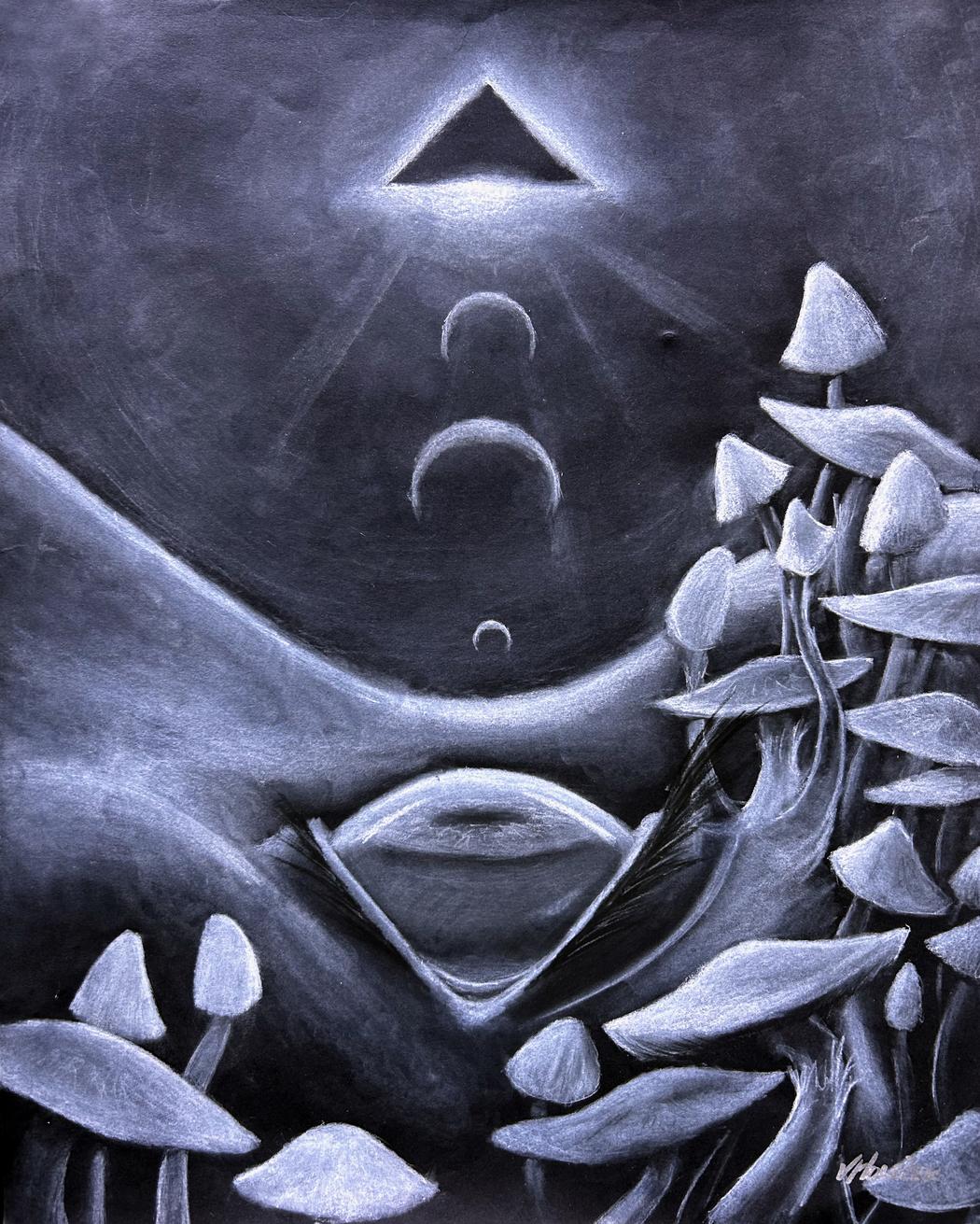 V Holecek | Equinox | 2026
Many of your works feel like visions from a dark ritual, a dream, or a post-human world. What emotional or philosophical space are you trying to open for the viewer?
Being alive in 2026 is kind of a dark ritual in and of itself. Dark and surrealist artwork is kind of having an underground renaissance moment right now on the internet. I attribute this largely to the fact that is mirrors the absurdity of the world around us.
Dark times call for dark art.
People, oddly enough, consume grim or dreary content more when the worldly outlook is bleak. Don’t get me wrong, there are those who seek out uplifting materials, but I feel like a lot of people just need to know what someone else recognizes how fucked up things are. Dark art becomes a shorthand where they can find catharsis with something they can’t necessarily put into words.
Its not even a new thing.
The draw of dark and unsettling imagery during grim and uncertain times goes back as far as recorded history, but it also transcends contemporaneous zeitgeists. People share Francisco Goya or Hieronymus Bosch paintings on social media centuries after those artists stopped consuming oxygen, possibly moreso now that many feel that we are spiraling into some form of tech-dystopia. They still hold resonance.
Your visual language often combines the body, machinery, bones, cosmic symbols, and occult atmosphere. What draws you to these hybrid forms?
The entire visual language of H.R. Giger’s “biomechanics” was incredibly formative for me. Being GenX, I probably saw ALIEN way younger than any parent these days would probably allow. That’s kind of the standard gateway drug into the larger aesthetic world…ALIEN lead to me finding a copy of H.R. Giger’s NECRONOMICON in my teens, which lead to finding artists like Zdzislaw Beksinski, Darius Zawadski, Chet Zar, Oenameus Dack, Mariusz Lewandowski, and so on.
I also grew up on doses of H.P. Lovecraft, Edgar Allan Poe, Stephen King, Douglas Adams, and shows like The Twilight Zone and The Outer Limits and the projects of David Lynch. Of course, growing up in the 80’s and 90’s, there was basically no chance that I was not going to be a social freak show. I made friends here and there, but some time around the 1996-1998, there was this sudden vogue moment for social misfits that came with the advent of the internet.
Being a freak on any level tends to imbue you with a gravitational pull between you and other freaks. The internet only amplified this pull by removing the physical barrier of geography, so being a oddball in the late 90’s put you on intersecting paths with a lot of fascinating and eccentric individuals.
The other contributing component to this is my love/hate relationship with the tech sector. I grew up at a time when tech was actually genuinely experimental and innovative in a lot of ways that it just isn’t today. This was back when tech was still largely run by actual tech people, rather than executives. Nowadays so much of the tech sector is just a hollow cash grab to strip away previously ubiquitous features and functions only to sell them back to you as an adapter or an app. Even something like just aimlessly browsing the web is something that so many people just don’t do like they used to, as social media companies do everything they can to keep all your contact with the outside world contained in their little sandbox.
Its funny, because I went into the Air Force to pursue a tech-related field, and ended up maintaining some of the most archaic Cold War Era systems you could imagine. Some of my aesthetic comes from that exposure…the big, clunky cabinet of circuit boards and arrays of bulky cables connecting them to other clunky cabinets in all directions. I worked on systems so old that their most recent “upgrades” were SCSI hard drives run off of a tape emulator module so the system could still read the data like reel-to-reel magnetic tape.
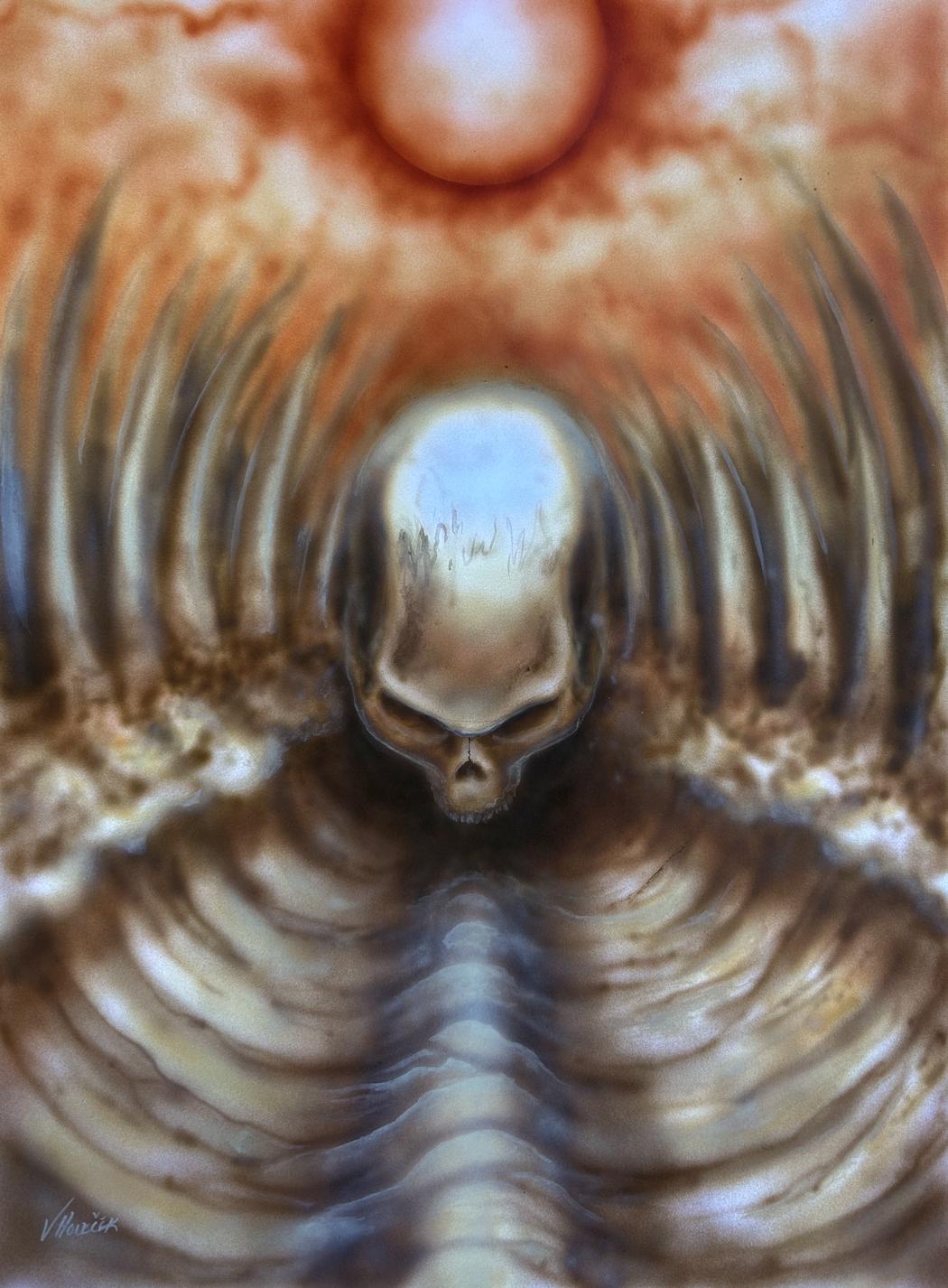 V Holecek | Solstice | 2026
Several of your works use a strong contrast between darkness and pale, almost glowing forms. What role does light play in your compositions?
Darkness is the backdrop that gives light its context and meaning. Without it you’re left with just a white void, which is no more revealing than a black void. Shadow is what helps determine dimension. It gives form, contour, and depth. It literally defines the difference between the second and third dimension.
Your drawings and paintings often seem both sacred and disturbing at the same time. Are you interested in the tension between beauty and horror?
When I am in a situation where I have to give my initiatory blurb to someone to explain what I do as an artist, my go-to answer is typically something to the end of: “I make beautiful images of terrible things”.
Over the past decade I’ve found myself increasingly inspired by the “feral women” movement that has kind of taken off. My partner is one of these women who has adopted the practice of “reclaiming her femininity in threatening ways”, and I’m finding that influence informing the direction of a number of my compositions these days.
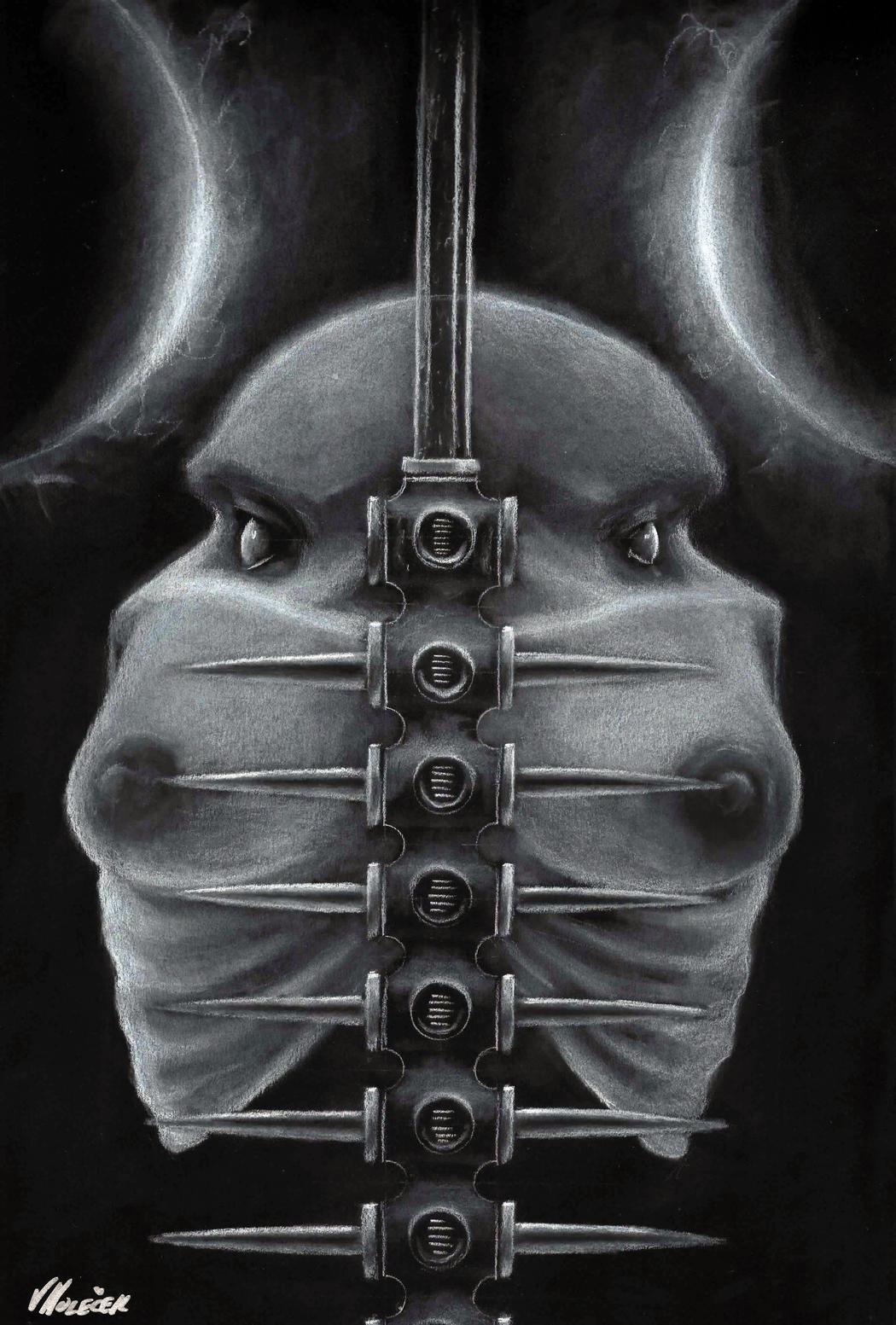 V Holecek | Janus | 2026
Many of your figures feel transformed, haunted, or caught between human and non-human states. What interests you about transformation as a subject?
I am reasonably certain my name exists on some sort of watch list somewhere because of the books I checked out from the school library. If the library had something to offer with arcane topics, unexplained phenomena, or conspiracy theory, I’m pretty sure I checked it out at least once.
As such, I am what you would call “casually superstitious”, in that I have a lot of placeholder beliefs for more esoteric things that serve as functional answers until such time as a better explanation and data is available. For example, I don’t necessarily believe in souls, but I do believe in hauntings. In my mind, I have rationalized it in ways that a particularly brutal or grief-stricken death can alter the environmental currents in and around a given locality, depending on the severity. I have zero scientific basis for this theory, and I’m not so attached to it that I’m unwilling to entertain a better explanation with more grounding in science. I keep these beliefs as a little treat, and I don’t require anyone else to subscribe to them.
I have found that holding space for some level of magical thinking makes for more creative exploration. That’s why most of the visually powerful art in history tends to be religious. Militant atheists who fetishize logic make terrible artists…and I say that as an atheist.
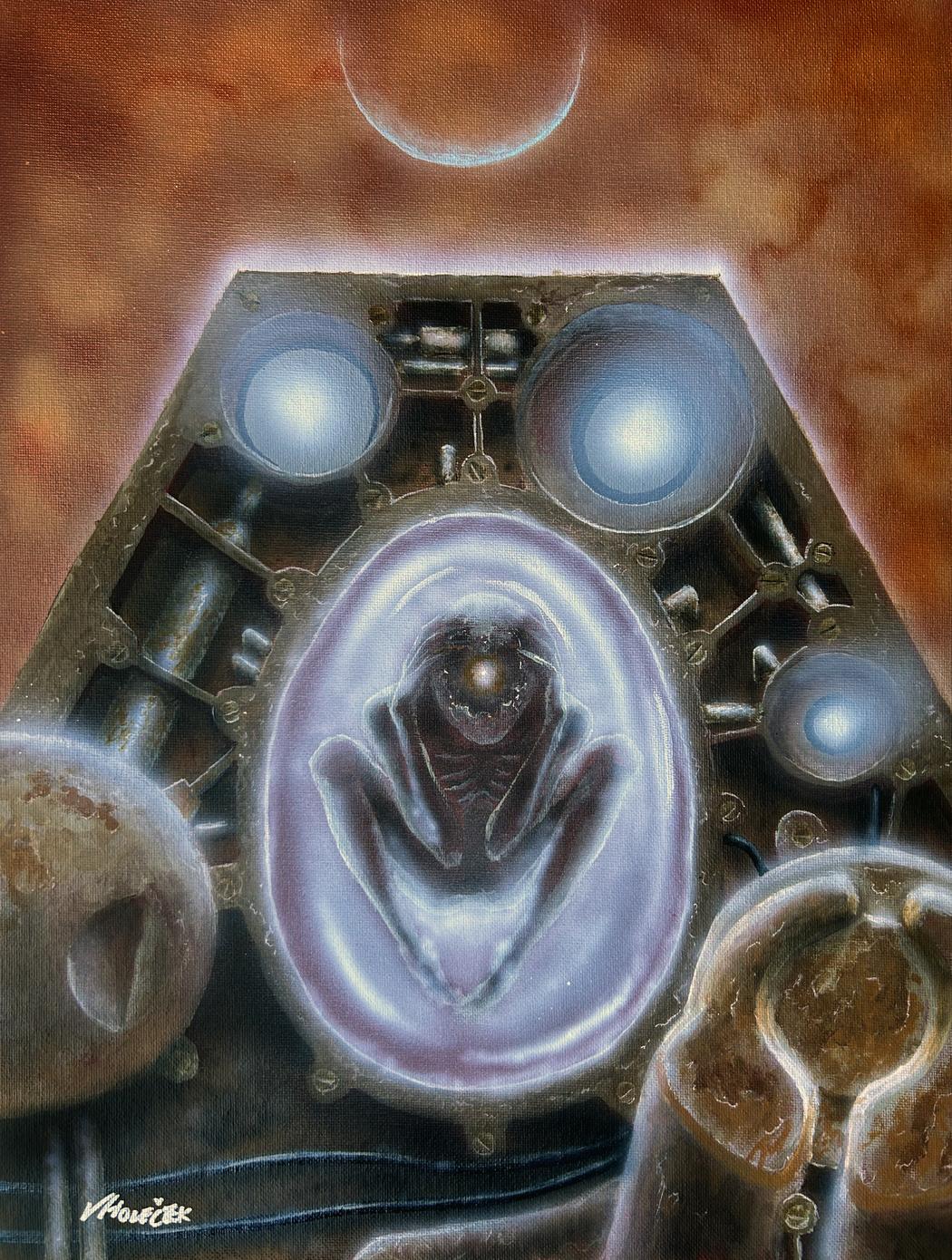 V Holecek | Kronos Reactor | 2026
When people encounter your work, do you hope they understand it, feel unsettled by it, or simply enter its atmosphere without needing a clear explanation?
My artwork isn’t really narrative-driven, but is more of the coalescing of a mood into an image. I guess if I have any kind of goal for a response when someone is encountering my work for the first time, I thing I’m really striving for is to create something that makes someone stand there a utter a quiet “Fuck…” to themselves. Something to that end.