
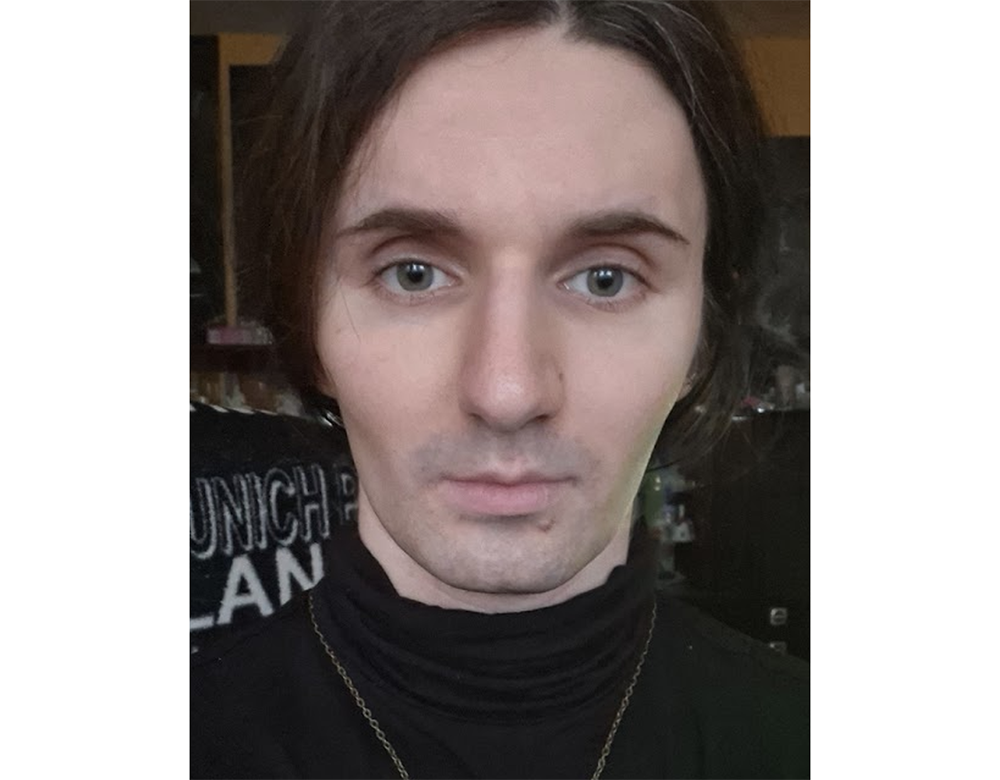
Stefan-Valerie Popescu
Your artistic path began with graphic arts and later moved toward painting. What attracted you to painting as a medium, and what did it allow you to express differently?
It is true that my artistic journey began with graphic arts, and I was fortunate to achieve recognition in that field at a young age. However, I ultimately chose to continue with painting because I felt that color offered me a much greater sense of freedom and emotional expression than graphic art alone.
That being said, my background in drawing and graphic arts remains deeply embedded in my visual language. Its influence can still be seen in my paintings, especially in my earlier works, where whites, greys, charcoal textures, and strong contrasts dominate the composition. A clear example is the painting depicting the distorted face of a soldier, where black-and-white elements play a central role.
I believe it is natural for any artist to seek new means of expression and to constantly expand their practice. In a sense, every artist strives to become more complete, while remaining aware that such completeness is never fully attainable. Throughout art history, even the great masters went through periods of experimentation that significantly transformed their artistic identity. This is even more evident in contemporary art, where the boundaries between painting, drawing, printmaking, sculpture, digital art, and other media are increasingly dissolving.
Today we encounter many works that can no longer be categorized as purely painting or purely drawing because they exist between disciplines and are shaped by multiple influences. Personally, I do not see this as a problem; I see it as something wonderful. Contemporary artists enjoy a level of creative freedom that previous generations could hardly have imagined. They are no longer required to conform to rigid rules, schools, or dogmas, and that freedom allows for a much richer and more diverse artistic landscape.
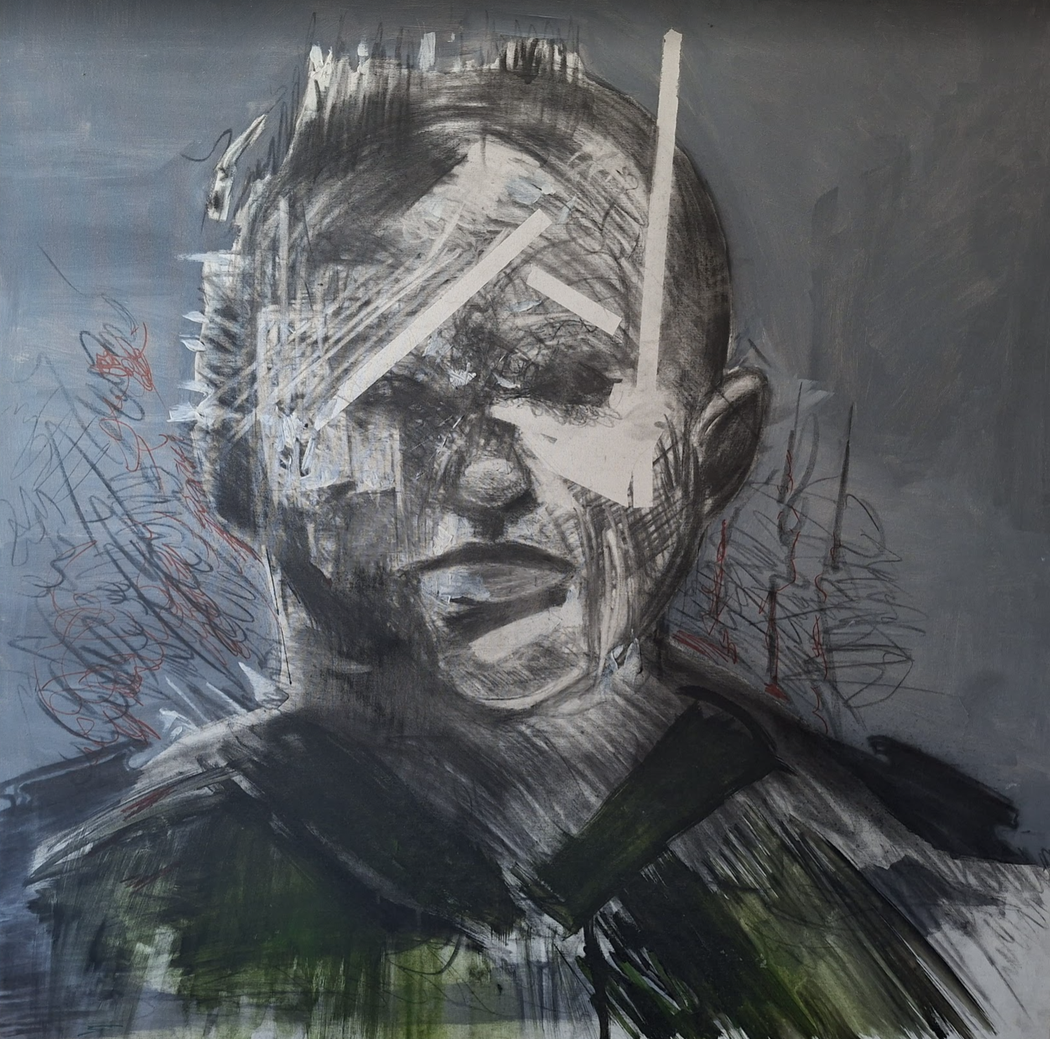 Stefan-Valerie Popescu | The Memorial Of Pain | 2018
Portraiture plays an important role in your practice. What draws you to the human face as a space for exploring emotion, memory, and trauma?
Everything about the human face fascinates me. Within my work, it serves as the most direct and powerful vehicle for conveying meaning. Through the face, I can explore the complexity of human nature, the contradictions of identity, and the individual’s ongoing struggle with the self.
I am not interested in creating portraits that are conventionally beautiful, nor am I concerned with producing images that are shocking for the sake of shock. What interests me is the possibility of communicating emotional states, psychological tensions, and inner conflicts. The face becomes a territory where vulnerability, memory, anxiety, resilience, and transformation can coexist.
In many ways, the subjects of my paintings are engaged in a form of warfare, but not necessarily an external one. Rather, they embody the internal battles that define contemporary existence. We live in a world that is increasingly alienating, technologically mediated, accelerated, and constantly changing. Against this backdrop, the individual is often forced to negotiate questions of identity, belonging, purpose, and self-understanding.
For me, portraiture is not simply a representation of a person; it is a way of reflecting on the human condition itself.
In several of your works, faces appear fragmented, erased, or partially hidden. What does this visual language mean for you?
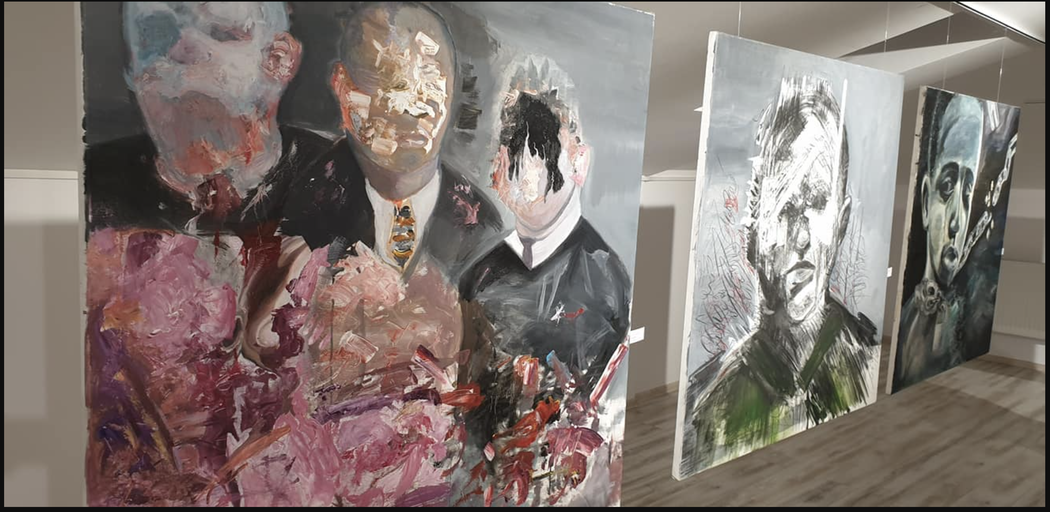
The fragmented, erased, or partially concealed faces that appear throughout my work reflect the inner conflicts of the individual and the complexity of human identity. I am interested in identity not as something fixed, stable, or fully defined, but as an ongoing process of transformation.
These interventions on the face function as metaphors for the tension between who we are, what we choose to reveal, what we conceal, and what we aspire to become. By disrupting the integrity of the portrait, I seek to create a space where certainty dissolves and multiple interpretations become possible.
At the same time, these visual strategies engage with ideas related to transhumanism and posthumanism. They suggest a questioning of traditional notions of the self and point toward the possibility of identity being reshaped through technology, memory, digital culture, and contemporary experience. As our relationship with these forces becomes increasingly complex, the boundaries of what we understand as human identity also become less stable.
The absence or fragmentation of the face should not be interpreted as a loss of humanity. On the contrary, it is an attempt to explore its many layers, contradictions, and future possibilities. What interests me is not disappearance, but transformation.
Your work often touches on invisible suffering and intergenerational trauma. How do you approach such sensitive themes without making them too literal?
As I mentioned before, although my work is fundamentally figurative, it incorporates many elements that some viewers might perceive as abstract. I often use distortions, fragmented faces, symbolic figures, altered backgrounds, and other visual interventions that move beyond straightforward representation. These elements allow me to suggest emotional and psychological states rather than illustrate them directly.
My intention is never to shock the viewer. In fact, over the years I have gradually introduced more color into my work, even though some people may still recognize what they describe as a darker or almost Gothic sensibility within it. For me, however, the focus has never been darkness for its own sake. The central theme remains the individual’s internal struggle and the ongoing process of self-discovery.
There are moments when I may include more „ graphic ” elements—such as blood or scenes that evoke violence—but these are never the true subject of the work. They usually function as symbols or traces of a deeper psychological reality rather than as ends in themselves. What interests me is not the external event, but the emotional and existential consequences that remain beneath the surface.
I believe that themes such as suffering, memory, and intergenerational trauma are often most powerful when they are approached indirectly. Suggestion can sometimes communicate more than explicit representation. By leaving space for ambiguity, the work invites viewers to bring their own experiences, memories, and emotions into the encounter.
Ultimately, interpretation belongs to the viewer. If you ask a thousand people what a painting means, you will likely receive a thousand different answers. Some may connect deeply with it, others may interpret it in completely unexpected ways, and some may not understand it at all. I do not see that as a problem. Authentic art is not something that must always be intellectually decoded; often it is something that is felt before it is understood.
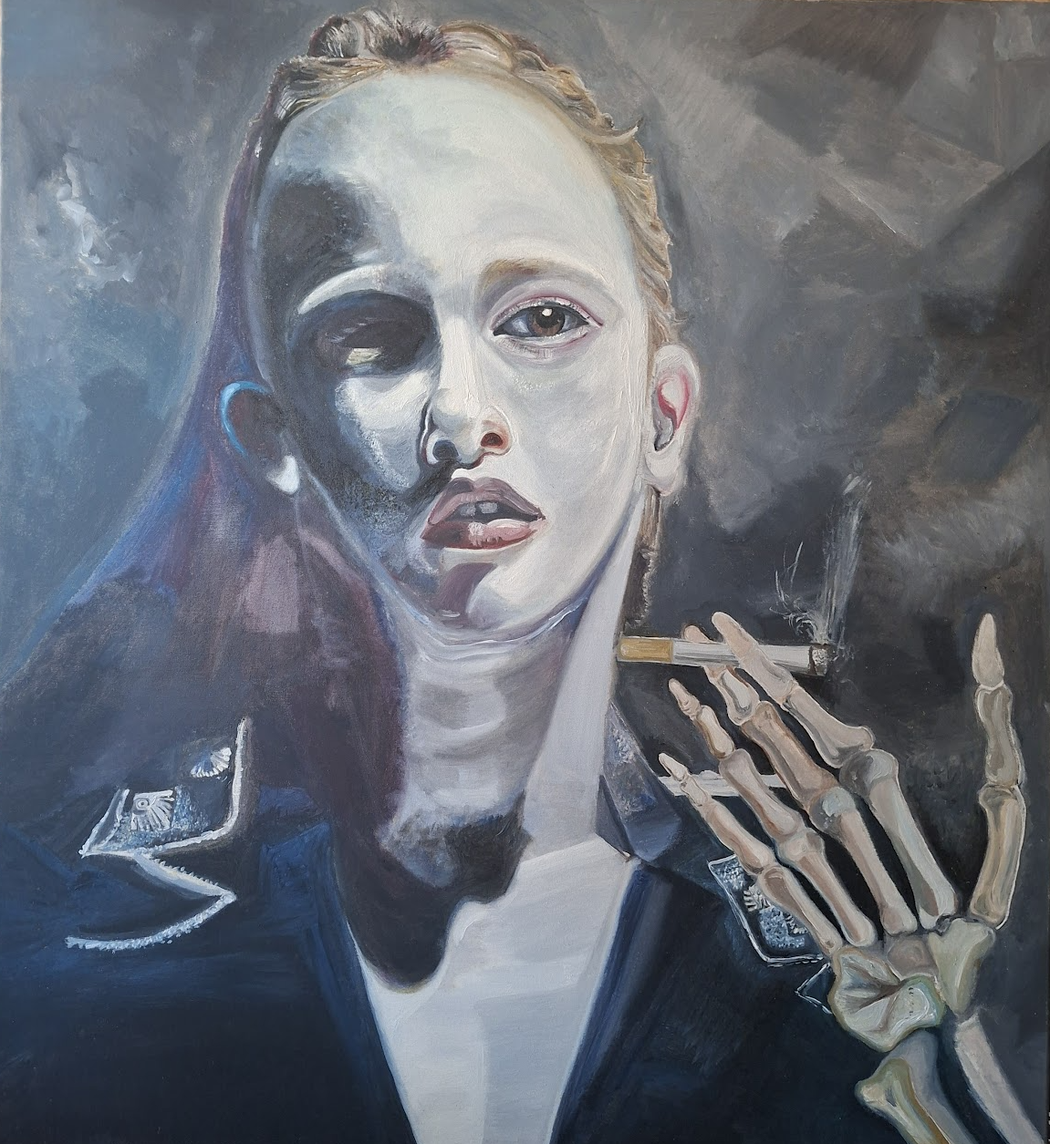 Stefan-Valerie Popescu | Ashes Of Obedience | 2018
Your paintings combine traditional techniques with references to digital culture and technology. How do you balance the handmade and the technological in your practice?
I think this aspect of my practice is largely influenced by my professor, Liviu Nedelcu, who helped broaden my artistic perspective and encouraged me to look beyond the traditional boundaries of painting. Through his guidance, I began exploring different media, methods, and ways of thinking about art, which ultimately allowed me to move beyond the conventional stereotype of the painter working exclusively with canvas and pigment.
For me, there is no real conflict between the handmade and the technological. I see them as complementary languages that can coexist within the same artistic space. My foundation remains rooted in painting, but over time I have experimented with a variety of approaches that introduced new visual and conceptual possibilities into my work.
This has led me to incorporate elements inspired by digital culture, such as glitch-like aesthetics, technological motifs, LED installations, collage, illuminated cables integrated directly into paintings, as well as photographic, video, and holographic installations. In some cases, technology functions as a physical material; in others, it appears as a conceptual presence that reflects the increasingly dominant role technology plays in contemporary life and in the way we construct our identities.
What interests me most is not really technology itself, but the dialogue it creates with traditional artistic practices. I am fascinated by the tension between something handmade, tactile, and deeply human, and something mediated by screens, data, and digital systems. That tension mirrors many of the broader questions explored in my work regarding identity, transformation, and the changing nature of human experience.
My artistic trajectory has gradually moved from traditional painting toward increasingly interdisciplinary and conceptual forms. One of my most recent works, for example, exists primarily as a concept rather than as a physical object. This evolution has opened new directions for me, and I am excited to continue exploring them. In the future, I would like to further integrate virtual objects, interactive installations, and other emerging technologies into my practice, not as replacements for painting, but as extensions of the same artistic inquiry.
You have experimented with holograms, LED strips, 3D printing, and 3D pens. How have these technologies changed the way you think about visual art?
These technologies have significantly changed both the way I think about art and the way I relate to it as an artist. More than anything, they have expanded my sense of freedom. While painting remains central to my practice, experimenting with holograms, LED installations, 3D printing, and 3D drawing tools has allowed me to move beyond the limitations of a flat surface and imagine new ways for an artwork to exist in space.
Through these experiments, I began to see art less as a specific medium and more as a field of possibilities. Technology opened doors to ideas and forms of expression that I would not have imagined when I was focused primarily on traditional painting. It encouraged me to think conceptually, to question the boundaries between object, image, light, space, and viewer, and to consider how different media can work together to create meaning.
Looking back, I remember being strongly attracted to technical skill and realism during my years at university. Like many young artists, I was fascinated by the ability to reproduce reality convincingly. However, I gradually realized that technical mastery alone is not enough. Art needs a deeper purpose. It needs a message, a direction, a question, or an idea that extends beyond the visual result itself.
In that sense, technology did not pull me away from art’s essential concerns; it pushed me closer to them. It helped me understand that the medium is only a vehicle. What truly matters is the ability to communicate something meaningful about the human experience, contemporary society, or our changing relationship with the world around us. For me, the adoption of new technologies has therefore been a very positive development—one that has expanded both my creative vocabulary and my understanding of what art can be.
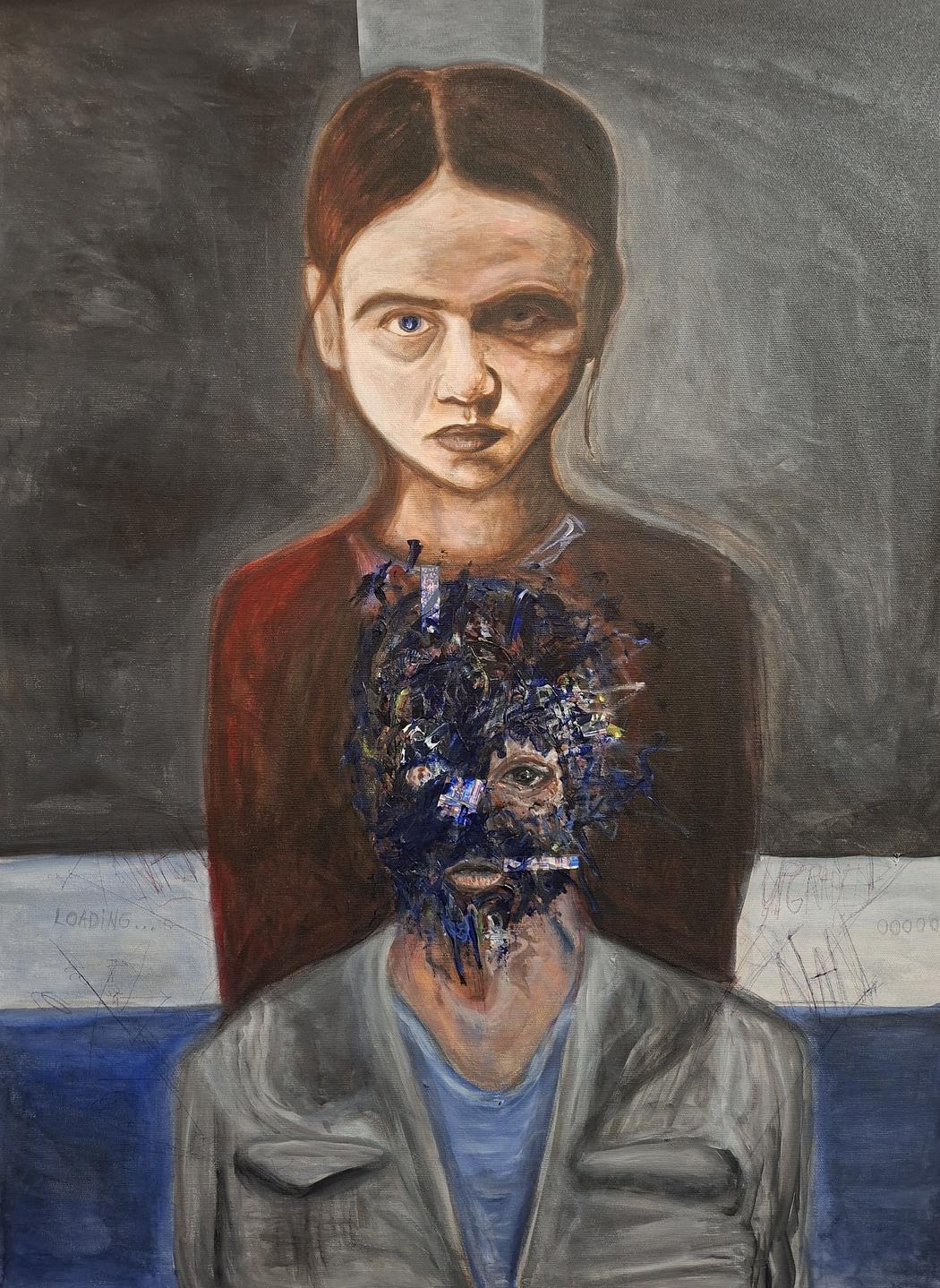 Stefan-Valerie Popescu | Digital Legacy | 2024
You describe yourself as an artist in continuous evolution. What direction would you like your practice to take next?
To be honest, I do not believe there are fixed limits to where an artistic practice can go. As long as I continue to live, learn, and respond to a world that is constantly changing, my work will continue to evolve alongside it. Art, for me, is not a destination but an ongoing process of exploration.
At the moment, I remain deeply interested in the themes that have shaped my work so far—identity, transformation, memory, technology, and the human condition—but I am increasingly drawn to expanding the forms through which these ideas can be expressed. Alongside painting, I would like to further explore virtual objects, interactive installations, and other emerging technologies that can create new relationships between the artwork and the viewer.
What excites me most is the possibility of creating experiences that exist somewhere between the physical and the virtual, between traditional artistic practice and new technological realities. I see these developments not as a departure from painting, but as a natural extension of the questions I have always been asking.
At the same time, this is a difficult question to answer with certainty because I genuinely do not know what my work will look like in ten or twenty years. In many ways, that uncertainty is precisely what keeps art alive. The future of my practice remains open, just as the future of humanity itself remains open.
Perhaps this connects to some of my interest in posthumanist ideas. We often speak about the “post-human,” yet no one can fully define what that might be. We can only imagine possible futures: a being that still retains traces of humanity, one that becomes increasingly intertwined with technology, or perhaps something entirely new that we cannot yet comprehend. I think artistic evolution works in a similar way. We can sense directions, possibilities, and transformations, but we cannot fully predict where they will lead.
For now, I am less interested in arriving at a final form than in remaining open to change, experimentation, and discovery. That openness is what continues to drive my practice forward.
Leave a Reply
You must be logged in to post a comment.