
Haoyue
 Haoyue | Escape from the Panopticon | 2025
Your collection Escape from the Panopticon uses a powerful architectural metaphor. What first drew you to the idea of the panopticon as a framework for understanding contemporary youth identity?
My design inspiration usually comes from reading. I first came across the concept of the panopticon when reading Foucault’s related theories. When I began to explore the origin and development of this concept, I found it to be a very “malicious yet intelligent” design. What interested me most at first was its form. Existing prison designs based on the panopticon concept show a high degree of consistency, where circles and regular hexagons are everywhere. What I am interested in is how to break and reconstruct this extremely stable and orderly structure, which coincides with structuralist styles in design. Such formal breakthroughs imply psychological and spiritual breakthroughs.
At the same time, what shocked me was the operating principle of this structure. In a panopticon, each prisoner has the same possibility of being seen at any moment, but does not know when they will be seen or who is watching them, so they carry out self-surveillance all the time. In this situation, only one or two people are needed to control hundreds or even thousands of prisoners. The observer stands in the central tower of the prison, and no one can see him.
When I first read about it, I felt it was terrifying, because in my view, visible, external constraints can be broken, since people at least know the force they need to resist is right in front of them. However, internalized, self-imposed surveillance and repression are often much harder to recognize and change.
Walking on the street and seeing surveillance cameras, or observing how people voluntarily replace sensitive words with other expressions or emojis under sensitive topics online (this may be more obvious in East Asian cultural contexts), I began to realize the true power of the panopticon.
Today’s young people, including myself, face the most dangerous form of discipline, which is invisible normalization, like being placed in slowly heated warm water. This is the starting point of everything.
 Haoyue | Escape from the Panopticon | 2025
You describe each era as having its own “prison”. In today’s digital society, what do you see as the most subtle or invisible forms of control shaping young people?
Each generation has its own panopticon because no era is completely free, although humanity has always been striving for freedom. For people in the 1970s punk era, economic recession brought a repressive and conservative social atmosphere, along with outdated and rigid cultural norms and stricter social control, which generated anger and frustration among young people with nowhere to release it. That was their prison.
In today’s digital society, the most obvious point is that I often feel that each internet user is almost exposed without protection. You do not know who is reselling or observing all of your personal information. On the other hand, in recent years, relatively conservative ideological and political climates have resurged globally. In many places in the world, people have been punished for their thoughts, and “thought crimes” are not rare cases.
Perhaps the internet has made surveillance easier, and increasingly mature education systems have also made social discipline more subtle and internalized. The term “discipline” here is not purely negative; it is more like an inevitable result of socialization. What I care about is that the will from governments, schools, and cultural systems can penetrate more easily through the reach of the internet.
The boundary between “granting freedom” and “teaching rules” is very vague, and the collective influence over individuals is also difficult to notice. I do not intend to oppose education or completely reject universal values. I only hope that young people can think about the logic behind every so-called absolute truth and the limits of self-repression.
 Haoyue | Escape from the Panopticon | 2025
Many garments in this collection balance exposure and concealment through layering and controlled transparency. How do you translate psychological tension into material structure?
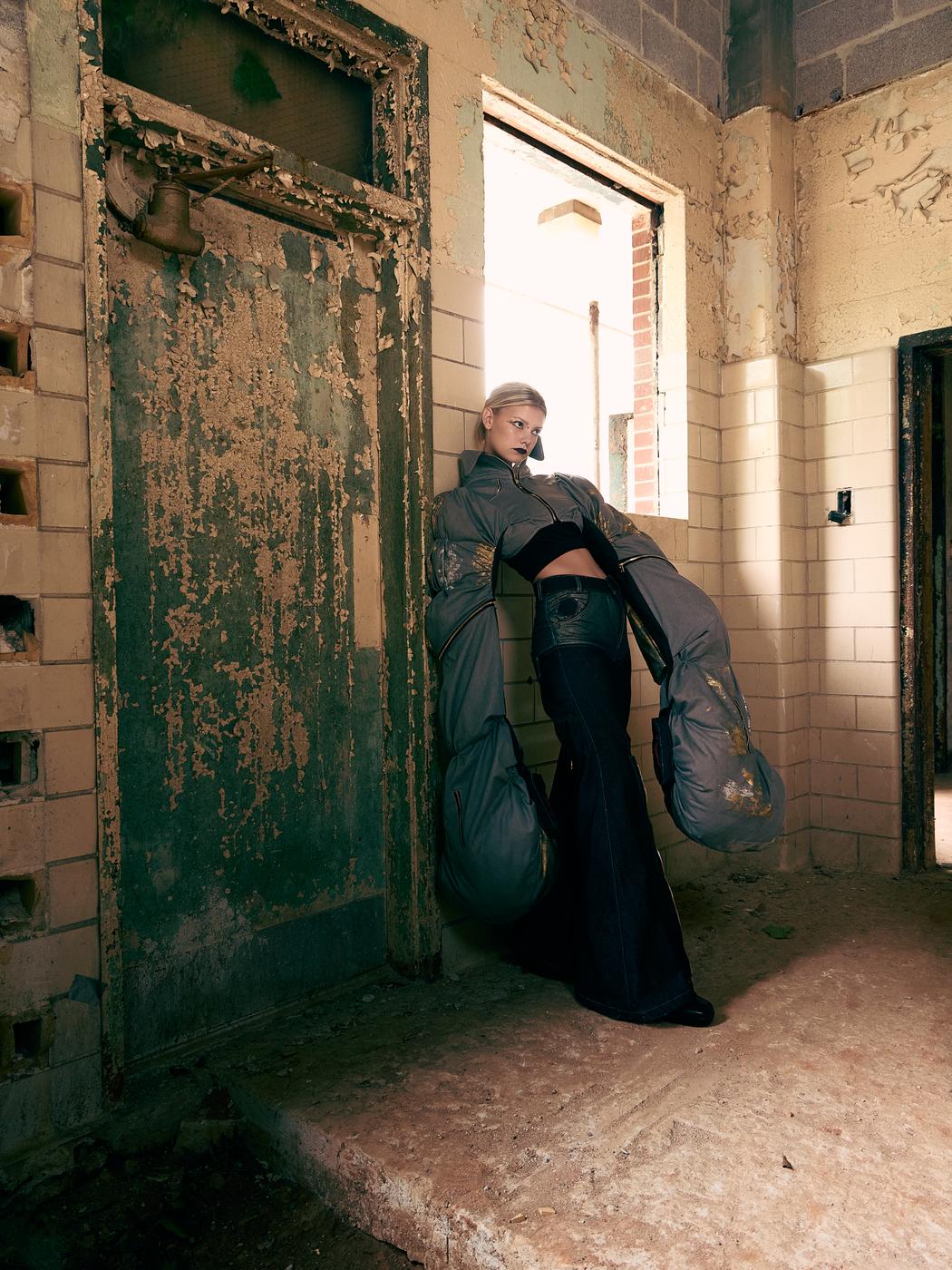
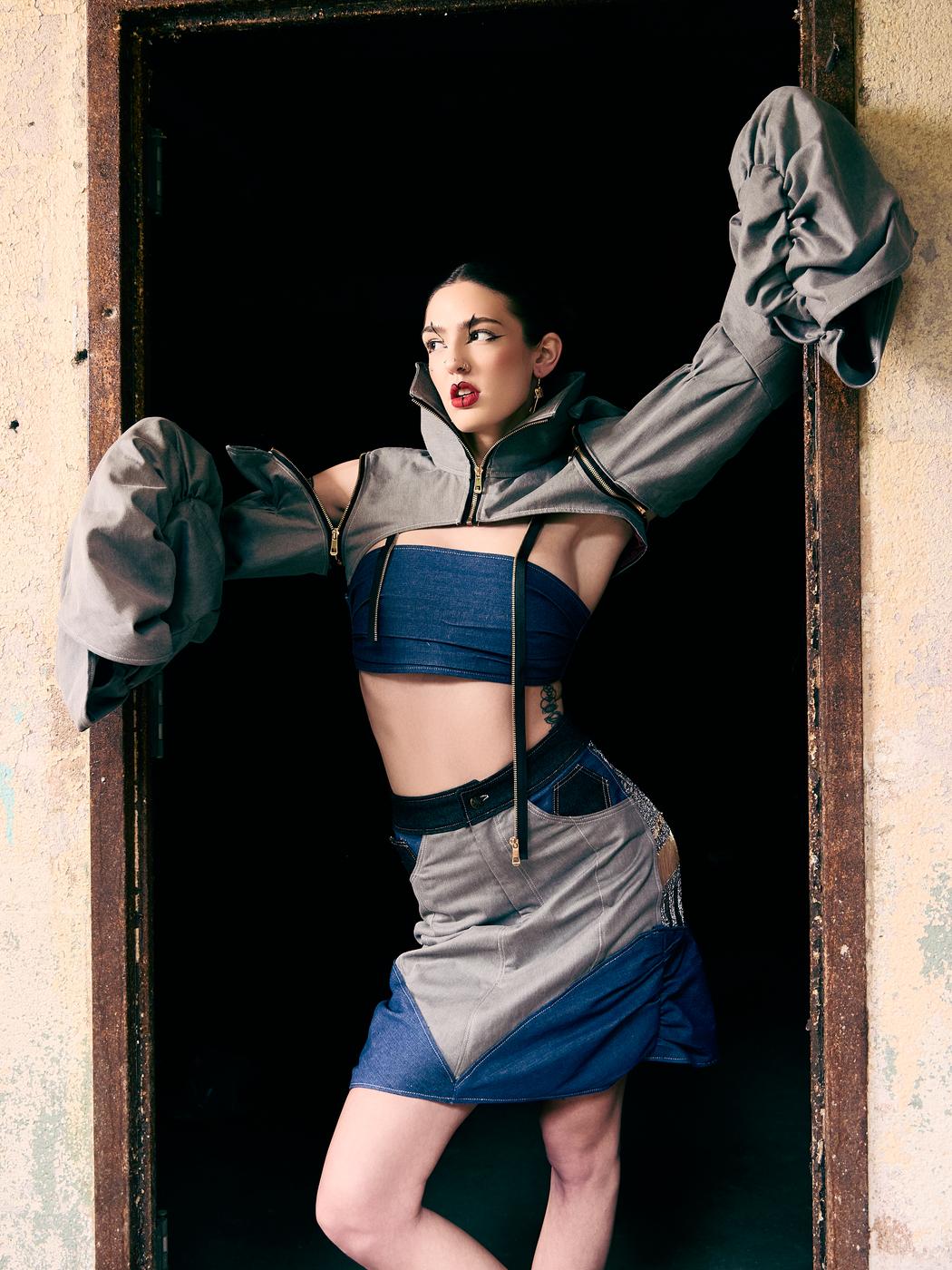
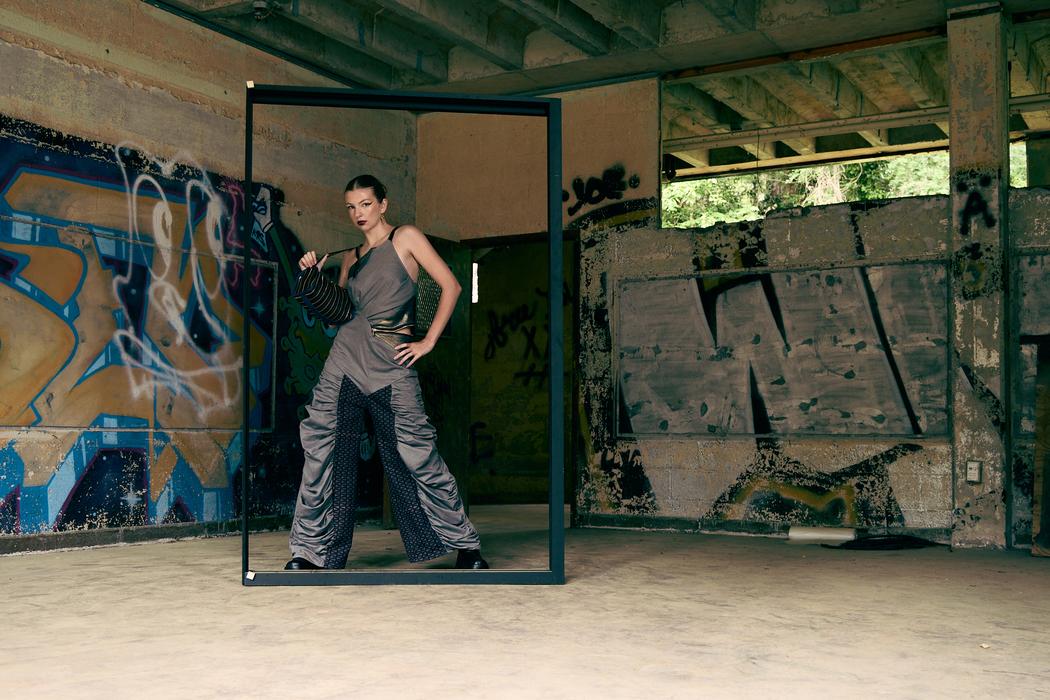
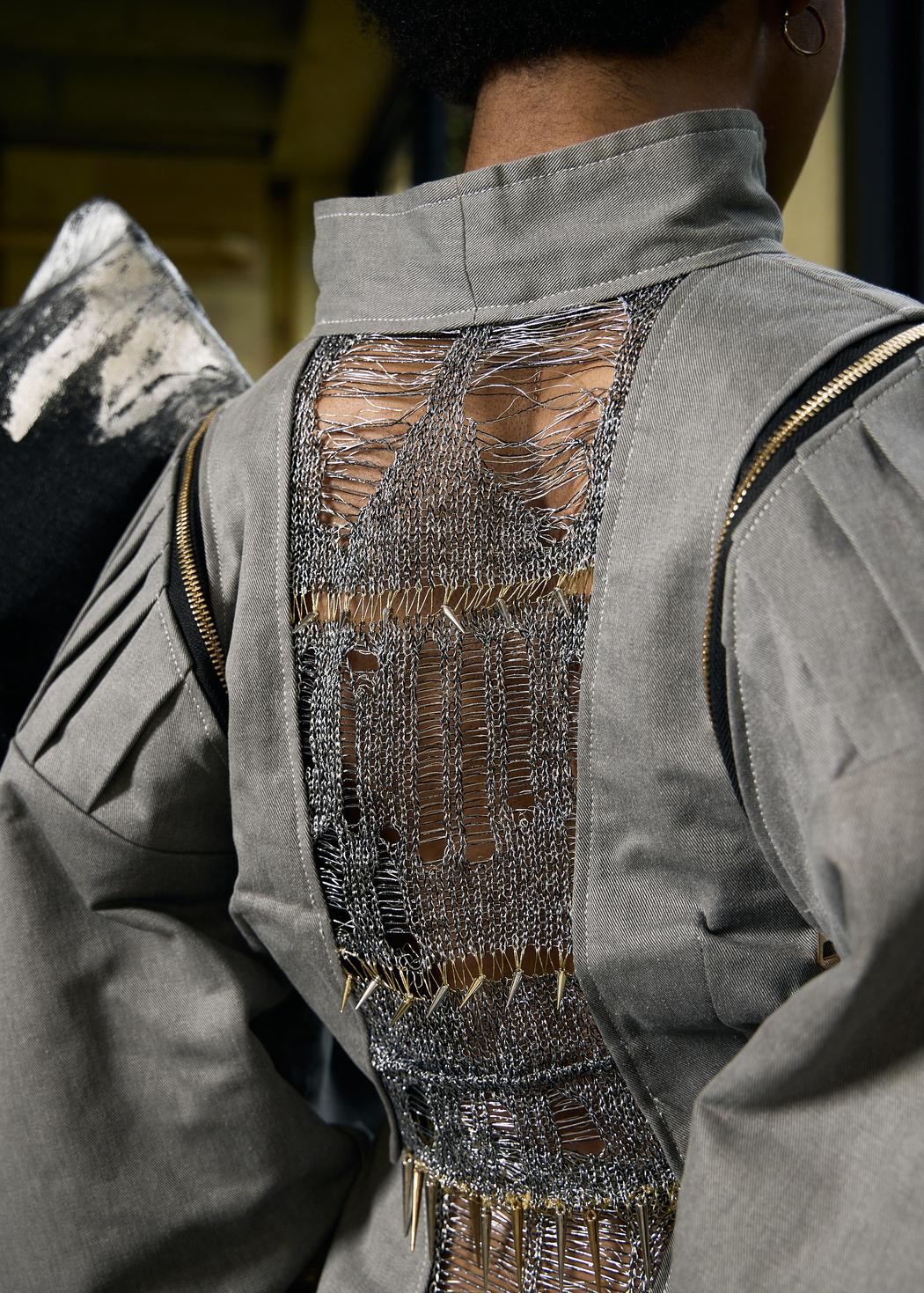
In my design, I used a lot of irregular knitting structures, which are exposed rather than hidden. Within the dense, opaque gray denim, these knitted elements can be understood as relaxed, partially broken prison barbed wires, or as windows that break outward from the body, allowing observation from the inside.
I hope that these highly metallic, durable, yet re-formable and stretchable sheer knit structures allow the entire design to breathe more freely.
At the same time, this collection also includes fabrics that I modeled in Rhino and produced using flatbed printing technology. The three-dimensional red triangular shapes simulate the skin of an armadillo. In the oral history of punk culture Please Kill Me, punk artists mentioned that their bold makeup was actually a protection for their fragile inner selves, much like an armadillo. This made me realize that rebellious people can still be vulnerable, and I wanted to use this fabric to create a layer of armor for brave individuals.
Meanwhile, the extensive use of zippers also serves as a tool to create both enclosure and exposure. Opening a zipper becomes a form of outward presentation. This concept also helps enrich the structural complexity of the garments.
 Haoyue | Escape from the Panopticon | 2025
The body in your designs seems to function as a site of negotiation between autonomy and surveillance. How do you approach the relationship between garment and body during your design process?
The human body itself is a very important field. To a certain extent, it is socialized and serves as a platform for display. In Foucault’s Discipline and Punish, he mentioned that the body has long been a site where rulers demonstrate punishment and ideological control. At the same time, it is undeniable that a person’s body should also belong to themselves and remain private, which creates a tension.
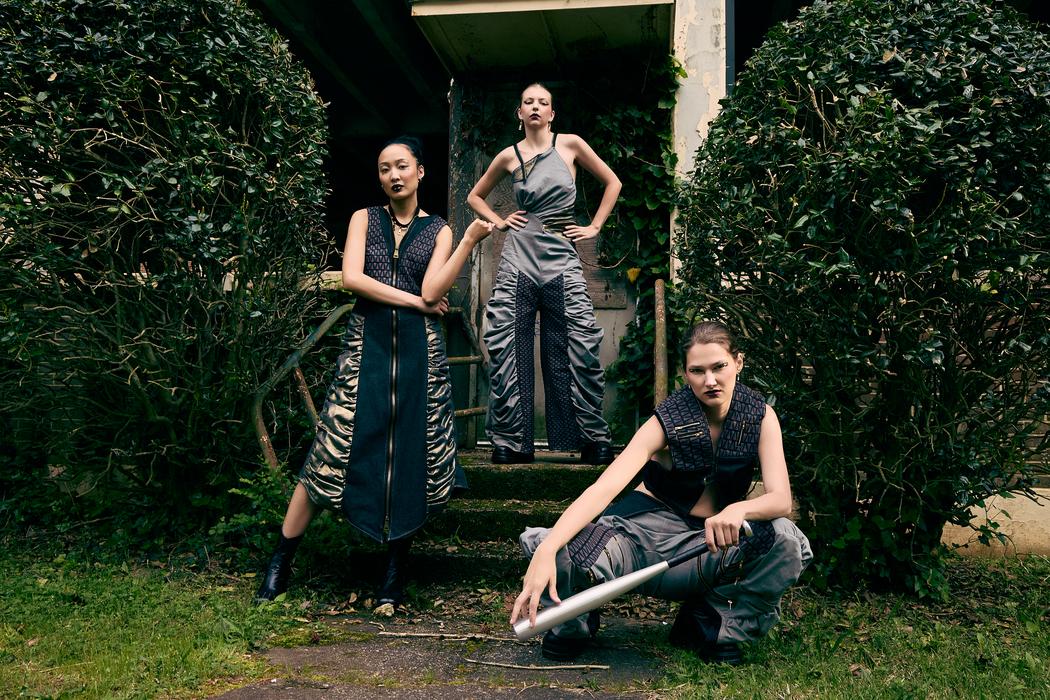
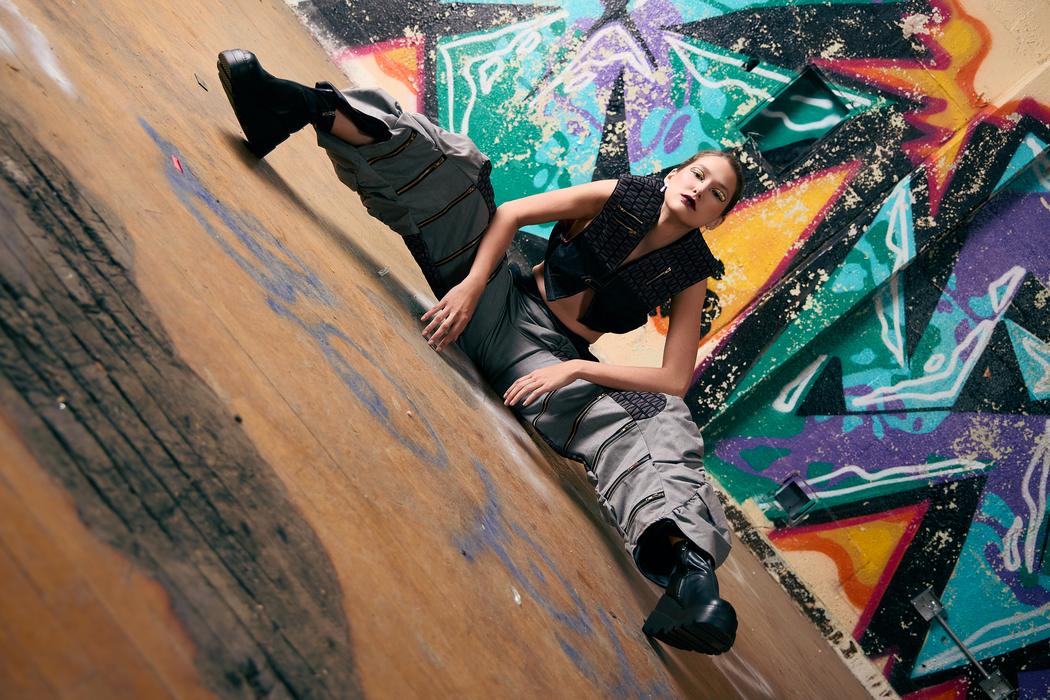
In my design, I place greater emphasis on the subjectivity of the body. Wearing this collection is meant to encourage people to express themselves bravely and resist rules they question. During the photoshoot, I told my models that they did not need to appear sweet or seductive, but instead should embody anger and aggression — as if they were trying to break this world apart.
At that time, they were located in an abandoned school in Atlanta that had been unused for twenty years. The walls were covered with countless graffiti created by different people over two decades. This setting perfectly echoed my design theme. Nothing represents the collapse of order better than an abandoned school.
Showing this collection at New York Fashion Week placed it within a global fashion system. How did the runway context affect the way the concept was perceived?
For a young designer, one of the most important things is to have their work seen by more people. Showing at a platform like New York Fashion Week is especially meaningful because the work can be presented to audiences from diverse cultural backgrounds.
As a designer from an East Asian cultural background, I sometimes feel that many designers and artists from China, Korea, and Japan are more inclined to explore the tension between the individual and the collective — a complex emotional relationship that involves both resistance and dependence.
Escape from the Panopticon is also connected to this theme. I hope that my work is not limited to expressing ideas that only people from specific cultural or regional backgrounds can understand. Instead, I want it to speak to shared human issues. New York Fashion Week provides the best platform for receiving such feedback.
 Haoyue | Escape from the Panopticon | 2025
Youth identity is often associated with radical gestures. Why is it important for you to portray youth as conscious and reflective rather than purely rebellious?
Young people tend to have stronger rebellious tendencies because they have spent a shorter time entering the large, strict, and relatively softly disciplined social system. Perhaps human nature is inclined toward the pursuit of freedom. When people find that their personal will conflicts with various surrounding rules, rebellious feelings naturally emerge.
We have probably all seen forms of so-called radical or pure rebellion. For example, violating school dress codes by wearing extremely exaggerated clothing, running away from home, or in more serious cases, drinking excessively or trying prohibited substances.
The reason I believe such behavior has limited meaning is that it often originates from instinctive resistance, emotional impulse, and inner frustration. However, if one does not reflect on the source of this frustration, does not understand what actually causes the pain, or even does not understand what one wants to express or change through such actions, then from an individual perspective, the pain can never be resolved.
Instead, young people may burn themselves out like a flame, ultimately being forgotten or ridiculed in a reckless and undignified way. Courage that is not guided by reflection may become impulsiveness.
On a larger scale, pure behavioral rebellion without systematic reflection and calm thinking is unlikely to create meaningful impact within a “panopticon-like” system composed of historical traditions, education, social culture, and reward-and-punishment mechanisms.
I often think that courage is certainly worthy of praise, but what is the direction of that courage?
When we combine courage with thinking about the logic behind rebellion and understand the structure of the panopticon, we may find ways to break through constraints. Such approaches can take the form of literature, art, music, social action, or becoming someone capable of changing structural systems.
 Haoyue | Escape from the Panopticon | 2025
In your view, can clothing genuinely alter the way individuals perceive themselves within social systems? If so, how?
Actually, my graduate thesis also discusses this kind of question, and I believe it is undoubtedly meaningful.
Clothing should always be examined within a social and cultural context. Historically, clothing can serve as a means of ideological education and reinforcement of social order, but it can also become a symbol of awakening and resistance.
In many cultural contexts, clothing has been used to demonstrate and define social hierarchy. For example, various versions of European sumptuary laws and the clearly differentiated official robes worn by different ranks of officials in ancient China.
In modern secular societies, most regions no longer enforce such explicit hierarchical dress rules, but uniforms used to unify collective identity and shape group consciousness are still a manifestation of the instrumentalization of clothing.
On the other hand, clothing can also be used for self-expression. Examples include the SAPE movement, where people in economically disadvantaged regions such as Congo maintain dignity through elegant and extravagant dressing, and the unique rebellious aesthetics formed in punk culture.
Specific clothing styles inevitably convey specific meanings. Dressing according to social expectations, following norms, or choosing to express individuality and defiance will visually generate different emotional tensions.
This is also why I chose to work in fashion design and why I never view fashion purely as consumerist culture. Clothing should not be something that exists only to satisfy the desire to “look more beautiful.” It is a tool of resistance, a channel of expression, and a form of armor.
Leave a Reply
You must be logged in to post a comment.