
Inna Chesniuk
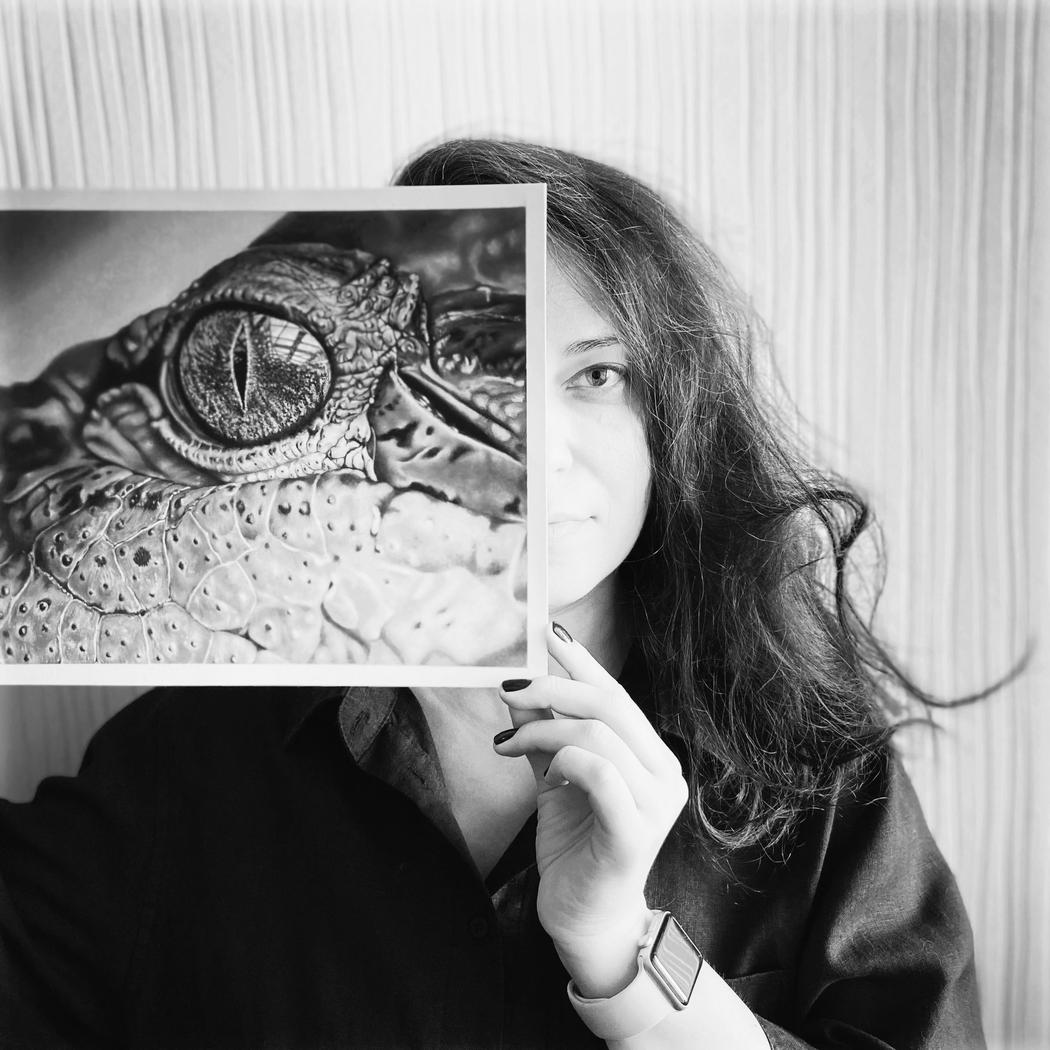
Your works balance botanical accuracy with emotional and poetic expression. How do you personally define this balance in your practice?
Personally, I prefer not to draw an object that doesn’t have any idea or reference behind it. Because I truly believe there is a story behind each interesting project and drawing is a good tool to get visualized what is hidden behind. Not to sound self-praising when it comes to picking up a drawing object I almost always see it either in the shape of a recognizable creature, or as a reference to different notions that appeal to people’s emotions. For instance, in the particular shape of petals, directions of branches or leaves I can spot the concept of love, friendship, or them conducting some social message, i.e. visualization of human loneliness inside urban jungle, teamwork, coupling and so on. Or a plant that visibly resembles a facial expression, movement or action. Or an existing animal or insect, or even mythological creature. But botanical or animalistic accuracy is crucial, since my drawing technique is realistic and detailed, there is no room for a mistake here.
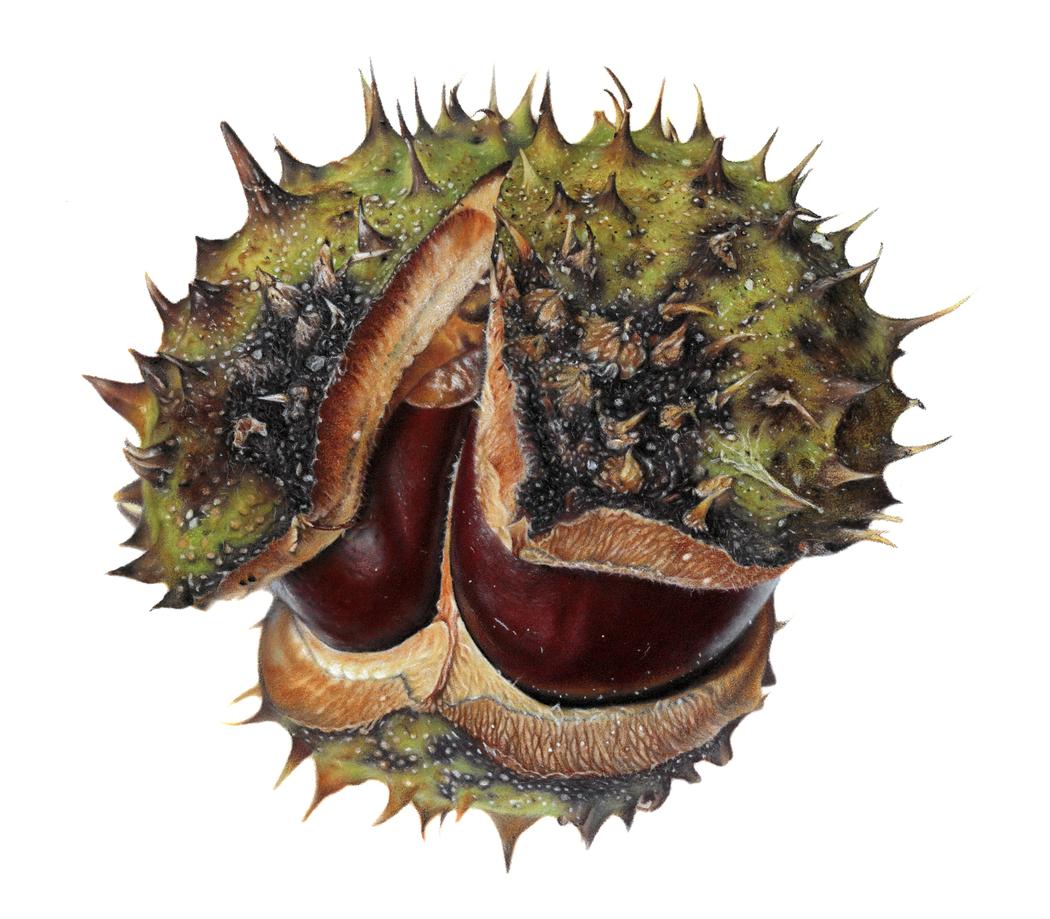 Inna Chesniuk | Chestnut | 2025
You often focus on imperfections, textures, and complex plant structures. What attracts you to these “non-ideal” details in nature?
I believe my dedication to focusing on “non-ideal’ detail in nature has been shaped by the impact of Japanese beauty appreciation , since one of my majors at university was Japanese culture, art and literature. As you probably know, such an approach is deeply rooted in a worldview that emphasizes harmony, imperfection and impermanence. The idea is to find beauty in its fleeting, natural state. Moreover, I treat these visual imperfections not as disadvantage but as potential to reveal the character of an object. Everybody is able to appreciate a visually ideal object, it is easy to spot and to work with. But sometimes it happens there is no spice in that pure beauty, no character behind. Yeah it is nice, beautiful, might even be perfect and easy to like but, at the same time, plain and dull. This hidden complexity is what I’m usually focused on, and it makes me satisfied and happy when I can achieve the concept.
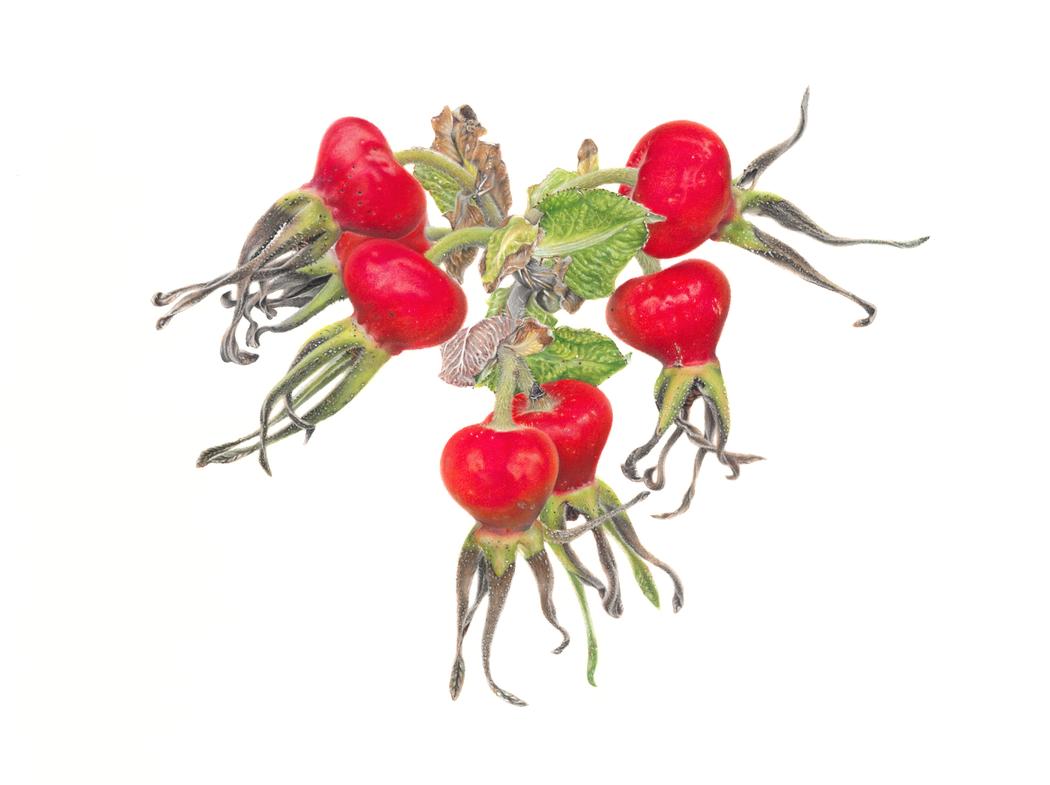 Inna Chesniuk | Dogrose heart | 2025
You work with colored pencils, pastel pencils, soft pastels, and mixed media. How do you decide which medium best suits a particular subject or story?
I have been constantly experimenting with different mediums, pigments and drawing surfaces. Some experiments have been quite successful, some not as such. But this practical knowledge usually helps to distinguish which medium to use or which paper to give the preference to, because both your drawing experience and your intuition predict the outcome. Also, the particular choice of medium depends much on the drawing task given. For example, if I need to depict a highly detailed small scaled botanical object I know in advance I will need non-abrasive smooth paper and this or that set of pencils, because only this set of tools gives the needed visual representation. On occasion there had been no similar drawing experience, but you can still somehow feel the medium to choose, sort of subconscious choice.
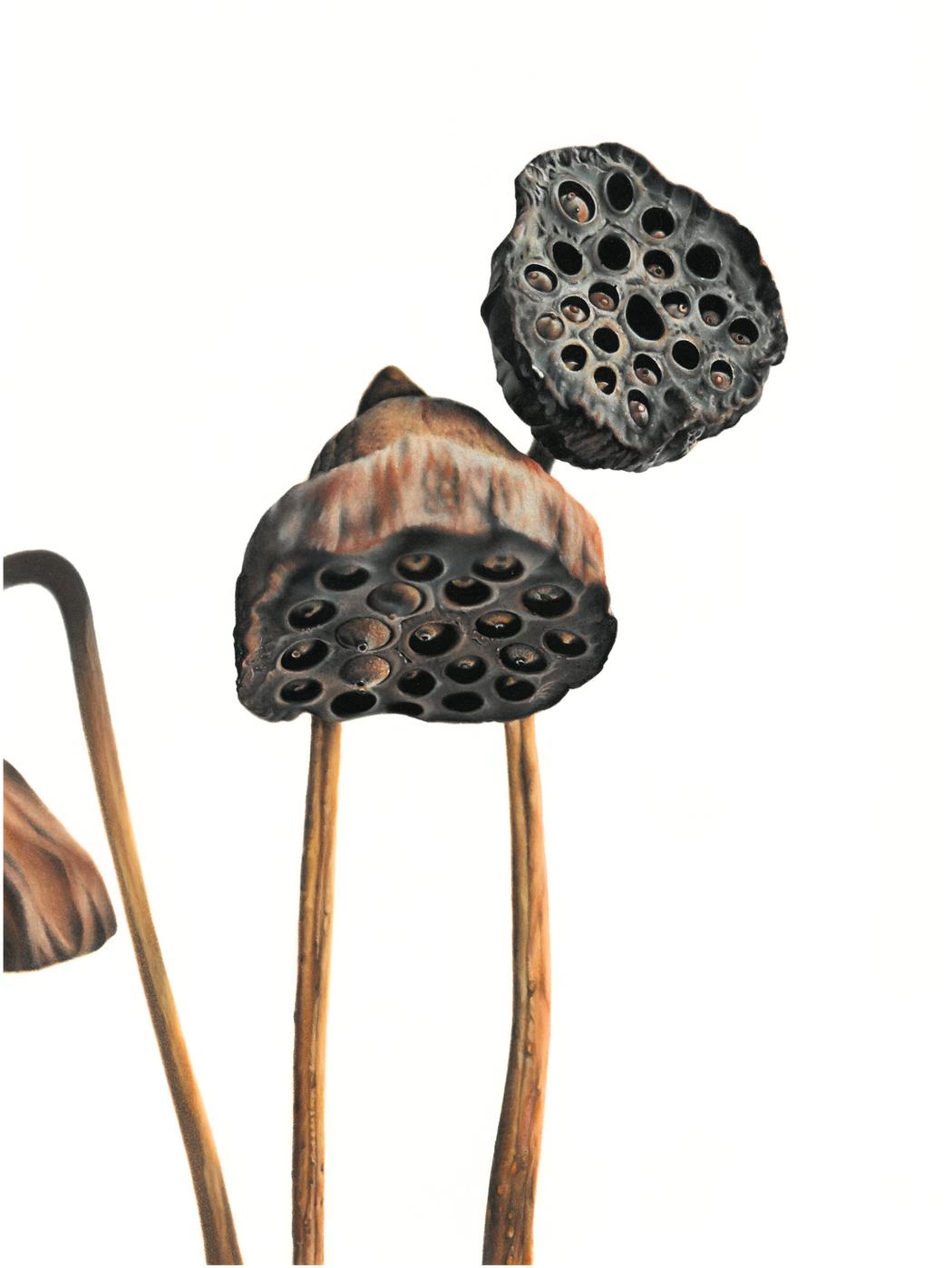 Inna Chesniuk | Dried lotus seedpods | 2025
Many of your works feel almost like portraits of plants. Do you approach botanical subjects in a similar way to portraying living characters?
Yes, of course. After having chosen the object I usually do pedantic and detailed research on the plant, study its structure, dimensions, characteristics, because it is always outstanding accuracy and recognizability that matters. Botanical accuracy is a key element of professional presentation, your representation must be accurate, consistent and technically sound.
Humor appears subtly in your art, even when the subject is fragile or melancholic. Why is humor important to you in botanical and wildlife art?
I highly appreciate a good sense of humor in all spheres of life, it is no doubt an essential life skill. Basically, it is a huge emotional, cognitive and social resource that helps individuals navigate the complexities of life. I believe it stirs non-liner thinking, mirroring cognitive processes of creative thinking. Adding a subtle pinch of humor into art I think helps to build an emotional bond of a spectator and a drawn story told. All our memories of something good or bad happened are mostly about emotions, no matter if they are positive or negative. So, a drawing that has a line of humor implemented becomes sort of an intelligent companion, like a good book, who doesn’t judge you but tells a story you might find touching and appealing to your inner world.
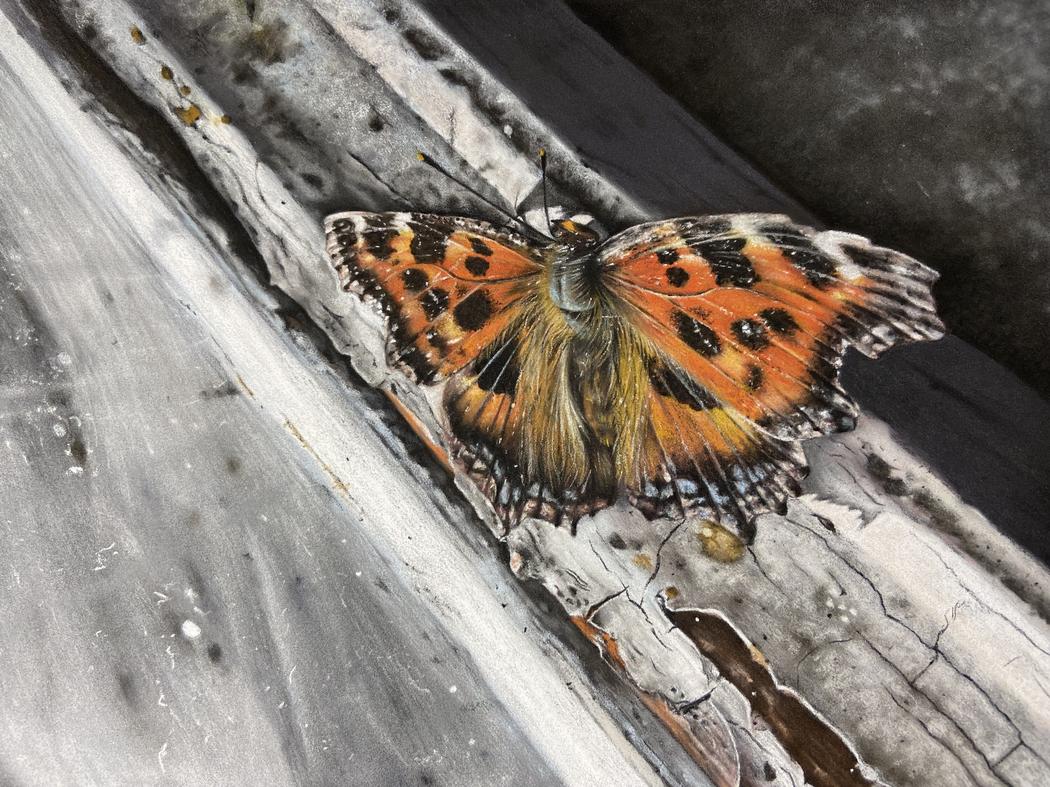 Inna Chesniuk | Fragile beauty | 2023
Your practice combines scientific accuracy with storytelling. How much research goes into a single artwork before you begin drawing?
I would say it mostly happens vice versa, the way an artwork lines up with the story. Sometimes I have a subject I am thinking about, or a situation/ case that had had an impact on me, not having the concrete idea of visual representation. And then I suddenly bump into a plant, an animal or insect, or even a still life scene, and get a strike – this is it! This is exactly what I have been thinking about, have read or watched. And you dress your idea up in a visual realistic object. Or sometimes it happens in totally the opposite way – you spot the object and it clicks ang brings up a line of memories, emotions or background information, and you know exactly what kind of story you are going to tell. But, if there is a custom artwork related to a particular topic, I usually do thorough research to get acquainted with it as much as I can, to see it from different angles.
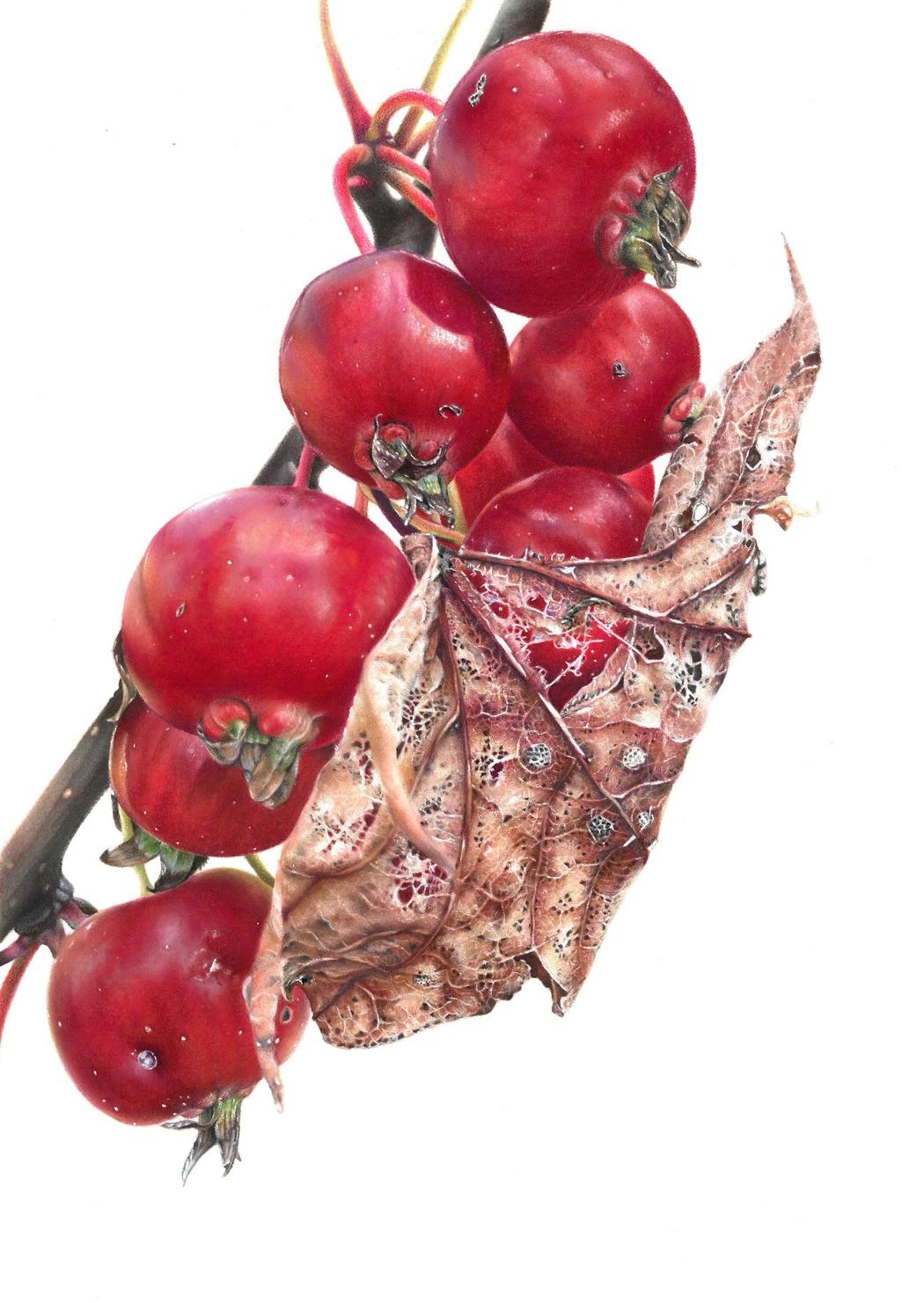 Inna Chesniuk | Malus Paradise | 2025
What do you hope viewers feel or discover when they spend time with your artworks?
I genuinely hope my art can draw people’s attention towards nature’s beauty and uniqueness, bringing up good personal memories and positive emotions. Some people might like technical skills, some might admire creativity or meticulousness that lies behind each work performed, some get surprised when they discover the artworks are human made drawings. Quite often I hear feedback that my art inspired people to start drawing with pencils, and it makes me really happy, because being able to create or comprehend art enriches you significantly, makes you kinder, wiser and more thoughtful.
Leave a Reply
You must be logged in to post a comment.