
Ivanna Swan
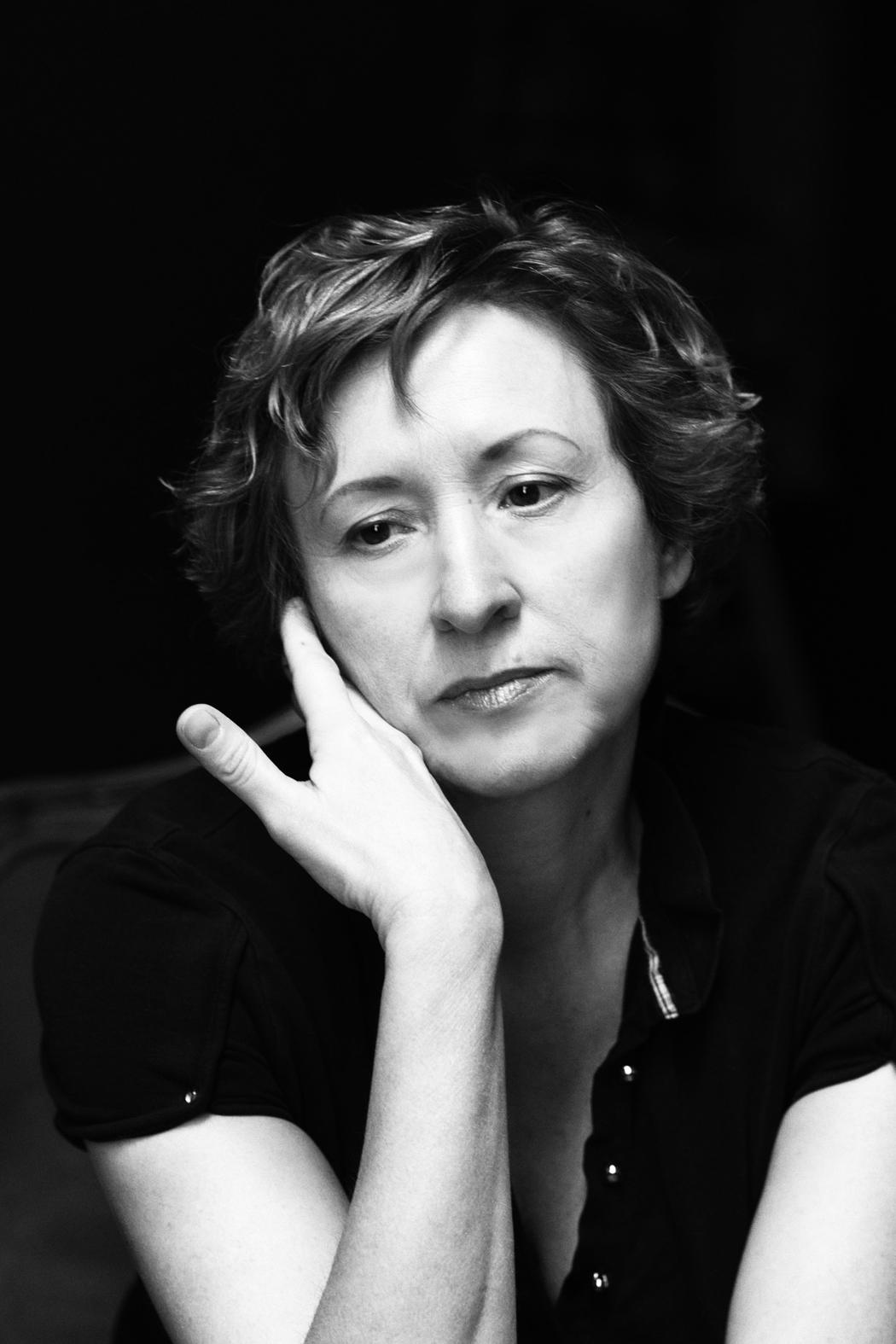
Your works portray not musicians themselves, but their “breath” and inner resonance. How do you translate a sound or feeling into a visual form?
I am a musician who never quite became one; I play a little on different instruments, enough to feel their breath. Music fills my home for two-thirds of every day. And when it is not coming from the speakers, it sounds within me — constant, insistent, alive. This inner sound is what I carry onto the canvas. I paint while listening to music; what I hear is exactly what appears on the surface. This is not a metaphor — this is my process.
I listen to a great deal of classical music and instrumental jazz. The works from my “Musical Mosaic” series were created under Piazzolla — his sharp, contrasting harmonies, his polyrhythms, the sudden bursts of expressive intensity. Yet behind it all stands a human being, a composer — there is always a “conduit” who leads us into the intricate world of music. My graphic pieces were shaped by Paganini’s “Caprice No. 24 in A minor, Op. 1,” with its dramatic flare, its urgency, its vivid emotional charge.
Lately I find myself immersed in melodic instrumental jazz — Tord Gustavsen Trio from Norway, the Swedish Bobo Stenson Trio, Aldo Romano, Lars Danielsson, Etta James. Thoughtful, beautifully crafted jazz. They are masters of contemporary European sound, with a profound sensitivity to atmosphere, weaving melancholy with hope, reflection with warmth. Within their music live both emotional intensity and a contemplative, human tenderness.
When did you first realize that music and visual art merge into a single language for you?
For as long as I can remember, I have been drawing music — even as a child, my hand instinctively reached for lines and contours. Music has always lived within me, and giving it shape on paper felt less like a choice and more like a necessity.
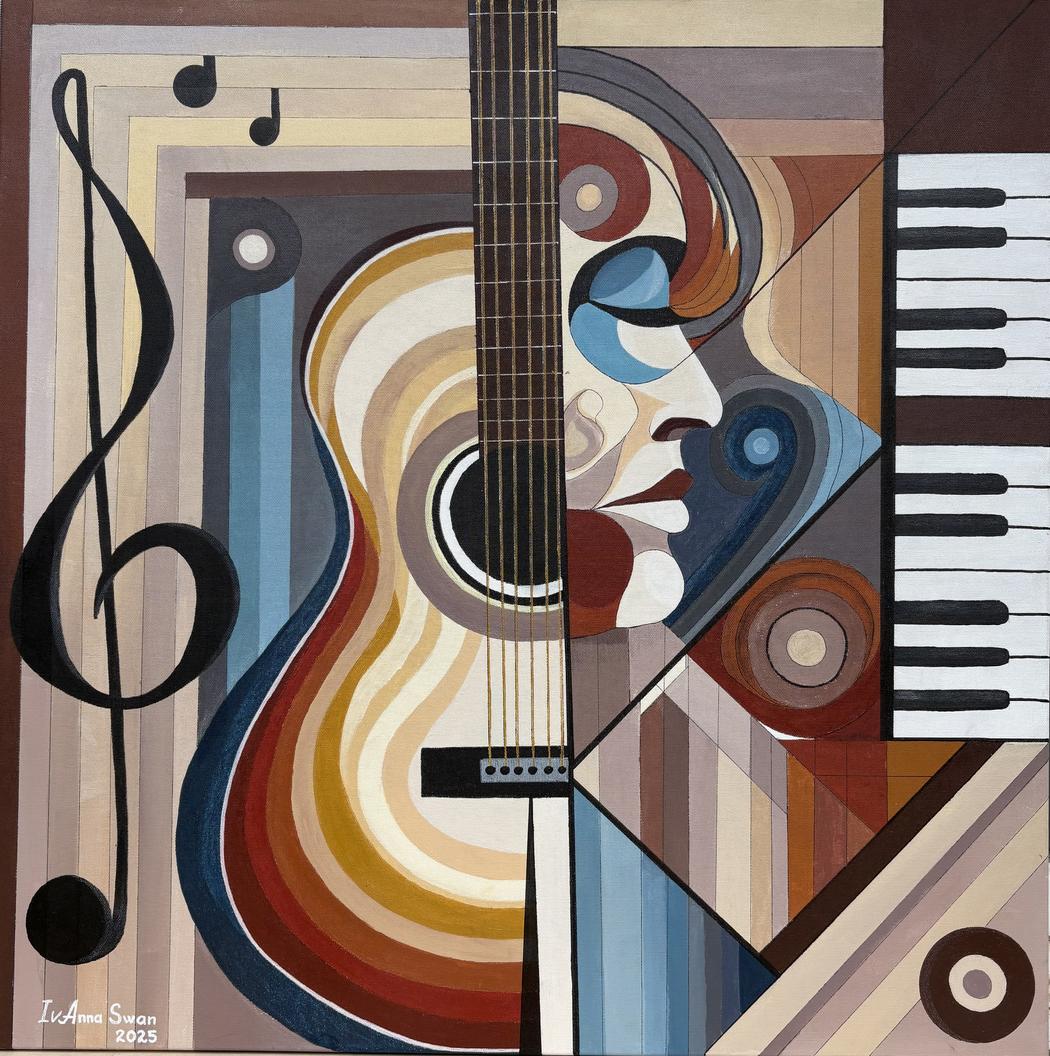 Ivanna Swan | The Sound Within | 2025
Your compositions combine geometry, abstraction, and figurative elements. How do you build the structure of a painting before you begin?
I never consciously plan the structure. The image of a painting appears in my mind first, fully formed. I work quickly; each piece is created in a brief, concentrated burst. I simply transfer the sketch from my inner vision onto the surface of the canvas. Along the way, certain details may shift or evolve, but these changes are minor — the essence of the work is already there from the very beginning.
Many of your artworks show only fragments of the human face. Why do you choose to portray the musician through essence rather than a full figure?
Yes, in all the works from my musical series there is always a stylized face or an eye — a subtle guide into the musical realm. An instrument, by itself, is silent; without a human being it remains lifeless. In each painting, the instrument is rendered in strict, almost architectural geometry and occupies one half of the composition. The other half belongs to a stylized human presence — a face, an eye, a fragment of a profile. On this “human side” we see the full turbulence of musical imagination: emotion, intensity, even rebellion against conventional harmony. These two stylized entities — the instrument and the performer or composer — together make the painting begin to sound.
A guide into the world of music is essential, especially when the music is complex or demanding. Once I gave a lecture on classical music to a group of young people who had little connection to it. It was an introductory journey through the history of music, filled with examples and accompanied by my paintings. Six months later they wrote to tell me that their interest in classical music had grown markedly; they were listening more, understanding more. There is always someone who must lead us into the world of challenging music. That is why, in my paintings, there is always a reference to a human presence — a “conduit,” a bridge.
And there is something more. Many musicians I have known throughout my life are deeply solitary; people often say of them: “He lives in his own world, not quite of this one.” I see their vulnerability before the storms of fate, and how only the instrument becomes their shield, while the world of music becomes their refuge. Music offers a shelter — fragile and steadfast at once. I feel this within myself as well. This is what I express in my series “Musician and Loneliness.”
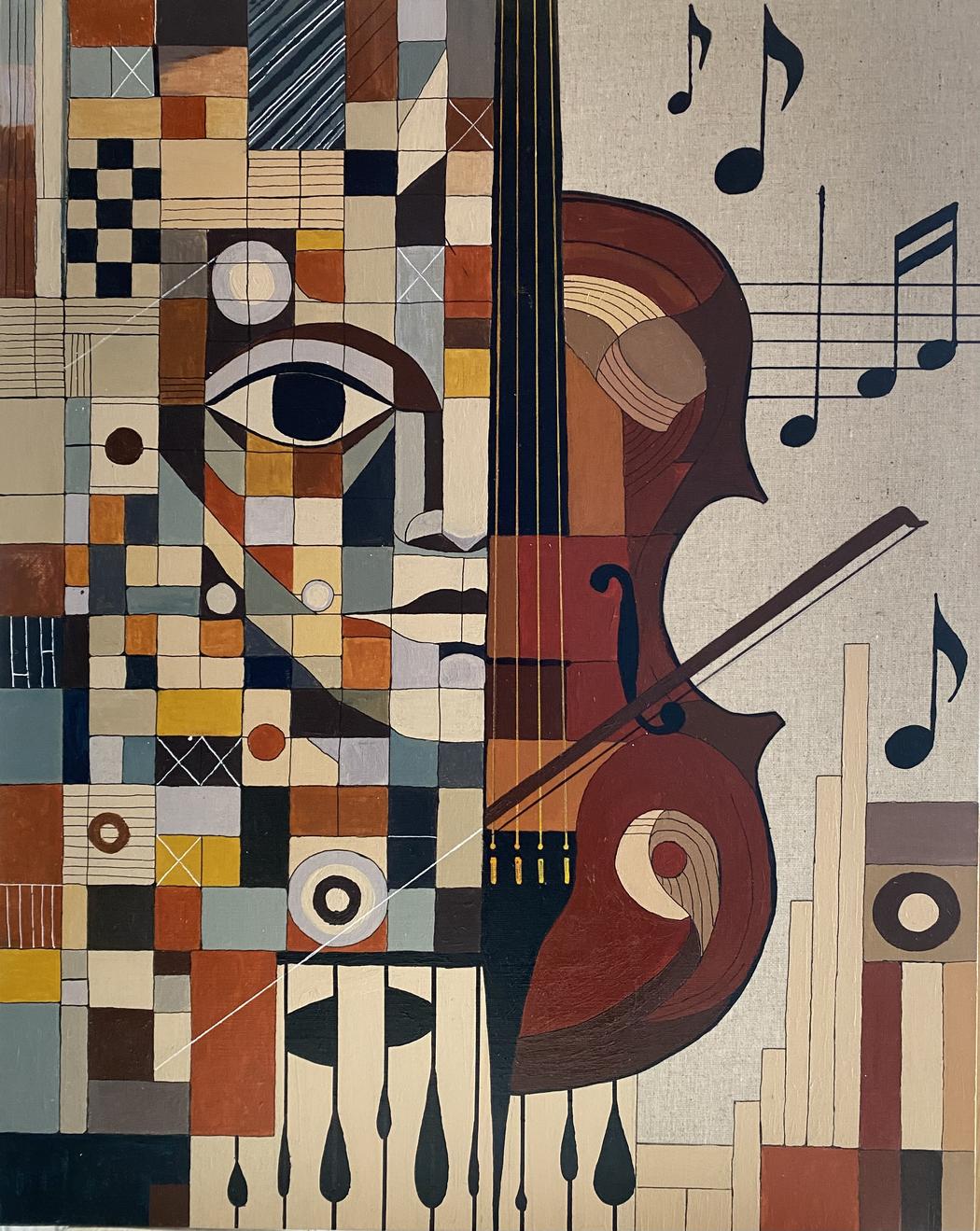 Ivanna Swan | Musical Mosaic With Cello | 2024
How does being a musician yourself influence the rhythm, harmony, and movement within your paintings?
I sense the rhythm and harmony of a painting long before I ever pick up a brush. Because I play different instruments myself, I understand how sound is born — from touch, from breath, from intention. This physical, embodied knowledge of music gives my lines their phrasing and my colors their inner dynamics. The rhythm of the strokes, the harmony of the color fields, and the movement within the composition are not invented on the canvas — they are translated. Painting, for me, is simply another language through which I let the music speak.
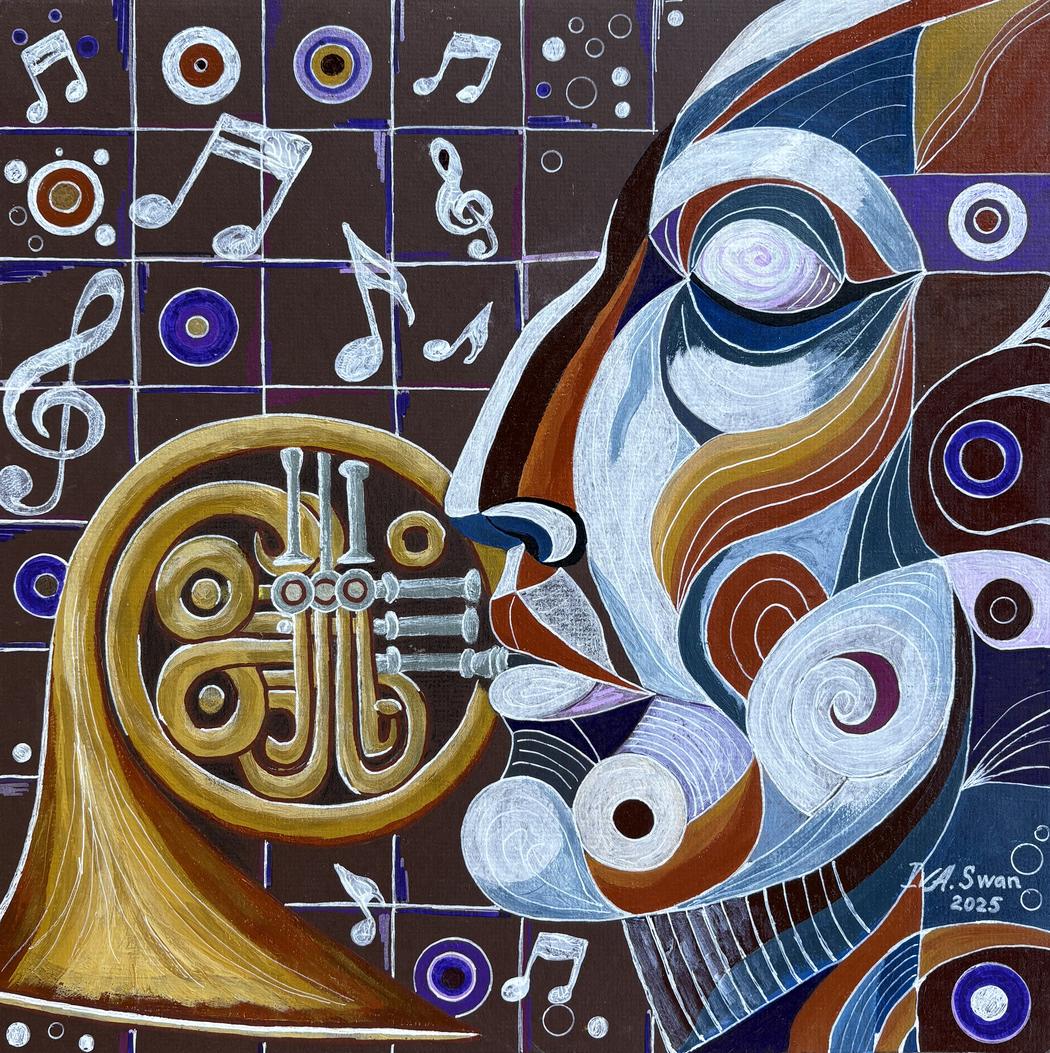 Ivanna Swan | Man With A French Horn | 2025
Instruments in your art feel alive — as if they “speak.” Do you imagine a specific sound or melody while creating each piece?
Yes. For each painting I create, I hear and remember a specific melody by a particular composer or performer. The instruments in my works feel alive because there is always a human presence beside them — with their emotion, their uniqueness, their inner state, whether it is trembling, solitude, or quiet sadness. This tension passes first into the wooden body of the instrument, then onto the canvas, and from there it reaches the viewer.
How has living and working in Antalya influenced your artistic process and themes?
Living in Antalya has allowed me to paint often and freely. The climate is gentle, the nature here is beautiful and calming. I walk the Lycian Way frequently, listening to music through my headphones — and those walks inspire me deeply.
Leave a Reply
You must be logged in to post a comment.