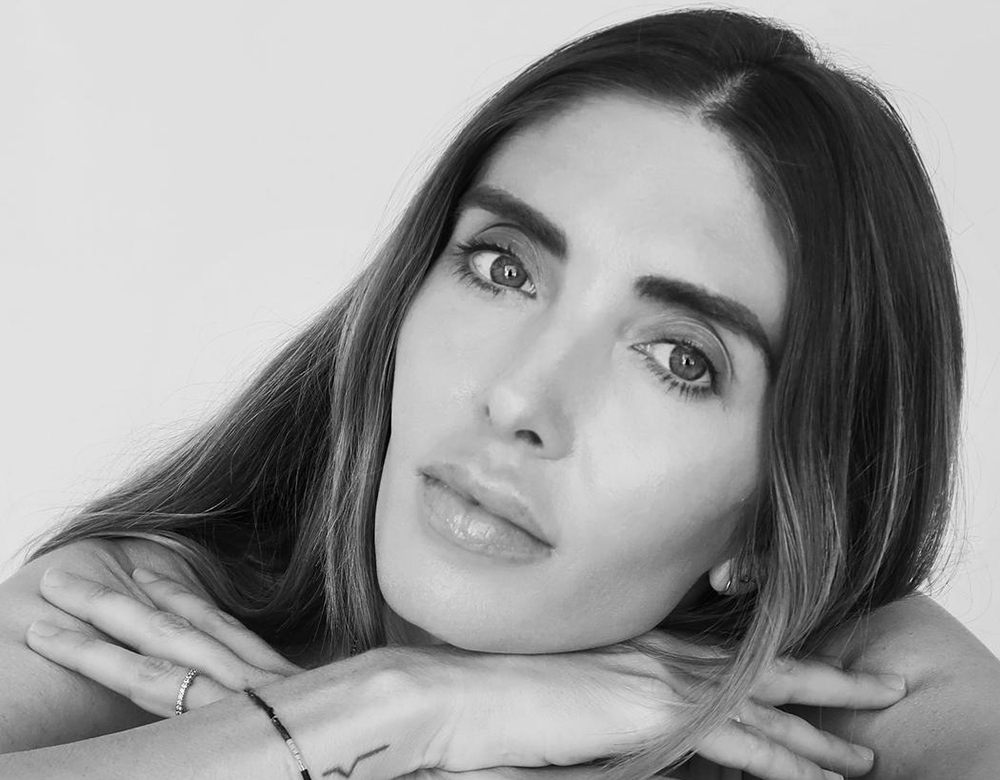
Donghyun Kim / Kaksu (김동현 / 각수)
Looking at your submitted works, what recurring images or ideas tie them together? Does each piece tell an individual story?
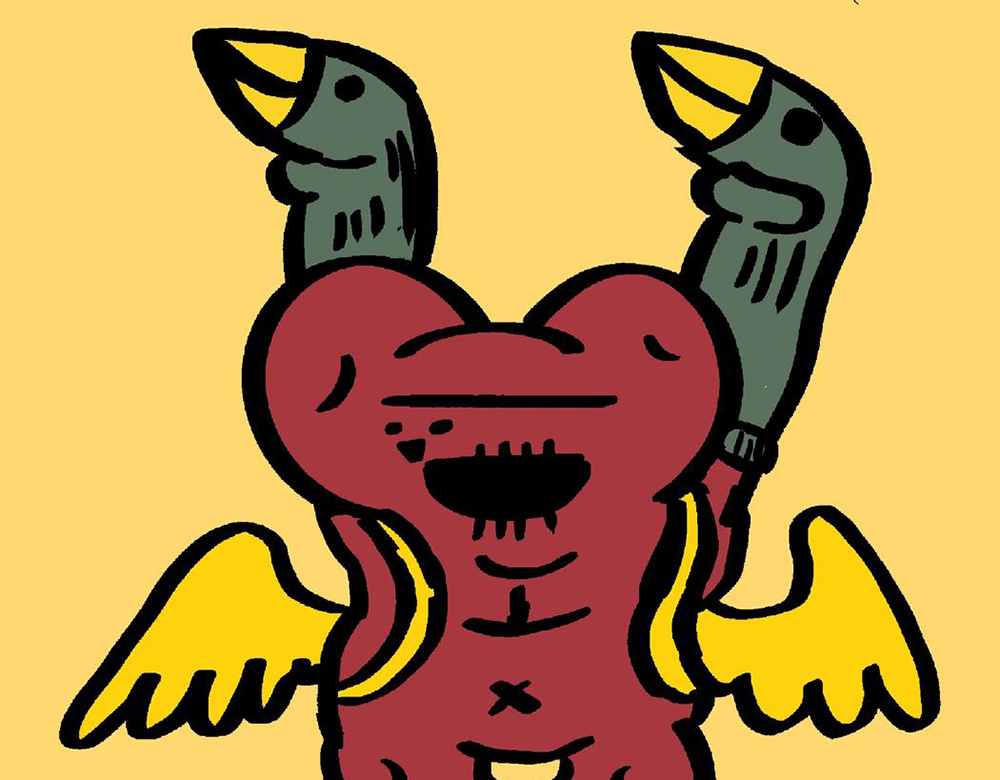
My work primarily captures the polished facade of the city overlaid with cartoon graphics. Rather than focusing strictly on narrative continuity across pieces, they evolve through my mascot, “Myeol-mang” (Collapse). The work visually conveys an emptiness beneath the surface—a cynical reality contrasting with vibrant aesthetics. Through this inhuman character displaying very human emotions (sometimes playful, happy, or sorrowful), I aim to communicate these contrasts through a comic, visual language.
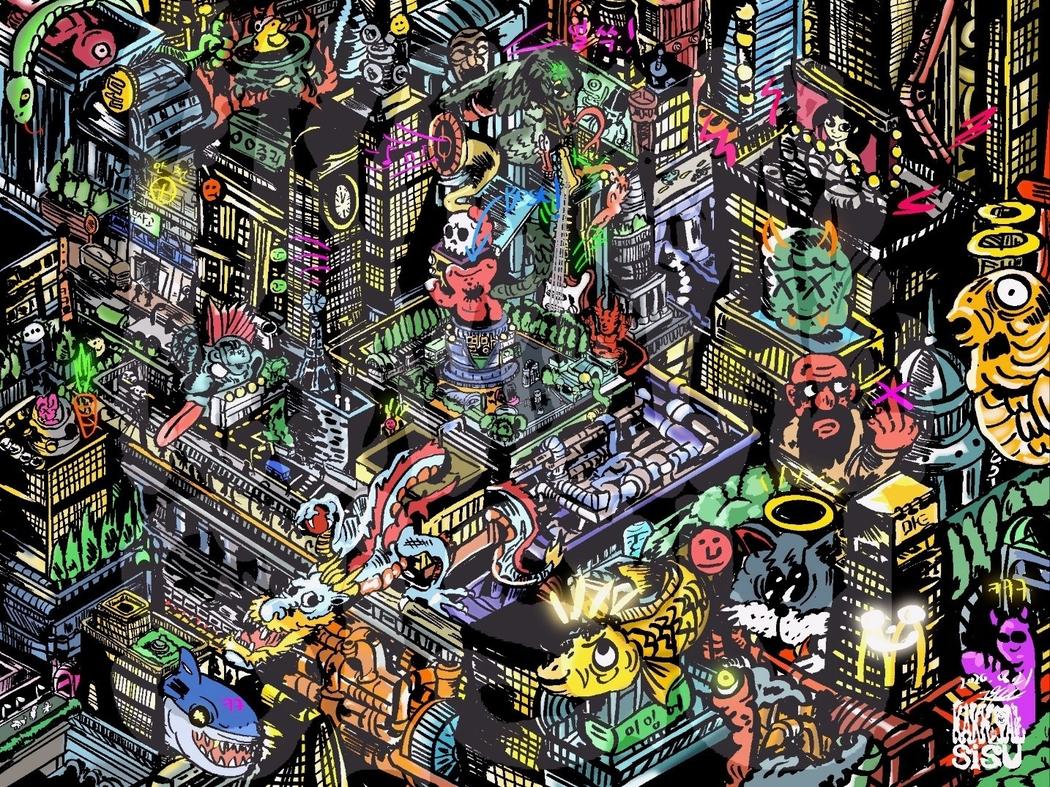 Donghyun Kim / Kaksu (김동현 / 각수) | Dopamine City | 2026
You draw directly without preliminary sketches. How do you decide where to make the first mark, and how do you determine when a detail-heavy piece is finished?
I usually place the first stroke in the center. Once the canvas is filled and it matches about 70% of the mental image I envisioned, I consider it complete. From that point on, I finish the piece through spontaneous adjustments and improvisation.
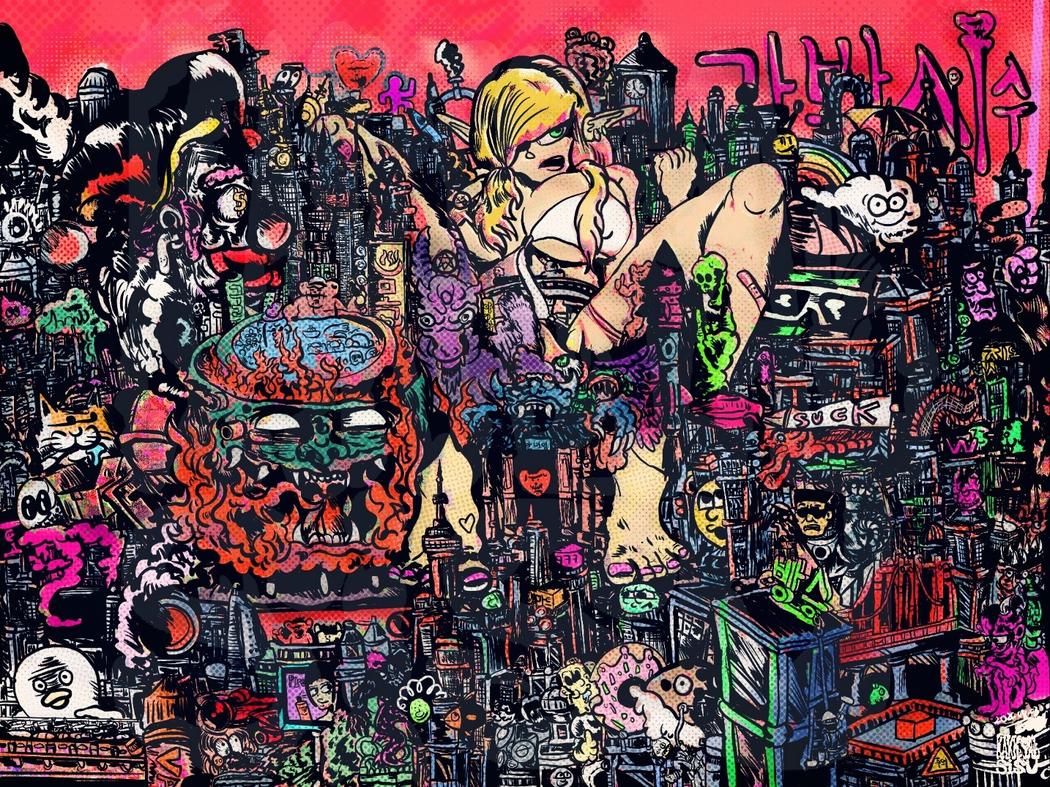 Donghyun Kim / Kaksu (김동현 / 각수) | Dopamine City | 2026
What draws you to fine pen lines and printmaking? How does each medium allow you to express what the other cannot?
Each medium has its own distinct personality. Line work offers a tactile catharsis as the pen traces the texture of the paper. It functions like a mental detox—similar to how companies brainstorm or mind-map when developing products, I organize my mind by continuously translating keywords into drawings. On the other hand, printmaking connects to my background working in print shops and advertising output labs; it allows me to explore color, various effects, and mixed techniques. While I sometimes combine or invert these approaches, my standard workflow starts with digital drawing, followed by digital fine art printing.
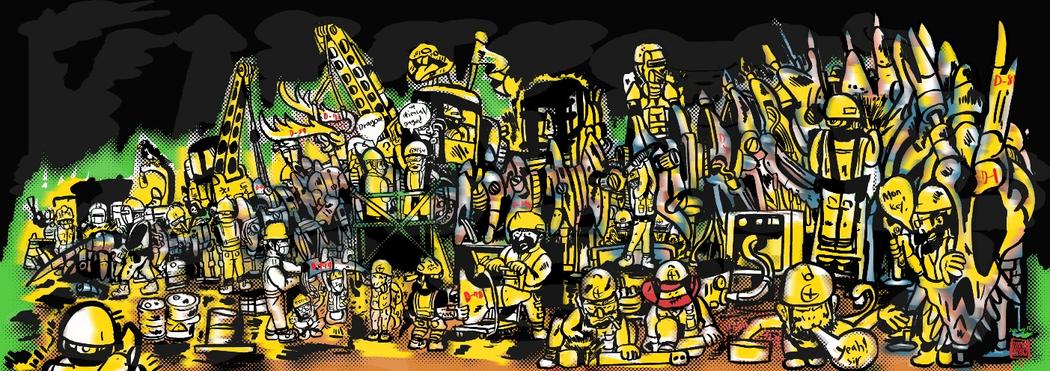 Donghyun Kim / Kaksu (김동현 / 각수) | Create A Dragon | 2026
How was “Myeol-mang” (Collapse) born? Does this alter-ego character reveal emotions that are difficult to express directly?
I conceived this character around 2025, during a period when I had put down drawing to work as a field laborer. Towards the end of 2024, facing layoffs, livelihood struggles, and a sense of failure in self-actualization, several challenges compounded, leading me to step away from art. From 2025 onward, I worked as a site assistant across stage production, construction, and civil engineering sites, aiming to become an industrial safety manager. Now in 2026, I balance that work while resuming my artistic career, having entered my 30s.
This character reflects my unstable 20s—entering society without knowing what I liked or was good at, remaining an overgrown child unable to fit in or find a footing. While others spoke of dreams, hope, honor, and wealth, I possessed none of those things. “Myeol-mang” was born from looking back at my alienated self and the cold judgments of others.
The emotion behind this character stems from the younger self who felt completely defeated, thinking, “I can’t even do this; I’m ruined!”—even though life wasn’t truly over. In English, “Myeol-mang” translates to “Collapse,” making him something like “Mr. Collapse.” Through him, I want to share a message: even when it feels like the absolute lowest point and the future remains uncertain, you still have to keep moving forward. I channel unfiltered, borderline manic thoughts—whether anger, pain, sorrow, or transcendent joy, laughter, and love. The interpretation is left entirely to the viewer.
Your work features grotesque forms and cartoonish imagery alongside themes of rage, loss, and pain. What does this visual language convey about enduring hardship?
To explain this, I have to share a personal story. Life hasn’t always been easy. During my school years, I struggled to fit in—I was an eccentric “nerd” who couldn’t easily relate to others or find empathy.
In my 20s, I took on countless jobs: convenience store clerk, kitchen assistant, assistant curator, library aide, print shop employee, advertising agency worker, and on-site laborer. Because I hadn’t pursued higher education seriously at the time, I faced the world with bare hands, which bred intense frustration and anger. Lacking maturity, I couldn’t even identify the causes behind my fractured relationships. Feeling like an overgrown child while peers settled down and my parents aged, I shrank into myself, learning not to expect much.
Then, in March of this year, I suffered an on-site accident where tendons and muscle in my right wrist (my dominant hand) were severed. All my suppressed emotions erupted: the sheer terror that all my hard work had cost me my hand and the ability to draw forever.
Yet, while that pain, anger, and despair coursed through my veins, I realized during rehabilitation and recovery that once it reaches the heart, it can bloom into love and laughter. I picked up drawing again. Reconciling past misunderstandings with my family through forgiveness and trust, alongside the unwavering support and love of my partner, showed me that nothing lasts forever. Even if the process begins in rage, the destination can be love. A cartoon style felt like the right medium to capture this journey—shaped by the visual language of Cartoon Network, Nickelodeon, Marvel, DC Comics, and video games,animation,and cartoons I grew up with.
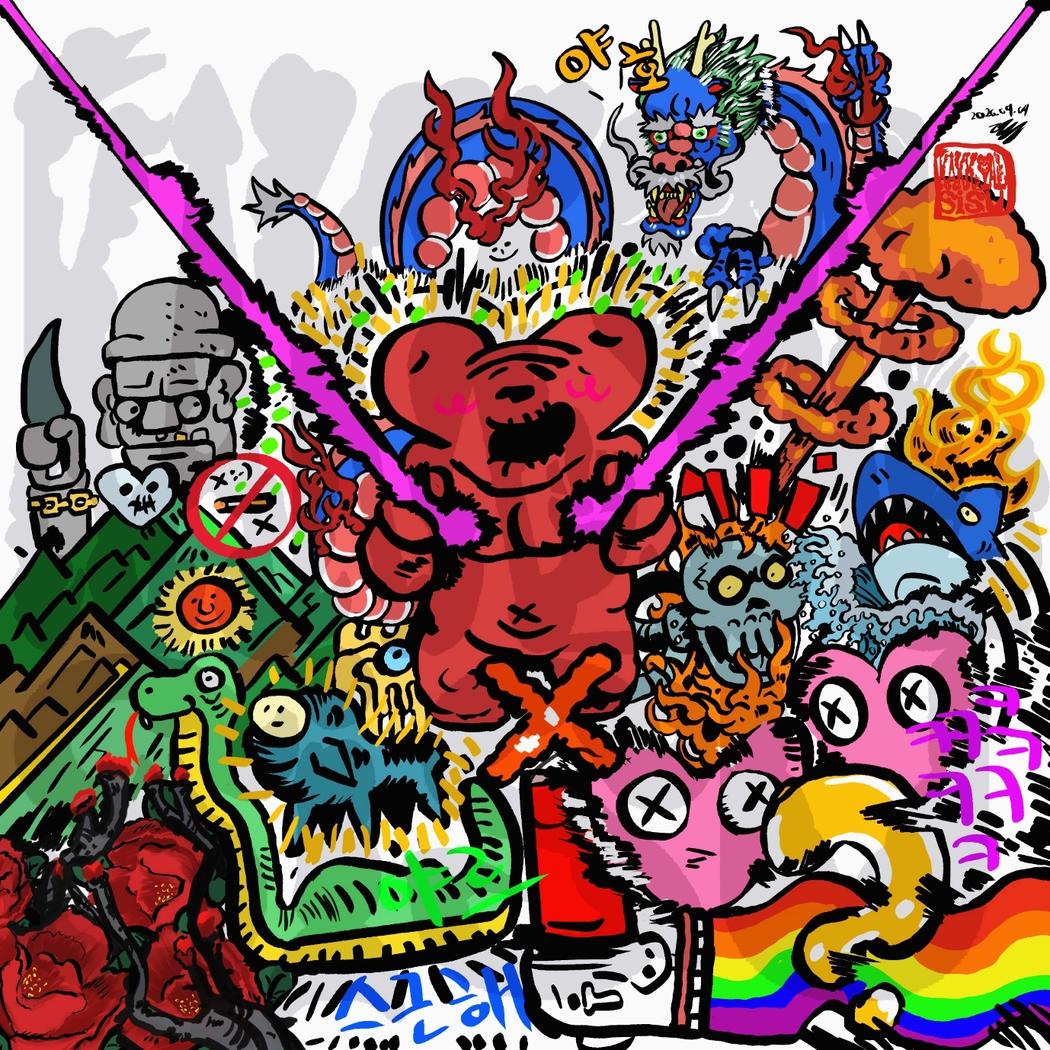 Donghyun Kim / Kaksu (김동현 / 각수) | Nipple Beam | 2026
You hope viewers find catharsis in your work. Have you had any particularly memorable reactions or moments of realization?
Yes, that’s true. When I tell people that I draw directly without sketches or that images simply project themselves before my eyes, the typical reaction is, “You’re out of your mind; go see a psychiatrist.” Sometimes I wonder, “Do I see the world so differently from everyone else? Am I a monster or crazy?” But when people look at my completed drawings and react with, “Oh, that’s funny,” “That’s so interesting,” or “That looks awesome,” I realize: maybe I’m not that crazy after all.