
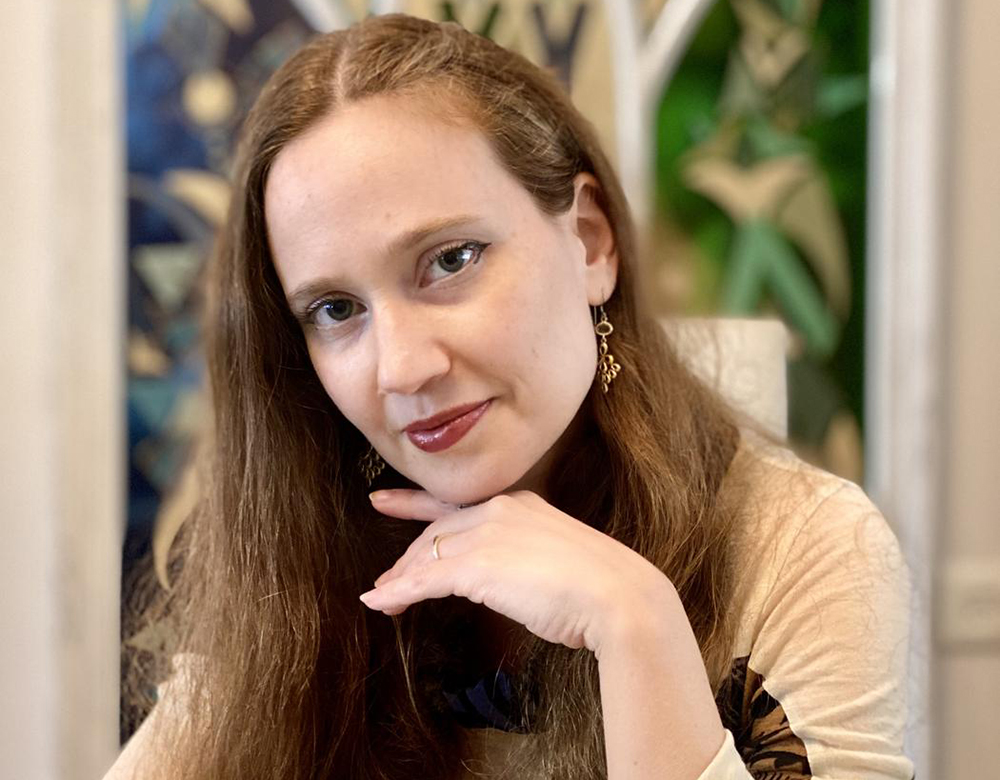
Noa Reichenberg
Your practice moves between visual art, photography, and poetry. How did this interdisciplinary path develop, and what first led you to begin working with mirrors?
I began working with mirrors many years ago, when I was walking down the street and came across a discarded mirror just lying there. It made me wonder about using it as a surface for an artwork instead of, for example, a canvas. I was intrigued by its unique qualities, particularly its reflectiveness. I thought about how this could allow the artwork to engage with its surroundings and especially with the person standing in front of it.
I began experimenting with different materials and techniques, initially using discarded mirrors I found and later buying and collecting mirrors that I was drawn to because of their particular shape or frame. I also love that many of the mirrors I work with are second-hand and come with a history of their own. There is something meaningful to me about giving them another life by transforming them into artworks.
My work with mirrors came first, and photography and poetry became part of my practice later on. Each gives me a different way of expressing myself, but they are all connected by questions that keep coming back in my work: what is present but unseen, what we reveal, and what we conceal. My poetry sometimes connects directly with my work on mirrors, while at other times it stands on its own. Through poetry, I feel I can reveal and expose parts of myself in a more direct way.
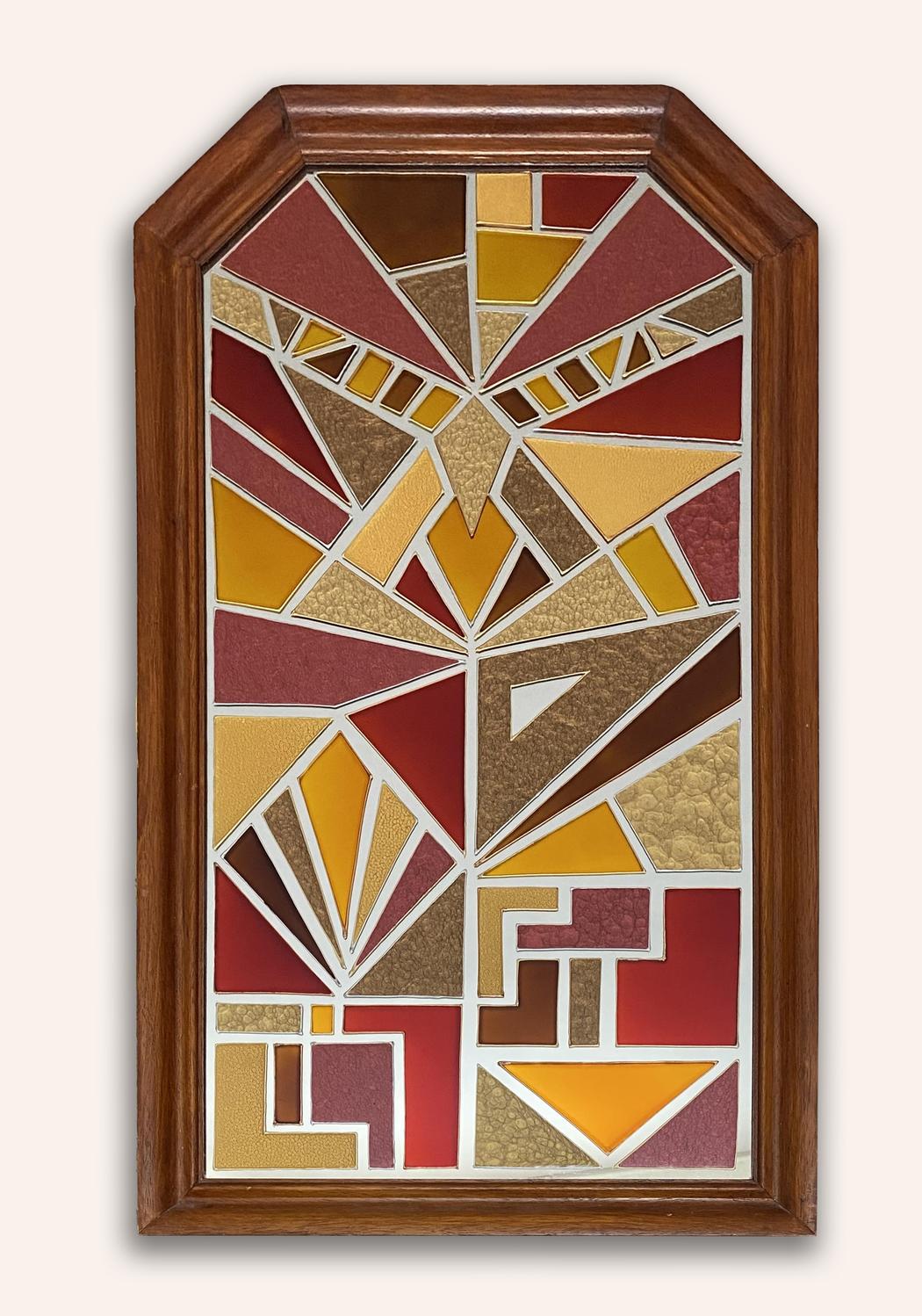 Noa Reichenberg | My Quilted Blanket | 2023
In your work, the mirror is not simply a surface but an active element that reflects the viewer and the surrounding space. What does this participation add to the meaning of the artwork?
I believe that art should move something inside you: both when you create it and when you experience it as a viewer. Through the use of mirrors, my work allows the viewer to become part of the artwork, changing it while also being changed by it. Each encounter is unique, and each time someone stands in front of one of my works, something different is seen.
The gaze moves both inward and outward. Seeing oneself fragmented through the abstract geometric forms and the exposed areas of the mirror can turn the act of looking into an act of self-reflection. It raises questions about the parts of ourselves we choose to reveal, what we conceal, and perhaps what we are unable or unwilling to see.
How do you decide which areas of the mirror to cover and which to leave exposed? Is this balance connected to your exploration of concealment and revelation?
Definitely. I think something always remains hidden. Each time we go out into the world, we allow certain parts of ourselves to be seen, while guarding or concealing other parts.
When I begin working on a mirror, I usually start with a sketch on paper, considering the shapes, their movement, the symmetry or asymmetry, and giving particular thought to which areas will be painted with reflective colors, which with opaque colors, and how much of the mirror itself will remain exposed. In my earlier works, I painted the entire mirror, allowing the viewer “into” the artwork only through areas painted with reflective colors rather than through the exposed mirror itself. It took me some time to realize that absence also has a presence.
I believe that when we reveal certain parts of ourselves, what is shown can also trace the outlines of what remains hidden. Those outlines can hint at the extent of what lies concealed beneath them. Something similar happens in my art: sometimes the painted forms reveal new shapes through the exposed spaces between them and along their edges, while at other times there is an emptiness within what appears full. These spaces allow the work to breathe. There’s no room to breathe without some emptiness within the fullness.
For me, it comes back to questions about what we see: in others, in ourselves, and in art. We always bring something of ourselves into the way we see things; our emotions, experiences, and perspectives inevitably “paint” what we see. Yet something always escapes the gaze. Parts of ourselves always remain hidden, sometimes by choice, and sometimes we hide them even from ourselves.
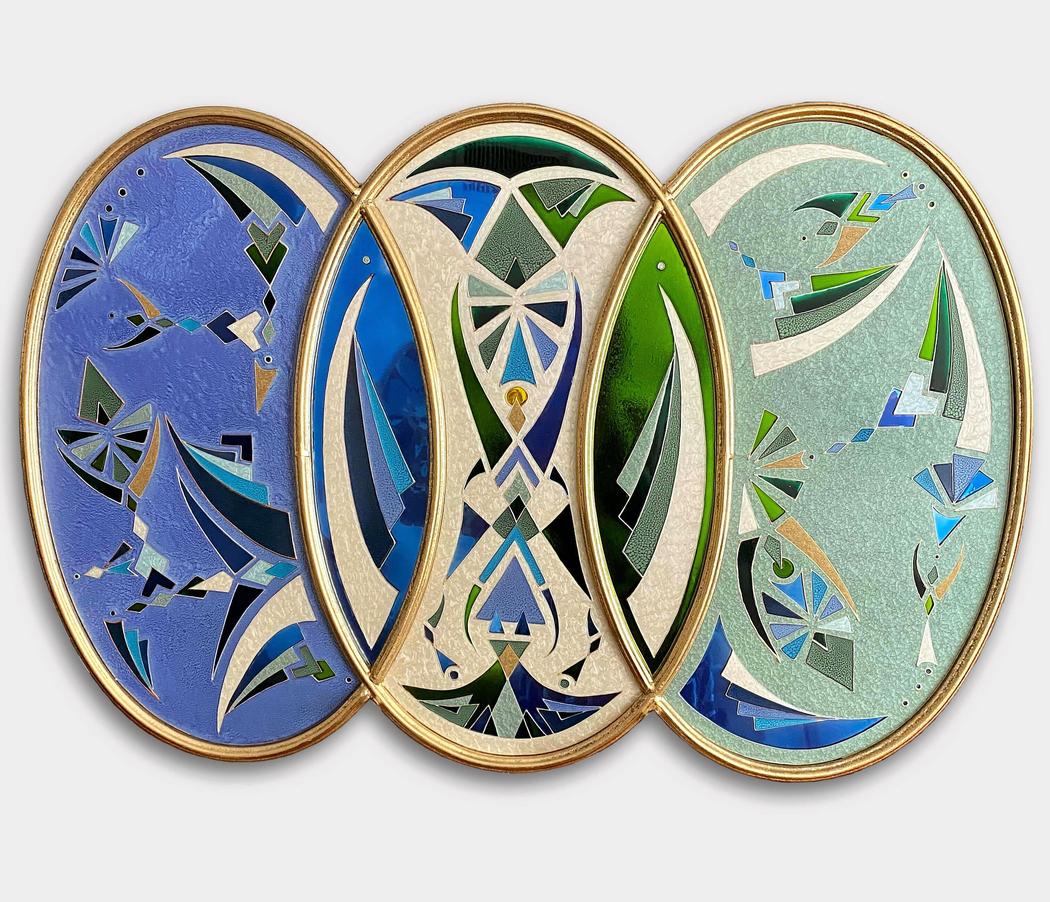 Noa Reichenberg | For Heaven’s Sake | 2020
You studied both art and philosophy at Tel Aviv University. How has your philosophical background shaped the questions you explore through abstraction, identity, and perception?
My philosophy studies definitely shaped the way I think, question, and challenge assumptions, both in life and through my art. The primary focus of my MA studies was the metaphysics of emotions, which was also the subject of my thesis. My art resonates with questions that have long interested me: the ideas that perception is never neutral or detached, and that our understanding of ourselves is shaped in relation to others. Thinkers such as Merleau-Ponty, through his understanding of perception as embodied and inseparable from our presence in the world, and Levinas, through his exploration of the relationship between the self and the Other, offer philosophical perspectives that echo some of the questions I explore in my art.
I engage with themes of identity, perception, concealment and revelation, and the relationship between inner and outer realities. The mirror presents an external image of the self while simultaneously becoming part of a subjective act of perception. As the viewer’s reflection enters the work, it is fragmented by the composition and becomes part of the artwork itself. This raises questions about the relationship between appearance and identity, between how we see ourselves and how we are seen by others, and what always remains hidden, escaping the gaze.
Your compositions combine carefully structured geometric forms with the fluid and unpredictable movement of alcohol inks. How do you negotiate the relationship between control and chance in your creative process?
Each represents a very different creative process. The geometric forms I create with relief outliners are carefully placed and require the utmost precision. I have full control over this part of the process and tend not to stop until everything is exactly where and how I want it to be. Alcohol inks, on the other hand, force me to relinquish some of that control, to accept that certain things are better left as they are, and to allow myself to be surprised by the outcome. The inks themselves influence the composition: the way they flow, spread and interact.
I believe it’s important to explore different creative processes: how they feel, what they demand of me, and what aspects of myself they reveal, both as an artist and as a person. In a way, they allow me to move between the need to shape and control an image and the willingness to let something unexpected emerge.
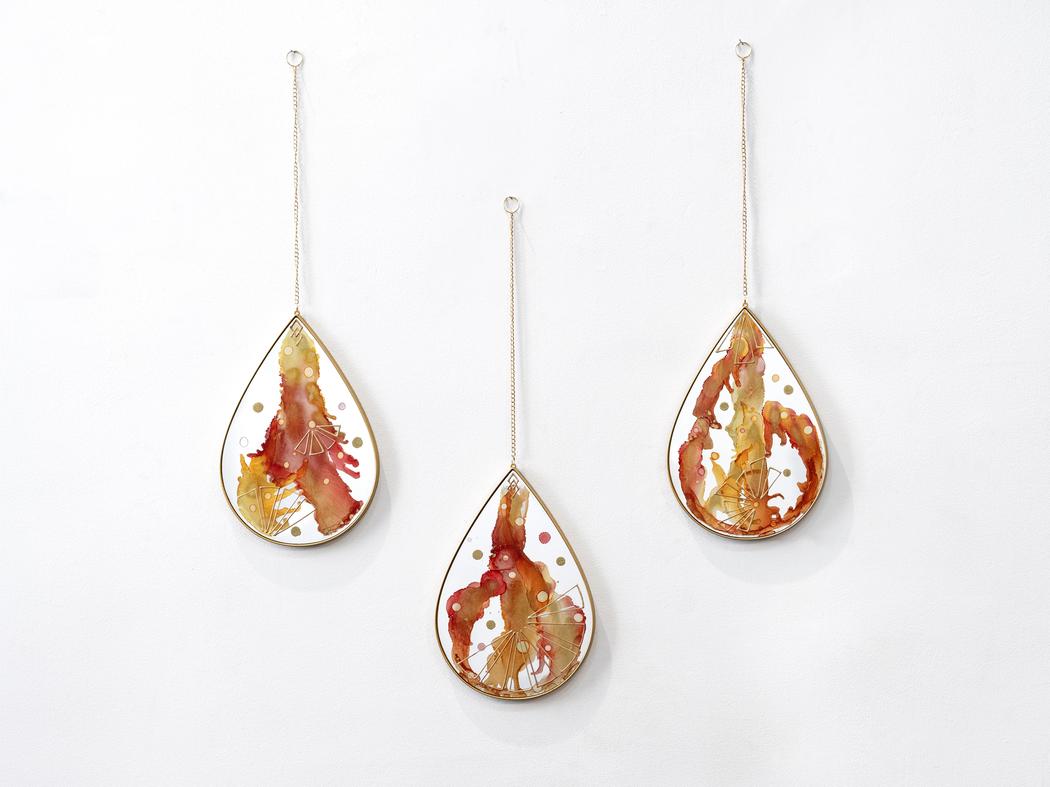 Noa Reichenberg | Fire Drops | 2023 | photo by Carmit Hassine
Many of your works recall stained glass, jewellery, mosaics, and architectural ornament while remaining distinctly contemporary. Which visual traditions or cultural references have been most significant to your artistic vocabulary?
Some of my pieces contain subtle references to Art Nouveau. My work also recalls stained glass, but from a different perspective and through a contrasting process. In stained glass, separate pieces of glass are joined together, whereas in my work the mirror remains intact and serves as the surface on which I create the composition using my own technique. There’s also an interesting contrast in the role of light. Stained glass traditionally depends on light passing through it, historically often associated with divine light. My works, on the other hand, use the light of the room or gallery. In that sense, the light they engage with is secular and belongs to the immediate environment.
In my art, I take these references to older visual traditions and place them within a contemporary context, where qualities such as geometry, luminosity, and carefully defined areas of color coexist with reflection, perception, and the active presence of the viewer.
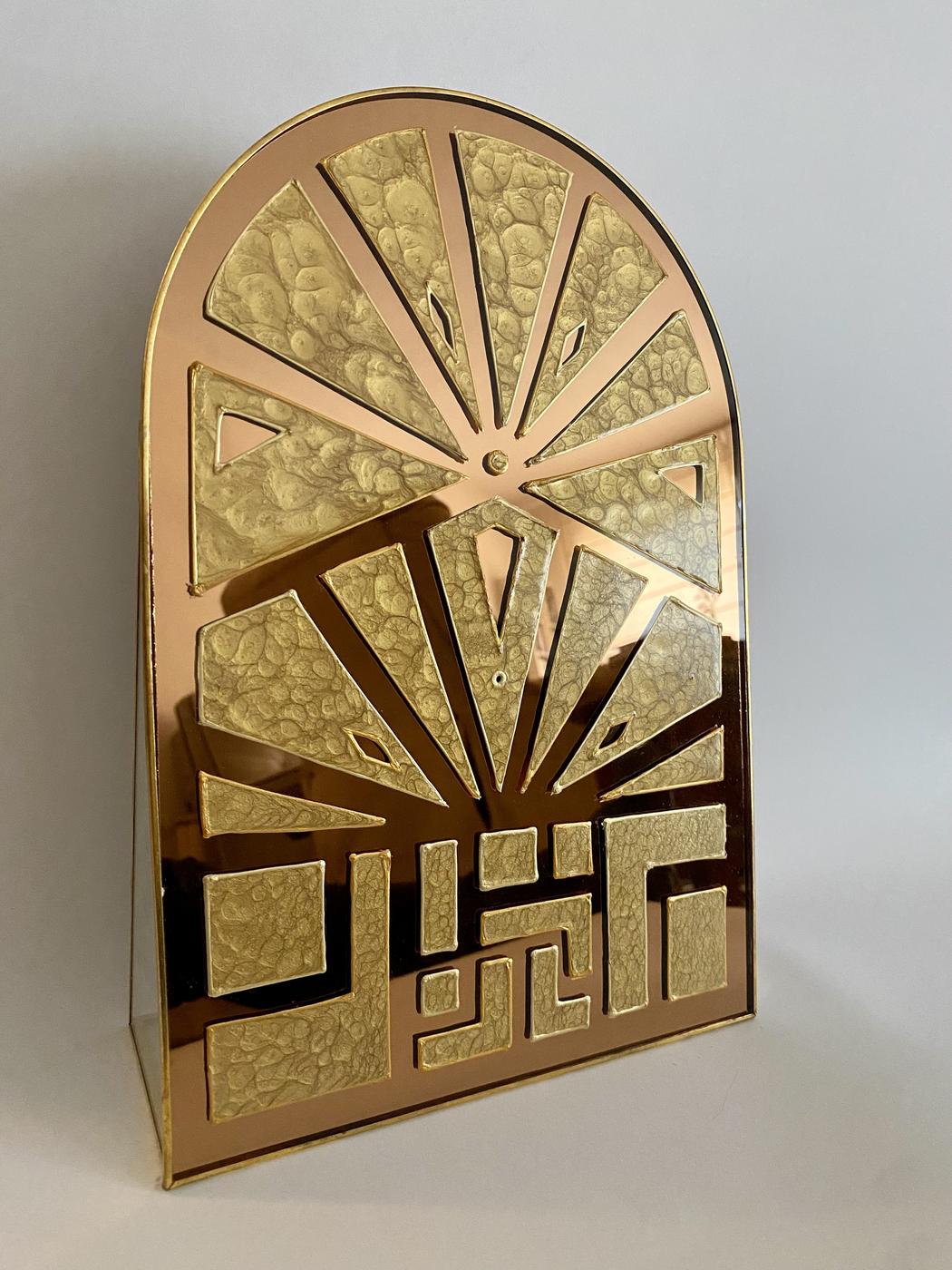 Noa Reichenberg | Golden | 2024
You are preparing a solo exhibition at Herzliya Municipal Gallery in November 2026. What ideas or new directions are you developing for this exhibition, and how does it relate to your previous work?
I’m very excited about it! I’m working closely with Nili Sessler, the gallery’s director and curator of my solo exhibition, whose thoughtful approach has been instrumental in developing the exhibition and bringing different aspects of my practice together in a way I haven’t presented before. It will feature new bodies of work that I’ve been developing over the past few years across different mediums: conceptual photography, drawings, my works on mirrors, and, for the first time, my poetry.
I love the idea of giving poems a place within the exhibition itself, allowing them a tangible presence where they can be encountered, read, and reflected upon. Poetry is another medium through which I express and reveal myself, so including it feels very personal to me. This will be the first time I exhibit all of these art forms together, allowing them to interact and create new connections. I hope that bringing them into dialogue will also deepen the meaning and understanding of themes I’ve explored in my previous work, such as identity, perception, concealment, and revelation. My poetry, by its nature, is less abstract than my visual art, and because of that, I think this exhibition will reveal different aspects of me, both as a person and as an artist. I’m allowing myself to be exposed in a way I haven’t been before.