
Darious Shan
The title I’m fine is a phrase that can often conceal more than it reveals. What role does this ambiguity play in the installation?
“I’m fine” is an extremely familiar, almost automatic response, yet it often conceals what someone is actually feeling. I chose the phrase because I wanted the audience’s first reaction to combine recognition with strangeness: something familiar, slightly unsettling, but intriguing enough to make them continue looking and discover what the work is doing. The ambiguity does not lead towards a single interpretation. Instead, it prompts reflection and leaves room for viewers to form their own feelings, associations and imagined narratives around the work.
In this work, music is translated into light through intensity, frequency and rhythm. How did you decide which characteristics of sound should correspond to particular visual behaviors?
In TouchDesigner, I used audio-analysis tools to translate intensity, frequency ranges and rhythmic changes into values that control the visual system. I think of the process as repeatedly adjusting a gate. I played different kinds of music, including classical music, and changed the high- and low-frequency ranges, thresholds and sensitivity to see which parts of the sound would pass through and how they would activate the movement, expansion and pulse of the image. The correspondences were not based on a fixed formula established in advance; they emerged through continuous listening, switching parameters on and off, and testing until the relationship felt balanced.

The brain-shaped vessel gives the installation a distinctly bodily and psychological presence. Why was the brain important as a physical container for the projected light?
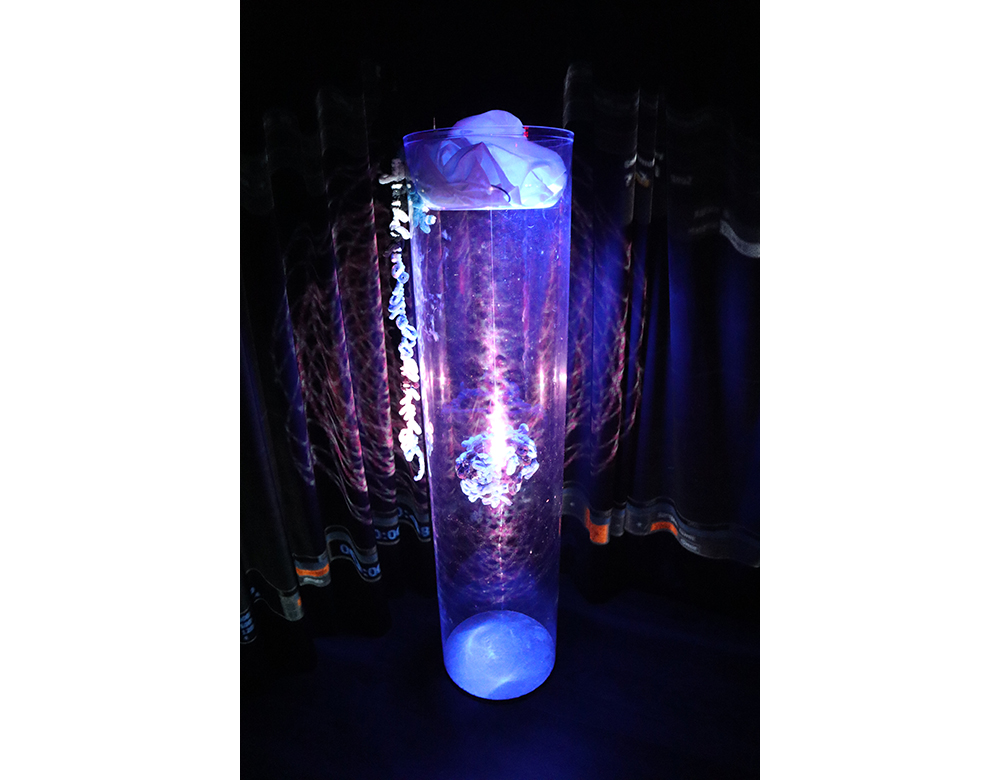
The project was initially inspired by the “brain in a vat” thought experiment. Placing a brain inside a structure resembling an experimental vessel creates a sense of dissociation: the viewer seems to stand outside themselves and observe their own brain and its activity from a third-person perspective. The brain is therefore more than a projection surface. It is the conceptual centre of the installation, giving the relationship between light, sound, thought and emotion a tangible bodily scale.
The projections sometimes resemble neural pathways, blood vessels or other organic systems. Are these biological associations intentional, or did they emerge naturally through the visual experiments?
It was both intentional and discovered through experimentation. From the beginning, I wanted to visualise thoughts and emotions within the brain, so I deliberately moved towards imagery resembling neural networks, capillaries and pulsating organic structures. It is as if invisible activity inside the brain has been enlarged, extracted and allowed to spread beyond the vessel into visible space. At the same time, the precise visual language emerged naturally through repeated projection tests. I gradually found that branching, fluid imagery worked best with the form of the container and communicated the sensation I wanted the work to hold.
You describe the work as allowing viewers to observe emotion from a detached, third-person perspective. What becomes possible when we look at our emotional responses from this distance?
Each person may respond differently, and different music can guide the audience towards different emotional states. When I recorded the final performance, I became completely immersed in the combination of sound, the brain inside the vessel and the neuron-like imagery spreading beyond it. Observing emotion from a distance does not necessarily mean becoming detached in a cold sense. It can allow us to notice how a sound evokes a feeling, memory or imagined scene, and how those associations continue to unfold. The work offers a moment in which viewers can pause and witness their own internal responses.

When developing an audio-responsive work, how do you know when the relationship between sound and image feels convincing rather than simply technically accurate?
I judge it mainly through repeated iteration and embodied response. Once the basic audio-reactive system was working, I spent long periods in a dark room adjusting the music, frequency ranges, thresholds, sensitivity and projection while recording each test. I would return to the footage several days later and select the version that remained most convincing. Technical accuracy is only the starting point. The relationship works when the image does more than simply follow the sound—when it extends the sound’s emotion, rhythm and spatial presence and sustains my attention as an immersive experience.
Immersive installations are difficult to fully preserve through photographs or video. What aspects of I’m fine do you feel can only be understood by experiencing the work physically in the space?
The first aspect is its bodily scale. The installation is approximately 1.5 metres high, so the viewer is not facing a small screen but a brain-shaped vessel close to the height of a human body, with projections spreading from inside it into a darkened space. “I’m fine” was exhibited in late May 2026 as part of a UAL student exhibition at Copeland Gallery in London. The live setup enabled several forms of sound input: visitors could play music through an iPad or trigger visual fluctuations simply by clapping. I also placed wind chimes and a large fan beside the installation, so air movement could set the chimes in motion and continuously alter the projection. This immediate relationship between sound, air, bodily movement and light is difficult to convey in photographs and can only be partially documented on video. A video is available on my personal Instagram, but the work’s scale, ambient sound and interactive feedback remain unique to the physical encounter.