
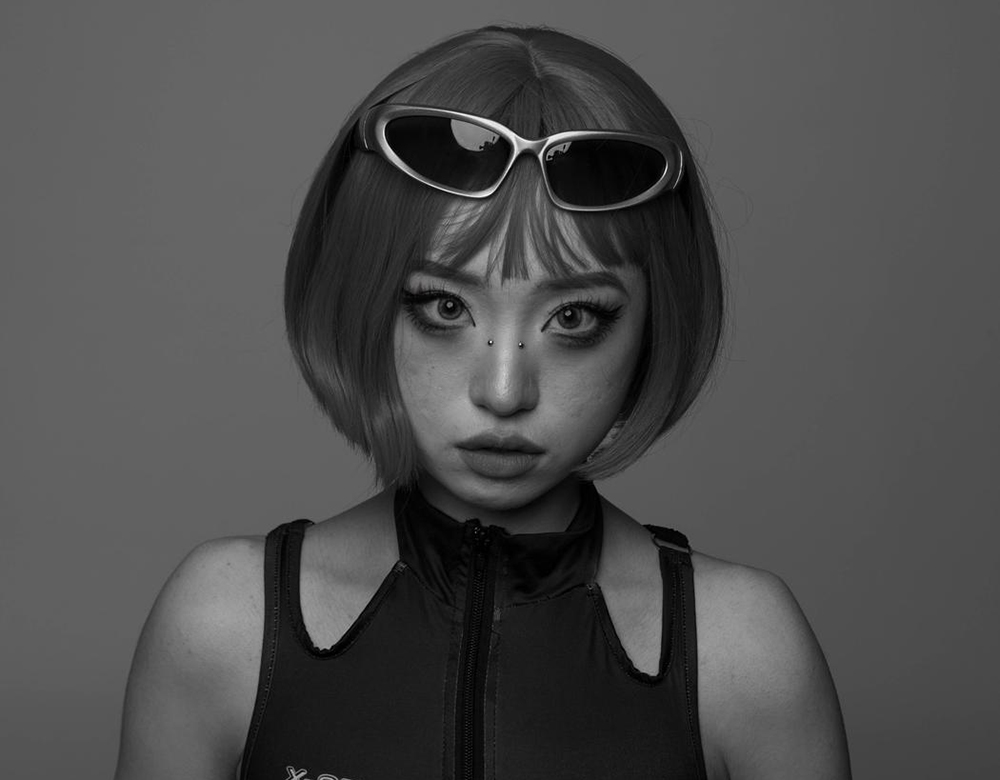
Kiska Shiyu Huang
What was the starting point for OsteoSymbiote, and how did the idea evolve into its final visual form?
OsteoSymbiote grew out of my ongoing interest in imagining synthetic life forms rather than designing wearable objects. Instead of asking how an object could decorate or enhance the human body, I became fascinated by the possibility of a digital organism evolving to live alongside it. I wanted to imagine a new form of life that would attach itself intimately to the body, not as an accessory or technological device, but as an independent organism capable of forming a long-term relationship with its host.
My background in Fashion Jewellery continues to influence the way I think about the body. While I was increasingly drawn to digital 3D design, the body remained central to my practice. Rather than creating ornaments for it, I became interested in imagining speculative organisms that could exist with it.
R. Giger’s biomechanical universe also had a profound influence on my artistic direction. His vision of blurred boundaries between humans and alien life encouraged me to imagine synthetic organisms that are neither purely biological nor entirely artificial, but something in between.
As the concept evolved, I began researching human anatomy, particularly the pelvis and spine, as the structural foundation for the organism’s growth. Instead of simply placing an object onto the body, I wanted the form to appear as though it had evolved with the body itself. This gradually developed into OsteoSymbiote, a speculative biomechanical organism that exists somewhere between anatomy, synthetic life, and wearable sculpture.
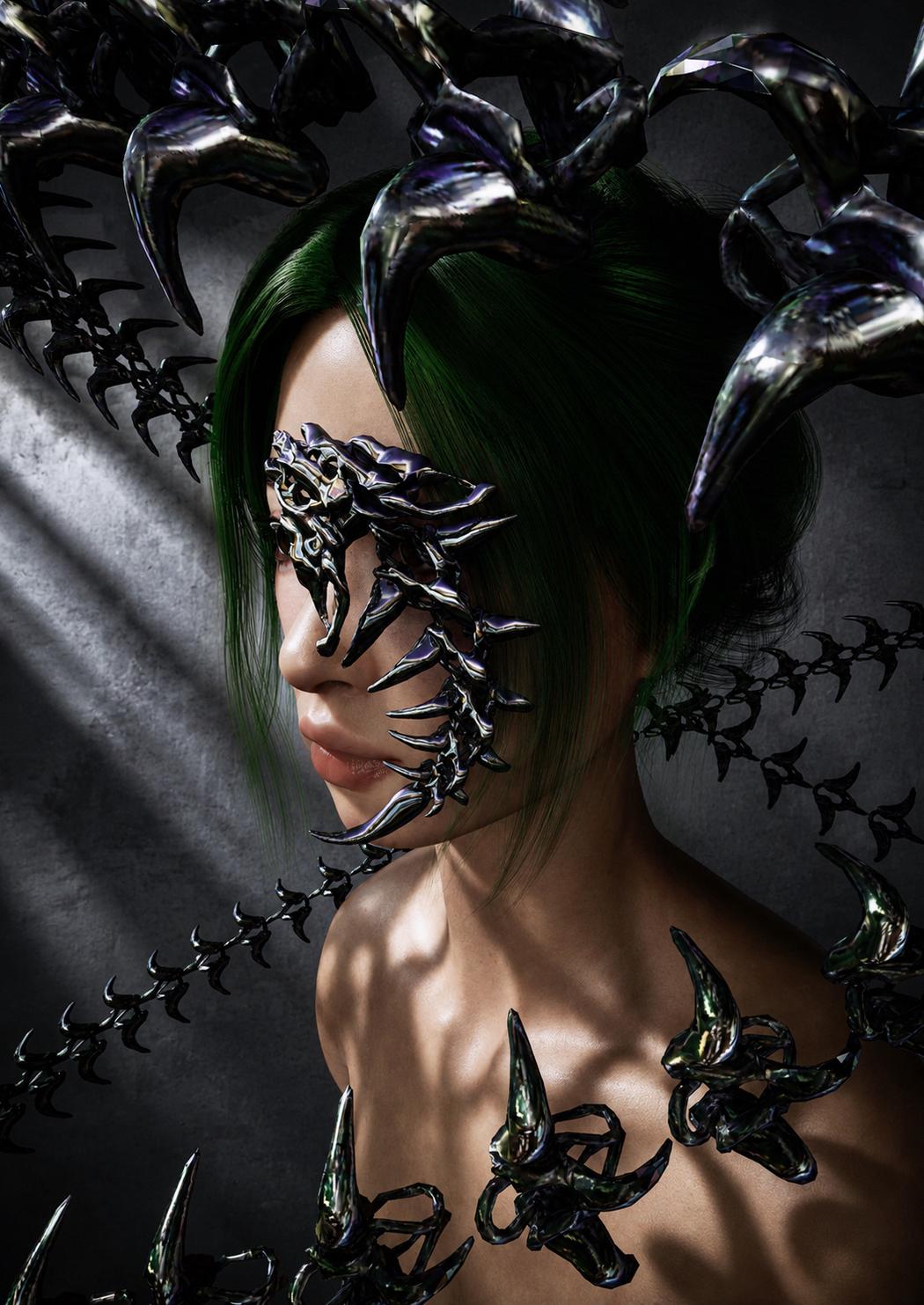 Kiska Shiyu Huang | Osteosymbiote | 2026
Your work draws on anatomy, biotechnology, and speculative evolution. Which biological structures or processes most strongly influenced the organisms in this series?
The pelvis and spine became the primary anatomical inspiration because they form the structural core of the human body. They provide support, protect vital systems, and serve as pathways through which the nervous system connects the brain to the rest of the body. Beyond their functional role, I was also drawn to their symbolic significance. The pelvis is closely associated with pregnancy and childbirth, making it a powerful symbol of the origin of life. This inspired me to imagine a synthetic organism that is not born through biological evolution alone, but through human creation. I wanted to explore the idea that artificial life could emerge from the same anatomical foundation traditionally associated with the beginning of human life. In this sense, the pelvis became more than an anatomical reference. It became a symbolic birthplace where biological life and synthetic life intersect.
I was equally interested in biological processes such as adaptation and symbiosis. Rather than imagining a fixed object, I imagined an organism capable of evolving alongside its host, gradually adapting its form to the human body over time. In my mind, the organism is never complete. Like any living system, it continues to evolve through its relationship with its host.
The forms in these works can be read as jewellery, armour, prostheses, parasites, or independent living beings. Is this ambiguity important to the way you want the audience to perceive them?
Yes, this ambiguity is entirely intentional. My background in Fashion Jewellery continues to influence the way I think about the body. What has always fascinated me is the way jewellery attaches to different parts of the body and changes the relationship between the body and the object. That way of thinking became the starting point for my practice.
As my work evolved, I became less interested in creating ornaments and more interested in creating life. Rather than designing an object to be worn, I wanted to imagine organisms that choose to inhabit the body. They are not simply accessories, nor are they fully independent creatures. They exist somewhere in between.
I deliberately keep that ambiguity because I want viewers to question what they are looking at. Is it jewellery? Is it armour? Is it a prosthesis? Is it a parasite? Or is it an entirely new form of life? More importantly, I want them to ask themselves another question: “How would I feel if I allowed this organism to attach itself to my own body?” I am less interested in providing an answer than in creating a space where those questions remain open.
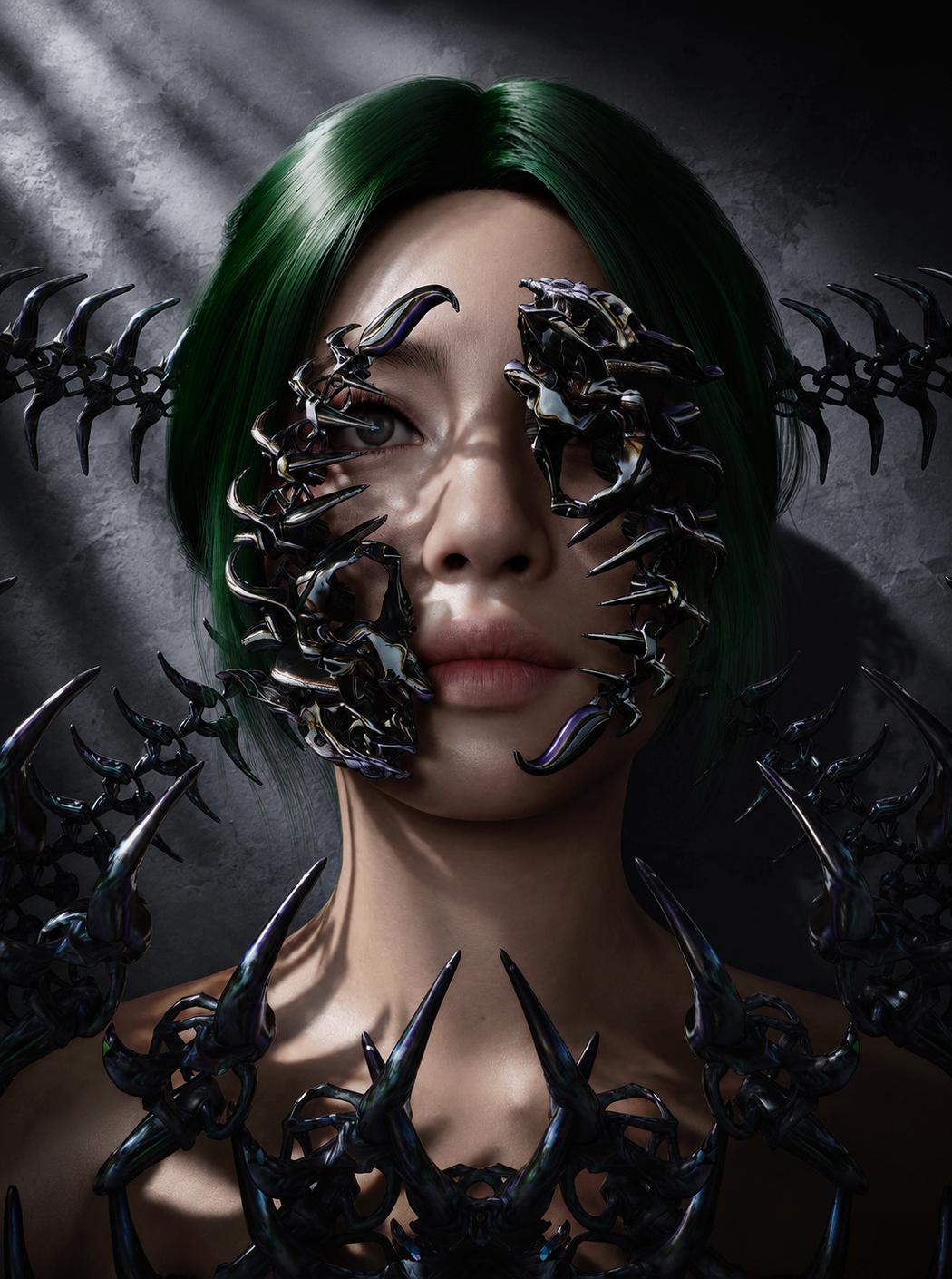 Kiska Shiyu Huang | Osteosymbiote | 2026
How do you imagine the relationship between the human figure and the synthetic organism: is it protective, parasitic, mutually beneficial, or something more complex?
I don’t think the relationship between humans and the synthetic organism can be reduced to a single definition. It is deliberately complex because it reflects the relationship we already have with digital technology today.
With the rapid development of AI and digital technologies, we have become deeply connected to digital tools. Smartphones, social media, and AI systems have become extensions of our everyday lives. We carry them with us constantly, build digital identities through online profiles, and increasingly rely on them for communication, learning, work, and entertainment. In many ways, we are creating digital forms of life while simultaneously allowing them to become an inseparable part of our own existence.
This relationship brings enormous benefits. Digital technologies make knowledge more accessible, connect people across geographical boundaries, and expand the way we experience and understand the world. At the same time, they also raise important questions about privacy, identity, dependency, and the misuse of artificial intelligence. Rather than seeing this relationship as simply positive or negative, I believe it is becoming increasingly interdependent and difficult to separate.
OsteoSymbiote is my way of visualising that complexity. The organism appears to attach itself to the human body, but whether it is protecting, controlling, evolving with, or depending on its host is intentionally left unresolved. I hope the work encourages viewers to reflect on their own relationship with digital technologies and to consider how closely they have already become integrated into their daily lives.
The organisms appear both threatening and highly ornamental. How do you approach the tension between beauty, attraction, discomfort, and danger?
I don’t see beauty and danger as opposites. I see them as qualities that often coexist. As I mentioned earlier, H. R. Giger has profoundly influenced my artistic practice. His biomechanical aesthetic demonstrates that something can be simultaneously beautiful yet unsettling. Rather than separating attraction from fear, his work allows these emotions to exist together, and that has greatly shaped the way I approach my own work.
The sense of discomfort in my work often comes from the skeletal forms. For many people, bones are closely associated with death because they are what remain after life has ended. However, I see them very differently. Bones are the structural foundation that supports life from the very beginning. They make movement possible, protect vital organs, and provide the framework through which the body grows. To me, they represent the architecture of life rather than simply a symbol of death.
This duality also reflects the relationship between humans and digital technology today. Digital technologies are deeply attractive because they offer convenience, connection, and endless possibilities. Yet the more attractive they become, the more deeply they integrate into our lives, bringing new ethical and social concerns such as dependency, privacy, and identity. I wanted the organism to embody this same contradiction.It is visually seductive enough to invite curiosity, yet unsettling enough to encourage viewers to question whether they would truly welcome it onto their own bodies, just as we continue to negotiate our relationship with the digital technologies that increasingly shape our everyday lives.
Your work has been presented in both art and fashion contexts. How has your experience with fashion influenced the way you think about the body, wearability, transformation, and self-presentation?
My background in Fashion Jewellery taught me how objects communicate identity and how they become extensions of the body. Jewellery is never just decorative; it reflects personality, culture, memory, and the way we choose to present ourselves. It also made me fascinated by the intimate relationship between objects and the body, and how something worn can transform both appearance and perception.
This curiosity led me to study Material Futures at Central Saint Martins, where my focus shifted from designing objects to imagining possible futures. Rather than asking what materials are, I became interested in what they could become and how emerging technologies might reshape our relationship with the body, identity, and the environment. My work gradually evolved from wearable objects into speculative digital organisms that question how humans might coexist with synthetic forms of life.
My current practice asks what happens when objects are no longer passive accessories, but active organisms that become part of our identity. Instead of simply expressing who we are, they begin to influence how we perceive ourselves, how we interact with others, and where we draw the boundaries between the physical body and the digital self.
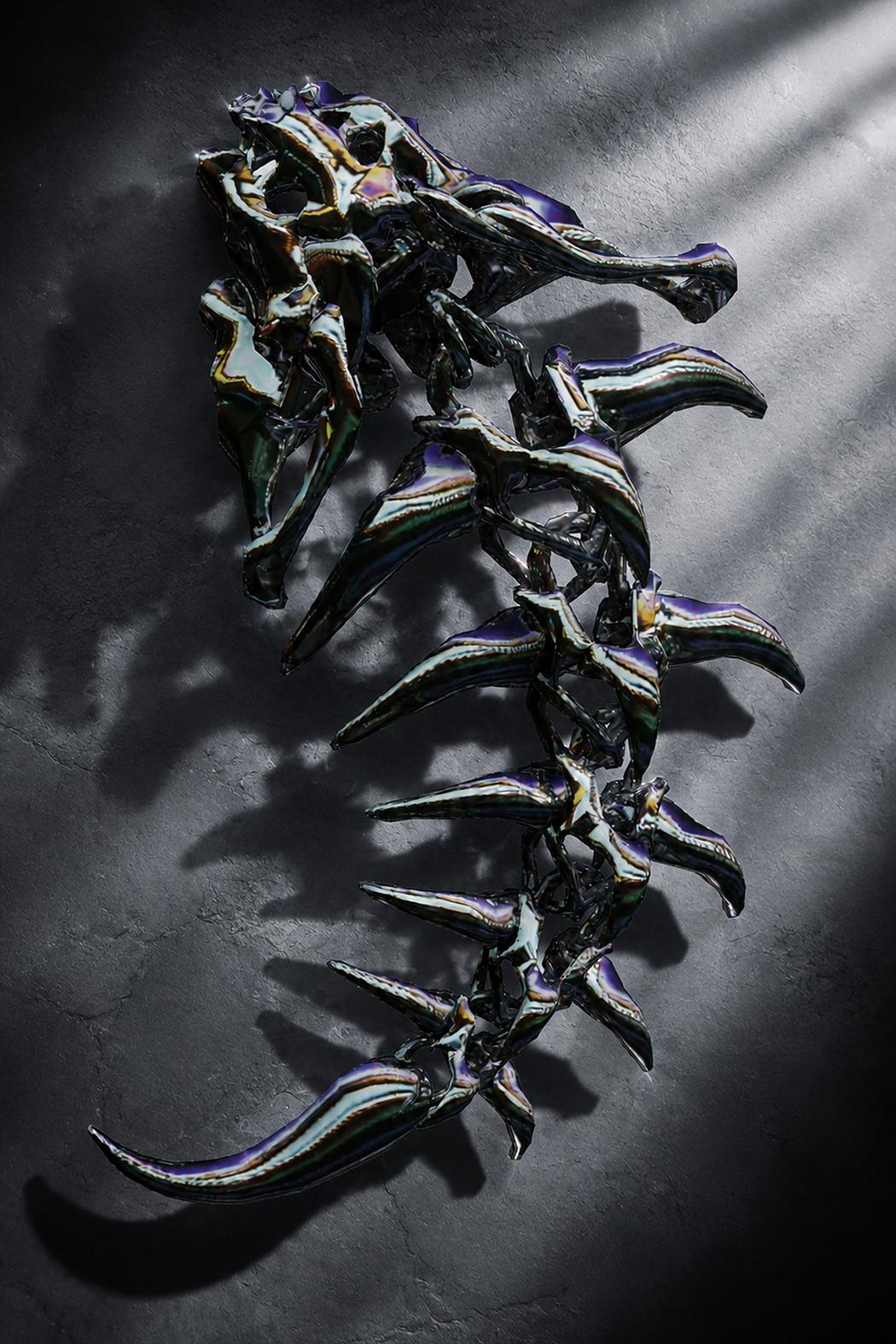 Kiska Shiyu Huang | Osteo Symbiote | 2026
What changes when a digital sculpture moves from a still image into augmented reality and becomes something the audience can encounter through their own camera and physical surroundings?
A still image only allows viewers to observe the digital organism from a distance. For me, augmented reality is not simply a display technology. It is the moment when the organism begins to exist in the same space as the viewer.
Once it enters augmented reality, the relationship changes completely. The audience is no longer simply looking at the digital organism; they become its host. More importantly, they shift from being observers to active participants. The work becomes deeply personal because every viewer experiences it on their own body and within their own surroundings.
I am interested in the moment when a digital organism appears to exist within physical space. Although viewers know it is virtual, their instinctive reaction often treats it as something genuinely present. That moment reveals how increasingly blurred the boundary between digital and physical experience has become.
Ultimately, this is the central theme of my practice: exploring the evolving relationship between humans and digital life. A still image introduces the digital organism, but augmented reality allows people to experience what it might feel like to coexist with it. Instead of simply observing a speculative future, they briefly become part of it. For a brief moment, the audience is no longer outside the work. They become part of the organism’s world, just as the organism becomes part of theirs. In that moment, the boundary between observer and subject, digital and physical, begins to dissolve.