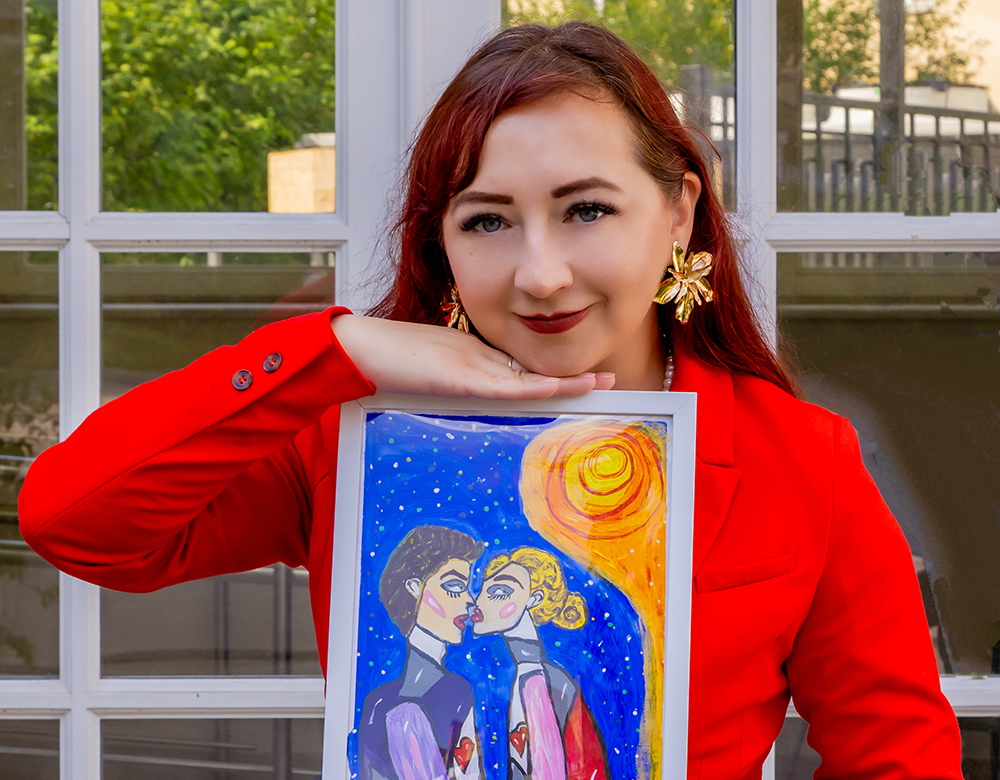
Olga Murtaeva
Your creative practice brings together painting, music, literature, theatre, and performance. How do these different art forms influence one another in your work?
I am fortunate to express myself vividly across many different fields of art. Whatever I undertake, I strive to find an optimal balance between self-expression, healthy perfectionism, humanism, and love for people and the world. And I never simply play a role – or rather, I never pretend. I always live what I create.
Different forms of creativity come together naturally in my work. For example, my extremely high coloratura notes, which rank among the highest in the world, are essentially the same vivid colours that I favour in painting, only expressed through the voice.
I also often use my paintings to illustrate literary works, including the fantasy stories in my book The Best in You – Cosmos. It is also very rewarding to know that my creative work resonates with other authors and inspires them to create interesting works of their own.

You are active in painting, literature, music, cinema, theatre, fashion, and public life. How do you preserve an authentic artistic voice while working across so many different fields?
In every field, I remain true to myself and try to do good—something one can never grow tired of. I believe this quality of character is what most strongly enables me to express, preserve, and develop my distinctive artistic voice.
Your paintings are characterised by vivid colours, expressive brushwork, and rich texture. How do you choose the palette and painting technique for each composition?
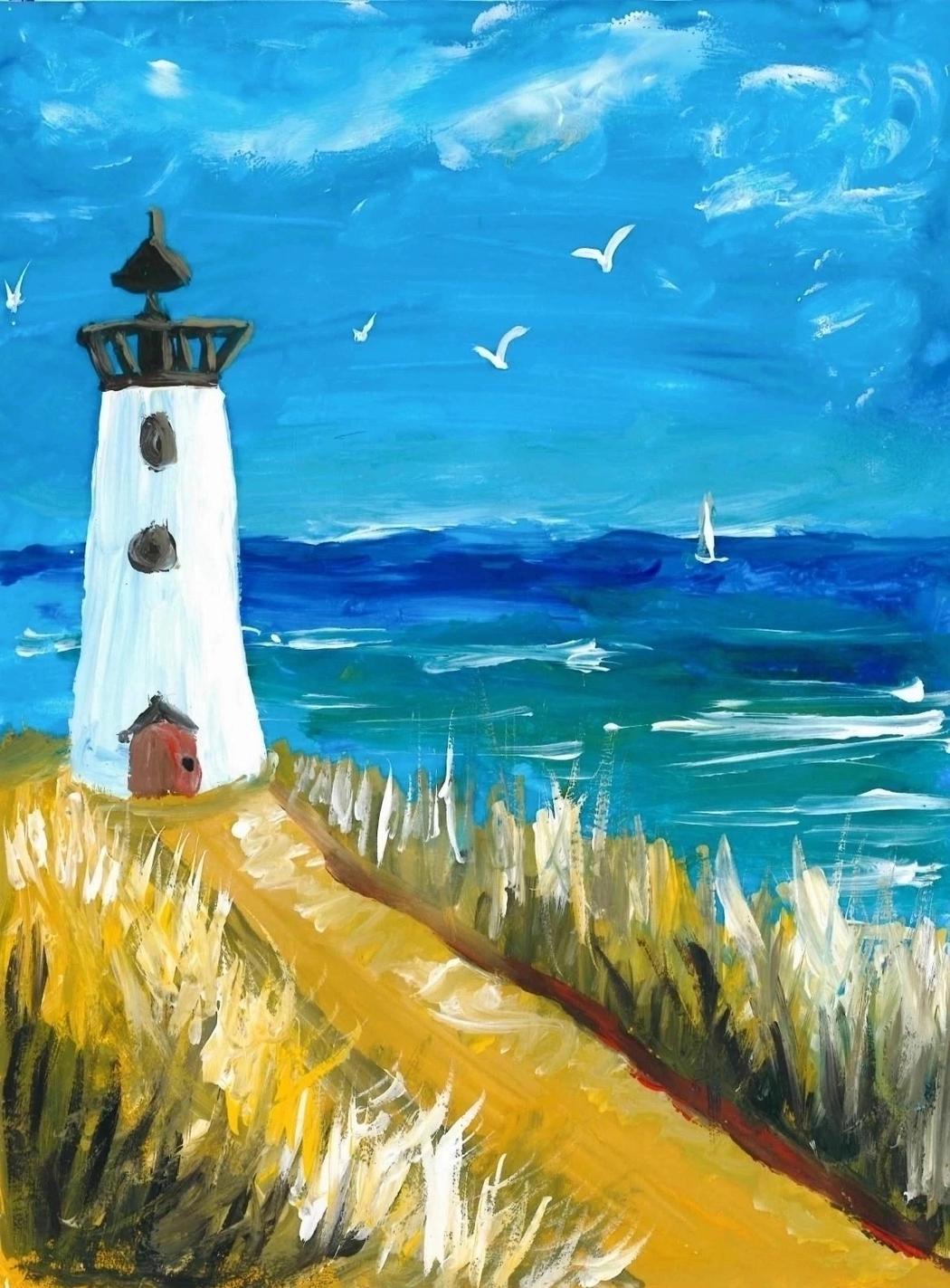
My colours and textures are naturally guided first and foremost by my emotions, intuition, and feelings, which are reflected in all my works. My original and innovative style is what I call painterly murmuration. My paintings are vivid, harmonious, and uplifting, and they can easily be associated with the dance of birds in the sky—the natural phenomenon of murmuration.
As a conservatory graduate and professional singer, do you experience colour, rhythm, and composition in painting in a musical way?
Music has been an essential part of my life since my earliest years. Even as a child, I had a unique voice, and my teachers helped me refine it with great precision, develop its potential, and achieve international recognition.
I have always enjoyed drawing, but I became seriously interested in painting much later, after the birth of my wonderful twin sons, Yaroslav and Stanislav. Above all, they are my greatest sources of inspiration. Music, of course, inspires me as well. I often listen to classical compositions while painting, and I see a clear connection between a palette of colours and the musical staff.

Musical instruments appear prominently in several of your works. What do they symbolise for you beyond their connection to sound and performance?
During my school years, I learned to play the domra, a traditional Russian folk instrument. Recently, I dedicated a series of paintings to the domra with the aim of promoting Russian culture among young people in Russia and abroad.
I also frequently depict other musical instruments. I believe that through them, humanity opens a magical portal into a primordial state of harmony.

Nature is an important presence in your work, from flowers and mountains to the sea and open landscapes. What draws you to these subjects?
We are all creations of nature and, at the same time, its co-creators. In the beauty of the world around me, I sense a divine freedom that is closely related to the freedom of creativity.
Moreover, when I paint earthly or even cosmic landscapes, I feel as though I am walking through these enchanting places myself, while inviting viewers to join me. This offers an opportunity to step away from everyday routines and experience something interesting, uplifting, and enjoyable.

You have studied the role of visual art in education and rehabilitation. How can artistic practice support emotional recovery, personal development, and self-expression?
Creativity has the power to ennoble and discipline us, to encourage constructive thinking, to reveal our best qualities, to heal the soul, and to help us notice beauty. It is not a universal remedy, but it is something without which a fulfilling life would be difficult to imagine.
In my paintings, I particularly want to emphasise the art-therapeutic effect. People can feel more comfortable, calm, and emotionally warm when looking at such unusual and colourful works, which contain a true firework of emotions.