
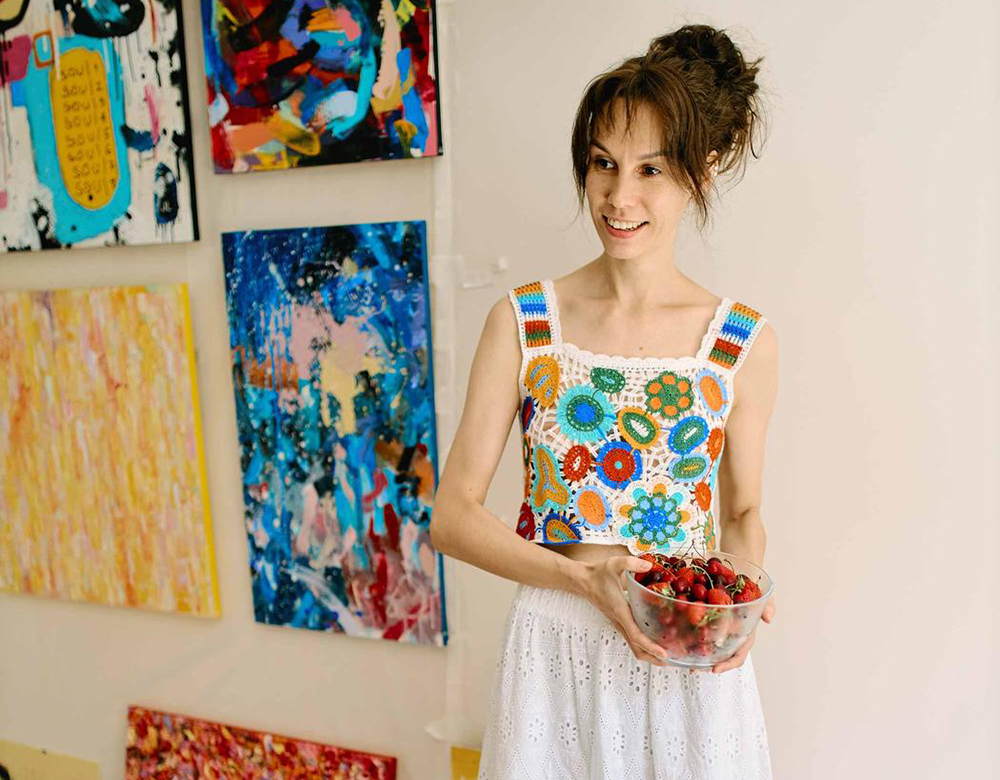
Julia Lilla
How did your journey in art begin, and at what point did you feel that creativity was becoming not just a passion, but a way of speaking about yourself and the world?
I paint because I cannot help but paint. Since childhood, I have had an intuitive sense of colour. For me, colour has become the most precise way to express inner states—things that are difficult to put into words. Abstraction, colour, texture, and experimentation with materials have become my way of experiencing and making sense of the world. Some people do this through words, others through music. For me, that language is colour.
But my path to art was not a direct one.
I have always felt a need to create something with my hands. I designed and sewed clothes, practised decorative inlay, baked cakes to order, developed a manicure business, earned a degree in mathematics and computer programming, travelled extensively, and lived in Europe and the United States. Each of these experiences taught me something, but none gave me the feeling that I was truly where I belonged.
Psychotherapy became a turning point. It helped me understand that, for a long time, I had used creativity as a way to earn love and recognition and to prove my own worth. At some point, I became curious about what my life might look like if I no longer had anything to prove. That was when I truly began to paint.
Today, my paintings are no longer a way of telling the world who I am. Quite the opposite: each new work helps me understand myself more deeply and discover who I am becoming.
How did your self-directed study of art influence your attitude toward rules, academic canons, and artistic freedom?
As a child, I attended art school, but the academic disciplines—drawing and sculpture—were the ones I found most difficult. Looking back now, I understand why. I was bored by the endless process of reproducing reality according to established rules. I wanted to explore, experiment, and find my own solutions. Even then, I could feel that rigid boundaries left me with too little room to breathe.
Later, when I continued studying art independently, this feeling only grew stronger. The absence of an academic education turned out not to be a disadvantage, but a space for freedom. I was not obliged to do things the “right” way—I was free to search for what felt honest and true to me.
I do not break rules simply for the sake of breaking them. When I depart from them, it is only because I feel intuitively that this is what will make the work more precise and alive. And this applies not only to art.
Over time, intuition gradually became my main point of reference. It is what tells me when a painting is complete. This is difficult to explain rationally. Perhaps it resembles the feeling of being full: you continue working until an inner hunger has been satisfied. Then, one day, you simply know—it is finished. There is nothing more to add.
Sometimes people ask whether I would have become a different artist if I had received a classical academic education. I think I would have. In fact, I am not even sure I would have remained an artist at all.
I feel that the habit of constantly asking myself, “Is this correct? Is this professional? Am I allowed to do this?” might eventually have silenced my ability to play, to be surprised, and to trust my own instincts. That is why today I place far more trust in my inner compass than in ready-made answers.
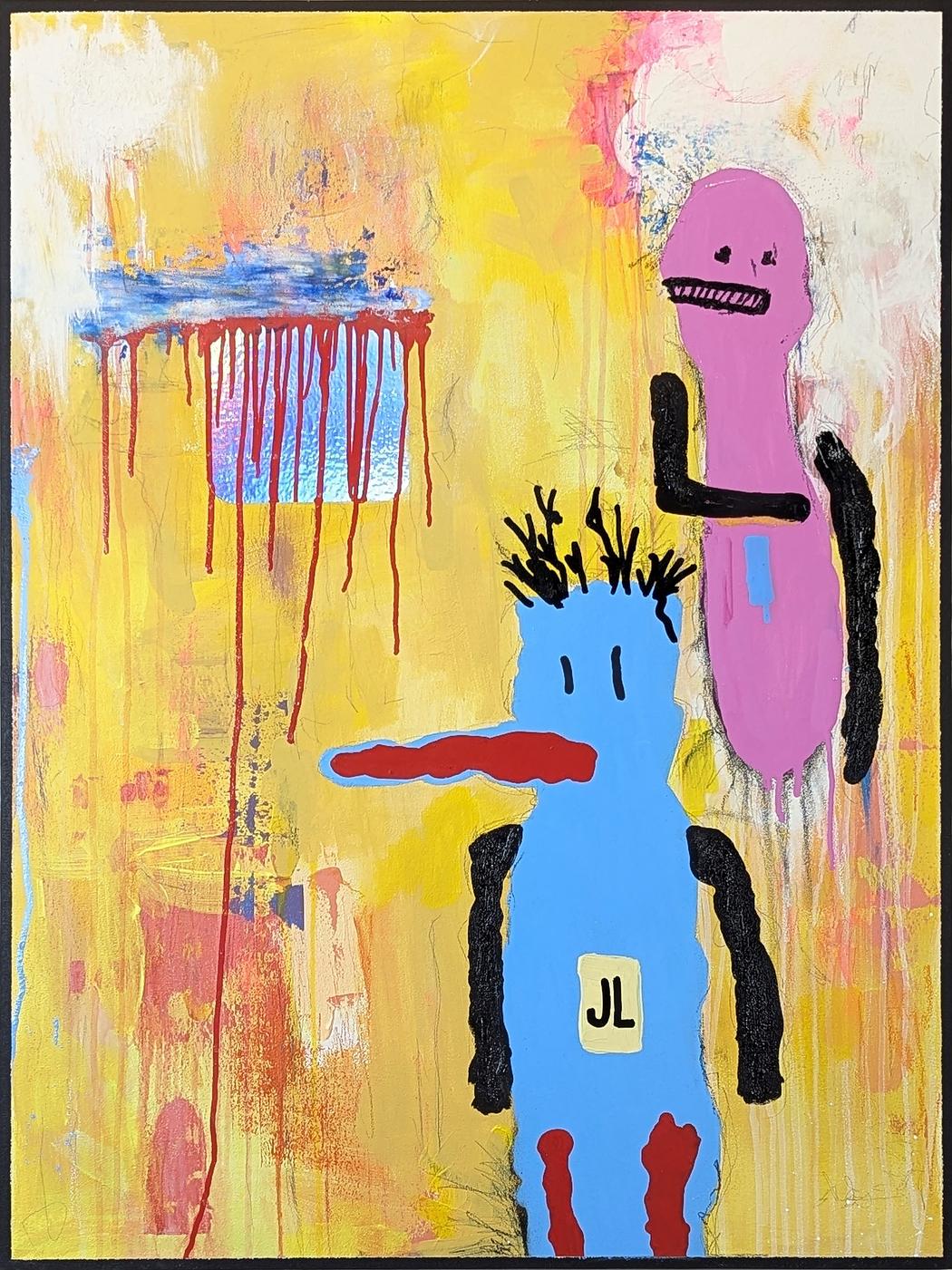 Julia Lilla | U&I | 2025
You define your artistic direction as “Abstract Infantilism.” What does this concept mean to you — a return to childlike freedom, a method of self-discovery, or an artistic approach?
For me, it is simultaneously a return to childhood freedom, a means of self-discovery, and an artistic method.
When people hear the word “infantilism,” they almost always perceive it as something negative. It is usually associated with an adult who refuses to take responsibility for their own life. This meaning of the word is familiar to me as well.
That is precisely why I found it interesting to use the term in an entirely different context.
“Abstract Infantilism” is a deliberate provocation. At first glance, my works may indeed appear overly naïve, almost childlike. Yet behind this apparent simplicity lies an experience that is far from childish. The free, spontaneous brushstrokes are grounded in years of personal work, reflection, the search for my own path, and attempts to understand how to preserve a sense of vitality while growing older.
I do not want to become a child again. On the contrary, I believe that being an adult is far more interesting, because an adult has the freedom to choose the life they want to live. At the same time, it has been important for me not to lose the part of myself that is capable of wonder, play, trusting intuition, and looking at the world with curiosity.
This is why my paintings emerge at the intersection of two states: adult awareness and childlike openness. For me, it is a space where experience meets freedom, structure meets spontaneity, and responsibility meets play.
Perhaps this is exactly where genuine creativity begins.
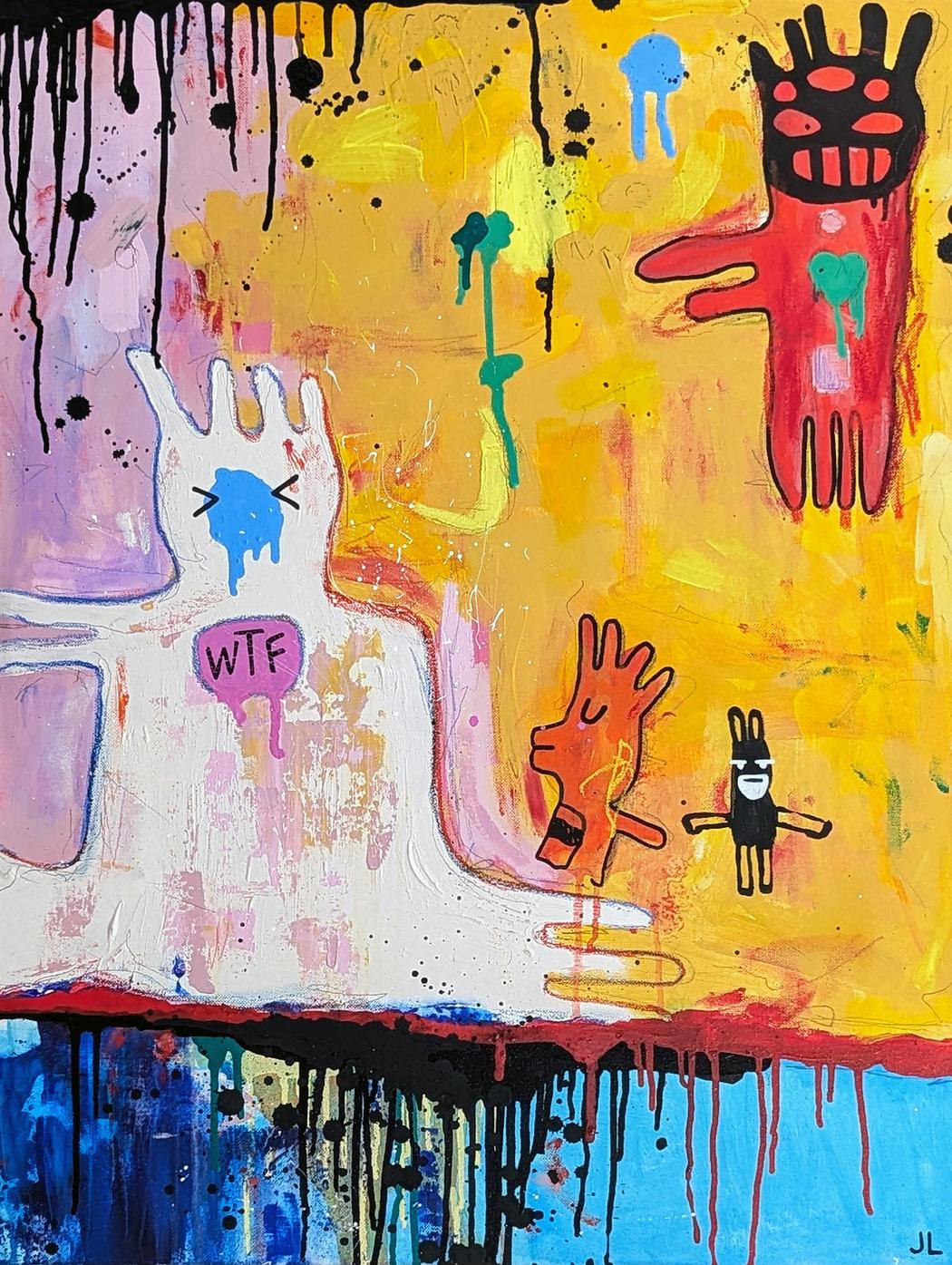 Julia Lilla | Stretching Baby | 2025
What role does play have in your creative process — with color, texture, form, and chance?
For me, play is not an artistic device. It is a way of exploring the world.
If I were presented with two canvases, one saying, “This is going to be a very important painting,” and the other, “Let’s see what happens,” I would choose the second without hesitation. The first phrase creates expectations and a fear of making mistakes, while the second opens up a space for curiosity. And it is curiosity, I believe, that keeps art alive.
I usually begin a work with a particular idea or mood, but the painting almost always changes during the process. I try to follow my instincts rather than resist these changes.
Spontaneity plays a particularly important role in this. I used to become frustrated when materials behaved differently from what I had intended. I wanted to keep everything under control. But at some point, I began asking myself, “How can I turn this mistake into something interesting?” Since then, unpredictability has ceased to be an enemy and has become an active participant in the creative process. Very often, it is precisely this unpredictability that makes a work feel more alive and unexpected.
Even if no one ever saw my paintings, I would still continue experimenting—not for the viewer, but because the process of discovery itself brings me joy. Perhaps that is why play, for me, is much more than a creative method. It is a way of remaining open to life.
The series “Mui Ne Drift” is connected with Vietnam, wind, kitesurfing, and a sense of movement. How do travel experiences change your perception of yourself and your visual language?
I feel that I travel not so much because I enjoy changing places, but because new places change me.
Each journey becomes an opportunity to see myself from an unexpected perspective. When I return home, I realise that I have become slightly different once again. And as I change, my paintings change with me.
Travel expands not only my understanding of the world, but also my sense of my own possibilities. After visiting each new country, a thought arises within me: “What else could I try? What else am I capable of?” It is precisely this feeling that creates the desire to keep moving forward—both in life and in art.
Of course, inspiration does not come from travel alone. I am equally inspired by books, films, exhibitions, and conversations with people. Yet there is a special kind of magic in travelling. When I arrive in a new country, it is as though I switch into observation mode. I begin to absorb everything around me: the light, colours, scents, rhythm of the streets, local cuisine, conversations, and people’s habits.
What strikes me most is how different we can appear on the outside and how similar we remain within. Love, kindness, the desire to be close to those we care about, and the ability to find joy in simple things—these exist in every culture. This is what restores my sense that the world is much kinder than it sometimes seems.
Vietnam holds a particularly special place in my life.
It did not so much change me as finally allow me to hear myself. For the first time in a long while, my nervous system was able to truly relax there. The sun, the ocean, the wind, new friends, a sense of safety, and the unhurried rhythm of life gradually released the inner tension I had been carrying for a long time.
When I stopped constantly trying to be strong and control everything that was happening, I discovered that the version of myself I had long wanted to meet had already been living inside me all along.
Perhaps this is why the Mui Ne Drift series turned out to be so light. It is not so much about Vietnam as it is about the inner sense of freedom that can sometimes emerge far away from home.
And yet, I believe that a true home is not a place on a map, but a state in which you gradually piece yourself back together. For me, travelling is one of the ways of experiencing this process.
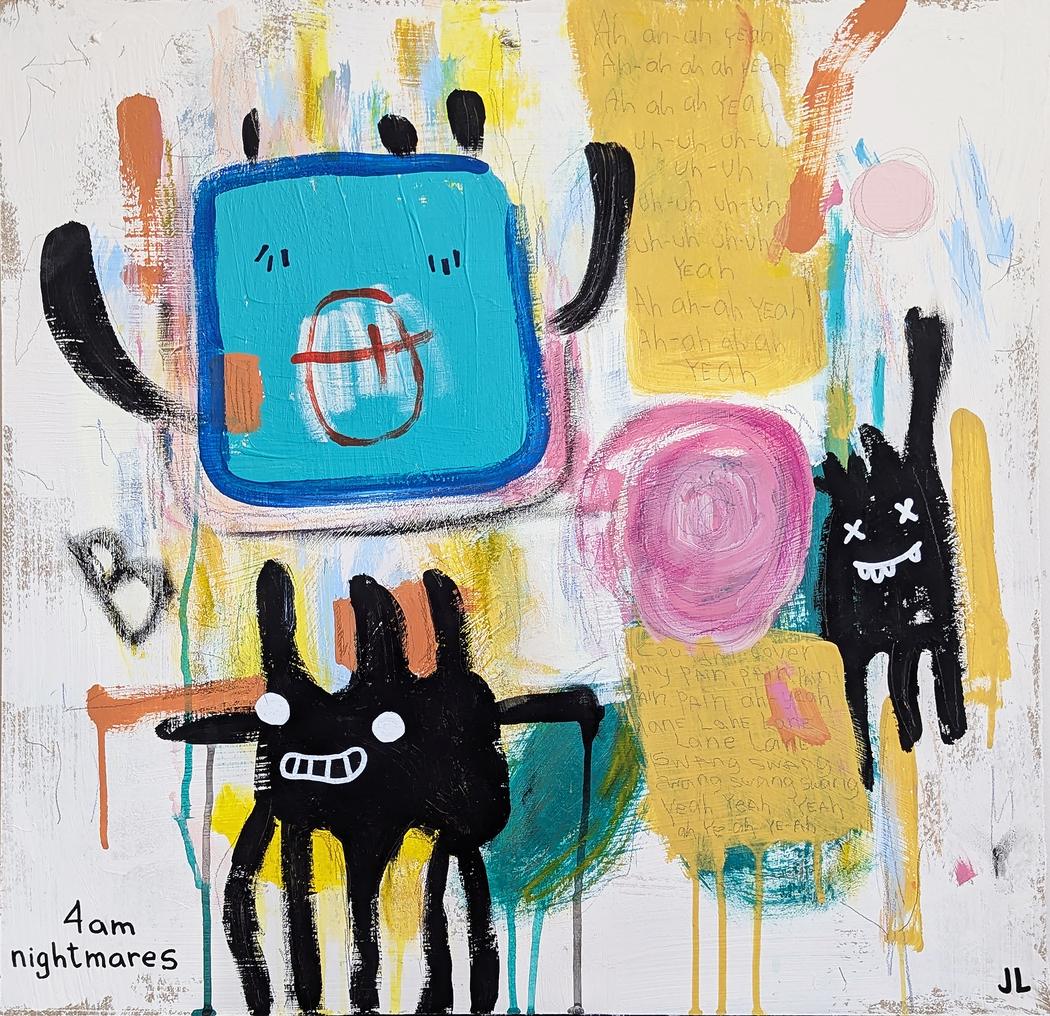 Julia Lilla | 4Am Nightmares | 2025
Which artists, cultural phenomena, or visual impressions have had the greatest influence on you?
I have always been influenced less by artistic movements than by people who found their own way of being themselves.
Of course, there are artists without whom I cannot imagine my own story. As a child, I saw Leonardo da Vinci’s Mona Lisa at the Louvre, and I still remember my surprise: “Is that all?” Perhaps that was the first time I realised that expectations and reality do not always align.
Later, I was deeply struck by Jean-Michel Basquiat—by his boldness, freedom, and complete lack of fear of being himself. Claude Monet influenced me in a very different way. Discovering Impressionism was the moment when I thought, “So this is possible too?”
Among contemporary artists, I am particularly interested in David Pher and Vitaly Prostov. I admire the fact that they have developed their own distinctive and recognisable artistic language.
But honestly, life itself influences me far more than any individual artist. Travel, books, music, psychology, running, conversations with people, love, and loss—all of these become part of my artistic experience.
Above all, I am inspired by people who are not afraid to be themselves. That is why I study not only paintings, but also human lives. I am interested less in the question, “How did this person paint?” and more in, “How did they become who they are?”
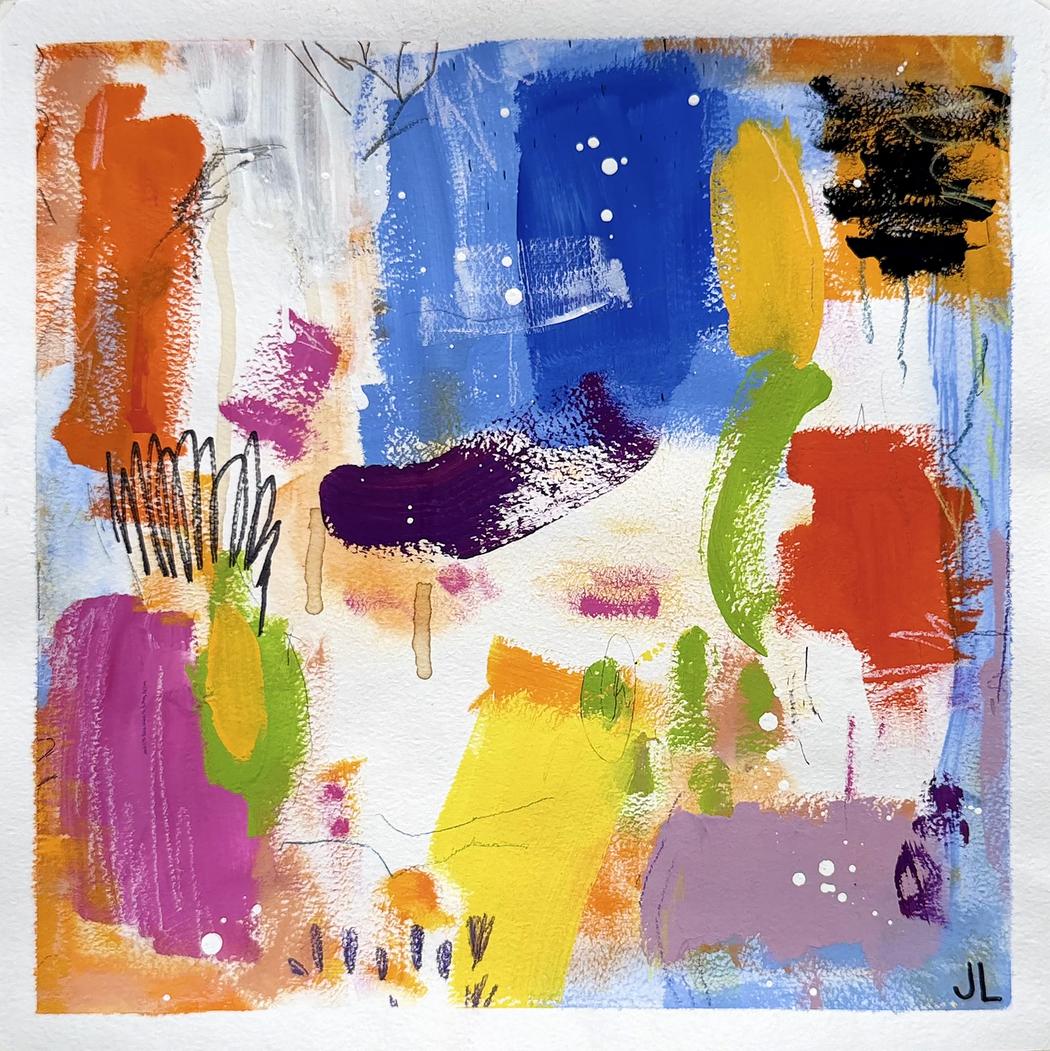 Julia Lilla | Bensa | 2025
What would you like viewers to feel when they encounter your works for the first time?
I would like people who encounter my work to remember, even if only for a few minutes, that life is much bigger than an endless list of tasks, anxieties, and expectations. I want them to allow themselves to pause, take a breath, and rediscover their interest in life.
Perhaps that is why my paintings are so bright, emotional, and slightly unusual. I like it when they surprise the viewer at first and then gradually reveal their mood. If, after some time, a person remembers not the subject itself but a feeling, an atmosphere, or a colour, then a genuine dialogue has taken place between us.
If my works could say just one thing to the viewer, it would be:
“Live your life. It’s just a game.”
For me, this is not an invitation to take life lightly, but a reminder not to live in constant fear of making a mistake or failing to meet someone else’s expectations.
I do not aim to evoke only pleasant emotions. I believe that every feeling has the right to exist. If my work helps someone give themselves permission to feel — joy, sadness, wonder, confusion, or hope — then it has already done something important.
I do not paint in order to tell the world who I am. Quite the opposite: each new work helps me understand myself more deeply and see who I am becoming. I would like my paintings to do something similar for the viewer — not to offer ready-made answers, but to gently invite them to pause, feel alive, and ask their own questions.
After all, I do not paint to teach people how to live.
I paint to remind them that life is already happening.