
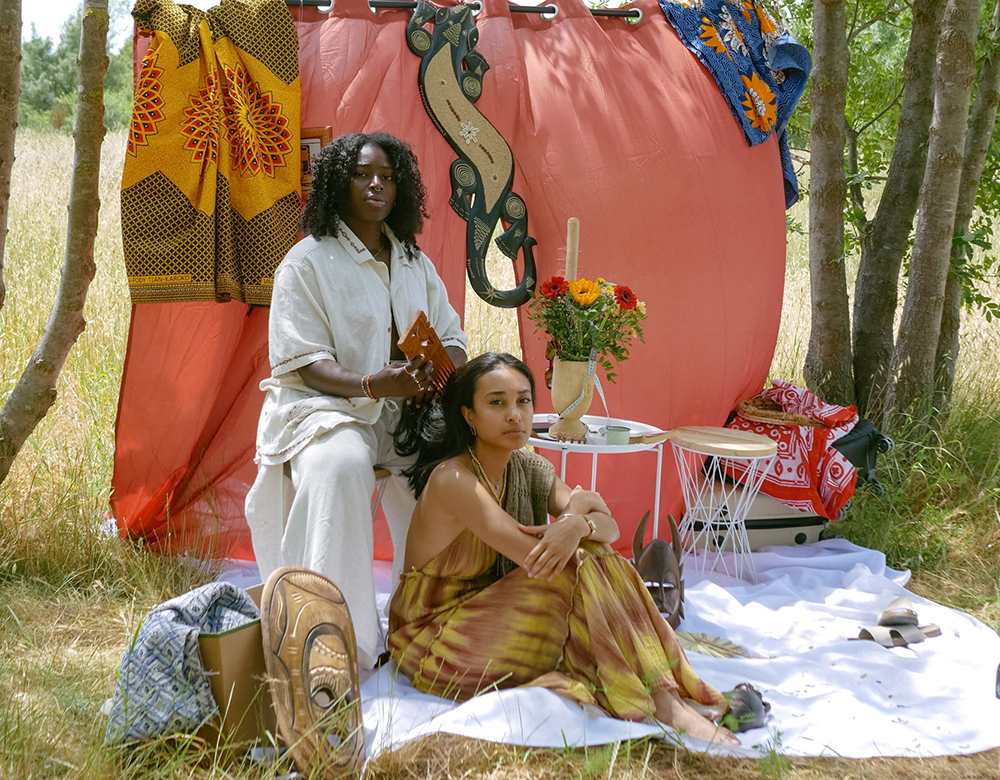
REALMS – Tsolady M’BOKOLO and Fitia JOLY RAZAFINDRAMNAVA
Your personal journey has taken you between France and Congo. How have these different cultural environments shaped your understanding of identity and your approach to fashion?
Tsolady M’BOKOLO: I was born in France in 2001, but from the summer of 2008 until the summer of 2016, I lived in the Democratic Republic of Congo. Those years shaped me in ways I don’t think I fully understood until much later.
When I returned to France, I realised I wasn’t simply Congolese or French—I had become both, and neither, all at once. That experience taught me that identity isn’t something fixed. It’s something we carry, negotiate, lose, rediscover and continuously reshape.
As a child, I was already dreaming about creating clothes. Fashion fascinated me because it seemed capable of expressing things words couldn’t. But over time, I realised what truly interested me wasn’t clothing itself—it was what clothing could carry. Memory. Pride. Belonging. History.
REALMS grew out of that realization. I don’t design garments simply because I think they’re beautiful. I design because I want people—especially those whose cultures have often been simplified, misunderstood or erased—to see themselves reflected with dignity, complexity and elegance.
Living between two worlds didn’t leave me feeling divided. It taught me that we are all made of multiple worlds, and that has become the foundation of everything I create.
For a long time, African cultures have often been interpreted through someone else’s gaze. With REALMS, I hope to contribute, however modestly, to telling our stories from within—not as nostalgia, not as folklore, but as living cultures that continue to evolve, inspire, and shape the future. Fashion is simply the language I chose to do that
Fitia JOLY RAZAFINDRAMNAVA: Identity is something we owe it to ourselves to assert, out of respect for ourselves and others. The identity each person carries is a multitude of facets and mindsets, forged through the different experiences and challenges each of us faces. My journey has therefore inevitably influenced my identity. Clothing itself has always been a messenger, a social marker, and has been for hundreds of years. It allows one to express a rank, a situation, a social status, and so on. Today, this approach can be elevated to a more personal dimension, one whose purpose is no longer to convey who we are in relation to society, but who we are within ourselves. And it is this vision that we must dare to assert, in order to present ourselves to the world in the most authentic way possible.

For both co-founders: How did your individual backgrounds, experiences, and perspectives come together in the creation of REALMS?
When we look back, we realise that our lives before REALMS already had many points of connection. We both grew up with a strong sense of cultural blending, carrying multiple influences that shaped the way we see ourselves and the world.
I was born in Normandy, France then lives in The Democratic Republic of Congo for eight years before coming back. Fitia grew up in Madagascar with a Malagasy mother and a French father. Our different backgrounds, our relationships with our heritage, and our experiences of navigating between cultures have always been a fundamental part of who we are.
When we first met in 2023, that was actually one of the first things we spoke about. Beyond fashion, we immediately connected through shared questions and convictions: How do we create something that goes beyond trends? How do we honour where we come from without being trapped by nostalgia? How do we speak about Africa with nuance, complexity, and respect rather than reducing it to a single visual language?
REALMS became our shared answer.
Our conversations rarely begin with clothes. They begin with history, anthropology, philosophy, architecture, literature, music, and the stories carried by people and places. Fashion becomes the medium through which these reflections take shape.
What makes our collaboration meaningful is that we challenge each other, bring different perspectives, and question our own ideas constantly. But we always share the same goal: creating something more honest, more thoughtful, and more complete than what either of us could have created alone.
How do you divide the creative, strategic, and entrepreneurial responsibilities within REALMS? Are there moments when your different perspectives challenge one another and lead to unexpected creative decisions?
Tsolady M’BOKOLO: People often imagine that one person designs while the other manages the business. In reality, our work is much more intertwined.
I naturally spend more time shaping the long-term vision of REALMS—its identity, creative direction, partnerships and strategic development—but every important decision is discussed together.
The best ideas often emerge from disagreement.
One of us might become emotionally attached to a concept while the other questions whether it truly serves the story we’re trying to tell. Sometimes we spend hours discussing a silhouette, a textile or even the meaning of a single detail.
Those conversations can be demanding, but they’re also incredibly valuable. They remind us that our responsibility isn’t simply to create beautiful garments; it’s to create garments that deserve to exist.

The name REALMS refers to the many worlds we carry within us—our histories, memories, cultures, and aspirations. How does this concept guide the development of a new collection from its earliest stages?
Tsolady M’BOKOLO: REALMS speaks about the invisible worlds each of us carries—our memories, our cultures, our dreams, our contradictions—but it is also a tribute to the countless kingdoms and realms that flourished across the African continent long before colonisation reshaped its borders and rewrote much of its history.
That double meaning is incredibly important to me.
Every collection begins with research rather than sketches. We immerse ourselves in history, anthropology, oral traditions, architecture, craftsmanship and symbolism. We ask ourselves not only what happened, but why it matters today.
Only after that process do garments begin to emerge.
Fashion has an extraordinary ability to preserve memory, but it also has the power to oversimplify cultures. We want to avoid that. Every collection is an invitation to discover a story—not a costume inspired by one.
Your inaugural collection includes sculptural tailoring, flowing silhouettes, draped forms, and vivid textile patterns. How did you develop a coherent visual language while allowing each garment to tell its own story?
Fitia JOLY RAZAFINDRAMNAVA: I’d say, rather, that every garment REALMS creates is part of a whole. Each piece tells the same story in different forms and with different details. And it is this story that forms the common foundation of every piece. What makes it unique is the person who wears it. It is they who add their own energy to it, finally making the garment complete.

Sustainability is expressed through reclaimed silk, recycled wool, organic linen, responsible materials, and a commitment to avoiding overproduction. What are the greatest challenges of maintaining these principles while building a growing fashion brand?
Fitia JOLY RAZAFINDRAMNAVA: Cost management, of course. Noble materials require more care and are therefore inevitably more expensive than cheap materials. This requires making choices in a way that upholds our principles without putting the brand at risk. But for REALMS, this isn’t really a challenge, as environmentally and health-harmful alternatives aren’t even an option we’d consider. Beyond materials, though, REALMS aims to work closely with artisans — and finding those artisans is a challenge in itself. What’s more, since each collection is built around a specific guiding thread and theme, the raw materials and craftsmanship required are also specific, which can make sourcing genuinely challenging.

For both co-founders: As REALMS grows, how do you hope to explore the diversity of African cultures while preserving the specificity and integrity of each history, community, and craft tradition you reference?
This question is probably one of the most important to us because it touches the responsibility we carry as designers.
REALMS’ ambition is to become a living museum that people can wear. Not a museum frozen in time, but one that allows stories, crafts, histories, and cultures to continue moving, evolving, and being rediscovered.
Africa is not a single culture, a single aesthetic, or a single history. It is a continent of extraordinary diversity, and we never want our work to flatten that richness. Each collection will be guided by a specific theme, period, culture, or story, with the intention of creating a bridge between the past and the present.
Whenever we explore a culture that is not our own, we know that inspiration alone is not enough. We take the time to research, question, learn, and understand the people and histories behind the elements we reference. We constantly challenge ourselves because we never want to appropriate something we do not fully understand or represent.
Our goal is not to simply borrow beautiful motifs or visual elements. It is to understand the meaning behind them, the communities that created them, and the stories they carry.
In the future, we hope to collaborate directly with historians, anthropologists, artisans, researchers, and local communities. We believe the most meaningful fashion does not extract from cultures—it creates conversations with them.
Ultimately, every REALMS collection is a work of memory. If someone discovers a people, a kingdom, a craft tradition, or a history they had never encountered before because of one of our creations, then we have achieved something far more meaningful than simply making beautiful clothes: we have contributed, even modestly, to the transmission of stories that deserve to continue living.