

Emily J Zweibel
Your collages feel like small surreal worlds built from fragments of everyday life. How do you usually begin a new work – with an image, an idea, a feeling, or a found material?
I usually don’t start with a premeditated concept. A specific image or color might spark an idea and then the images I choose begin to dictate the direction of the piece. When that happens, the process feels less like creating, and more like responding. It’s an ongoing dialogue. There are times when I feel blocked. That is when I may use a concept like ‘ocean’ or ‘solitude’ as a point of departure. But the process remains deeply intuitive, allowing the collage to outgrow its original prompt.
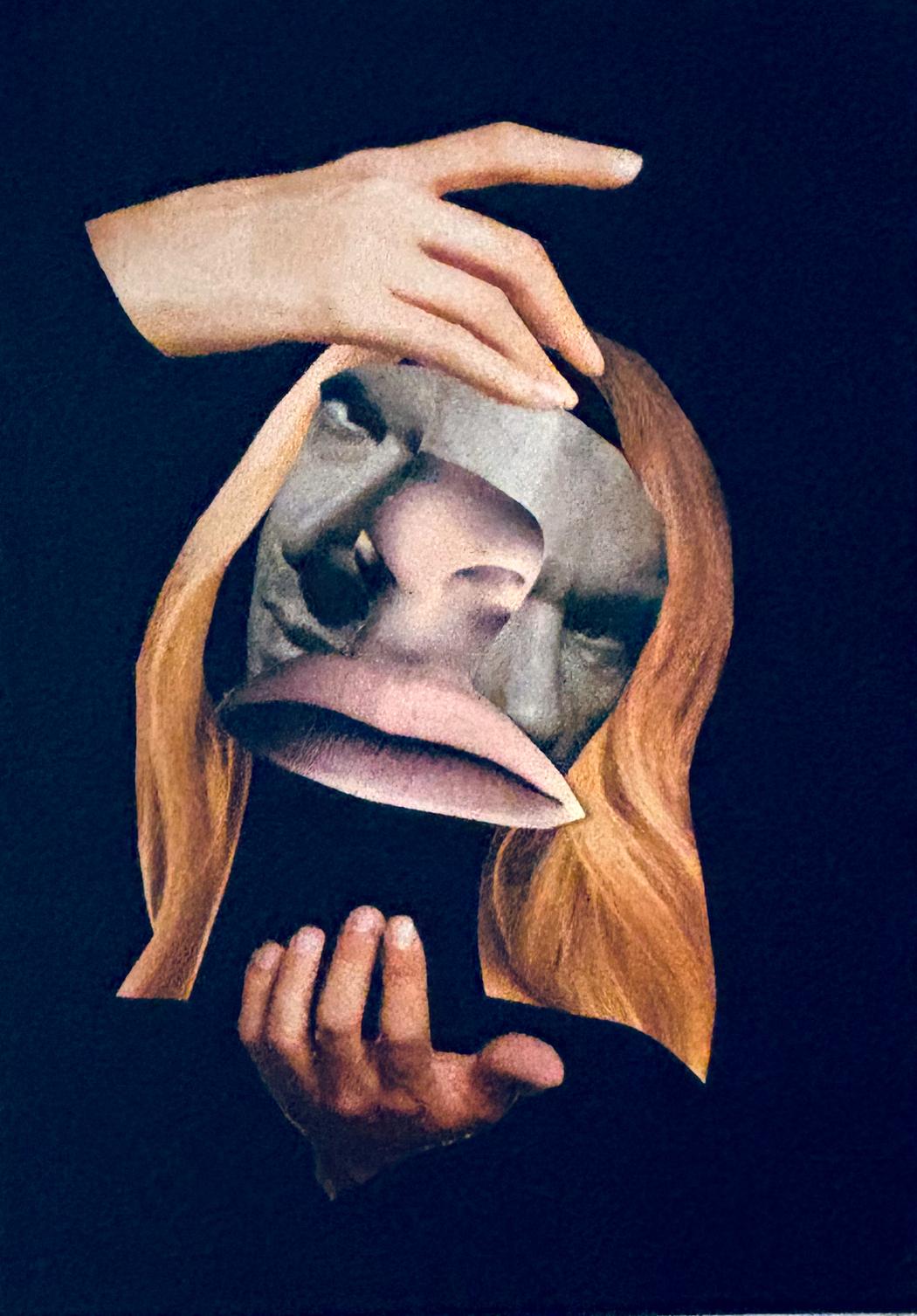 Emily J Zweibel | Redhead
You describe your practice as “visual archaeology and reconstructive surgery”. What do these two ideas mean to you in the context of analog collage?
“Visual archaeology” is the act of unearthing forgotten histories from old print media, like vintage magazines and old textbooks. “Reconstructive surgery” is the physical grafting that happens on the cutting mat. I cut open these distinct realities and stitch them into a new, breathing visual organism that takes on a life of its own.
Many of your works combine humor, unease, beauty, and strangeness at the same time. How important is this emotional ambiguity in your work?
Emotional ambiguity is at the core of my work because it reflects the true complexity of human experience. Our most profound moments often exist at the intersection of conflicting feelings. The tension in juxtapositions creates life. That friction—where you want to laugh but also feel a slight chill—turns a static image into a living psychological space.
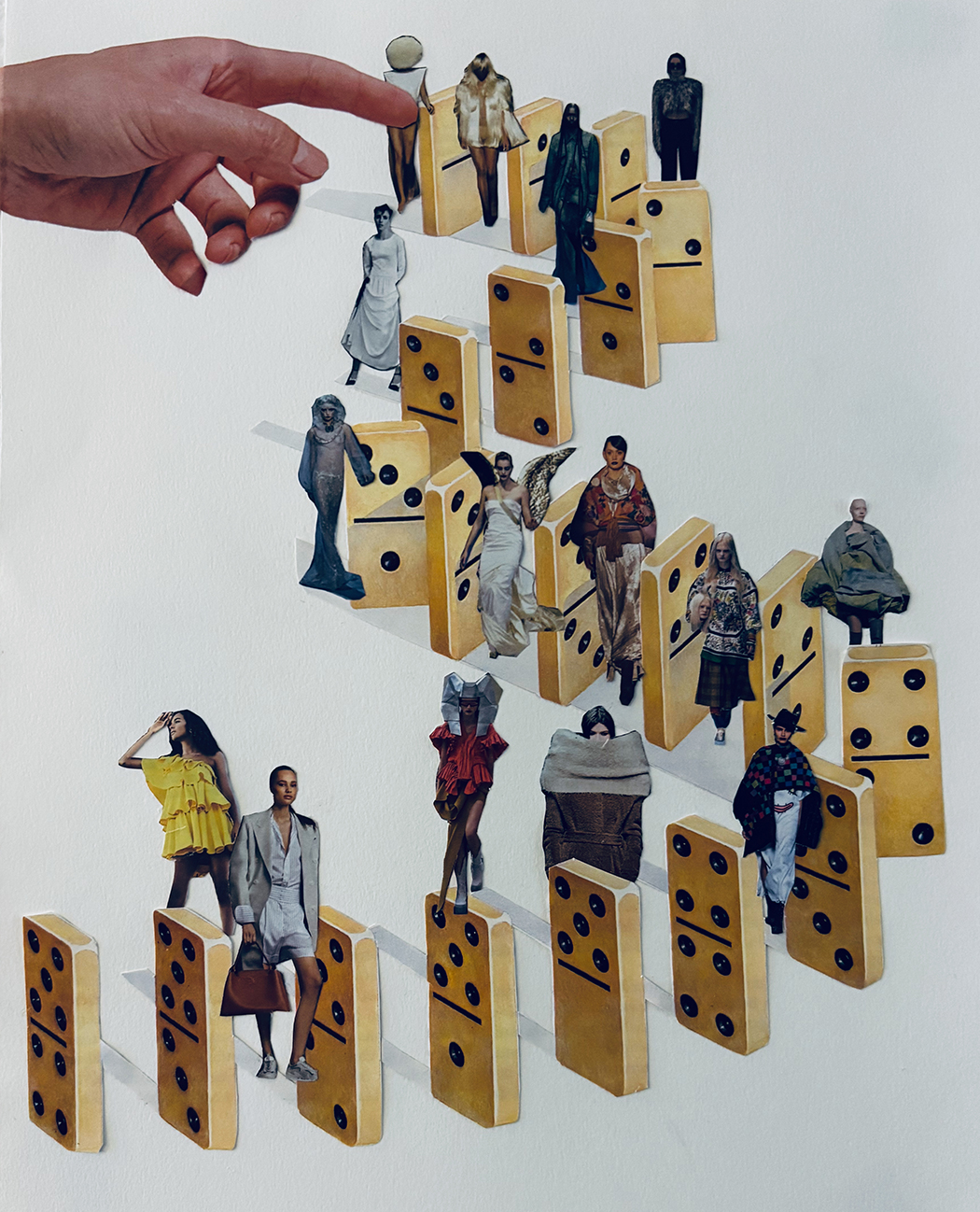 Emily J Zweibel | Dominoes
Female figures appear often in your collages, sometimes flying, transforming, or inhabiting impossible landscapes. What role does the body play in your visual language?
In my collages, the body functions as a site of transformation, agency, and subconscious freedom rather than a passive object for visual consumption. The female figures—whether sprouting wings, morphing into a mythological creature, or dissolving into clouds — suggest the physical as psychological. The body is a medium for dreaming, processing trauma, and experiencing joy. It is an active participant in its own surreal universe.
Your work often plays with scale – tiny figures, oversized objects, dreamlike proportions. How do you use scale to change the viewer’s sense of reality?
Scale is the ultimate tool for disrupting a viewer’s everyday logic and breaking the subconscious autopilot we use to navigate the world. Making a commonplace object massive assigns an absurd, almost mythic significance to the ordinary. Conversely, placing tiny human figures in vast spaces evokes a sense of vulnerability, isolation, or childlike wonder. By destabilizing standard proportions, I create a sort of dream logic effect. The viewer is pulled into an alternate, surreal universe where the rules of physics are suspended, and the possibilities are boundless.
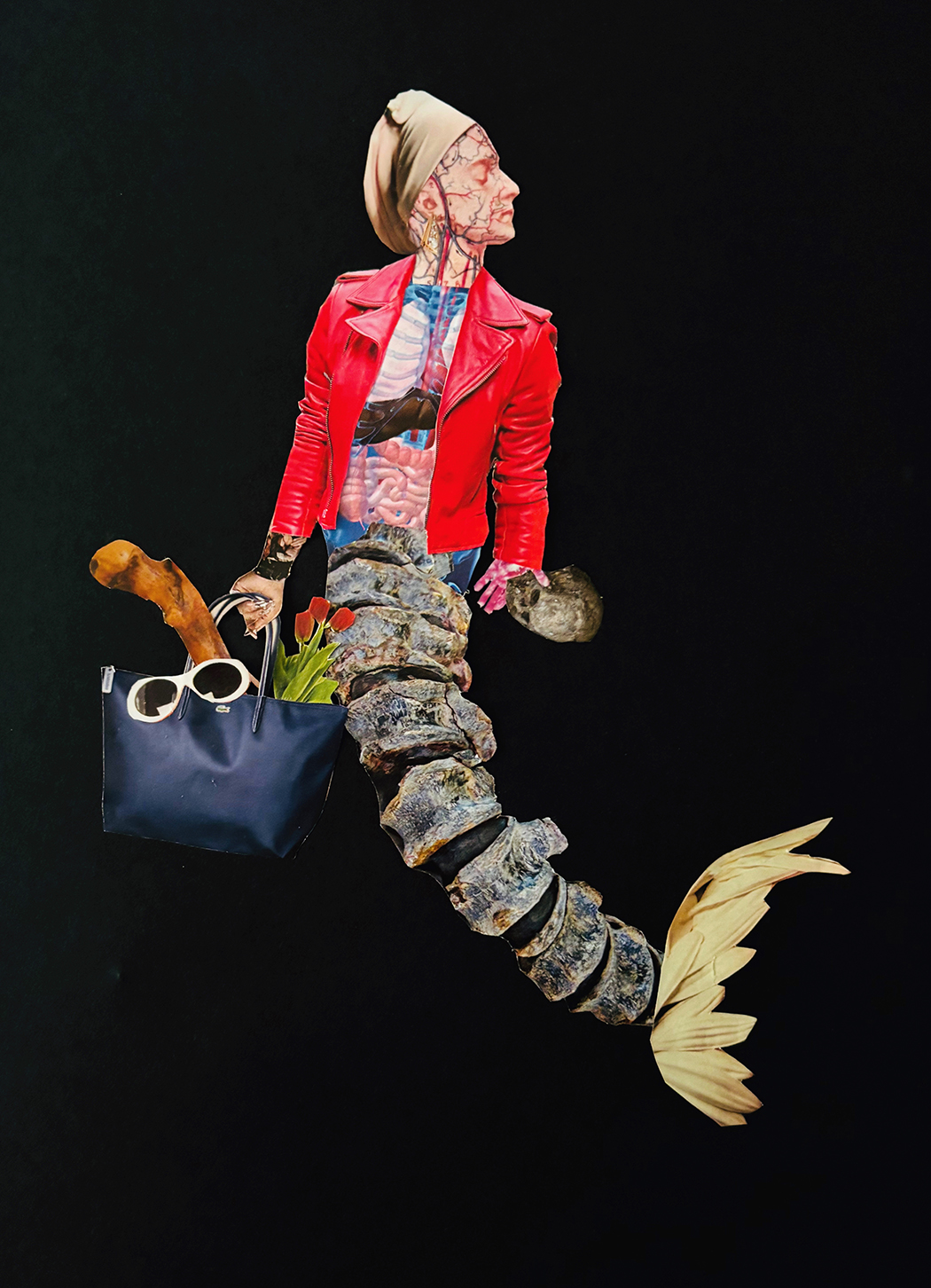 Emily J Zweibel | Errands Vivid
Since moving from New York to Mexico City in 2023, has your environment changed your artistic practice or the atmosphere of your work?
Moving from New York to Mexico marked the beginning of a major transformation in both my daily life and my artistic practice. I was a teacher in New York for many years. I always loved collaging but simply didn’t have the time or energy to consistently make art. Retiring and completely changing my physical environment gave me a sense of liberation. For the first time, I had the mental space to commit to my artistic practice. Moving here also profoundly impacted my creative choices. Mexico City altered my visual language. It has a kind of poetic density, with a rich surrealist legacy, layers of visible history, lush flora, and urban chaos all coexisting. On a practical level, I find incredible vintage images and local ephemera in Mexico City’s many markets and used bookstores. All of these factors have led to more layered, patient work.
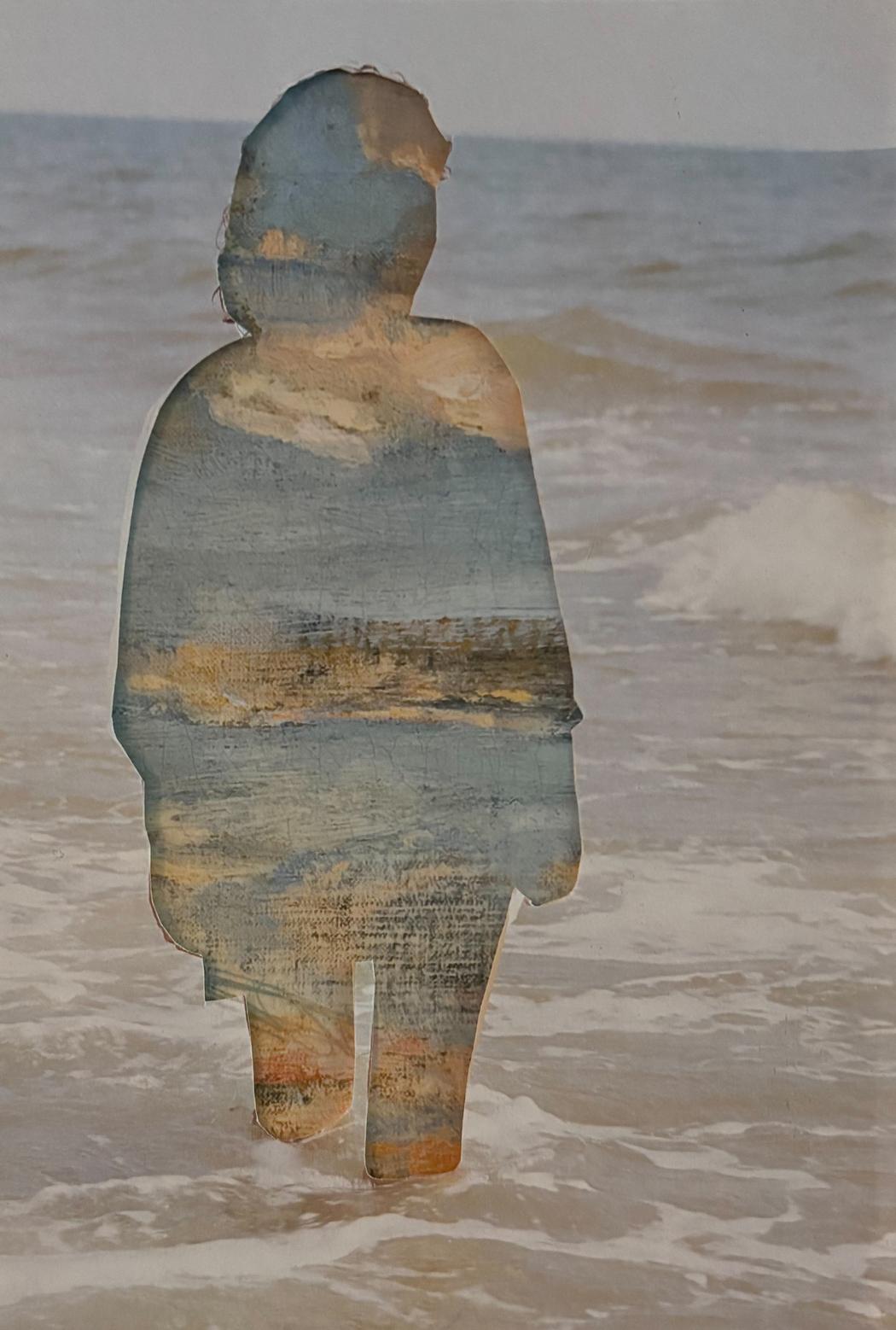
When viewers encounter your collages, what do you hope they feel first: curiosity, discomfort, recognition, amusement, or something else entirely?
If I have to choose, I hope they initially feel a bit disoriented, quickly followed by curiosity and then recognition. Curiosity is the hook that makes you step closer to the piece to figure out what you’re seeing. The ultimate goal is recognition. I don’t mean recognizing a specific face or object, but rather an emotional recognition. I want viewers to look at a peculiar, impossible scene and think, “I don’t know what this is, but I know what that feels like.” If that recognition carries with it a bit of amusement or a twinge of discomfort, then the collage has successfully done its job. My ultimate goal is to create a strange familiar.